What you'll learn
- What fragile environments are, where they are found, and why they are easily damaged.
- How desertification happens through both physical and human pressures.
- Why deforestation occurs, especially in tropical rainforest regions such as Amazonia and Southeast Asia.
- How natural climate change differs from the enhanced greenhouse effect caused by human activities.
Starting point: what is a fragile environment?
A fragile environment is one that is easily damaged and may recover very slowly, or not fully recover, once disturbed. Fragility can come from harsh climate, thin soils, slow plant growth, low biodiversity, steep slopes, or intense human pressure.
Fragile environment
A fragile environment is a physical or ecological system that has limited ability to cope with change, so damage can happen quickly and recovery is slow.
Some fragile environments look empty, such as hot deserts. Others look extremely rich, such as tropical rainforests. The key point is not whether an environment is “barren” or “beautiful”; it is how easily the system can be pushed beyond recovery.
The world’s main fragile environments
Fragile environments are not randomly spread around the world. They often follow patterns linked to latitude (distance north or south of the Equator), climate, relief and geology.
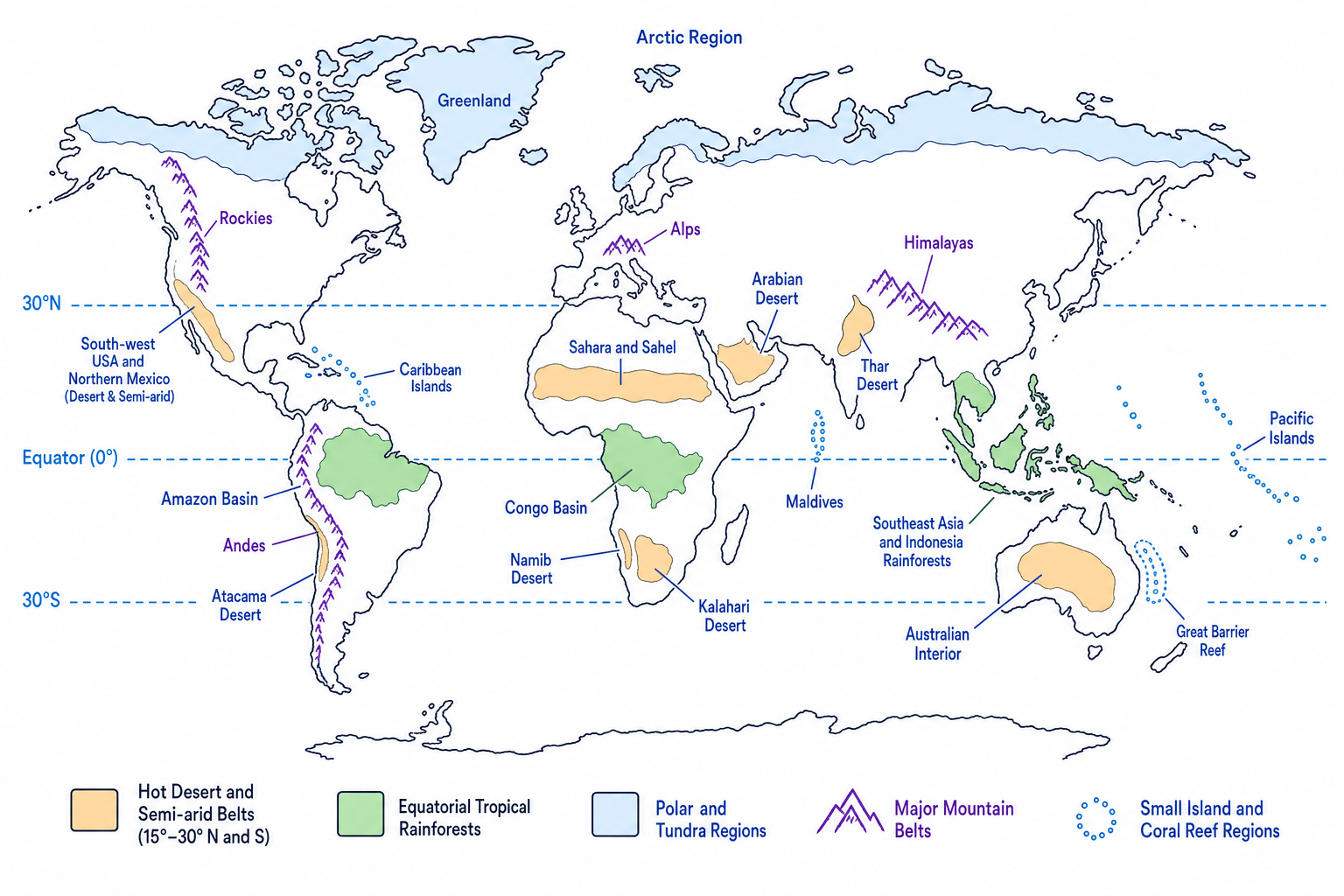
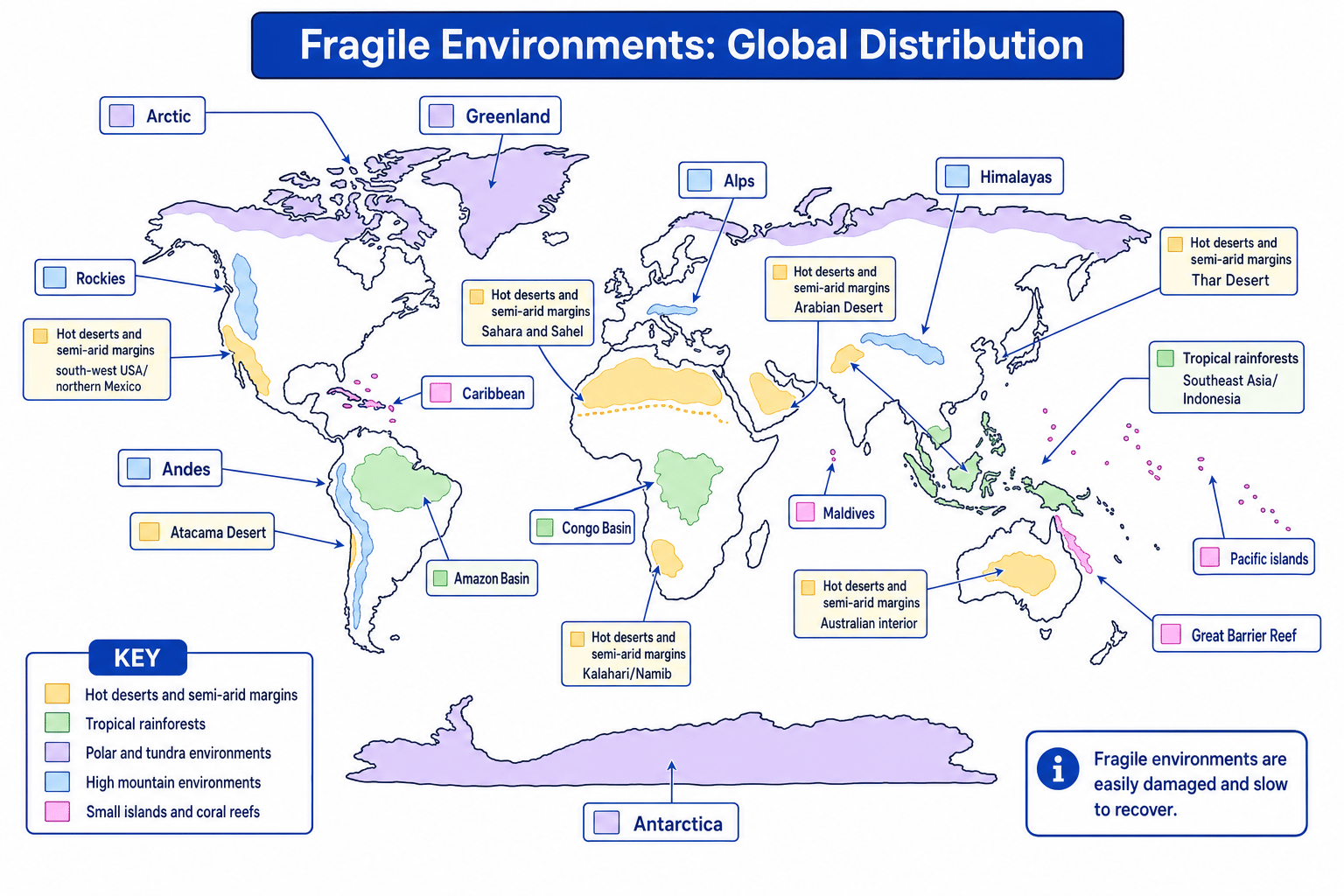
The map below shows the broad global distribution of fragile environments you should be able to describe using named regions.
Hot deserts and semi-arid margins
Hot deserts are found mainly around 15–30° north and south of the Equator, where dry sinking air limits rainfall. Examples include the Sahara, Arabian Desert, Thar Desert, Kalahari/Namib, Australian interior, Atacama, and deserts of the south-west USA and northern Mexico.
A semi-arid area is not as dry as a desert, but rainfall is still low and unreliable. The Sahel, south of the Sahara, is a key example.
Characteristics include:
- Low and unreliable rainfall, often below 250 mm per year in true deserts.
- Sparse vegetation, so soil is exposed to wind and water erosion.
- High evapotranspiration — water loss from evaporation and plant transpiration.
- Thin, low-nutrient soils that recover slowly after damage.
Tropical rainforests
Tropical rainforests are found close to the Equator, especially in the Amazon Basin, Congo Basin, and Southeast Asia/Indonesia.
They are fragile because most nutrients are stored in the living vegetation rather than deep in the soil. Heavy rainfall causes leaching, where dissolved nutrients are washed down through the soil.
Polar, tundra and mountain environments
Polar and tundra environments, such as the Arctic, Greenland and Antarctica, have very cold conditions and slow biological activity. Permafrost is ground that remains frozen for at least two years, making construction and ecosystem recovery difficult.
Mountain environments, such as the Himalayas, Andes, Rockies and Alps, are fragile because steep slopes, thin soils and landslide risk make them vulnerable to disturbance.
Small islands and coral reefs
Small islands and coral reef environments, such as the Maldives, Caribbean islands, Pacific islands and the Great Barrier Reef, are fragile because they often have limited freshwater, low-lying land, narrow ecosystems and exposure to storms and sea-level rise.
Describing a global distribution
-
Identify the broad pattern: fragile environments are concentrated in dry belts around 15–30° north and south, equatorial rainforest zones, high latitudes, mountain chains and tropical island regions.
-
Add named examples to prove the pattern: the Sahara and Sahel in Africa, the Amazon Basin in South America, Greenland and Antarctica in polar regions, and the Himalayas in Asia.
-
Mention variation or exceptions: fragile environments are not only in hot places; cold tundra, high mountains and small islands can also be fragile because recovery is slow and disturbance has long-lasting effects.
Describing distribution
Use the pattern “where, scale, examples, exceptions”: say where it is found, how widespread it is, name places, then add anything that does not fit the main pattern.
Desertification: land turning into desert-like conditions
Desertification
Desertification is land degradation in dryland areas, where soil, vegetation and water resources decline until the land becomes less productive and more desert-like.
Desertification does not mean a desert simply “moves forward” like a wall. It is a process where land loses its ability to support crops, grazing animals and natural vegetation.
Physical cause: drought
A drought is a long period of below-average rainfall. In dryland regions, drought reduces plant growth, dries out soils and lowers river and groundwater supplies. Without vegetation cover, soil is more easily removed by wind and heavy rain.
The Sahel is a useful located example. It is a semi-arid belt south of the Sahara, crossing countries such as Senegal, Mali, Niger, Chad and Sudan. Rainfall is seasonal and unreliable, so drought can quickly affect farming and grazing.
Human cause: population pressure
Population pressure happens when the demand for land, food, water and fuel rises beyond what the environment can sustainably provide. More people may mean more land is cultivated, including marginal land — land only just suitable for farming.
If fields are farmed too intensively, soil nutrients fall and vegetation has less time to recover.
Human cause: fuel supply
In many dryland regions, wood and charcoal are important fuel sources for cooking and heating. Cutting trees and shrubs reduces root networks that hold soil together. This increases erosion and reduces shade, making the ground hotter and drier.
Human cause: overgrazing
Overgrazing occurs when too many animals feed on the same area for too long. Animals remove vegetation faster than it can regrow, and their hooves compact the soil. Compacted soil has lower infiltration, meaning less water soaks into the ground and more runs off the surface.
Human cause: migration
Migration can contribute to desertification when people and livestock move into already stressed areas. For example, drought may force pastoralists to move herds towards remaining water sources. This can concentrate grazing pressure around wells, towns or refugee camps.
Desertification is a chain reaction
Desertification often happens when drought and human pressure combine: less vegetation leads to more erosion, which reduces soil fertility, which makes vegetation even harder to regrow.
Explaining desertification in the Sahel
-
Begin with the physical stress: drought reduces rainfall, so grasses and shrubs grow less and the soil surface becomes more exposed.
-
Add the human pressures: population growth increases demand for crops and fuelwood, while overgrazing removes vegetation and livestock hooves compact the soil.
-
Link the pressures to processes: exposed and compacted soil has less infiltration, more surface runoff, and greater wind and water erosion.
-
Explain the outcome: as fertile topsoil is lost, crop yields fall, vegetation recovery slows, and the land becomes increasingly desert-like.
Desertification is not just drought
Drought can trigger desertification, but human actions such as overgrazing, fuelwood collection and farming marginal land often decide whether the land recovers or continues to degrade.
Deforestation: removing forest cover
Deforestation
Deforestation is the removal of forest, usually so the land can be used for something else, such as farming, mining, settlement or infrastructure.
Deforestation is especially important in tropical rainforests because they contain high biodiversity and play a major role in carbon and water cycles. However, their soils are often surprisingly poor once the forest cover is removed.
Main causes of deforestation
| Cause | How it removes forest | Located examples |
|---|---|---|
| Commercial timber extraction | Valuable trees are cut for sale; logging roads open up the forest | Amazon Basin, Congo Basin, Borneo |
| Agriculture | Forest is cleared for cattle ranching, crops, palm oil or small-scale farming | Brazil for cattle and soy; Indonesia/Malaysia for palm oil |
| Mining | Forest is cleared for open pits, waste areas, access roads and worker settlements | Gold and iron ore mining in parts of Amazonia |
| Transport | Roads, railways and ports cut through forest and make remote areas accessible | Trans-Amazonian Highway in Brazil |
| Settlement | New villages, towns or planned settlement schemes clear land for housing and services | Frontier settlement in Amazonia |
| HEP | Hydroelectric power dams flood valleys and require roads, power lines and construction zones | Belo Monte area in Brazil is often used as an Amazon example |
Exact proportions vary by country and year, but in Amazonia, cattle ranching, commercial farming, logging, mining and road building have all been major pressures.
Why roads matter so much
Roads are often the “starter cause” of deforestation. A new road does not just remove a narrow strip of trees. It gives access to loggers, farmers, miners and settlers, so deforestation spreads out from the road network.
Linking road building to Amazon deforestation
-
A road is built through previously remote rainforest, reducing the cost and difficulty of reaching the area.
-
Commercial timber companies can then extract valuable hardwoods, and logging tracks open smaller routes deeper into the forest.
-
Farmers, ranchers and settlers move in because land is now accessible, so forest is cleared for cattle, crops, housing and services.
-
Forest edges become drier and more exposed, increasing the risk of fire and further clearance.
Logging is not the only cause
Do not write that deforestation is caused only by cutting trees for timber. In many places, forest is cleared mainly for agriculture, roads, settlement, mining or HEP reservoirs.
Climate change: natural and human causes
Climate change
Climate change is a long-term shift in average weather conditions, such as temperature, rainfall and storm patterns, usually measured over decades or longer.
Climate has changed naturally throughout Earth’s history, but the current rapid warming is strongly linked to human activities increasing greenhouse gas concentrations.
Natural cause: Milankovitch cycles
Milankovitch cycles are long-term changes in Earth’s movement around the Sun. They affect how much solar energy reaches different parts of Earth.
They include:
- Eccentricity — changes in the shape of Earth’s orbit.
- Obliquity — changes in the tilt of Earth’s axis.
- Precession — the wobble of Earth’s axis.
These cycles work over thousands to hundreds of thousands of years, so they help explain ice ages and warmer interglacial periods, not sudden warming over just a few decades.
Natural cause: solar variation
Solar variation means small changes in the amount of energy released by the Sun. Sunspot cycles can cause minor changes in incoming solar radiation, but they do not explain most recent global warming.
Natural cause: volcanism
Volcanism means volcanic activity. Large eruptions can release ash and sulfur gases high into the atmosphere. These form tiny particles called aerosols that reflect sunlight, often causing short-term cooling for one or more years.
Volcanoes also release carbon dioxide, but recent human emissions from burning fossil fuels are far larger than volcanic carbon dioxide emissions.
The enhanced greenhouse effect
Greenhouse gases
Greenhouse gases are gases in the atmosphere, such as carbon dioxide, methane and nitrous oxide, that absorb outgoing longwave heat radiation and re-radiate some of it back towards Earth.
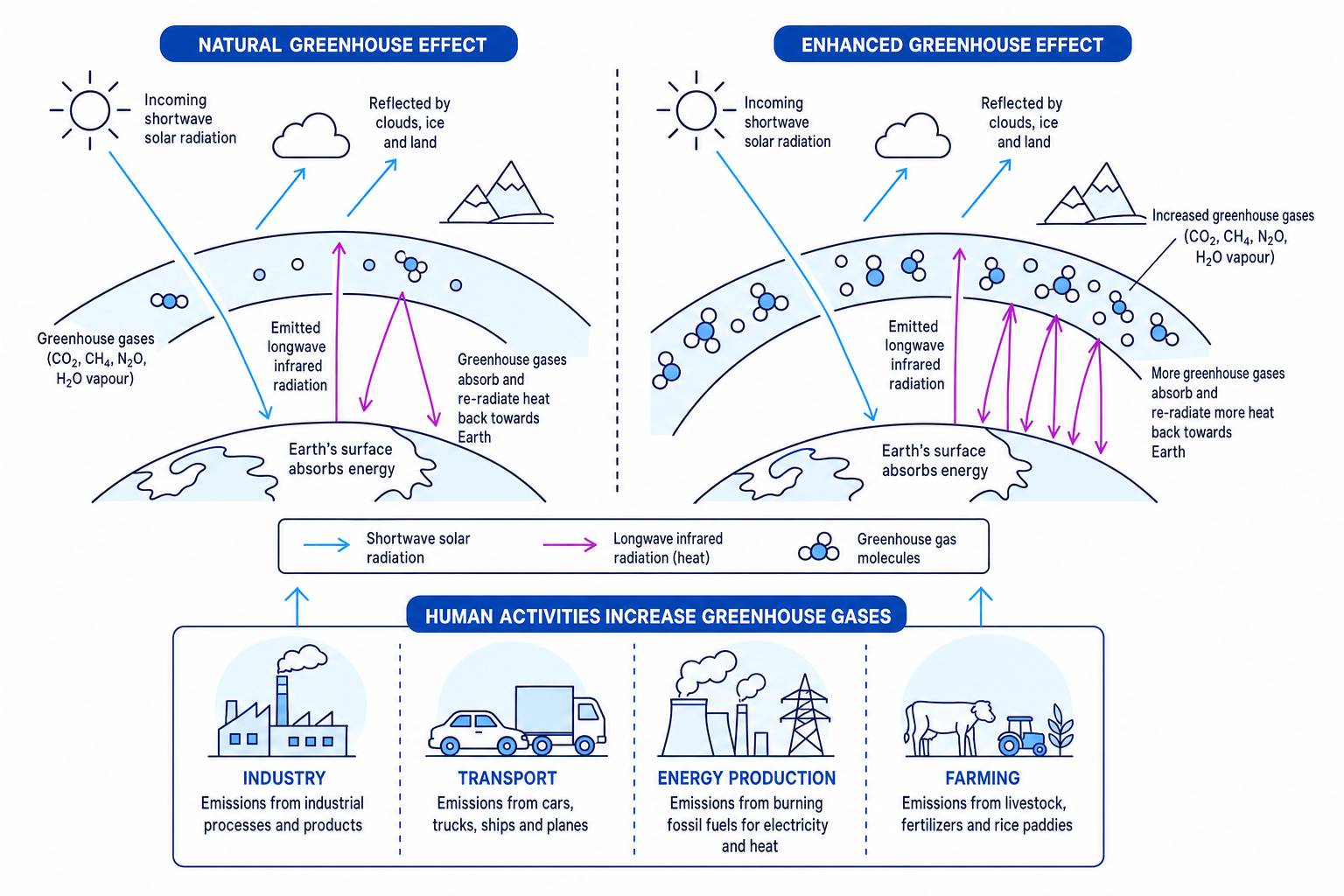
The natural greenhouse effect is essential because it keeps Earth warm enough for life. The enhanced greenhouse effect happens when human activities increase greenhouse gas concentrations, trapping extra heat and raising global temperatures.
The diagram below shows the difference between the natural greenhouse effect and the enhanced greenhouse effect.
Human activities causing the enhanced greenhouse effect
Industry releases greenhouse gases through manufacturing, cement production, chemical processes and energy use in factories.
Transport releases carbon dioxide when petrol, diesel and aviation fuel are burned in cars, lorries, ships and planes.
Energy production releases carbon dioxide when coal, oil and gas are burned to generate electricity and heat.
Farming releases methane from livestock and rice paddies, and nitrous oxide from fertilisers. Deforestation for farmland also reduces the number of trees absorbing carbon dioxide.
Explaining the enhanced greenhouse effect
-
Human activities such as energy production and transport burn fossil fuels, adding extra carbon dioxide to the atmosphere.
-
Earth’s surface absorbs incoming solar energy and emits heat as longwave infrared radiation.
-
Increased greenhouse gases absorb more of this outgoing heat and re-radiate more energy back towards Earth.
-
The global energy balance changes, so average temperatures rise and climate patterns shift.
Greenhouse effect is not the ozone hole
The enhanced greenhouse effect causes global warming by trapping heat. Ozone depletion is a separate issue involving reduced protection from ultraviolet radiation.
In the exam
-
For distribution questions, describe the pattern using named places: for example, “rainforests are concentrated near the Equator in Amazonia, the Congo Basin and Southeast Asia.”
-
For cause questions, build chains of explanation: pressure → process → environmental damage → long-term result.
-
Separate natural and human climate causes clearly; Milankovitch cycles, solar variation and volcanism are natural, while industry, transport, energy and farming enhance the greenhouse effect.
Check yourself
- Why can both tropical rainforests and polar tundra be described as fragile environments?
- How can drought, overgrazing and fuelwood collection combine to cause desertification?
- What is the difference between the natural greenhouse effect and the enhanced greenhouse effect?