What you'll learn
- Why relationships between countries affect trade, migration and tourism.
- How the UK manages long-term migration as a named developed-country example. 🌐
- How sustainable tourism can be managed by individuals, organisations and governments.
- How responses differ in a developed country, New Zealand, and a developing/emerging country, Costa Rica. 🌐
The big idea: responses depend on capacity and priorities
Globalisation means the world is becoming more connected through flows of goods, money, people, information and culture. In this topic, the key flows are migration and tourism.
Migration and tourism
Migration is the movement of people from one place to another to live, usually for work, family, study, safety or quality of life. Tourism is travel away from home for leisure, business or other temporary purposes.
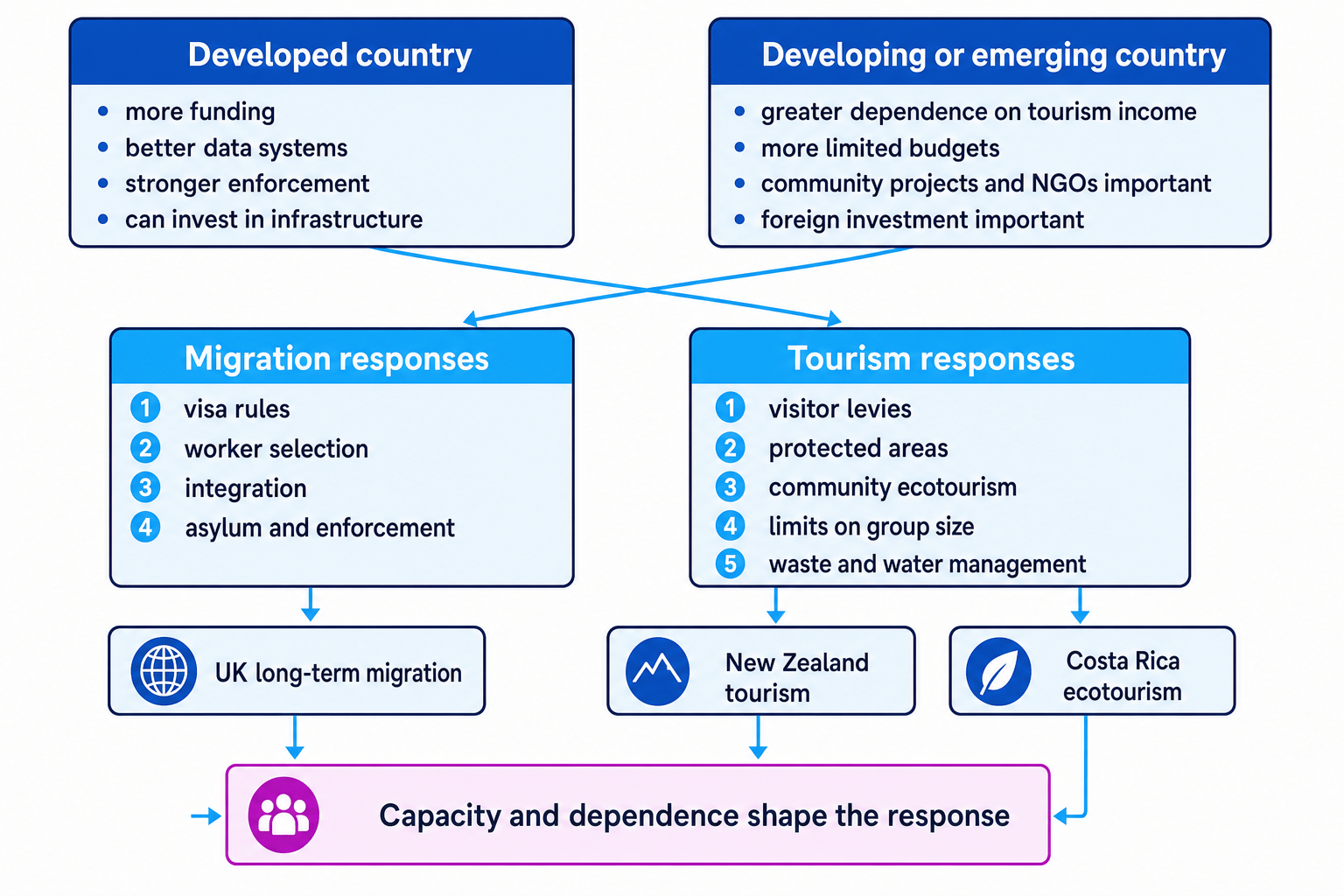
A country’s level of development affects how it responds. A developed, high-income country usually has more money, data systems and enforcement capacity. A developing or emerging country may rely more heavily on tourism income, international organisations, community projects and foreign investment.
This does not mean developed countries always manage flows better. It means they often have different choices, pressures and resources.
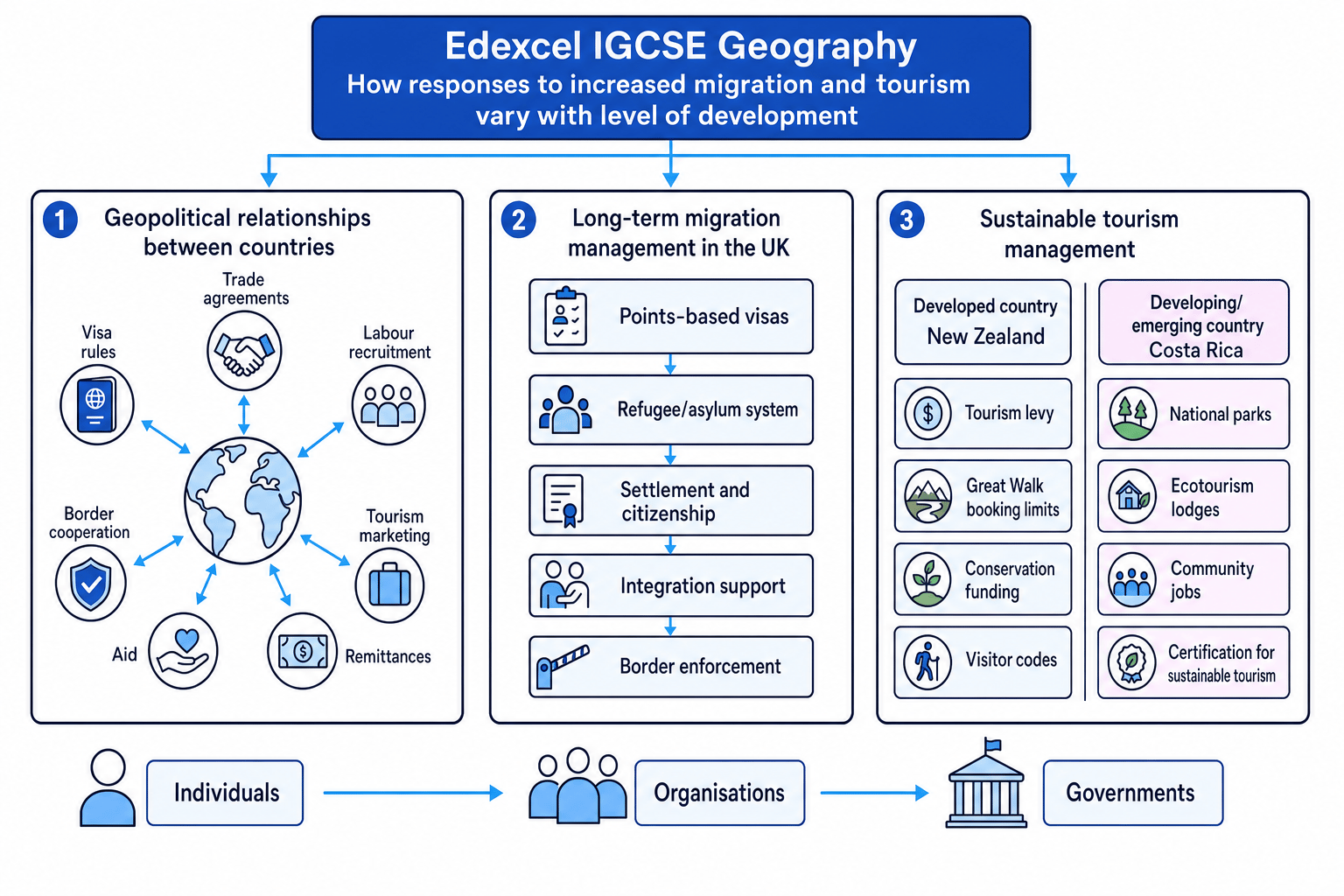
The diagram below summarises the main parts of this section: international relationships, migration management and sustainable tourism responses.
The core argument
In 2.5.3, you are not just naming policies. You need to explain why a country chooses particular responses and how its level of development affects what is possible.
1. Why geopolitical relationships matter
Geopolitics means the way countries use power, agreements and relationships to influence each other. It includes cooperation, conflict, trade deals, border rules and shared security.
Bilateral and multilateral relationships
A bilateral relationship is between two countries. A multilateral relationship involves several countries, often through organisations such as the United Nations, the World Trade Organization or regional groups.
Countries rarely manage migration or tourism completely alone. People cross borders, businesses trade internationally, airlines need flight agreements, and refugees may move through several countries before reaching safety.
Managing trade
Trade is affected by:
- trade agreements, which reduce tariffs or set shared rules
- tariffs, which are taxes on imports
- quotas, which limit the amount of a good that can be imported
- shared standards, such as food safety or product rules
For example, a country with strong trade links may also negotiate easier business visas, student visas or work permits. Trade and migration are often connected because businesses need workers and skilled staff.
Managing migration
Migration is managed through:
- visa rules and passport controls
- labour agreements, such as recruiting nurses, farm workers or construction workers
- refugee agreements and international law
- cooperation on border security and human trafficking
- recognition of qualifications, such as medical or engineering training
A refugee is someone forced to leave their country because of persecution, war or violence. An asylum seeker is someone who has applied for refugee protection but whose claim has not yet been decided.
Managing tourism
Tourism is affected by:
- visa-free travel or e-visas
- air travel agreements
- safety advice from governments
- joint marketing campaigns
- conservation agreements, for example protecting World Heritage Sites
Good relationships can increase tourist flows. Poor relationships, conflict or strict visa rules can reduce them.
Explaining how a geopolitical relationship changes flows
Suppose two neighbouring countries agree to easier tourist visas and stronger border cooperation.
- Easier visa rules reduce the time, cost and uncertainty of travel, so more tourists are likely to cross the border for holidays, shopping or family visits.
- Stronger border cooperation allows both governments to share security information, so they can manage risk while still allowing movement.
- Businesses near the border may benefit from higher spending, but local authorities may need more waste collection, transport planning and visitor management.
- The overall judgement is that the agreement can increase tourism and trade, but only if infrastructure and environmental controls keep up with the extra pressure.
Forgetting the relationship part
Do not write as if one country controls everything. Migration and tourism are cross-border flows, so agreements, tensions and shared rules between countries are often central to management.
2. Long-term migration management in the UK 🌐
For your named country example, you can use the United Kingdom, a developed, high-income country in north-west Europe. The UK attracts migrants because of employment, universities, the English language, family links and historic connections with many countries.
Long-term migration
Long-term migration usually means moving to another country for at least 12 months. This is different from short visits, tourism or seasonal travel.
The UK’s responses show how a developed country can use legal systems, data, border technology and public services to manage migration. However, it also faces challenges such as labour shortages, housing pressure, political debate and humanitarian responsibilities.
Approach 1: selecting workers through visas
The UK uses a points-based immigration system. This means migrants usually need to meet requirements such as:
- a job offer from an approved employer
- a suitable skill level
- a minimum salary or shortage-occupation rule
- English-language requirements
This approach aims to attract workers needed by the economy, such as health workers, engineers or care staff, while limiting migration that does not meet the rules.
Approach 2: managing students and temporary routes
The UK has large numbers of international students. Student visas support universities and bring income to towns and cities, but rules can control whether students can bring dependants or stay after their course.
A temporary visa allows someone to stay for a limited period. Some migrants later apply for settlement if they meet the rules.
Approach 3: settlement, citizenship and integration
Integration means helping migrants take part in society, for example through English-language learning, employment, schools, healthcare and community support.
Some long-term migrants can apply for Indefinite Leave to Remain, meaning they can live in the UK without a time limit. Some later apply for citizenship.
This approach matters because migration management is not only about entry. It is also about how people live, work and belong once they arrive.
Approach 4: asylum and humanitarian protection
The UK is a signatory to the Refugee Convention, so it has legal responsibilities towards people fleeing persecution. It also uses specific schemes, such as routes for some Ukrainians, Afghans and people from Hong Kong with British National Overseas status.
This shows that migration policy is not only economic. It also involves human rights, safety and international relationships.
Approach 5: border enforcement and internal checks
The UK uses passport checks, visa systems, employer checks and rules against illegal working. Enforcement is intended to maintain control and public confidence.
However, strict enforcement can be controversial if it causes delays, separates families or affects people with genuine protection needs.
Evaluating UK migration management
A question asks whether the UK’s migration management is mainly economic.
- The points-based system supports the argument because it selects migrants using job offers, skills and salary thresholds, linking migration directly to labour-market needs.
- Student visas also support the economic argument because universities receive fees and local areas benefit from student spending.
- Humanitarian routes weaken the argument because asylum, refugee resettlement and emergency schemes are based more on protection and international responsibility than on economic gain.
- A balanced judgement is that UK policy is strongly economic, but not only economic: it also includes humanitarian, political and social aims.
Use the word ‘approach’ carefully
For this specification point, try to include at least two different approaches: for example selection of workers, humanitarian protection, integration and enforcement. That is stronger than listing several similar visa rules.
3. Making tourism more sustainable
Tourism can create jobs, improve infrastructure and bring foreign currency. But it can also cause overcrowding, water shortages, waste, habitat damage, rising house prices and cultural tension.
Sustainable tourism
Sustainable tourism aims to meet the needs of visitors, local people, businesses and the environment now, without damaging the ability of future generations to meet their needs.
Sustainable tourism has three linked parts:
- economic sustainability: local people and businesses should benefit
- social sustainability: communities and cultures should be respected
- environmental sustainability: ecosystems, landscapes and resources should be protected
Another useful term is economic leakage. This happens when tourist spending leaves the local economy, for example when hotels are foreign-owned or food is imported. The opposite is a stronger multiplier effect, where tourist money circulates locally through wages, suppliers and services.
4. Sustainable tourism in a developed country: New Zealand 🌐
New Zealand is a developed, high-income country in the South Pacific. It is famous for mountains, coasts, national parks, Māori culture and adventure tourism. Tourism brings income and jobs, but it can put pressure on fragile environments such as alpine tracks, lakes and small settlements.
Individuals
Individual tourists can:
- follow the Tiaki Promise, a visitor code encouraging people to care for New Zealand
- stay on marked tracks
- avoid disturbing wildlife
- reduce litter and water use
- respect Māori cultural sites and local communities
These actions are small individually, but powerful when visitor numbers are high.
Organisations
Tourism businesses, conservation groups and local organisations can:
- limit group sizes on sensitive routes
- employ local guides
- use sustainable accommodation standards
- support conservation projects
- reduce waste and energy use
The Department of Conservation manages many protected areas and tracks, including booking systems for popular Great Walks.
Government
The New Zealand government can use national-level policies such as:
- tourism levies to fund conservation and infrastructure
- national park rules
- freedom camping restrictions
- investment in toilets, paths, visitor centres and waste systems
- regional tourism planning
Because New Zealand is developed, it has more ability to monitor visitor numbers, enforce rules and invest in infrastructure. But it still faces challenges, especially carbon emissions from long-haul flights and pressure on famous places such as Queenstown and Milford Sound.
5. Sustainable tourism in a developing or emerging country: Costa Rica 🌐
Costa Rica is an emerging/developing country in Central America, widely known for biodiversity, rainforests, volcanoes and coasts. It has built a strong reputation for ecotourism, which is tourism focused on natural environments and conservation.
A large share of Costa Rica’s land is protected in national parks and reserves, although exact figures vary by source and year. Tourism provides jobs and foreign currency, so the country must balance conservation with development.
Individuals
Tourists can support sustainability by:
- choosing locally owned lodges
- paying national park fees
- using local guides
- avoiding wildlife disturbance
- reducing plastic waste and water use
Organisations
Businesses and NGOs can:
- run community-based ecotourism projects
- train local people as guides
- use certification schemes for sustainable tourism
- support rainforest conservation
- reduce energy and water use in hotels
Community tourism helps reduce leakage because more money stays with local families and businesses.
Government
Costa Rica’s government has supported sustainability through:
- national parks and protected areas
- park entry fees
- promotion of ecotourism
- conservation policies, including payments to landowners for protecting forests
- sustainability certification for tourism businesses
Costa Rica’s approach is often praised, but it still has problems. Some coastal resorts use large amounts of water, some profits leak abroad, and conservation enforcement can be harder where budgets are limited.
Choosing sustainable tourism responses for a rainforest area
A rainforest region in a developing country wants more tourism income without losing biodiversity.
- Government zoning can protect the most fragile habitats by allowing visitors only on marked trails or in specific areas.
- Community-owned lodges can increase local income and reduce leakage because wages, food supply and guiding fees stay in the area.
- Certification for tour operators can reward businesses that reduce waste, employ local people and avoid disturbing wildlife.
- The best response is a combination: government rules protect the ecosystem, organisations create responsible jobs, and tourists support the system through their choices.
Assuming tourism is either good or bad
Tourism usually has mixed impacts. Strong answers explain the trade-off: it can fund conservation and jobs, but it can also damage environments and increase inequality if poorly managed.
6. Comparing responses by level of development
A developed country such as New Zealand may have more money for visitor monitoring, online booking systems, conservation staff and infrastructure. It may also have stronger enforcement and more capacity to charge levies.
A developing or emerging country such as Costa Rica may depend more heavily on tourism for jobs and foreign currency. That can make strict visitor limits harder to apply, because limiting tourism may reduce income. However, community ecotourism can be very effective where local people directly benefit from conservation.
Best comparison sentence
A country’s level of development affects both its capacity to manage tourism and migration, and its dependence on the income or labour those flows bring.
In the exam
- Name the country and set it in context: developed, emerging or developing; location; and why migration or tourism matters there.
- Explain responses at different scales: individuals, organisations and governments for tourism; entry control, integration and humanitarian policy for migration.
- Evaluate by linking back to development: money, technology, enforcement capacity, dependence on tourism income, labour shortages and international relationships.
Check yourself
- Why do geopolitical relationships affect migration and tourism management?
- What are two different approaches used by the UK to manage long-term migration?
- How do sustainable tourism responses differ between New Zealand and Costa Rica?