The impacts of globalisation vary on a global scale
What you'll learn
- How globalisation creates winners and losers in different countries and communities.
- The benefits and costs of countries hosting TNCs.
- How different types of migration affect migrants, source areas and destination areas.
- How the growth of global tourism, including mass tourism, affects economies, people and environments.
1. The big idea: impacts are uneven
Globalisation
Globalisation is the increasing connection of places through flows of goods, services, money, people, technology and ideas.
An impact is an effect or consequence. In this topic, you are not just learning “globalisation is good” or “globalisation is bad”. You are learning that its impacts vary by place, scale and group of people.
For example, a new factory may benefit young workers who gain wages, but it may harm nearby residents if it creates pollution. A tourist resort may bring jobs, but it may also increase house prices for local families.
The diagram below summarises the three big impact areas in this section: TNC investment, migration and tourism.
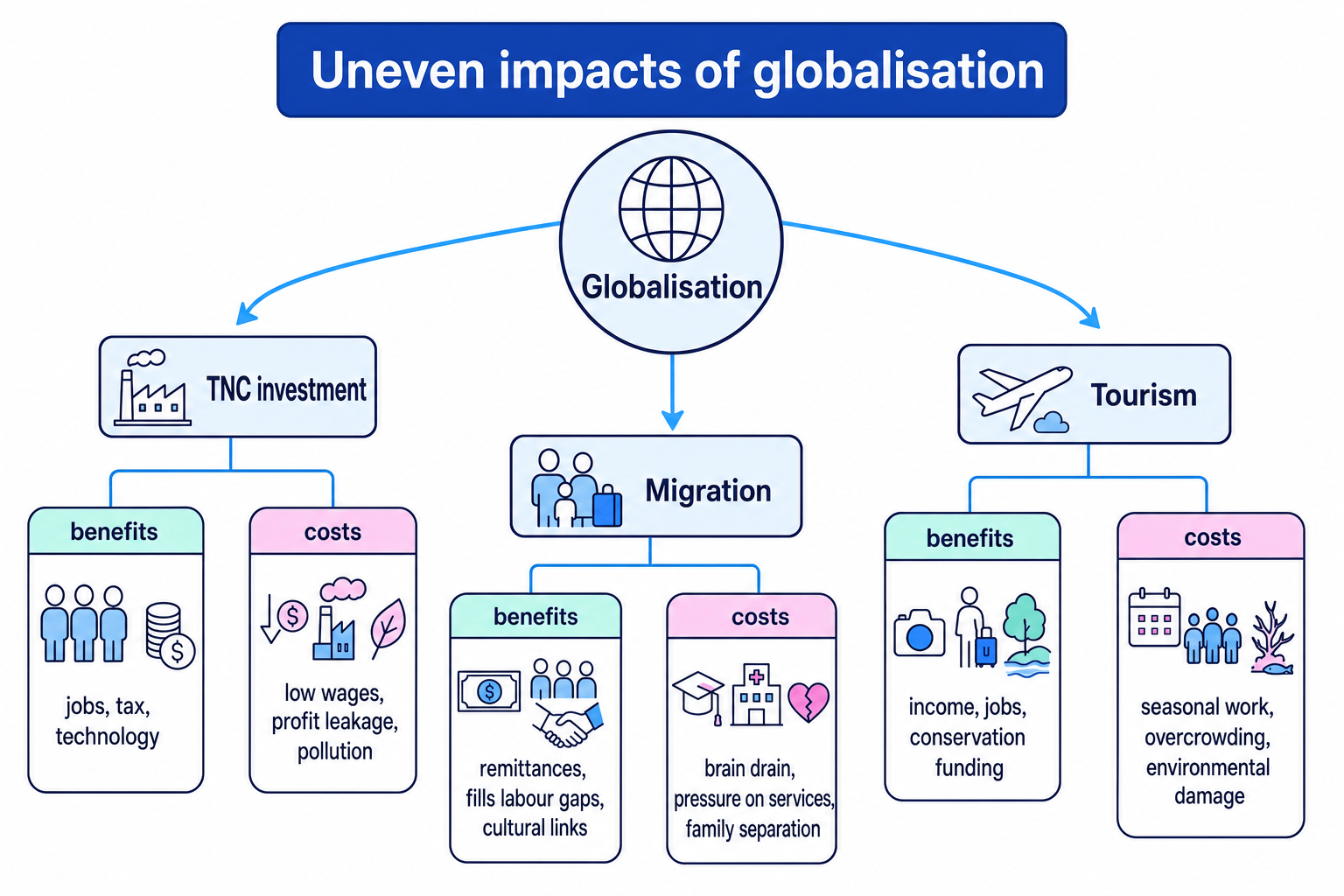
Same process, different outcomes
Globalisation does not affect everyone equally. In your answers, always ask: who benefits, who loses, where, and why?
2. TNCs and host countries
Transnational corporation (TNC)
A transnational corporation, or TNC, is a company that operates in more than one country. Its home country is where its headquarters are based, and a host country is a country where it has factories, offices, shops or other operations.
TNCs are a major driver of globalisation because they move capital money, jobs, technology and products across borders.
When a TNC invests in another country, this is often called foreign direct investment or FDI. For example, Samsung has major manufacturing operations in Vietnam, while car companies such as Toyota and Nissan have invested in the UK.
Benefits for countries hosting TNCs
Host countries can gain:
- Jobs and wages for local workers.
- Tax revenue for governments, if profits are taxed effectively.
- Exports, which bring money into the country.
- Skills and technology transfer, where workers and firms learn new methods.
- A multiplier effect, where spending by a TNC creates extra income for other local businesses, such as transport companies, food suppliers and construction firms.
- Improved infrastructure, such as roads, ports, energy supply and internet connections.
For an emerging economy like Vietnam, TNC manufacturing can support export-led growth. For a developed country like Ireland, high-tech and pharmaceutical TNCs can bring highly skilled jobs and large tax payments.
Costs for countries hosting TNCs
TNCs can also create problems:
- Jobs may be low paid, insecure or involve poor working conditions.
- Profit leakage can occur when money earned in the host country is sent back to the TNC’s headquarters overseas.
- TNCs may use legal methods of tax avoidance, reducing tax paid to the host country.
- Local firms may struggle to compete with powerful global companies.
- Factories can cause air, water or land pollution if regulations are weak.
- TNCs can be footloose, meaning they can move production elsewhere if wages rise or cheaper sites become available.
Different groups are affected differently
| Group in the host country | Possible benefits | Possible costs |
|---|---|---|
| Workers | More jobs, wages, training | Low pay, long hours, unsafe conditions |
| Government | Tax income, exports, investment | Tax avoidance, dependency on one sector |
| Local businesses | More customers, supply contracts | Competition from powerful TNCs |
| Consumers | Wider choice, cheaper products | Loss of local shops or brands |
| Local communities | Infrastructure improvements | Pollution, traffic, pressure on land |
Weighing TNC impacts in Vietnam
-
Set the national context: Vietnam is an emerging economy in South-East Asia with a large workforce and strong links to global manufacturing. This helps explain why TNCs are attracted there.
-
Identify benefits by group: Workers may gain factory jobs and regular wages. The government may gain exports and some tax income. Local suppliers may gain contracts to provide transport, packaging or services.
-
Identify costs by group: Some workers may face long hours or low pay compared with workers in richer countries. Local communities may experience pollution or traffic. Some profits may leave Vietnam and return to the TNC’s home country.
-
Make a balanced judgement: TNC investment can support economic growth, but the overall impact depends on wages, labour laws, environmental regulation and how much profit stays in the host country.
Writing only country-level impacts
Do not write “Vietnam benefits” as if every person benefits equally. Separate the impacts on workers, governments, local businesses, consumers and communities.
3. Migration: different types, different impacts
Migration
Migration is the movement of people from one place to another to live, usually for at least one year. The place people leave is the source area and the place they move to is the destination area.
Migration is part of globalisation because people move for work, safety, education, family and lifestyle. It can be voluntary or forced, and it can happen within a country or across borders.
Key migration types
- Voluntary migration: people choose to move, often for jobs, education or family reasons.
- Forced migration: people have little or no choice, often because of war, persecution, famine or natural hazards.
- National migration, also called internal migration: movement within one country.
- International migration: movement across a national border.
- Rural-urban migration: movement from countryside areas to towns or cities. This is a major cause of urbanisation, which means an increasing percentage of people living in urban areas.
A refugee is someone forced to leave their country because of conflict, persecution or serious danger. For example, millions of Syrians have moved to countries such as Turkey, Lebanon and Germany since the Syrian civil war began.
Impacts on migrants
Migration can improve people’s lives if they gain:
- Higher wages.
- Better education or healthcare.
- Safety from conflict or persecution.
- Access to family networks.
But migrants may also face:
- Dangerous journeys.
- Language barriers.
- Discrimination or racism.
- Poor housing.
- Exploitation by employers.
- Separation from family.
Impacts on source areas
Source areas can benefit from remittances, which are money transfers sent home by migrants. For example, international migrants from countries such as the Philippines, India and Mexico send large amounts of money back to families, supporting food, housing and education.
However, source areas can also suffer brain drain, which is the loss of skilled or educated workers, such as doctors, engineers or teachers. Rural areas may also be left with older populations if many young adults move to cities.
Impacts on destination areas
Destination areas can gain:
- Workers for farms, factories, care homes, hospitals and construction.
- New businesses and entrepreneurship.
- Cultural diversity, including food, music, language and festivals.
- More tax revenue if migrants work legally.
But they may also experience:
- Pressure on housing, schools and healthcare.
- Competition for some low-paid jobs.
- Social tension if integration is poor.
- Extra short-term costs when receiving forced migrants.
For example, rural-urban migration to Chinese cities such as Shenzhen has helped provide labour for manufacturing, but it has also increased pressure on urban housing and services. International migration from Poland and other EU countries to the UK after 2004 helped fill labour gaps, but also created debate about pressure on public services.
Calculating net migration
- Find the difference between arrivals and departures: If 3,500 people move into a town and 1,800 leave, then:
-
Decide whether it is a gain or loss: Because more people arrived than left, the town has a net migration gain of 1,700 people.
-
Calculate the rate per 1,000 people: If the town’s population is 250,000, then:
So the town gained 6.8 people per 1,000 population through migration.
- Link the figure to impacts: A positive rate may increase the workforce and tax base, but it may also increase demand for housing, school places and healthcare.
Assuming migration is always international
Rural-urban migration within one country is still migration. In many emerging and developing countries, internal migration has a huge impact on cities.
4. Global tourism and mass tourism
Mass tourism
Mass tourism is tourism involving large numbers of visitors going to the same destination, often on package holidays or through major transport routes such as airports and cruise terminals.
Global tourism has grown because of rising incomes, cheaper flights, online booking, paid holidays and better transport. Before the COVID-19 pandemic, international tourist arrivals were around 1.5 billion per year, although exact figures vary by data source and year.
A destination area is the place tourists visit. Examples include Spain’s Costa del Sol, Thailand’s Phuket, Mexico’s Cancún, Venice in Italy and Kenya’s Maasai Mara.
Economic impacts of tourism
Tourism can bring:
- Jobs in hotels, restaurants, airports, guiding and transport.
- Foreign currency earnings.
- Tax income for governments.
- A multiplier effect as tourists spend money in local businesses.
- Investment in roads, airports, water supply and electricity.
But tourism can also cause:
- Leakage, where profits leave the destination because hotels or airlines are foreign-owned.
- Seasonal jobs, meaning work is only available at certain times of year.
- Low wages in cleaning, catering and informal work.
- Dependency on tourism, making places vulnerable to pandemics, terrorism, conflict or natural hazards.
- Rising prices for land, housing and food.
Social impacts on people
Tourism can improve local services and create pride in culture. It can support museums, festivals, heritage sites and local crafts.
However, mass tourism can also cause overcrowding, noise, traffic congestion and conflict between tourists and residents. In cities such as Venice and Barcelona, local people have protested about cruise ships, short-term holiday rentals and rising housing costs.
Environmental impacts
Tourism can have positive environmental effects if entrance fees fund conservation. For example, safari tourism in Kenya can provide income for wildlife protection, and ecotourism in Costa Rica has helped make forests economically valuable.
But mass tourism can damage environments through:
- High water use in hotels, swimming pools and golf courses.
- Waste and sewage pollution.
- Damage to coral reefs from boats, diving and coastal development.
- Habitat loss from resort construction.
- Carbon emissions from flights and cruise ships.
A useful term here is carrying capacity, which means the maximum number of people an environment or place can support without serious damage or decline in quality of life.
Calculating tourism growth
- Use the percentage change formula: If a resort had 20 million visitors in one year and 34 million visitors later, use:
- Substitute the values:
Visitor numbers increased by 70%.
- Interpret the growth geographically: A 70% increase could bring more jobs and tax revenue, but it could also increase pressure on water supply, waste disposal, beaches, roads and local housing.
Tourism is vulnerable to shocks
Tourism data can change suddenly after events such as pandemics, volcanic eruptions, conflict, terrorist attacks or extreme weather. In answers, link this to the risk of over-dependence on tourism.
5. Why impacts vary globally
The impacts of globalisation vary because places have different levels of development, different governments, different environments and different amounts of power in the global economy.
A developed country may attract high-skilled TNC jobs, while a developing country may attract lower-paid manufacturing. A well-regulated tourist destination may protect local environments, while a poorly planned resort may suffer pollution and overcrowding. A destination country with spare jobs and strong services may absorb migrants more easily than a country already facing housing shortages or conflict.
Use the group-scale-place method
For strong explanations, organise your thinking by group workers, residents, governments, businesses, migrants, tourists; scale local, national, global; and place a named example such as Vietnam, China, Spain, Kenya or Syria.
6. Summary: the core argument
Globalisation increases connections between places, but it does not spread benefits and costs evenly. TNCs, migration and tourism can all create jobs, income and cultural links. They can also create inequality, exploitation, pressure on services and environmental damage.
The best answers do not simply list positives and negatives. They explain who is affected, how, and why the impact may be different in another place.
In the exam
-
Name real places whenever you can: for example, Samsung in Vietnam, Syrian refugees in Turkey or Germany, rural-urban migration in China, or mass tourism in Spain’s Costa del Sol.
-
Separate groups of people rather than writing generally about “the country”. Mention workers, governments, local residents, migrants, businesses and tourists.
-
Balance benefits and costs, then add a judgement using words like “however”, “whereas”, “depends on” and “overall”.
Check yourself
- How can a TNC bring both benefits and costs to a host country?
- What is the difference between voluntary, forced, national, international and rural-urban migration?
- Why might mass tourism create economic growth but environmental pressure in the same destination?