

What you'll learn
- How the global economy has grown through trade, investment and commodity chains.
- Why transport, information technology, labour, aid and foreign investment make countries more connected.
- How the WTO, IMF and TNCs help shape globalisation.
- How push and pull factors explain economic, medical, sport and tourism-related movement over the last 50 years.
1. Globalisation: the big idea
Globalisation is about places becoming more connected. It is not just “more trade”. It includes the movement of goods, services, money, information, ideas and people across national borders.
Globalisation
Globalisation is the increasing connection between countries through flows of goods, services, money, information, culture and people.
You can see globalisation when a phone is designed in California, uses minerals from central Africa and South America, is assembled in East Asia, advertised online worldwide, and delivered through global shipping networks.
Globalisation is not only trade
Trade is a major part of globalisation, but exam answers should also mention investment, technology, transport, labour migration, tourism and the role of global institutions.
2. The rise of the global economy
Global economy
The global economy is the worldwide system of production, trade, investment and consumption linking countries together.
Over the last 50 years, many products have stopped being made entirely in one country. Instead, production is split between different places, depending on costs, skills, resources and access to markets.
Commodity chain
A commodity chain is the full sequence of activities involved in making, transporting and selling a product, from raw materials to the final consumer.
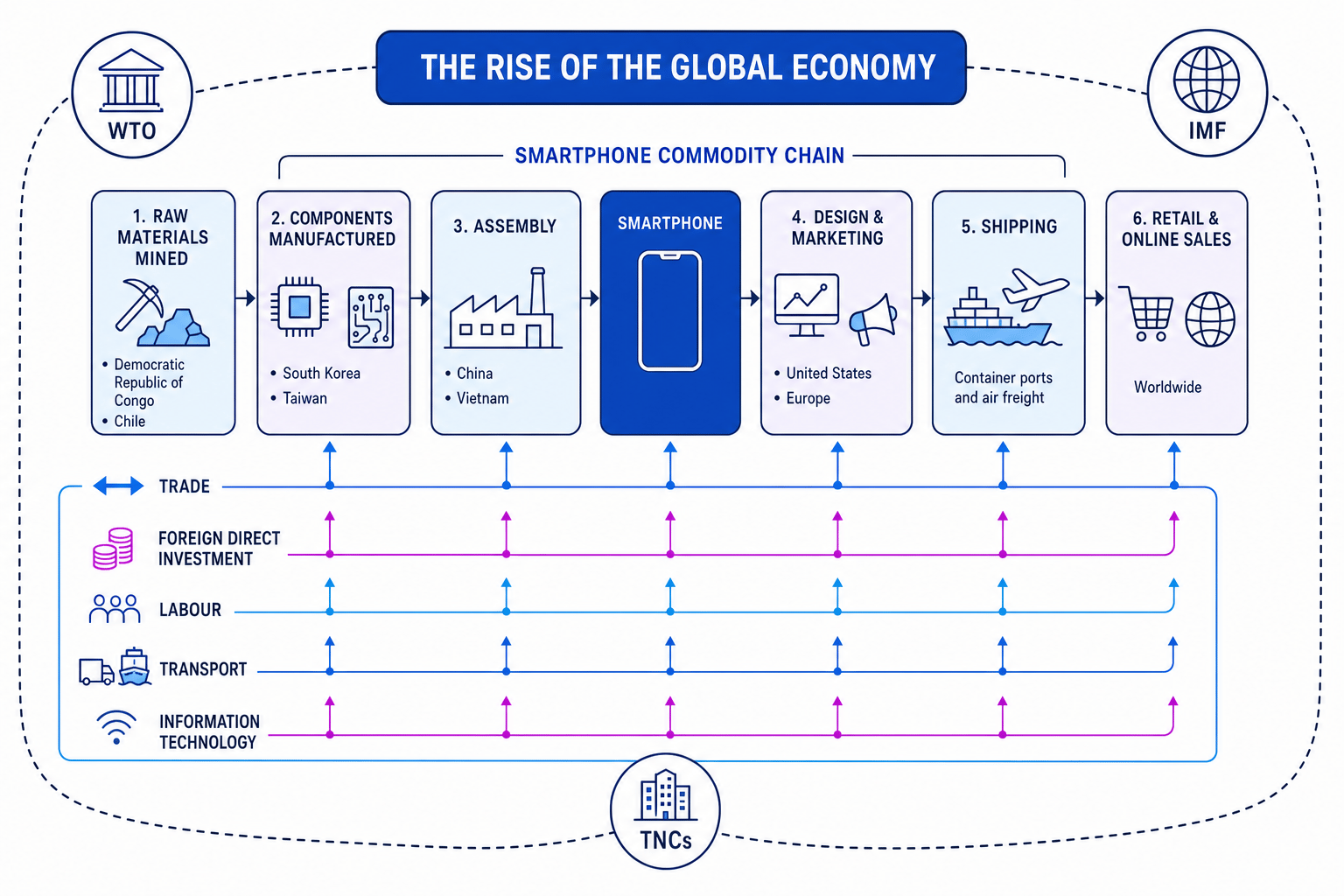
The diagram shows how one product can connect many countries through raw materials, manufacturing, transport, marketing and sales.
Why commodity chains have grown
Commodity chains have grown because companies can now choose the best location for each stage of production:
- Raw materials may come from countries rich in natural resources, such as cobalt from the Democratic Republic of Congo or copper from Chile.
- Manufacturing may happen where there is skilled labour, reliable factories and lower costs, such as China, Vietnam, South Korea or Taiwan.
- Design and marketing often remain in high-income countries, such as the USA, Japan or European countries.
- Sales are global, especially through online platforms and international retailers.
Analysing a commodity chain
A smartphone is designed in the USA, uses minerals from the Democratic Republic of Congo and Chile, has components made in South Korea and Taiwan, is assembled in China, and is sold in Europe.
- Identify the stages. Raw materials, component manufacturing, assembly, design, marketing, shipping and retail all happen in different countries.
- Match each stage to a location advantage. The USA has high-value design and software skills; China has large-scale assembly capacity; South Korea and Taiwan have advanced electronics industries.
- Explain the globalisation link. The phone depends on international trade, transport, investment and information flows, so one product connects many economies.
- Add a consequence. Jobs and export earnings may increase in assembly countries, while profits may mainly return to the TNC’s headquarters.
The key pattern
Globalisation has made production more spread out, but also more connected: one final product may depend on dozens of countries.
3. Factors encouraging globalisation
Trade
Trade
Trade is the buying and selling of goods and services between countries.
Trade has increased because many countries have reduced tariffs and quotas. A tariff is a tax on imports. A quota is a limit on the number of goods that can be imported.
Lower trade barriers make it easier and cheaper for companies to sell products worldwide. For example, car parts may cross borders several times before a finished vehicle is sold.
Foreign investment
Foreign direct investment
Foreign direct investment, often shortened to FDI, is when a company or government invests money in business activity in another country, such as building a factory or buying a company.
FDI helps globalisation because it spreads factories, jobs, technology and business methods across borders. For example, Toyota, Samsung and Unilever operate in many countries, not just where their headquarters are located.
Aid
Aid
Aid is money, resources or expertise given to a country, often to support development, reduce poverty or respond to disasters.
Aid can encourage globalisation when it improves transport, education, healthcare or infrastructure. For example, improved roads, ports and internet access can help a country export goods and connect with world markets.
However, aid does not automatically create development. Its impact depends on how it is managed, whether it reaches the intended people, and whether it supports long-term growth.
Labour
Labour means workers and their skills. Globalisation uses both low-cost labour and highly skilled labour.
Some companies locate factories where wages are lower, while other companies seek highly skilled workers in finance, technology, medicine or engineering. Migration also supplies labour: for example, many workers from South Asia have moved temporarily to Gulf states such as the UAE, Qatar and Saudi Arabia for construction and service jobs.
Modern transport
Transport has become faster, cheaper and more reliable. Containerisation — moving goods in standard metal containers — has made shipping far more efficient because containers can move easily between ships, lorries and trains.
Air freight also allows high-value or time-sensitive goods, such as electronics, flowers and medical products, to move quickly between continents.
Information technology
Information and communication technology, or ICT, includes the internet, mobile phones, satellites, online banking and digital tracking systems.
ICT allows companies to coordinate factories, suppliers, customers and payments across different time zones. A TNC can manage a global supply chain almost instantly using emails, video calls, tracking data and online platforms.
A strong explanation chain
For a 4–6 mark answer, link factor → flow → result. For example: “Container ships reduced transport costs, so TNCs can move components between countries more cheaply, which encourages longer global commodity chains.”
4. Global institutions and TNCs
Some organisations operate across national borders and help create the rules, finance and business networks of globalisation.
The World Trade Organization
World Trade Organization
The World Trade Organization, or WTO, is a global institution that sets and monitors rules for international trade.
The WTO encourages countries to reduce trade barriers and settle trade disputes. This can increase global trade because companies have more predictable rules when selling goods and services overseas.
However, critics argue that the benefits of freer trade may not be shared equally. Richer countries and powerful TNCs can sometimes gain more than poorer countries with less bargaining power.
The International Monetary Fund
International Monetary Fund
The International Monetary Fund, or IMF, is a global institution that gives loans and financial advice to countries facing serious economic problems.
The IMF can help stabilise economies, which may make countries more attractive to investors and more connected to global markets.
However, IMF loans may come with conditions, such as reducing government spending or opening markets to foreign companies. These policies can be controversial because they may affect public services and living standards.
Transnational corporations
Transnational corporation
A transnational corporation, or TNC, is a company that operates in more than one country.
TNCs are major drivers of globalisation. They organise commodity chains, invest overseas, employ workers in different countries and sell products worldwide. Examples include Apple, Toyota, Coca-Cola, Samsung, Shell and Unilever.
TNCs can bring benefits to host countries, including jobs, training, tax revenue and improved infrastructure. But there can also be costs, such as low wages, poor working conditions, environmental damage or profits being sent back to the company’s home country.
Explaining the role of a TNC
Apple is headquartered in the USA, but its products involve suppliers, factories and consumers across the world.
- Identify the TNC’s global structure. Design and management are mainly in the USA, while components and assembly involve countries such as Taiwan, South Korea, China, Vietnam and India.
- Link this to investment and production. Apple and its suppliers use international contracts, factories and logistics networks to make products at a global scale.
- Show the flows created. Goods, money, information, technology and labour are all moving between countries.
- Evaluate briefly. Host countries may gain jobs and exports, but the highest profits may remain with the TNC and its shareholders.
5. Movement of people: migration and tourism
Globalisation also increases the movement of people. Some people move permanently or for many years. Others move temporarily for work, healthcare, sport, study or leisure.
Migration
Migration is the movement of people from one place to another, usually involving a change of home for a significant period of time.
Tourism is temporary travel away from home, usually for leisure, business, visiting friends and relatives, or specialist activities such as medical treatment.
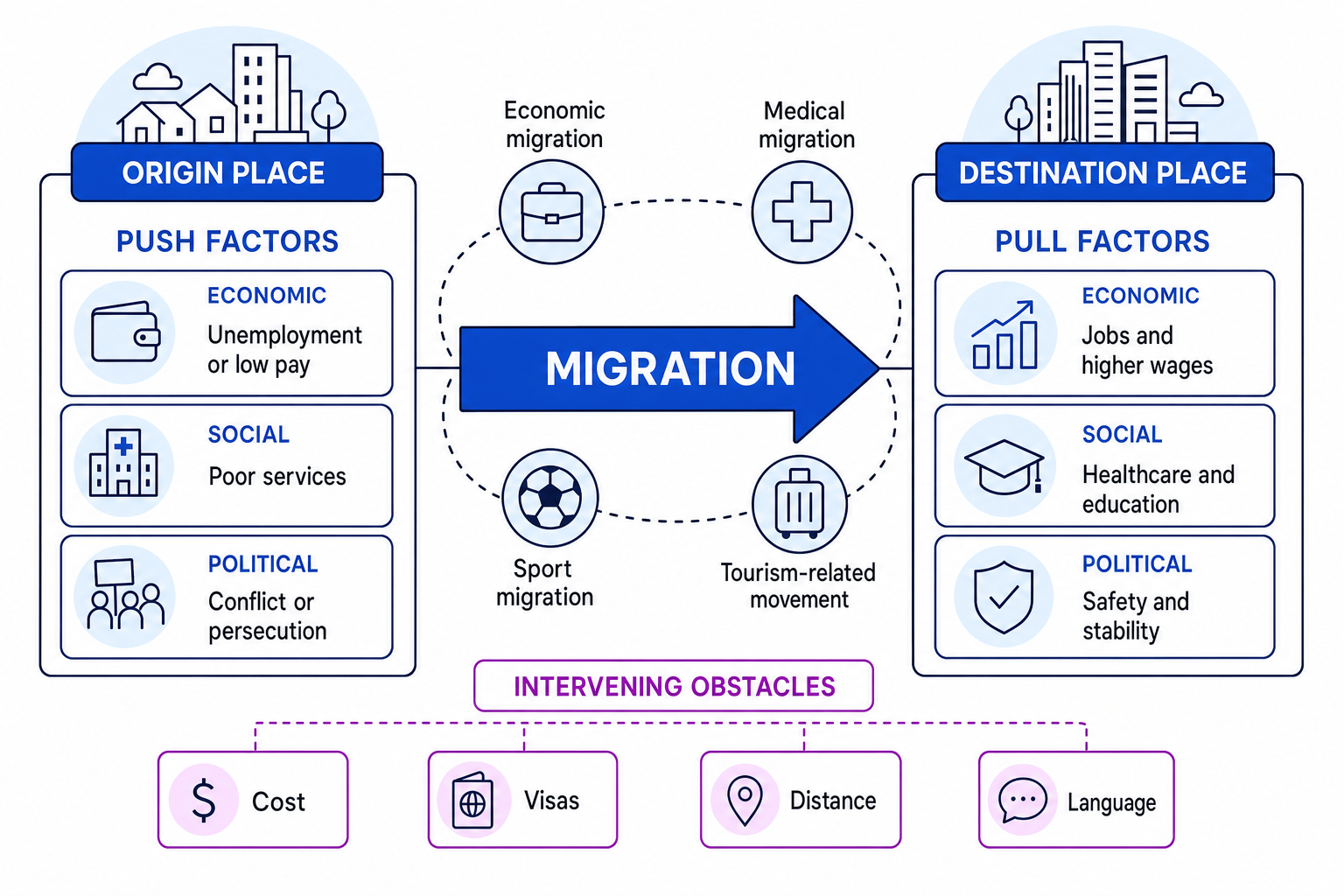
The push–pull model helps explain why people leave one place and are attracted to another.
Tourism and migration are different
Tourism is normally temporary and is not always counted as migration. In this topic, both matter because the specification focuses on the wider movement of people in a globalised world.
6. Push and pull factors
Push and pull factors
Push factors are reasons that encourage people to leave a place. Pull factors are reasons that attract people to a destination.
Push and pull factors can be grouped into three main types.
Economic factors
Economic push factors include unemployment, low wages, poverty and lack of opportunities. Economic pull factors include jobs, higher wages, better working conditions and career progression.
This explains many flows of economic migration, where people move mainly to improve income or employment. For example, workers from South Asia have migrated to Gulf states for construction and service work, while some Eastern European workers moved to the UK and Germany after EU expansion.
Social factors
Social push factors include poor healthcare, limited education, overcrowding or lack of services. Social pull factors include better schools, hospitals, housing, family networks and quality of life.
This helps explain medical movement, where people travel for healthcare. For example, patients from the UK, USA and other countries may travel to India, Thailand or Turkey for dental work, cosmetic surgery or specialist treatment, often because costs or waiting times are lower. Exact numbers vary by source and year.
Political factors
Political push factors include war, persecution, corruption, lack of rights and insecurity. Political pull factors include safety, stability, legal protection and asylum systems.
For example, conflict in Syria since 2011 pushed millions of people to move within Syria or to nearby countries such as Turkey, Lebanon and Jordan, with some later moving to European countries such as Germany. The exact figures change over time, but the pattern shows how political factors can rapidly increase migration rates.
Classifying push and pull factors
A young footballer leaves Ghana to join a club academy in France because local facilities are limited, European clubs offer higher wages, and an agent has arranged a visa.
- Identify the type of movement. This is mainly sport migration because the person is moving for training and a professional sporting career.
- Separate push from pull. Limited local facilities are a push factor; higher wages and better training in France are pull factors.
- Classify the factors. Limited facilities are social/economic; higher wages are economic; the visa process is a political or legal factor affecting whether movement is possible.
- Explain the rate of movement. Global scouting networks, air travel and online communication make this kind of sport migration more common than it was 50 years ago.
7. How movement has changed over the last 50 years
International movement has generally increased since the 1970s, although it can fall during shocks such as wars, recessions, pandemics or tighter border controls.
Economic migration has increased
Large income differences between countries encourage people to move for work. Ageing populations in some richer countries also create demand for migrant workers in healthcare, farming, construction and services.
Medical movement has grown
Cheaper flights, online information and global hospital advertising have made medical travel easier. Patients can compare prices, read reviews and arrange treatment abroad more easily than in the past.
Sport migration has become more global
Professional sport is now a global industry. Football, basketball, cricket, athletics and tennis all involve international scouting, sponsorship, coaching and competition. Athletes may move for better facilities, contracts or exposure.
Tourism has expanded rapidly
International tourism has grown because of rising incomes, paid holidays, cheaper air travel, online booking and global marketing. Around the world, international tourist arrivals rose from roughly 166 million in 1970 to about 1.46 billion in 2019, before falling sharply during the COVID-19 pandemic and then recovering. Exact figures depend on the source and definition used.
Calculating percentage growth in tourist arrivals
Use rounded global figures: international tourist arrivals rose from 166 million in 1970 to 1.46 billion in 2019.
- Put the figures in the same units. 1.46 billion is 1460 million.
- Find the increase. The increase is 1460 million minus 166 million, which equals 1294 million.
- Apply the percentage change formula.
- Substitute the values.
- Interpret the result. International tourist arrivals increased by about 780%, meaning they were nearly nine times higher in 2019 than in 1970.
Why people move
Most movement is caused by a combination of factors: people rarely move for only one reason. Strong answers combine economic, social and political push and pull factors.
8. Bringing it together
Globalisation creates a more connected world in two linked ways:
- Goods and money move more easily through trade, FDI, TNCs, transport and ICT.
- People move more easily through migration, tourism, medical travel, sport opportunities and global labour markets.
The result is a world with more connections, but also more uneven impacts. Some places gain investment, jobs and tourism income. Others may face exploitation, environmental pressure, brain drain or dependence on global markets.
In the exam
- Define key terms quickly before explaining them: globalisation, commodity chain, TNC, push factor and pull factor.
- Use named examples such as Apple’s global supply chain, South Asian workers in Gulf states, medical tourism to India or Thailand, or sport migration to European football clubs.
- Build explanation chains using “because”, “therefore” and “this leads to” so you show how a factor actually increases trade or movement.
- If data is given, comment on direction and scale: say whether the value increased or decreased, calculate percentage change if useful, and link the pattern back to globalisation.
Check yourself
- How does a commodity chain show that production has become more global?
- What is the difference between the roles of the WTO, IMF and TNCs?
- Can you give one economic, one social and one political push or pull factor for migration?
