What you'll learn
- How economies shift between primary, secondary, tertiary and quaternary sectors as they develop.
- The positive and negative impacts of sector change in the UK and China.
- Why informal employment grows in megacities such as Lagos, Nigeria.
- How Malthus and Boserup explain the relationship between population and resources.
1. The basic building blocks: economic sectors
Economic activity means work that produces goods or services. Geographers divide this activity into sectors so we can compare how economies change over time.
Economic sector
An economic sector is a category of jobs and businesses that do a similar type of activity, such as farming, manufacturing or services.
The four main sectors
- Primary sector: extracting raw materials from the natural environment, such as farming, fishing, forestry and mining.
- Secondary sector: making or processing goods, such as manufacturing, construction and steel-making.
- Tertiary sector: providing services, such as retail, healthcare, tourism, education and transport.
- Quaternary sector: high-level knowledge and information work, such as research, ICT, design and some finance or data-based services.
Sector shift
A sector shift is a change in the importance of different economic sectors in a country, usually measured by their share of employment or GDP.
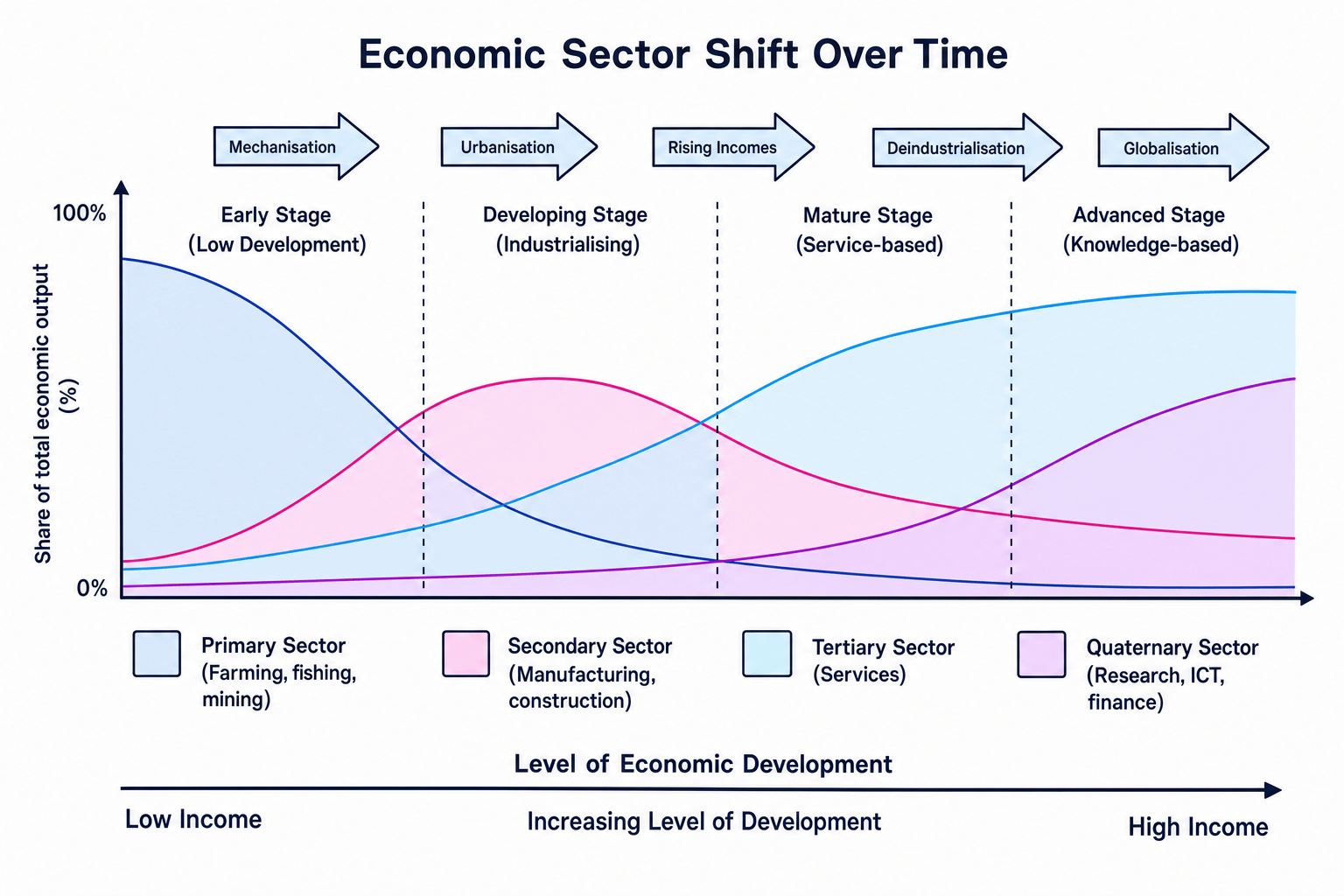
The diagram below shows the general pattern: countries often move from primary-dominated economies, to industrial manufacturing, and then towards services and knowledge-based work.
The big pattern
As countries develop, primary employment usually falls, secondary employment often rises then later falls, and tertiary and quaternary employment usually grow.
Why do sector shifts happen?
Sector shifts are linked to several processes:
- Mechanisation: machines replace human labour, especially in farming and manufacturing.
- Industrialisation: a country increases manufacturing and factory production.
- Deindustrialisation: manufacturing declines in importance, often because factories close, automate or move abroad.
- Globalisation: countries become more connected through trade, investment, migration and technology.
- Rising incomes: people spend more on services such as education, leisure, healthcare and finance.
Employment and output are not the same
A sector can employ fewer people but still produce a lot. For example, modern farming in a developed country may use very few workers because machines do much of the work.
Interpreting a sector shift from data
A data table shows that a country’s secondary-sector employment fell from 38% to 18%, while tertiary employment rose from 59% to 81%.
- Compare the old and new secondary-sector values: 18% is lower than 38%, so the country has experienced a decline in manufacturing employment.
- Calculate the percentage point change: 18% - 38% = -20 percentage points, so secondary employment has fallen by 20 percentage points.
- Compare the tertiary-sector change: 81% - 59% = +22 percentage points, so service employment has grown strongly.
- Link the pattern to development: this suggests deindustrialisation and growth of a service-based economy, typical of many developed countries.
2. Sector shifts in a named developed country: the UK
The United Kingdom is a developed, high-income country in north-west Europe, with a population of about 67 million. Its economy is now dominated by services, especially finance, retail, education, healthcare, tourism, creative industries and ICT.
Positive impacts in the UK
The growth of tertiary and quaternary sectors has created many higher-paid jobs, especially in places such as London, Cambridge, Manchester and the M4 corridor. These areas have benefited from universities, skilled workers, transport links and investment.
Old industrial areas have also been regenerated. For example, parts of London Docklands changed from derelict docks and warehouses into offices, housing, shopping and leisure areas.
There have also been environmental improvements in some places. The closure of heavy industries such as coal mining and steel-making reduced local smoke, waste and river pollution, although this does not mean the UK has no environmental impact.
Negative impacts in the UK
Deindustrialisation caused serious problems in former industrial areas such as South Wales, north-east England, parts of northern England and the Scottish Central Belt. Factory and mine closures led to unemployment, lower incomes, out-migration and derelict land.
There is also a regional inequality issue. London and the South East have attracted more high-value service jobs, while some post-industrial towns have struggled to replace lost manufacturing work.
The UK also imports many manufactured goods and raw materials. This can hide environmental impacts abroad, because pollution and resource use may occur in the countries producing the goods.
3. Sector shifts in a named emerging country: China
China is an emerging economy in East Asia with a population of around 1.4 billion. Since economic reforms began in 1978, China has shifted from a mainly agricultural economy towards manufacturing, construction, services and high-tech industries.
Positive impacts in China
Manufacturing growth created millions of jobs in coastal cities and special economic zones, such as Shenzhen, which grew rapidly from a small town into a major technology and manufacturing city.
Export-led growth increased national income, improved infrastructure and helped reduce extreme poverty. China invested heavily in roads, ports, high-speed rail, housing, factories and energy supply.
The growth of tertiary and quaternary work is now creating more jobs in banking, e-commerce, education, tourism, ICT and research.
Negative impacts in China
Rapid industrialisation has increased demand for energy, water, land and raw materials. China still uses large amounts of coal, which contributes to air pollution and greenhouse gas emissions.
There are also social impacts. Many rural migrants moved to cities for factory and construction work, but some faced long hours, poor conditions and limited access to urban services because of the household registration system known as hukou.
Growth has been uneven. Coastal cities such as Shanghai, Shenzhen and Guangzhou became much richer than many inland rural areas.
Resource issue
A resource issue happens when demand for resources such as food, water, energy, land or minerals creates problems of supply, cost, access or environmental damage.
Use balanced impacts
For sector-shift questions, organise impacts as economic, social and environmental. Strong answers usually include both winners and losers.
4. Informal employment in a named megacity: Lagos, Nigeria
A megacity is a city with more than 10 million people. Lagos, in south-west Nigeria, is one of Africa’s largest megacities and Nigeria’s main economic centre.
Informal employment
Informal employment is work that is not fully registered, taxed or protected by formal contracts and labour laws.
Informal work includes street vending, market trading, waste picking, domestic work, motorcycle taxis, small repairs, casual construction and food selling.
Causes of informal employment in Lagos
One major cause is rural-urban migration, which means people move from the countryside to the city. Migrants may be pushed by low farm incomes, poor rural services or lack of opportunities, and pulled by the hope of jobs, education and healthcare in Lagos.
Another cause is uneven economic development. Lagos has more businesses and investment than many rural areas, so it attracts workers. However, formal jobs do not grow fast enough for all new arrivals, and some migrants lack the qualifications, money or contacts needed for formal employment.
Characteristics: advantages and disadvantages
Informal employment can be useful. It provides income quickly, has low start-up costs and offers flexible work. It also supplies cheap goods and services to millions of city residents.
However, it has serious disadvantages. Workers may have low and irregular wages, no sick pay, no pension, unsafe working conditions and little legal protection. City authorities may also lose tax revenue and sometimes remove informal traders from streets or markets.
Informal does not always mean illegal
Many informal workers are not criminals. The key point is that their work is usually unregistered, insecure and poorly protected, not necessarily illegal.
Explaining informal employment in Lagos
- Start with the migration pressure: many people move to Lagos because it offers more opportunities than rural areas.
- Compare job demand and job supply: the number of people needing work is greater than the number of secure formal jobs available.
- Explain the low barriers to entry: informal work often needs little education, little capital and no formal contract, so migrants can start quickly.
- Add the impacts: informal work provides income and services, but it can also mean insecurity, low pay and unsafe conditions.
5. Population and resources: the key debate
Population growth can increase pressure on resources such as food, water, energy and land. Geographers use theories to explain whether this pressure leads mainly to crisis or innovation.
Carrying capacity
Carrying capacity is the maximum population that an environment can support sustainably with the available resources and technology.
6. Malthus: population can outgrow resources
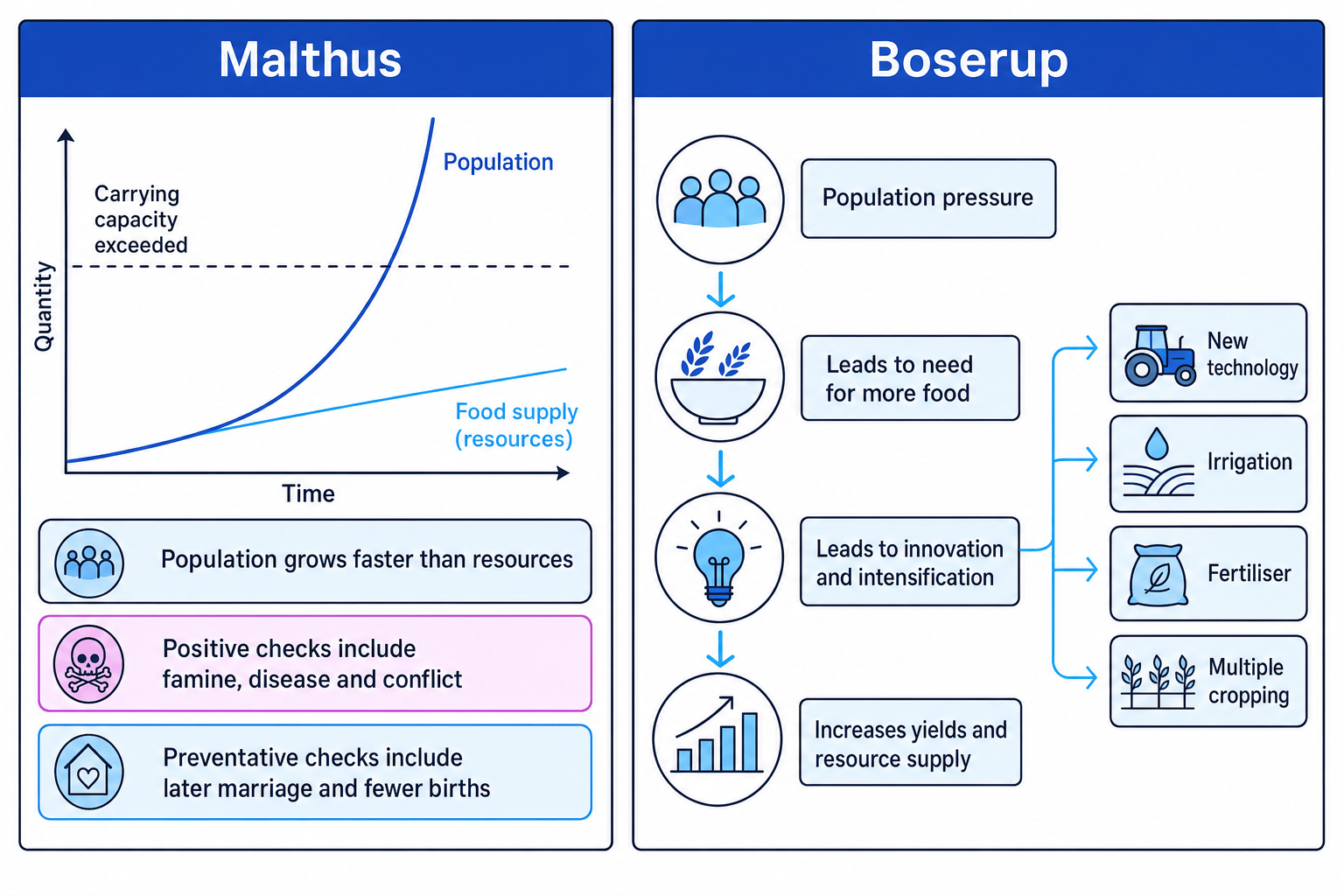
Thomas Malthus argued in 1798 that population grows faster than food supply. He believed population could increase very rapidly, while food production increased more slowly.
If population rises above carrying capacity, Malthus argued that shortages would lead to positive checks, such as famine, disease and conflict, which increase death rates. He also described preventative checks, such as later marriage and fewer births, which reduce birth rates.
Malthus is useful because he reminds us that resources are not unlimited. However, his theory is often criticised because he underestimated technological change, global trade, contraception and improvements in farming.
7. Boserup: population pressure can cause innovation
Ester Boserup argued that population growth can encourage people to develop new ways of producing food and using resources. Her view is sometimes summarised as “necessity is the mother of invention”.
When food demand rises, societies may respond with irrigation, terracing, fertilisers, high-yield seeds, mechanisation and multiple cropping. This can increase output and raise carrying capacity.
Boserup is useful because it explains why many countries have increased food production despite rapid population growth. However, innovation needs money, education, infrastructure and stable government, and it can also cause environmental damage.
The diagram below compares the two theories: Malthus focuses on shortage and checks, while Boserup focuses on pressure leading to innovation.
Choosing between Malthus and Boserup
A country’s population grows quickly, food demand rises, and the government invests in irrigation, fertiliser and high-yield crops. Food output then increases.
- Identify the direction of cause and effect: population growth creates pressure for more food.
- Look at the response: the country uses technology and farming intensification rather than simply suffering collapse.
- Match the theory: this fits Boserup, because resource pressure leads to innovation and higher yields.
- Add a balanced point: if innovation failed and food shortages caused famine or disease, the situation would fit Malthus more closely.
Neither theory explains everything
Real resource problems are affected by wealth, trade, government policy, conflict, climate change and inequality. Hunger can happen even when enough food exists globally, because access and distribution are uneven.
8. Bringing the topic together
Sector shifts change jobs, incomes, landscapes and resource demand. In developed countries such as the UK, the shift towards services has brought high-value jobs but also deindustrialisation and regional inequality. In emerging countries such as China, industrialisation has reduced poverty and increased national income, but it has also increased pollution, energy demand and resource pressure.
Informal employment shows that economic growth does not automatically create secure jobs for everyone. In fast-growing megacities such as Lagos, informal work helps people survive, but it often leaves them vulnerable.
Malthus and Boserup help you think about resource pressure. Malthus warns that population can outstrip resources; Boserup argues that population pressure can stimulate innovation.
In the exam
- Name and locate your examples clearly: for example, UK as a developed country, China as an emerging country, and Lagos, Nigeria as a megacity.
- For impacts, give a balanced answer: include positives and negatives, and try to cover economic, social and environmental effects.
- For theory questions, explain the chain of reasoning: Malthus = population pressure leading to shortage and checks; Boserup = population pressure leading to innovation and higher output.
Check yourself
- How can deindustrialisation create both environmental benefits and social problems?
- Why does rural-urban migration increase informal employment in Lagos?
- In what situation would Boserup’s theory explain resource change better than Malthus’s?