The relative importance of different economic sectors and the location of economic activity varies spatially, and changes over time
What you'll learn
- How jobs are classified into primary, secondary, tertiary and quaternary sectors.
- How the Clark-Fisher Model links employment structure to development.
- Why different economic activities locate in different places.
- Why employment in each sector changes over time.
The big idea
Economic activity is not spread evenly across the world. Some places are dominated by farming, mining or fishing; others by factories; others by finance, healthcare, tourism, education, research or digital services.
Economic activity
Economic activity means work that produces goods or services and creates income. A good is a physical product, such as wheat, steel or a phone. A service is something done for people or businesses, such as teaching, banking or healthcare.
Employment structure
A country’s employment structure is the proportion of workers employed in each economic sector. It is usually shown as a percentage of total employment.
The four economic sectors
| Sector | What it involves | Examples |
|---|---|---|
| Primary | Extracting or harvesting raw materials from the natural environment | farming, fishing, forestry, mining, oil extraction |
| Secondary | Manufacturing or processing raw materials into finished or semi-finished goods | car assembly, steel-making, food processing, textiles |
| Tertiary | Providing services to people or businesses | retail, tourism, healthcare, education, transport, banking |
| Quaternary | Knowledge-based services involving research, information and innovation | software design, biotechnology, university research, data analysis |
Some sources group quaternary work inside the tertiary sector, but for Edexcel IGCSE Geography you should know it separately.
Sector ≠ named industry
Do not write “farming is the primary sector”. More accurately, farming is an industry within the primary sector. The sector is the broad category; the industry is the specific type of work.
Measuring the relative importance of sectors
The relative importance of a sector means how significant it is compared with the others. In this topic, the main measure is the share of people employed in each sector, although GDP, exports and wages can also show importance.
To calculate a sector’s share of employment:
sector share (%)=workers in that sectortotal workers×100\text{sector share }(\%) = \frac{\text{workers in that sector}}{\text{total workers}} \times 100sector share (%)=total workersworkers in that sector×100Reading sector data
On a pie chart, divided bar chart or stacked bar chart, the sectors for one country should normally add to 100%. If they do not, check whether quaternary employment has been included within tertiary employment.
The Clark-Fisher Model
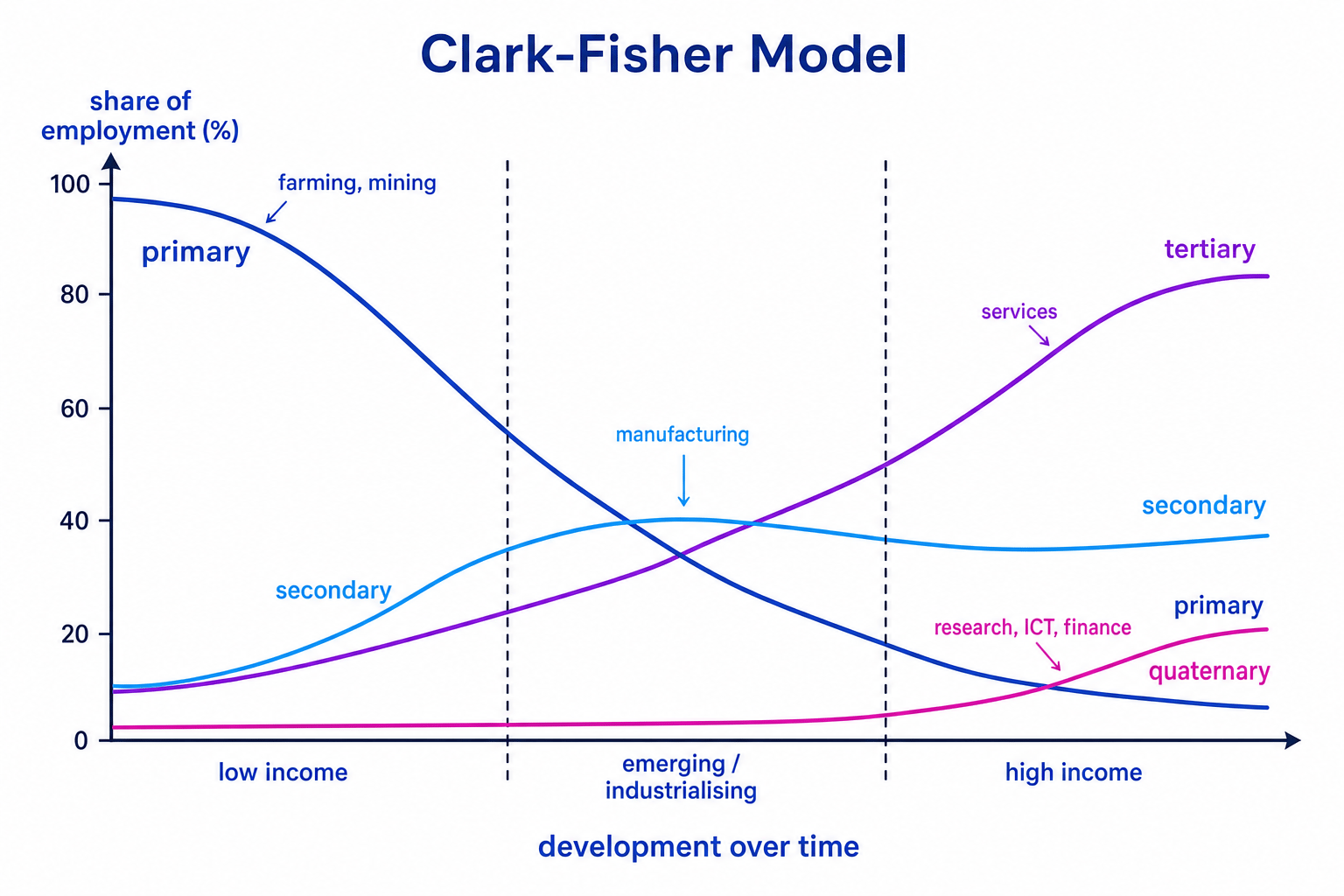
The Clark-Fisher Model is a simplified model showing how employment usually shifts between sectors as a country develops. A country’s level of development means its economic and social progress, often linked to income, education, health, infrastructure and technology.
Clark-Fisher Model
The Clark-Fisher Model suggests that as countries develop over time, employment generally moves from the primary sector, to the secondary sector, and then towards the tertiary and quaternary sectors.
Low-income countries
In lower-income countries, a large share of employment is often in the primary sector, especially farming. This is because agriculture may be labour-intensive, mechanisation may be limited, and many people rely on subsistence or small-scale farming.
Example: in countries such as Ethiopia, agriculture still employs a large share of the workforce, although services and manufacturing are growing. Exact figures vary by year and data source.
Emerging or industrialising countries
As countries industrialise, the secondary sector grows. More people move from rural areas to towns and cities for factory work. Manufacturing expands because of investment, better transport, energy supplies and access to global markets.
Example: China grew rapidly through manufacturing, especially in coastal cities such as Shenzhen and Shanghai, helped by global trade, foreign investment and Special Economic Zones.
Developed or high-income countries
In high-income countries, tertiary and quaternary employment usually dominate. Manufacturing may still be valuable, but it often employs fewer people because of automation and outsourcing.
Example: in the UK, services such as finance, healthcare, education, retail, tourism and ICT employ the majority of workers, while agriculture employs a very small share.
Development usually shifts jobs
As development increases, employment normally moves away from primary activities and towards services and knowledge-based work, but the pattern is not identical in every country.
Interpreting sector data
A country has 35 million workers: 18 million in primary, 7 million in secondary and 10 million in tertiary or quaternary work.
- Calculate the primary share: 1835×100≈51%\frac{18}{35} \times 100 \approx 51\%3518×100≈51%. This means just over half of workers are in primary activities.
- Calculate the secondary share: 735×100=20%\frac{7}{35} \times 100 = 20\%357×100=20%. Manufacturing exists, but it is not the largest employer.
- Calculate the tertiary and quaternary share: 1035×100≈29%\frac{10}{35} \times 100 \approx 29\%3510×100≈29%. Services are growing but still smaller than primary employment.
- Compare this with the Clark-Fisher Model: the country is likely to be low-income or early industrialising, because primary employment is still dominant.
Models simplify reality
The Clark-Fisher Model is a trend, not a law. Some oil-rich countries have high income but limited manufacturing employment, and some countries develop large service sectors before becoming major manufacturers.
Location of economic activity: why here and not there?
Spatial variation means that something differs from place to place. Economic activity varies spatially at many scales: between continents, between countries, between regions of the same country, and within cities.
Location factor
A location factor is a reason why an economic activity is found in one place rather than another, such as raw materials, labour, transport, markets, land cost or government policy.
Primary sector location factors
Primary activities depend strongly on the physical environment.
Important factors include:
- Geology: mining and oil extraction must take place where resources exist.
- Climate: crops need suitable temperature, rainfall and growing seasons.
- Soil: fertile soils support commercial farming.
- Relief: steep land may limit machinery but suit grazing or forestry.
- Water supply: irrigation can allow farming in drier areas.
Example: tea farming in the Kenyan Highlands benefits from high altitude, rainfall and suitable temperatures. North Sea oil extraction occurs where oil and gas reserves are located offshore.
These factors can change in importance. Improved irrigation, greenhouses, fertilisers, drilling technology and new transport links can make previously unsuitable areas more useful. However, resource depletion can also reduce employment.
Secondary sector location factors
Secondary activities involve manufacturing, so they often need inputs, workers and transport.
Traditional manufacturing was often located near:
- raw materials, such as coal, iron ore or timber
- energy supplies
- ports, canals or railways
- large pools of labour
Modern manufacturing may be more influenced by:
- motorway, port and airport access
- skilled or low-cost labour
- reliable electricity and digital networks
- suppliers and supply chains
- government grants or tax incentives
- access to markets
For example, older UK steel and textile industries were linked to coalfields, ports and industrial cities. Today, electronics and vehicle assembly may locate in places with good logistics, skilled labour and access to global supply chains.
Tertiary sector location factors
Tertiary services usually locate near customers or where they are easy to access.
Important factors include:
- population size and income
- transport accessibility
- tourism attractions
- land cost
- internet access
- safety and image of the area
A shopping centre needs customers nearby. A hotel may locate near beaches, heritage sites or business districts. Hospitals and schools locate where populations need them.
Online services have changed this pattern. Banking, retail and some education can be delivered digitally, so not all tertiary work needs a high-street location.
Quaternary sector location factors
Quaternary activities depend on knowledge, innovation and skilled workers.
Important factors include:
- universities and research institutes
- highly skilled labour
- high-speed internet
- venture capital and investment
- good quality of life to attract workers
- airports and links to other knowledge centres
Examples include the Cambridge “Silicon Fen” in the UK, linked to the University of Cambridge, and Bangalore in India, known for ICT and software services.
Location factors change over time
A location that was ideal in 1900 may not be ideal today. Transport, technology, wages, energy supplies, environmental rules and government policies can all change the best place for an activity.
Choosing a factory location
A company wants to assemble electric buses for European cities. It is comparing three sites: a remote former coalfield, a rural low-wage area with poor electricity supply, and a site near a motorway, rail link, skilled workers, battery suppliers and a government grant.
- Identify the most important needs of the activity: electric bus assembly needs reliable components, skilled labour, electricity and transport for bulky finished vehicles.
- Compare the sites against those needs: the rural low-wage area is weak because poor electricity would disrupt production, while the former coalfield is less useful because modern factories are not tied to coal.
- Add the role of policy: the government grant reduces costs at the well-connected site.
- Choose the best location: the motorway and rail site is strongest because modern secondary industry depends more on logistics, skilled labour and supply chains than on being next to raw materials.
Why employment in sectors changes over time
Employment changes because economies, technology and populations change. The key causes in the specification are raw materials, globalisation, mechanisation, demographic change and government policy.
1. Availability of raw materials
If raw materials are discovered, employment can grow in extraction and related industries. If resources are exhausted, too expensive to extract, or replaced by alternatives, employment may fall.
Example: UK coal mining employment declined sharply as mines became less profitable, energy sources changed and government policy shifted. In contrast, new interest in lithium in places such as Cornwall could create specialist extraction and processing jobs if projects become commercially viable.
2. Globalisation
Globalisation
Globalisation is the increasing connection between countries through trade, investment, migration, transport and communication.
Globalisation allows companies to move production to countries with lower wages, growing markets or fewer barriers to trade. This can reduce manufacturing employment in some developed countries while increasing it in emerging economies.
Example: many textiles, electronics and consumer goods are produced in countries such as China, Vietnam or Bangladesh for global markets. At the same time, high-income countries may gain jobs in design, finance, marketing, logistics and research.
3. Mechanisation and automation
Mechanisation
Mechanisation means using machines to replace or support human labour. Automation goes further when machines or computer systems control tasks with limited human input.
Mechanisation usually reduces the number of workers needed in farming and manufacturing, even if output increases. A modern farm can produce more food with fewer workers than a traditional farm. A car factory using robots may need fewer assembly workers but more engineers and technicians.
4. Demographic changes
Demographic changes are changes in population size, age structure, migration and education levels.
A growing young population can increase the labour supply. Rural-to-urban migration can shift workers from farming into manufacturing and services. An ageing population increases demand for healthcare, social care and pensions services. Higher education levels can support quaternary employment.
5. Government policies
Governments can strongly influence economic activity by changing taxes, subsidies, training, trade rules, infrastructure and environmental laws.
Examples include:
- Special Economic Zones, such as Shenzhen in China, which attracted manufacturing investment.
- investment in roads, ports, railways and broadband
- education and skills policies to support high-tech industries
- renewable energy policies that create jobs in wind, solar or battery technology
- stricter environmental rules that may reduce employment in polluting industries
Share of jobs is not the same as number of jobs
A sector’s percentage share can fall even if the actual number of workers rises, because the total workforce may have grown faster. Always check whether the question asks about number employed or percentage employed.
Percentage points vs percentage change
If primary employment falls from 40% to 10%, it has fallen by 30 percentage points, not by 30%. The percentage change is 10−4040×100=−75%\frac{10 - 40}{40} \times 100 = -75\%4010−40×100=−75%.
Explaining a shift from manufacturing to services
The UK has shifted from a more industrial economy to one dominated by services and quaternary work.
- Identify the pattern: primary employment is very low, secondary employment has declined, and tertiary plus quaternary employment now dominates.
- Apply raw materials and mechanisation: coal mining and some heavy industries declined, while farming and manufacturing became more mechanised, so fewer workers were needed.
- Apply globalisation: some manufacturing moved to countries with lower labour costs or closer access to fast-growing markets, reducing UK factory employment in sectors such as textiles.
- Apply demographics and policy: an ageing population increased healthcare demand, while education, finance, ICT and research investment helped services and knowledge-based work grow in places such as London and Cambridge.
In the exam
- Use the correct sector terms: primary, secondary, tertiary and quaternary, then give a specific industry example.
- For “explain” questions, link cause to effect: for example, “mechanisation reduces the need for farm workers, so primary employment falls.”
- Use data carefully: compare largest and smallest sectors, quote percentages, and distinguish percentage points from percentage change.
- Add place detail where possible, such as the UK, China, Ethiopia, Shenzhen, Bangalore or Cambridge, but avoid inventing exact statistics.
Check yourself
- Why does primary employment usually fall as a country becomes more developed?
- How can globalisation increase manufacturing jobs in one country but reduce them in another?
- Choose one sector and explain two location factors that affect where it is found.