What you'll learn
- Why energy demand and production vary between countries.
- How non-renewable and renewable energy sources compare.
- What an energy gap, energy security and a balanced energy mix mean.
- How countries manage energy more sustainably, with UK and China case studies.
The starting point: energy demand and energy production
Energy is needed for homes, transport, industry, farming, services and digital technology. Countries do not all use the same amount of energy, and they do not all produce energy in the same way.
Core energy terms
- Energy demand means the amount of energy people, businesses and services want to use.
- Energy production means the amount of energy a country generates or extracts.
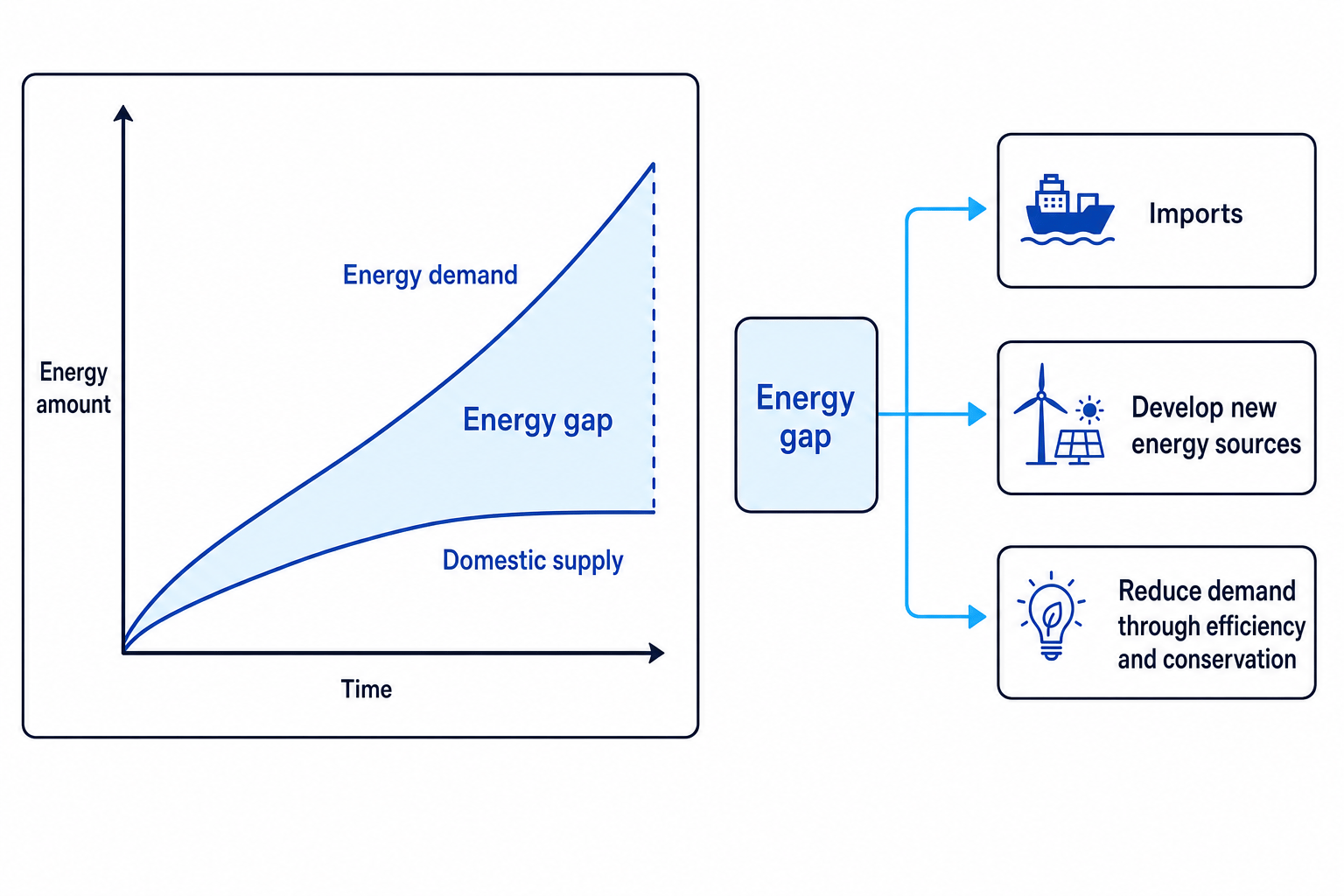
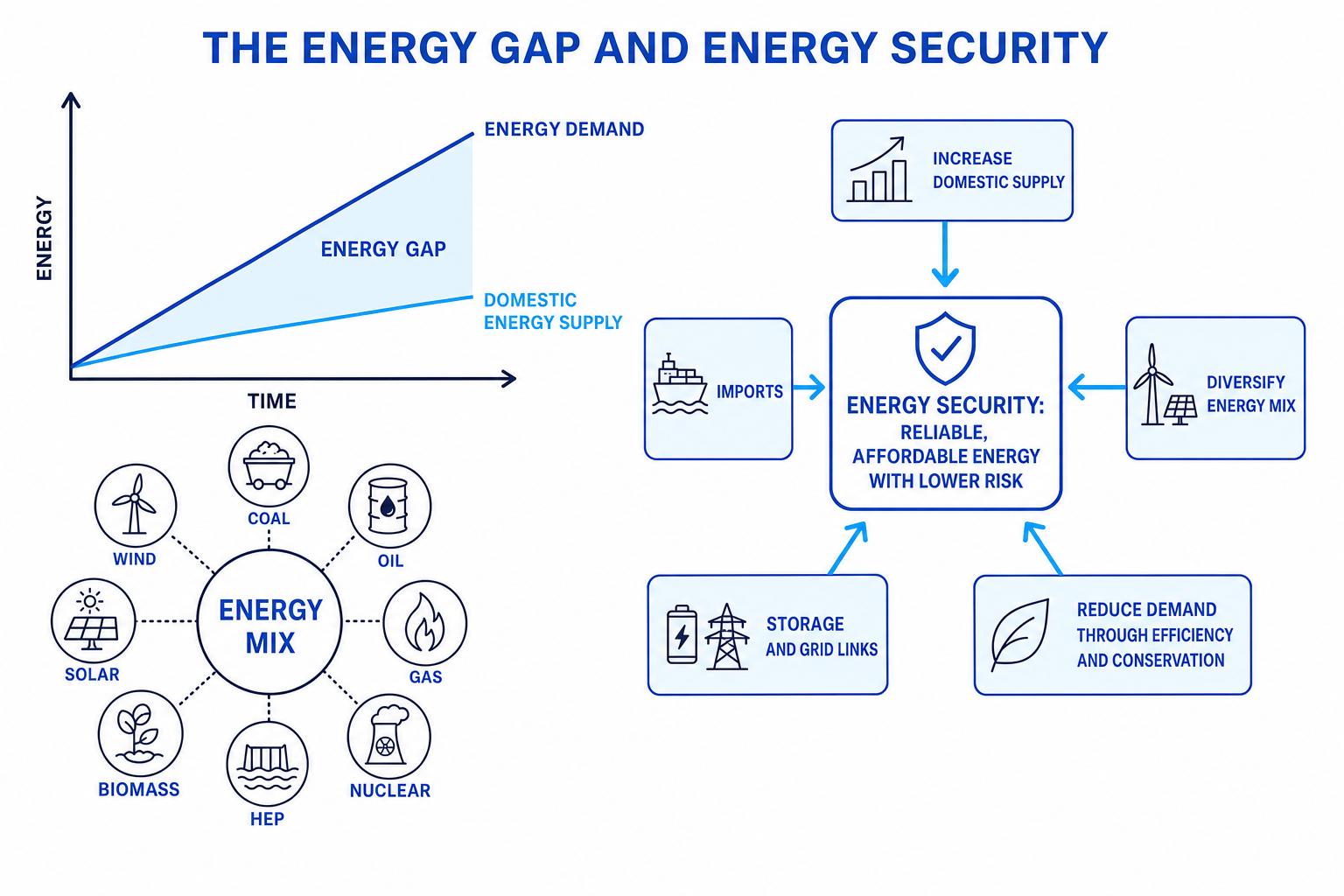
- An energy gap happens when demand is greater than the country’s reliable domestic supply.
- Energy security means having a reliable, affordable and sufficient energy supply, with low risk of disruption.
- An energy mix is the proportion of energy from different sources, such as gas, oil, nuclear, wind and solar.
A country can have high energy demand but low production, so it must import energy. Another country may produce lots of oil or gas but have a smaller population, so it can export energy.
The diagram shows how a growing gap between demand and domestic supply can create pressure for imports, new energy sources and lower demand.
Energy is not just electricity
Electricity is only one form of energy. Energy demand also includes heating, cooking, transport fuels, industrial processes and agriculture.
Why energy demand varies globally
1. Population growth
A larger population usually needs more total energy because there are more homes, schools, hospitals, vehicles and workplaces. Rapidly growing countries such as India, Nigeria and Indonesia face rising energy demand as more people need access to electricity and transport.
2. Increased wealth
As incomes rise, people tend to use more energy. They may buy fridges, air conditioning, cars and electronic devices. Businesses also expand, using more power for factories, offices and transport.
High-income countries such as the USA, Canada and Australia have very high energy use per person. Emerging economies such as China and India have seen fast growth in total demand as manufacturing and urban living have expanded.
3. Technological advances
Technology can increase energy demand, for example through data centres, electric vehicles and air conditioning. However, it can also reduce demand if appliances, buildings and vehicles become more efficient.
Calculating percentage change in energy demand
World primary energy use has risen strongly since 2000. Exact figures vary by data source, but imagine a simplified dataset where global use rises from about 400 exajoules to 620 exajoules.
-
Use the percentage change formula:
percentage change=new value−old valueold value×100\text{percentage change}=\frac{\text{new value}-\text{old value}}{\text{old value}}\times 100percentage change=old valuenew value−old value×100 -
Substitute the values:
620−400400×100\frac{620-400}{400}\times 100400620−400×100 -
Calculate the change:
220400×100=55%\frac{220}{400}\times 100=55\%400220×100=55% -
Interpret the result geographically: global energy demand has risen by about half, mainly because population, incomes and industrial activity have increased.
Why energy production varies globally
Energy production depends on physical geography, geology, money, technology and government decisions.
- Coal, oil and gas are found where ancient organic material was buried and compressed over millions of years.
- Uranium is mined in countries such as Kazakhstan, Canada and Australia and used in nuclear power.
- HEP, or hydroelectric power, works best in mountainous or wet areas with reliable river flow, such as Norway or parts of Brazil.
- Geothermal energy is strongest near tectonic activity, such as Iceland, Kenya and New Zealand.
- Solar power is most effective in sunny regions, while wind power works best in exposed coastal or upland areas.
The global pattern
Energy demand is highest where population, wealth and industry are large. Energy production is highest where countries have suitable resources, investment and technology.
Non-renewable and renewable energy sources
Renewable and non-renewable energy
Non-renewable energy comes from sources that will run out on human timescales, such as coal, oil, natural gas, uranium and shale gas or oil. Renewable energy is naturally replenished, such as solar, wind, HEP, geothermal and biomass.
Comparing the main energy sources
| Energy source | Advantages for people and economies | Disadvantages for people and the environment |
|---|---|---|
| Coal | Reliable, high output, often cheap where reserves exist | High carbon dioxide emissions, air pollution, mining damage |
| Oil | Energy-dense, useful for transport and industry | Oil spills, greenhouse gases, price shocks and import dependence |
| Natural gas | Flexible for electricity generation, lower emissions than coal | Still a fossil fuel, methane leaks, reliance on pipelines or LNG imports |
| Uranium / nuclear | Very high output, low operational carbon emissions | Expensive, radioactive waste, decommissioning and safety concerns |
| Shale gas / oil | Can increase domestic supply and jobs | Fracking may cause water pollution concerns, methane leakage and small earth tremors |
| Solar | Low running emissions, useful from rooftops to solar farms | Intermittent, needs land or roof space, weaker in cloudy winters |
| Wind | Low emissions, increasingly cheap in windy places | Intermittent, visual/noise concerns, grid connections needed |
| HEP | Reliable where rivers are suitable, can store water | Dams can displace people, trap sediment and damage ecosystems |
| Geothermal | Reliable baseload power in suitable areas | Location-specific and expensive to drill |
| Biomass | Can use waste and is storable | Can cause air pollution and land-use conflict; not sustainable if forests are cleared |
Renewable does not mean impact-free
Renewables usually have lower greenhouse gas emissions than fossil fuels, but they can still affect landscapes, wildlife, rivers, land use and local communities.
Why countries want a balanced energy mix
A balanced energy mix avoids relying too heavily on one source. This matters because each source has risks.
For example, gas power stations are reliable but depend on fuel prices and imports. Wind power has low emissions but varies with weather. Nuclear power provides steady output but is expensive and takes years to build.
A balanced mix can improve energy security by:
- reducing dependence on one fuel or one exporting country
- combining reliable baseload power with renewables
- lowering carbon emissions
- spreading economic and environmental risks
- allowing storage, interconnectors and smart grids to smooth supply
Choosing a balanced energy mix
A wealthy coastal country has high electricity demand, strong offshore winds, limited coal reserves and a target to reduce carbon emissions.
-
Use the physical resource: offshore wind is a strong choice because the country has windy seas and enough money for large wind farms.
-
Add reliability: nuclear or gas can provide electricity when wind output is low, although gas creates emissions and may require imports.
-
Reduce risk: solar, battery storage and interconnectors to neighbouring countries help diversify supply further.
-
Make a judgement: the best mix is not one perfect source, but a combination that balances cost, reliability and environmental impact.
Sustainable energy use
Sustainable energy use
Sustainable energy use means meeting current energy needs while reducing environmental damage and protecting the ability of future generations to meet their needs.
Energy can be managed sustainably in three main ways: education, efficiency and conservation.
Education
Education changes behaviour. People may learn to switch off unused appliances, reduce unnecessary car journeys, use public transport, or understand energy labels when buying appliances.
Efficiency
Energy efficiency means getting the same output while using less energy. Examples include LED lighting, better home insulation, efficient motors in factories and electric trains.
Conservation
Energy conservation means reducing unnecessary energy use. This could mean turning heating down, car-sharing, cycling short journeys or designing compact cities where people travel shorter distances.
Estimating savings from home efficiency
A home uses 12,000 kWh of gas per year for heating. Better insulation reduces heating demand by 20%.
-
Calculate the saving:
saving=0.20×12000=2400 kWh\text{saving}=0.20 \times 12000=2400\text{ kWh}saving=0.20×12000=2400 kWh -
Subtract the saving from the original demand:
new demand=12000−2400=9600 kWh\text{new demand}=12000-2400=9600\text{ kWh}new demand=12000−2400=9600 kWh -
Scale up the idea: if many homes make similar savings, national energy demand falls and the energy gap becomes easier to manage.
Use the three settings
When writing about sustainable energy use, try to mention industry, transport and homes. This shows you understand management at different scales.
🌐 Case study: energy resource management in a developed country — United Kingdom
The UK is a high-income developed country with about 67 million people. It has a long history of coal mining and North Sea oil and gas, but many fossil fuel reserves have declined. The UK also has a legal target to reach net zero greenhouse gas emissions by 2050.
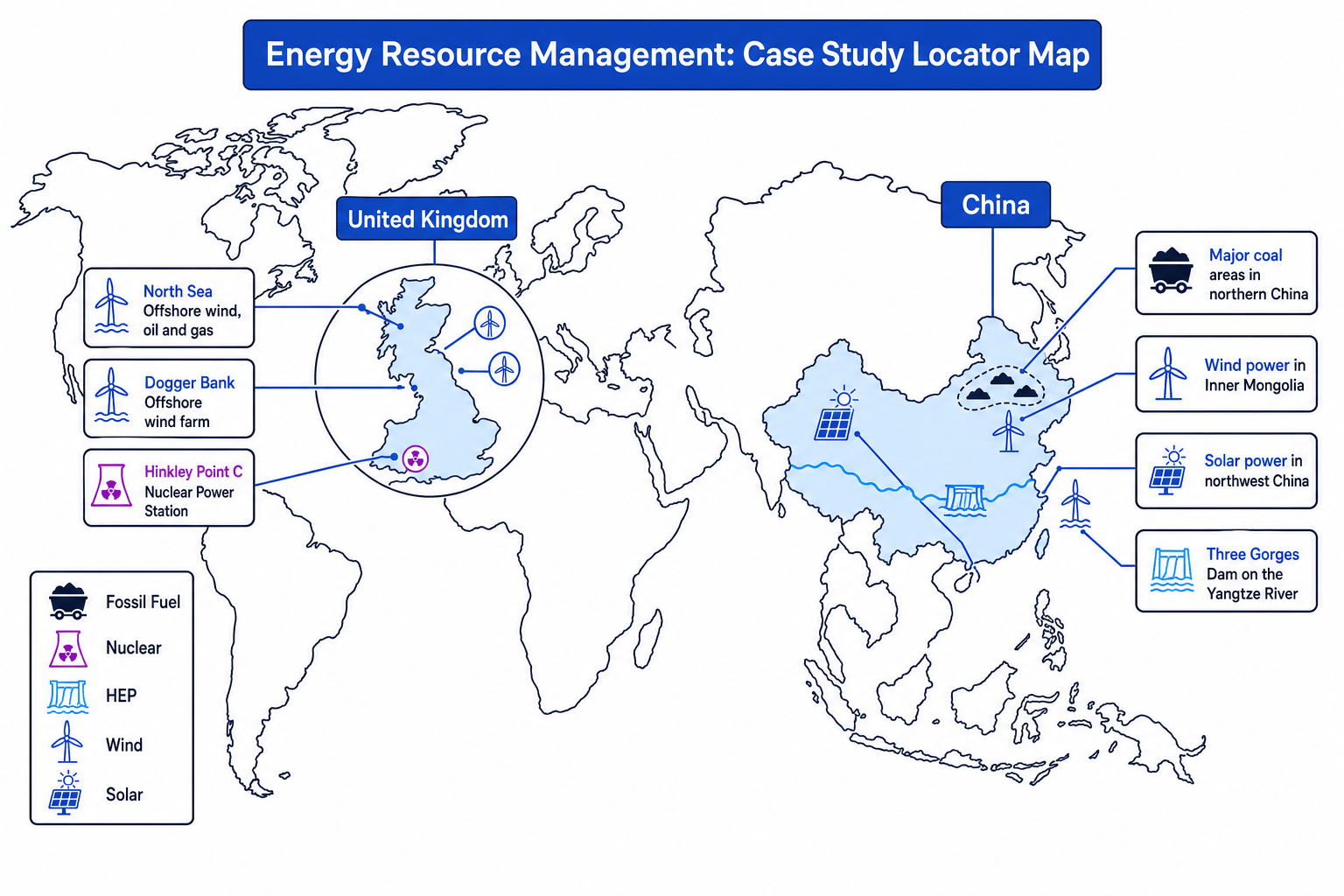
The locator map shows the UK and China case studies, including key energy resources and named examples.
UK energy mix and security
The UK has moved away from coal very quickly. Coal produced around 40% of UK electricity in 2012 but was phased out of electricity generation by 2024. Gas remains important for electricity and home heating, but this can create import dependence.
Renewables, especially offshore wind, have grown rapidly. The North Sea has major offshore wind farms such as Dogger Bank and Hornsea. Nuclear power, including Hinkley Point C in Somerset, is intended to provide reliable low-carbon electricity, although it is expensive and slow to build.
UK sustainable management
The UK manages energy by:
- improving home insulation and boiler efficiency
- using smart meters to help households monitor energy use
- expanding offshore wind and grid connections
- encouraging electric vehicles and public transport
- reducing industrial energy waste through efficient machinery and processes
The UK’s challenge is to keep energy affordable while replacing fossil fuels and managing periods when wind and solar output are low.
🌐 Case study: energy resource management in an emerging country — China
China is an emerging economy with about 1.4 billion people. It has experienced rapid industrialisation, urbanisation and rising wealth, so its energy demand has grown extremely quickly. China is now the world’s largest energy consumer and a major carbon dioxide emitter.
China’s energy mix and security
Coal is still central to China’s energy system because China has large domestic coal reserves and coal provides reliable power for industry. This improves energy security but causes air pollution and high greenhouse gas emissions.
China has also invested massively in renewables. It has the Three Gorges Dam on the Yangtze River, very large solar farms in the north-west, wind power in Inner Mongolia and offshore wind along the east coast. It is also expanding nuclear power and importing oil and gas through pipelines and shipping routes.
China’s sustainable management
China manages energy by:
- investing in solar, wind, HEP and nuclear power
- building ultra-high-voltage transmission lines to move electricity from resource-rich west and north China to coastal cities
- expanding high-speed rail and electric vehicles
- setting energy-efficiency targets for industry
- aiming for carbon neutrality by 2060
China’s challenge is balancing economic growth, energy security and environmental protection. Coal keeps factories powered, but it also creates major air pollution and climate impacts.
Comparing the two case studies
The UK and China both want energy security, but their starting points are different.
- The UK’s main issue is replacing declining fossil fuels and reducing imports while keeping bills affordable.
- China’s main issue is meeting huge and still-growing demand while reducing coal dependence.
- Both countries use a more balanced mix, but China’s scale is much larger and its coal reliance is greater.
- Both use sustainable strategies, but these must fit national context: UK homes and offshore wind matter greatly, while Chinese industry, coal regions and long-distance transmission are crucial.
In the exam
- Define key terms clearly: energy gap, energy security, energy mix and sustainable energy use.
- Use named places and national context, especially for the UK and China case studies.
- Evaluate trade-offs: cost, reliability, environmental impact and social effects all matter.
- When using data, calculate percentage change carefully and then explain what it means geographically.
Check yourself
- Why might a country with rising wealth experience faster growth in energy demand?
- What are two advantages and two disadvantages of relying heavily on natural gas?
- How do the UK and China manage energy differently because of their different national contexts?