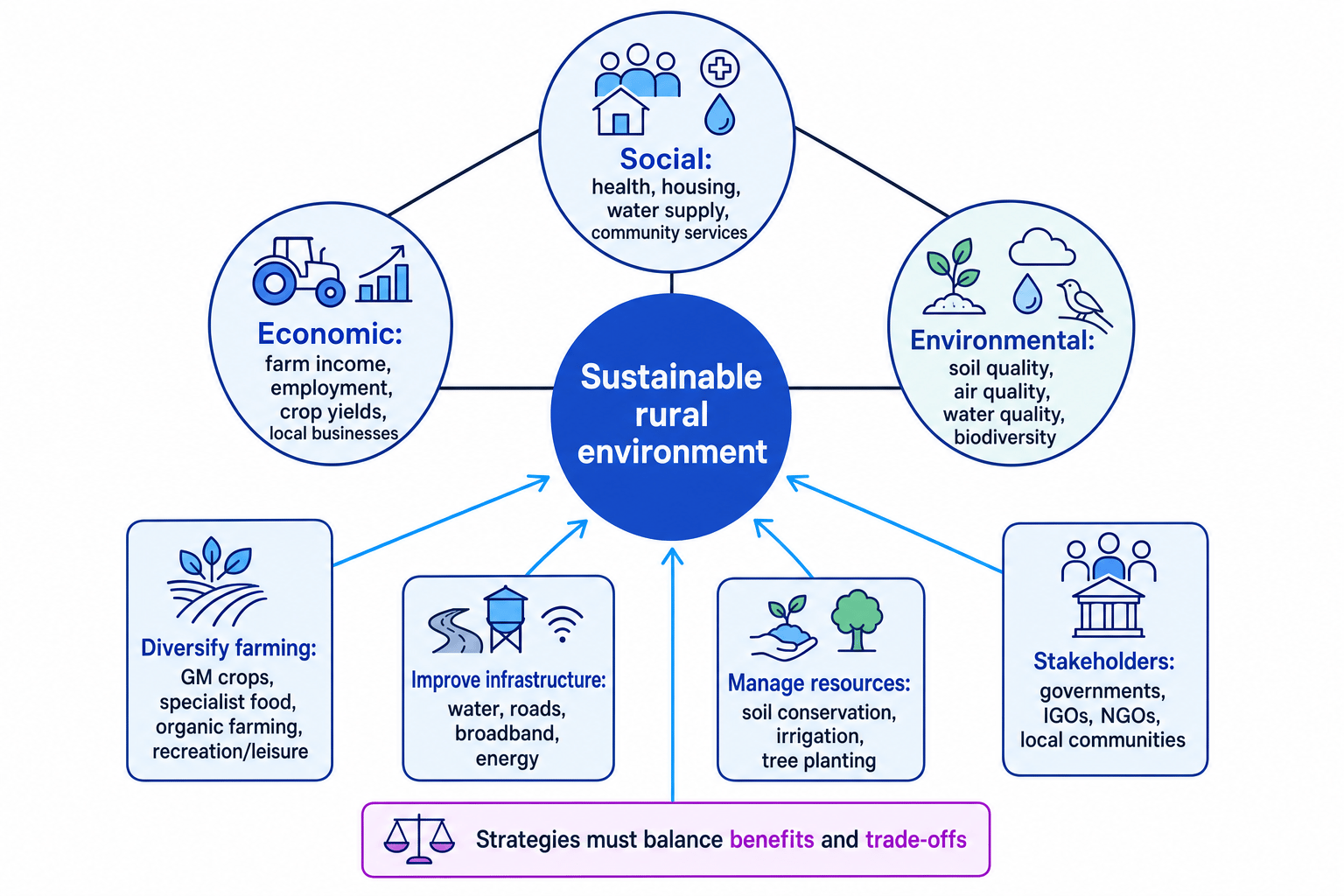
What you'll learn
- Why rural environments need to adapt, not just “stay traditional”.
- How farming can diversify through GM crops, specialist food, organic farming, recreation and leisure.
- How strategies can improve soil, air, water, crop yields, health, employment and housing.
- How different stakeholders manage rural challenges in a developed and a developing/emerging country.
1. The big idea: sustainable rural environments
A rural environment is a countryside area with small settlements, low population density and land uses such as farming, forestry, conservation, tourism and water supply.
Sustainable rural development
Sustainable rural development means improving rural people’s lives and incomes now, while protecting the environment and resources so future generations can also meet their needs.
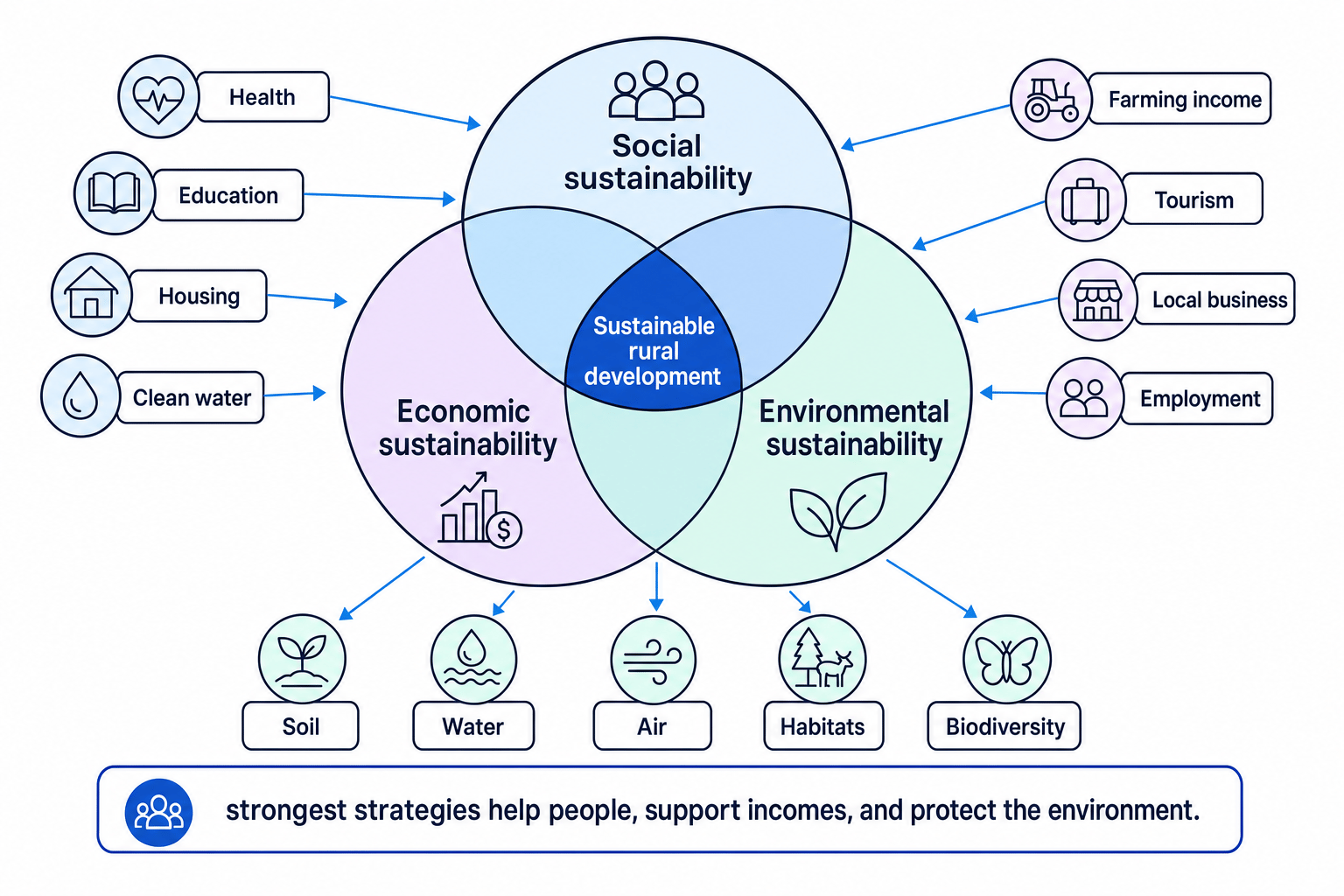
Rural sustainability has three linked parts:
- Social sustainability: people have a good quality of life, including health, education, housing, clean water and community services.
- Economic sustainability: people can earn reliable incomes through farming, tourism, local businesses or other work.
- Environmental sustainability: soil, water, air, habitats and biodiversity are protected rather than used up or damaged.
The three-way balance
A rural strategy is strongest when it helps people, supports incomes and protects the environment. If it only does one of these, it may not be sustainable long term.
Why adaptation is needed
Rural places face pressure from changing markets, climate change, ageing populations, unreliable water supplies, land degradation and competition from tourism or urban growth.
For example, an upland sheep farm in the UK may struggle with low farm-gate prices and high costs. A semi-arid farming village in Kenya may struggle with drought, soil erosion and limited access to markets. Both need adaptation, but the best strategies will differ.
2. Farming diversification: earning money in more than one way
Diversification
Diversification means adding new activities or products so a farm or rural household has more than one income stream.
An income stream is a source of money coming into a household, farm or business. Diversification reduces risk because the family is not relying on one crop, one animal type or one market price.
Main types of farming diversification
| Diversification type | What it means | Possible benefits | Possible trade-offs |
|---|---|---|---|
| GM crops | Crops whose genes have been changed to give useful traits, such as pest resistance or drought tolerance. | Higher yields, fewer crop losses, sometimes less pesticide use. | Seeds may be expensive; there may be concerns about biodiversity, seed ownership and public acceptance. |
| Specialist crops and food | High-value or niche products such as local cheese, rare-breed meat, lavender, soft fruit, honey or branded regional food. | Higher prices and a stronger local identity. | Markets can be small and demand may change. |
| Organic farming | Farming that avoids synthetic fertilisers, synthetic pesticides and GM crops, usually with certification. | Can improve soil health, biodiversity and consumer trust. | Yields may be lower and labour costs may be higher. |
| Recreation and leisure | Using the farm for tourism or leisure, such as campsites, glamping, farm shops, cafés, fishing, walking trails or holiday cottages. | Creates jobs and brings money into the area. | Can increase traffic, waste, noise and pressure on housing. |
Confusing diversification with intensification
Diversification adds different income sources. Intensification tries to produce more from the same land, often using more machinery, fertiliser, irrigation or high-yield seeds.
GM crops are not automatically sustainable
GM crops can improve yields or reduce losses, but exam answers should still discuss cost, access for poorer farmers, environmental risks and whether local people accept the technology.
Calculating the share of diversified income
A Lake District farm earns £45,000 from sheep, £15,000 from a campsite and £10,000 from a farm shop.
- Find the total income by adding the three income streams: 45,000+15,000+10,000=70,00045{,}000 + 15{,}000 + 10{,}000 = 70{,}00045,000+15,000+10,000=70,000.
- Identify the diversified income. The campsite and farm shop are new non-traditional income streams: 15,000+10,000=25,00015{,}000 + 10{,}000 = 25{,}00015,000+10,000=25,000.
- Calculate the percentage of income from diversification:
So about 36% of the farm’s income now comes from diversified activities.
3. Strategies to improve rural living and quality of life
Quality of life
Quality of life means people’s overall wellbeing, including income, health, housing, safety, education, community life and access to services.
When you evaluate a rural strategy, link it clearly to a problem and to one or more sustainability dimensions.
| Rural issue | Possible strategies | How this improves sustainability |
|---|---|---|
| Soil quality | Crop rotation, compost, cover crops, terracing, contour ploughing, controlled grazing. | Reduces erosion, maintains fertility and supports long-term yields. |
| Air quality | Efficient stoves, less crop burning, tree planting, renewable energy, lower-emission farm machinery. | Reduces smoke and pollution, improving health and lowering emissions. |
| Water supplies | Rainwater harvesting, boreholes, drip irrigation, sand dams, water committees, pollution controls. | Provides cleaner and more reliable water for households, crops and animals. |
| Crop yields | Improved seeds, GM crops where accepted, irrigation, pest management, farmer training. | Raises food supply and income, but may increase costs or chemical use. |
| Health | Clean water, sanitation, clinics, mobile health services, nutrition projects. | Reduces disease and improves life expectancy and productivity. |
| Employment | Farm shops, food processing, tourism, cooperatives, broadband for remote work. | Reduces rural poverty and out-migration, especially for younger people. |
| Housing | Affordable housing schemes, upgrading homes, insulation, secure land tenure. | Helps local families stay in the area and improves safety and comfort. |
Use the triple test
For any strategy, ask: Who benefits socially? How does it make money or save money economically? What happens to the environment?
Judging whether a water strategy is sustainable
A community in semi-arid Makueni County, Kenya, builds a sand dam across a seasonal river to store water underground in the sand.
- Assess the social impact: a more reliable local water supply can reduce time spent collecting water and improve health if water is protected from contamination.
- Assess the economic impact: water can support livestock, small-scale irrigation and kitchen gardens, which can raise food supply and household income.
- Assess the environmental impact: storing water underground reduces evaporation, but the community must manage abstraction so the water source is not overused.
- Make a balanced judgement: the strategy is likely to be sustainable if local people maintain it, water use is shared fairly and it is combined with soil conservation and drought-resistant crops.
4. Who manages rural challenges?
Rural management involves different groups working at different scales.
- National government: makes laws, funds roads, schools, healthcare, agricultural subsidies, water infrastructure and climate adaptation.
- Local government: manages planning, local roads, housing decisions, waste, tourism pressures and local economic development.
- IGOs, or intergovernmental organisations, are organisations made up of governments, such as the UN Food and Agriculture Organization, World Bank or IFAD. They may provide funding, data, training and development programmes.
- NGOs, or non-governmental organisations, are independent charities or non-profit groups such as WaterAid, Practical Action, Excellent Development, the National Trust or local conservation groups.
- Local communities: provide local knowledge, labour, maintenance, monitoring and decision-making. Without community support, rural projects often fail.
Top-down plus bottom-up
The best rural management usually combines top-down support from governments or agencies with bottom-up knowledge from local people.
5. Case study: developed country rural environment — Lake District, UK
The Lake District National Park is in Cumbria, north-west England. The UK is a high-income developed country with strong planning systems, good infrastructure and a service-based economy. The Lake District covers about 2,362 km² and receives many millions of visitors each year, though exact visitor numbers vary by year and source.
Main challenges
- Economic: upland sheep farming can have low profit margins and depends on changing subsidies and market prices.
- Social: villages may have ageing populations, second homes and high house prices, making it harder for young local families to stay.
- Environmental: tourism can cause footpath erosion, traffic congestion, litter, water pollution and pressure on fragile upland habitats.
Adaptation strategies
Farmers and rural businesses diversify through:
- bed and breakfasts, campsites, glamping and holiday cottages
- farm shops, cafés and local food branding, such as Herdwick lamb or local cheese
- guided walks, school visits, bike hire, fishing or outdoor activity tourism
- organic or regenerative farming where markets and conditions suit it
Environmental and social strategies include footpath repair, public transport promotion, visitor management, tree planting, agri-environment schemes, affordable housing policies and careful planning controls through the National Park Authority.
Roles of different groups
- UK national government and Defra fund agricultural and environmental schemes.
- Lake District National Park Authority manages planning, conservation and visitor pressure.
- Local councils deal with housing, roads and local services.
- National Trust and Natural England protect landscapes, habitats and historic sites.
- Farmers, residents and tourists shape whether strategies actually work day to day.
Overall, the Lake District shows that diversification can support rural incomes, but tourism must be managed carefully so it does not damage the landscape that people come to enjoy.
6. Case study: developing/emerging country rural environment — Makueni County, Kenya
Makueni County is in eastern Kenya. Kenya is a lower-middle-income emerging economy in East Africa, where agriculture remains very important for rural livelihoods. Makueni is largely semi-arid, with unreliable rainfall and frequent drought risk; local rainfall totals vary, but many areas receive roughly 500–800 mm per year.
Main challenges
- Water supply: rivers may be seasonal, and drought can reduce household water, livestock survival and crop growth.
- Soil quality: heavy rain after dry periods can wash away exposed topsoil.
- Crop yields: rain-fed farming is vulnerable to rainfall failure.
- Health: unsafe water and long collection times can affect disease risk, education and daily life.
- Employment and housing: limited rural jobs can encourage migration, while poorer households may struggle to improve homes and sanitation.
Adaptation strategies
Common strategies include:
- sand dams, rainwater harvesting and water tanks to store water
- terracing, contour bunds, mulching and tree planting to reduce erosion
- drought-resistant crops such as sorghum, millet and pigeon peas
- small-scale irrigation and kitchen gardens where water is available
- beekeeping, goats, mango production and local processing to diversify income
- improved stoves, sanitation projects and community health work
Roles of different groups
- Kenyan national and county governments support roads, agricultural extension, drought planning, schools, clinics and water projects.
- IGOs such as FAO, World Bank or IFAD may support food security, climate resilience and rural livelihoods.
- NGOs such as Africa Sand Dam Foundation, Excellent Development or WaterAid have supported community water and sanitation projects in parts of Kenya.
- Local communities form water committees, maintain dams, provide labour and decide how water is shared.
Makueni shows that low-cost, community-managed strategies can improve quality of life, but climate change, market access and maintenance funding remain serious challenges.
In the exam
- Name and locate your rural environment, then give its national context: developed, developing or emerging.
- Link each strategy to a specific improvement, such as water supply, crop yields, health, employment, housing, soil quality or air quality.
- Evaluate balance: explain at least one benefit and one trade-off, and mention which stakeholders are involved.
Check yourself
- How is farming diversification different from farming intensification?
- For one named rural case study, can you explain one social, one economic and one environmental strategy?
- Which stakeholder is most important in making a rural water project last, and why?