

What you'll learn
- How urbanisation has changed in different world regions over the last 50 years.
- What suburbanisation and counter-urbanisation mean, and how they differ.
- Why some cities grow into megacities.
- The main problems linked to rapid urbanisation: congestion, transport, employment, crime and environmental issues.
1. The basic idea: people and percentages
An urban area is a built-up settlement such as a town or city, where many people live close together and most jobs are not based on farming. A rural area is the countryside or smaller settlements where land use is more open and often agricultural.
Countries define “urban” slightly differently, so in exams you should use the data you are given rather than assuming one global rule.
Urbanisation
Urbanisation is an increase in the percentage of a country’s population living in urban areas. Urban growth is different: it means an increase in the number of people living in urban areas.
The rate of urbanisation is how quickly the urban percentage rises, often measured in percentage points per year.
Urbanisation is not just city growth
If a city gains people, that is urban growth. It only becomes urbanisation if the share of the total population living in urban areas increases.
2. Contrasting urbanisation trends over the last 50 years
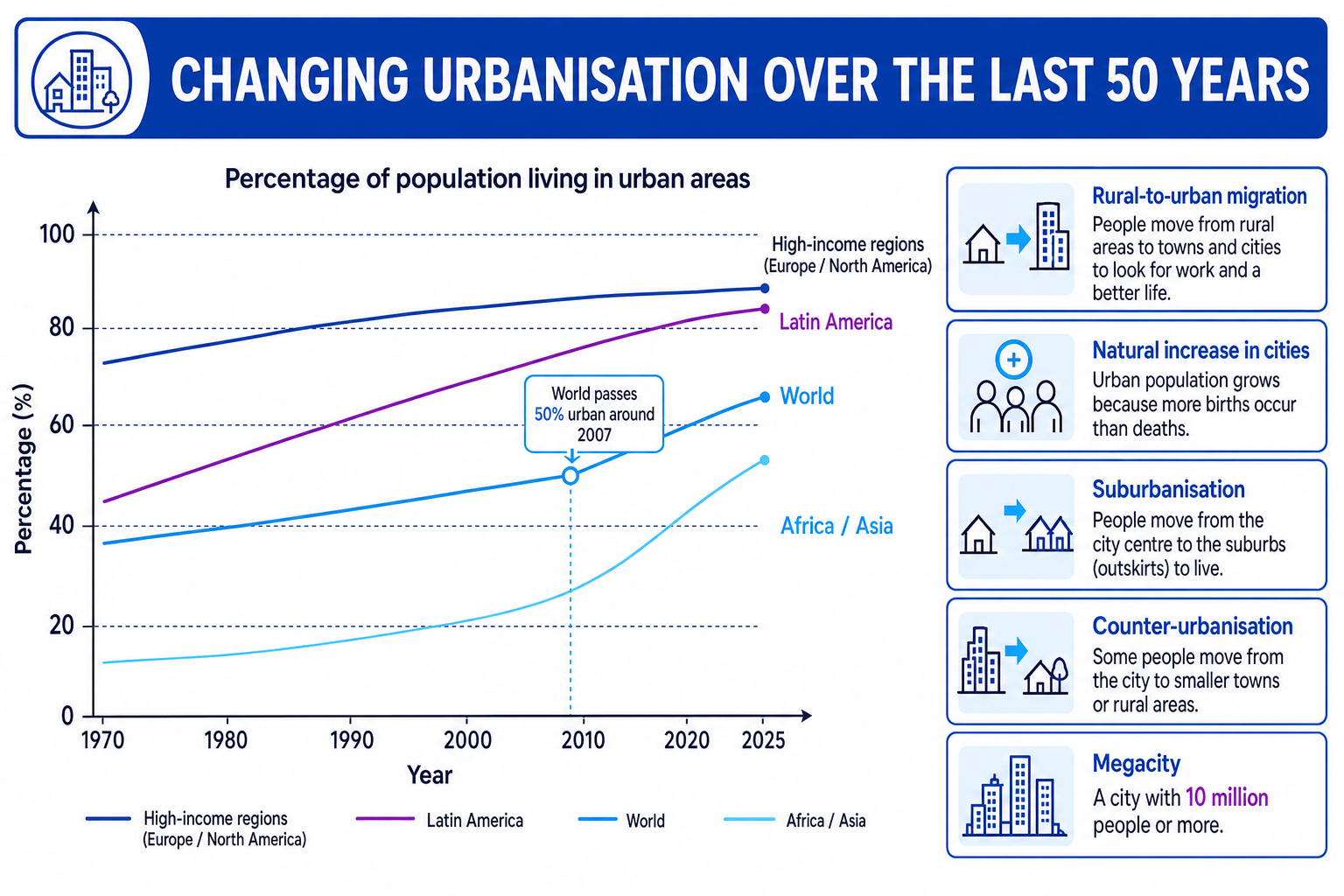
In 1970, roughly 37% of the world’s population lived in urban areas. Today it is around 57%, and the world passed the “more urban than rural” point in about 2007. However, the pattern is not the same everywhere.
The diagram below summarises the main contrast: high-income regions were already very urbanised, while parts of Africa and Asia have experienced faster recent change.
Developed countries: high but slower growth
Many developed countries such as the UK, USA and Japan urbanised earlier, especially during industrialisation. Industrialisation means the economy shifts towards manufacturing and services rather than mainly farming.
These countries already had a high urban percentage by the 1970s, so their urbanisation rate is now usually slower. For example, the UK is already around four-fifths urban, so there is less “room” for the percentage to rise quickly.
Emerging and developing countries: faster recent growth
Many emerging and developing countries have urbanised more rapidly since the 1970s. China’s urban percentage rose from under 20% in 1980 to over 60% today, linked to manufacturing growth, new transport networks and city-based jobs.
In parts of Africa, including Nigeria and Ethiopia, urbanisation has also increased quickly, though many countries still have large rural populations.
The big contrast
Developed countries tend to have high urban percentages but slower change. Many emerging and developing countries have had lower starting points but faster urbanisation over the last 50 years.
Comparing rates of urbanisation
Using rounded data for 1970–2020:
- Calculate the change in urban percentage. For the UK, 84%−78%=684\%-78\%=684%−78%=6 percentage points. For Nigeria, 52%−17%=3552\%-17\%=3552%−17%=35 percentage points.
- Divide by the time period. The UK’s average change is 6÷50=0.126\div50=0.126÷50=0.12 percentage points per year. Nigeria’s is 35÷50=0.7035\div50=0.7035÷50=0.70 percentage points per year.
- Compare the pattern. The UK was already highly urbanised, so change was slow. Nigeria urbanised much faster because rural-to-urban migration and natural increase added rapidly to city populations.
3. Processes that change where people live
Migration means people moving from one place to another. Rural-to-urban migration is movement from the countryside to towns and cities. It is often driven by push factors, which encourage people to leave an area, and pull factors, which attract people to a new area.
Examples of rural push factors include low farm wages, drought, land shortage and lack of services. Urban pull factors include jobs, schools, hospitals, electricity, entertainment and the hope of a better standard of living.
Natural increase also matters. This happens when births are higher than deaths. Many fast-growing cities have young populations, so birth rates can remain high while death rates fall due to better healthcare.
Suburbanisation and counter-urbanisation
Suburbanisation is movement from inner-city areas to the suburbs on the edge of a city. Counter-urbanisation is movement from large urban areas to smaller towns, villages or rural areas.
Suburbanisation is common where people can commute by car, train or bus. In the UK, many people have moved from inner London to outer London boroughs or commuter towns because of housing costs, space and transport links.
Counter-urbanisation is often linked to quality of life, home working, retirement, cheaper housing outside major cities, or escaping congestion. It can bring pressure to rural areas, including higher house prices and more commuting traffic.
Classifying movement processes
A family leaves an inner-city flat in Manchester and moves to a house on the edge of the Manchester built-up area. Another worker leaves London and moves to a village in Devon while working remotely.
- For the Manchester family, the destination is still part of the city’s outer built-up area, so this is suburbanisation.
- For the London worker, the destination is a smaller rural settlement beyond the main city, so this is counter-urbanisation.
- The key difference is the destination: suburbs are usually still urban, while counter-urbanisation involves movement down the settlement hierarchy to smaller places.
4. Why some places urbanise faster
The rate of urbanisation depends on several linked factors:
- Economic change: factories, offices, ports and service jobs cluster in cities.
- Rural conditions: poverty, mechanisation of farming, drought or conflict may push people away from rural areas.
- Urban opportunities: education, healthcare, transport and perceived job opportunities pull people in.
- Natural increase: young migrant populations can increase the number of births in cities.
- Government policy: investment in special economic zones, capital cities, roads, housing or ports can speed up urban growth.
- Starting point: if a country is already 80% urban, it is harder for the percentage to rise quickly than if it starts at 20%.
5. The emergence of megacities
Megacity
A megacity is an urban area with a population of 10 million or more. The figure often refers to an urban agglomeration, meaning the main city plus connected built-up suburbs.
In 1970 there were only a few megacities. Today there are over 30, with many in Asia, Africa and Latin America. Examples include Tokyo, Delhi, Shanghai, São Paulo, Cairo, Lagos and Dhaka. Exact population totals vary because city boundaries are defined differently.
Megacities emerge when migration, natural increase and economic concentration reinforce each other. Agglomeration economies are the advantages businesses gain by clustering together, such as shared workers, suppliers, customers and transport links.
Explaining the growth of Lagos as a megacity
Lagos is in Nigeria, an emerging economy in West Africa with a large, youthful population and major regional inequalities.
- Rural push factors such as limited services and low farm incomes encourage people to leave parts of rural Nigeria.
- Lagos pulls migrants because it is a major port, commercial centre and transport hub, with more formal and informal job opportunities than many rural areas.
- Natural increase adds further growth because many migrants are young adults, so births can remain high.
- As firms, markets and transport links concentrate in Lagos, more people and investment are attracted. This helps explain why Lagos is widely classed as a megacity, though the exact population depends on the boundary used.
6. Problems linked to rapid urbanisation
Rapid urbanisation becomes difficult when population growth is faster than the growth of infrastructure: roads, public transport, water supply, sanitation, electricity, schools, healthcare and waste collection.
Congestion and transport
Congestion means roads or transport systems are overcrowded, causing delays. In rapidly growing cities such as Lagos, Dhaka or Jakarta, roads may fill faster than new public transport can be built. This increases journey times, fuel use, air pollution and stress.
Employment
If the number of workers grows faster than formal jobs, unemployment and underemployment can rise. Informal employment means work that is not officially registered or protected, such as street vending or casual labour. It can provide income, but workers may have low pay and little security.
Crime and social pressure
Rapid growth can stretch policing, housing and youth services. Inequality and lack of opportunities may increase the risk of theft, gang activity or violence in some areas. Be careful: crime is not caused by migrants themselves, but by a mix of poverty, exclusion, weak services and inequality.
Environmental issues
Fast urban growth can increase air pollution from traffic and industry, water pollution from untreated sewage, and waste problems where collection services cannot keep up. Building over green space also increases surface runoff, making flash flooding more likely. Dense built-up areas can become hotter because concrete and tarmac store heat.
Do not blame migrants
Migration is not “the problem” by itself. Problems occur when housing, jobs, services and infrastructure do not keep pace with population growth.
Linking rapid growth to transport and environmental problems
A city grows from 5 million to 10 million people in 20 years, but road capacity and waste collection barely improve.
- The population doubles, so demand for journeys, water, energy and waste disposal rises sharply.
- Because road space and public transport have not doubled, more people compete for the same transport capacity, causing congestion and longer commuting times.
- More idling vehicles increase air pollution, while waste collection shortages lead to dumping or blocked drains, worsening water pollution and flood risk.
In the exam
- When describing a trend, include direction, figures, dates and a comparison between regions or countries.
- Keep “urbanisation” and “urban growth” separate: percentage change versus number change.
- For explain questions, build a chain: cause → process → effect → named example, such as Lagos, London, China or Nigeria.
Check yourself
- Why can a developed country have a large urban population but a slow rate of urbanisation?
- What is the difference between suburbanisation and counter-urbanisation?
- How can rapid urbanisation lead to both employment and environmental problems?
