

What you'll learn
- How to describe a rural environment using physical, social and economic characteristics.
- Why rural areas in a developed country, such as the UK, are changing.
- Why rural areas in a developing or emerging country, such as India, are changing.
- How to build clear cause-and-effect chains for exam answers.
1. What is a rural environment?
A rural environment is an area outside large towns and cities. It usually has lower population density, smaller settlements, more open land, and land uses such as farming, forestry, tourism and conservation.
Rural areas are not all the same. A remote upland sheep-farming valley in Cumbria is very different from an accessible commuter village near London, and both are different from a densely populated farming village in northern India.
Rural environment
A rural environment is a countryside area with relatively low population density, smaller settlements such as villages or hamlets, and land uses often linked to farming, forestry, tourism, conservation or resource extraction.
Physical, social and economic characteristics
Geographers describe rural environments using three broad types of characteristic:
- Physical characteristics: natural features such as relief, climate, soils, rivers, vegetation and landscape.
- Social characteristics: features linked to people and communities, such as population density, age structure, housing and services.
- Economic characteristics: features linked to work, income and business, such as farming, tourism, transport links and employment.
Big picture
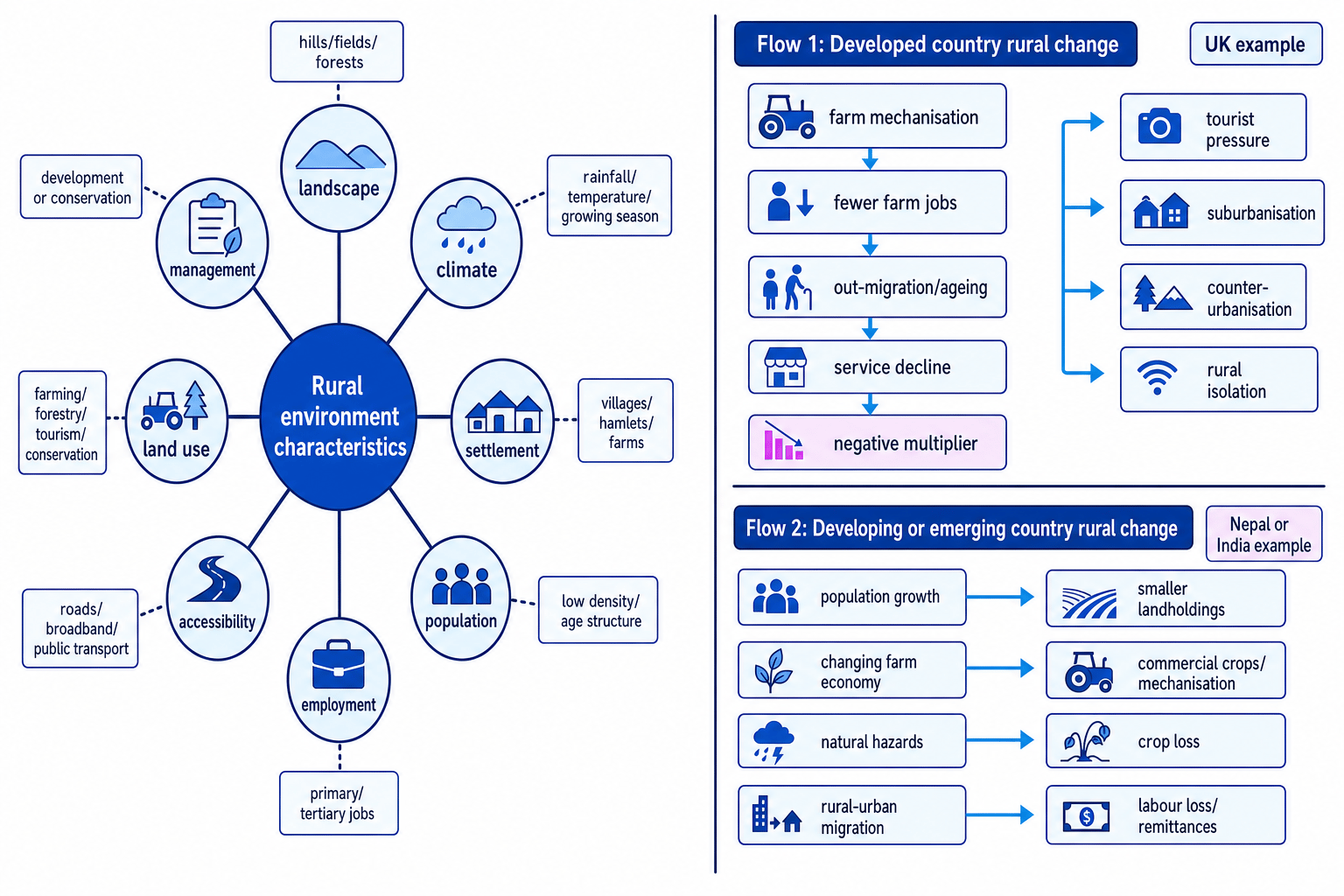
A strong rural answer does not just say “it is countryside”. It describes the place using several characteristics: landscape, climate, settlement, population, land use, employment, accessibility and management.
The diagram below summarises the main characteristics and the key change processes you need for this section.
2. Characteristics of rural environments
Landscape and climate
Landscape means the visible features of an area, including relief, vegetation, fields, woodland, rivers and buildings. Relief means the height and shape of the land.
Rural landscapes can include upland mountains, lowland plains, coastal farmland, forests or dryland grazing areas. Landscape affects what people can do there. Steep slopes may suit sheep farming or tourism, while flat fertile land may support arable farming.
Climate means the average weather conditions of a place, usually measured over around 30 years. Temperature, rainfall and seasonality affect crops, water supply, tourism and hazards.
Settlement and population
A settlement is a place where people live. Rural settlements are often smaller than urban settlements. They may be:
- Dispersed: scattered farms or houses.
- Nucleated: buildings grouped closely in a village.
- Linear: buildings arranged along a road, river or valley.
Population density means the number of people living in an area, usually per square kilometre. Rural areas often have lower population density than cities, but this is not always true. Some rural areas in India or Bangladesh are very densely populated because many people depend on small farms.
Land use, employment and accessibility
Land use means how land is used. In rural areas this may include farming, forestry, reservoirs, mining, tourism, housing, transport routes and conservation.
Employment means paid work. Traditional rural employment is often in the primary sector, which involves extracting or producing raw materials, such as farming, fishing, forestry and mining. Many rural areas now also have more tertiary sector jobs, which are service jobs such as tourism, retail, education and healthcare.
Accessibility means how easy it is to reach a place or service. It depends on distance, road quality, public transport, cost, journey time and digital connections such as broadband.
Accessibility is more than distance
A village 20 km from a town may feel isolated if buses are rare, roads flood in winter, broadband is poor and many residents do not own cars.
Management: development or conservation
Management means the decisions made about how a rural area is used and protected. Management may focus on:
- Development: building housing, roads, tourist facilities, renewable energy or businesses.
- Conservation: protecting landscapes, wildlife, heritage, soils and water.
For example, UK National Parks such as the Lake District aim to conserve attractive landscapes while allowing farming, tourism and local communities to continue.
Reading a rural profile
A place has scattered farms, 45 people per square kilometre, sheep grazing on steep hills, one bus per day, and strict planning controls because it lies inside a National Park.
- Use the population and settlement evidence: 45 people per square kilometre plus scattered farms suggests a rural area rather than an urban one.
- Link landscape to land use: steep hills make large-scale crop farming difficult, so sheep grazing is a sensible rural land use.
- Use accessibility and management together: one bus per day suggests rural isolation, while National Park planning controls show conservation is an important management aim.
3. Rural change in a developed country: the UK
A developed country is a high-income country with advanced infrastructure, high levels of services and a largely tertiary economy. For this named developed-country example, you can use the United Kingdom. The UK has a population of around 67 million and is highly urbanised, but it still contains very varied rural areas, including the Scottish Highlands, rural Wales, East Anglian farmland and National Parks such as the Lake District in Cumbria.
Rural isolation
Rural isolation happens when people or businesses in rural areas have poor access to services, transport, jobs or digital connections. In the UK, remote upland areas and islands may have limited public transport, long travel times to hospitals and schools, and fewer shops.
This can affect older people especially, because they may be less able to drive. It can also affect young people, who may leave to find college, university or work opportunities.
Decline in farm employment
UK farming has changed because of mechanisation, which means using machines to do work previously done by people. Larger tractors, milking machines, GPS-guided equipment and more efficient supply chains mean fewer farm workers are needed.
This can make farming more productive, but it reduces rural employment. Young adults may move away, the population may age, and local services may lose customers.
The negative multiplier effect
The negative multiplier effect is a downward spiral where job losses reduce local spending, causing services and businesses to close, which then causes further job losses and out-migration.
Negative multiplier effect
The negative multiplier effect is a chain reaction in which an initial decline in jobs or income leads to less local spending, service closure, further unemployment and more decline.
Tracing a negative multiplier
A rural area loses farm jobs after farms merge and invest in machinery.
- Start with the direct economic change: fewer workers are needed, so household income in the village falls.
- Link income to local services: with fewer wages being spent locally, the village shop, pub or bus route has fewer customers.
- Extend the chain: if services close, the village becomes less attractive for families and young workers, so more people leave and the local economy weakens further.
Tourist pressures
Tourist pressure means stress caused by large numbers of visitors. In the Lake District, tourism brings income and jobs in accommodation, cafes, outdoor activities and transport. However, it can also cause traffic congestion, footpath erosion, litter, seasonal employment and high house prices where second homes or holiday lets are common.
Tourism is therefore both an opportunity and a pressure. The best answers show both sides.
Suburbanisation and counter-urbanisation
Suburbanisation is the outward growth of towns and cities into surrounding rural areas. It can lead to new housing estates, retail parks and roads on former farmland.
Counter-urbanisation is the movement of people from urban areas to rural areas, often because they want more space, cleaner air or a quieter lifestyle. It has been helped by car ownership, remote working and improved digital technology.
In the UK, commuter villages near cities such as London, Bristol, Manchester and Cambridge have experienced housing growth and rising prices. This can support rural services, but it may also make housing unaffordable for local young people.
Mixing up suburbanisation and counter-urbanisation
Suburbanisation is mainly about the built-up city spreading outwards. Counter-urbanisation is mainly about people moving from urban areas to rural settlements, even if the city itself does not physically expand into that village.
4. Rural change in an emerging country: India
An emerging country is a country experiencing rapid economic growth and industrialisation, but where incomes and services are still uneven. A useful named example is India. India has around 1.4 billion people, and a large share of the population still lives in rural areas, although cities such as Delhi, Mumbai, Bengaluru and Hyderabad are growing quickly.
Rural India is very diverse. Punjab and Haryana have highly commercialised farming, while parts of Bihar, Uttar Pradesh and Assam have dense rural populations and flood-prone river plains. Some dry regions, such as parts of Maharashtra and Rajasthan, face drought risk.
Population growth and pressure on land
Population growth means an increase in the number of people. In rural areas, this can increase demand for food, water, fuelwood, housing and farmland.
A landholding is the area of land farmed or owned by a household. In many rural parts of India, land is divided between children through inheritance. Over generations, this can create smaller and smaller farms. Many farms are small, often below 2 hectares, although exact figures vary by state and census year.
Smaller landholdings can make it harder for families to earn enough from farming. This may lead to debt, seasonal work, migration, or a shift into non-farm jobs.
Calculating landholding change
A 4 hectare family farm is divided equally between four children.
- Calculate the new landholding for each child: 4÷4=14 \div 4 = 14÷4=1 hectare.
- Compare the new holding with the original holding: the change is from 4 hectares to 1 hectare, so the decrease is 3 hectares.
- Calculate the percentage decrease:
This means each new holding is 75% smaller than the original farm.
Changing farm economy
The farm economy means the way farming is organised, paid for and connected to markets. In India, some rural areas have changed from mainly subsistence farming to more commercial farming.
Subsistence farming means growing food mainly for the farmer’s own family. Commercial farming means producing crops or livestock to sell for profit.
Changes may include:
- More irrigation, fertiliser, pesticides and high-yield crop varieties.
- More commercial crops such as cotton, sugar cane, rice or wheat in suitable regions.
- Mechanisation in richer farming areas.
- Greater dependence on market prices, loans and input costs.
These changes can increase production, but benefits are uneven. Wealthier farmers may be able to invest, while poorer farmers may struggle with debt or lack of land.
Natural hazards
A natural hazard is a natural event that threatens people, property or the environment. Rural India is affected by several hazards, including monsoon floods, droughts, landslides in mountain areas and tropical cyclones on some coasts.
In Bihar and Assam, monsoon flooding can damage crops, homes, roads and irrigation systems. In drought-prone areas, crop failure may reduce income and increase debt. Hazards can therefore speed up rural-urban migration.
Rural-urban migration
Rural-urban migration is the movement of people from the countryside to towns and cities. In India, people may be pushed out of rural areas by small landholdings, low farm income, debt or hazard losses. They may be pulled towards cities by jobs, education, healthcare and higher wages.
Migration changes rural areas in mixed ways. Villages may lose young adults and skilled workers, but migrants may send back remittances, which are money transfers to family members. Remittances can pay for school fees, house improvements, farm equipment or healthcare.
Rural change is not simply decline
Rural change can bring problems, such as service loss or land pressure, but it can also bring opportunities, such as tourism income, remittances, improved roads, new technology and conservation schemes.
5. Comparing rural change in developed and emerging countries
In the UK, rural change is often linked to an ageing population, fewer farm jobs, commuting, tourism and pressure on housing. The countryside may become more service-based, with cafes, holiday lets, outdoor activities and remote workers replacing some traditional farm employment.
In India, rural change is often linked to population pressure, small landholdings, uneven farm modernisation, natural hazards and migration to cities. Farming remains more central to livelihoods, so changes to rainfall, land ownership or crop prices can have very direct effects on families.
A strong comparison uses the same categories for both places: population, employment, land use, accessibility and management.
In the exam
- Name and locate your example: for instance, “the UK, a developed country in north-west Europe” or “India, an emerging country in South Asia”.
- Build chains of reasoning: factor → process → effect. For example, mechanisation → fewer farm jobs → out-migration → service closure.
- Balance your answer where possible: tourism, migration and farm change can create benefits as well as pressures.
Check yourself
- Can you describe a rural environment using at least four characteristics?
- How does the negative multiplier effect change a rural area in a developed country?
- Why might population growth and landholding change encourage rural-urban migration in India?

