

What you'll learn
- How the world’s major biomes are distributed and what their main characteristics are.
- What goods and services natural ecosystems provide for people.
- How humans use and modify rural ecosystems through different farming systems.
- How to classify farms as arable/pastoral, commercial/subsistence, and intensive/extensive.
Starting point: what is a rural environment?
A rural environment is an area outside towns and cities, usually with lower population density and more land used for farming, forestry, conservation, tourism, mining or water supply. Rural does not always mean “untouched”: many rural landscapes have been heavily changed by people.
Ecosystem
An ecosystem is a community of living things, such as plants and animals, interacting with each other and with the non-living environment, such as climate, soil, water and rock.
A natural ecosystem is one mainly shaped by natural processes. In reality, very few ecosystems are completely natural because human activity, including pollution, farming, road-building and climate change, now affects even remote areas.
The big idea
Rural environments often begin as natural ecosystems, but people exploit them to obtain resources, make money, produce food and improve quality of life.
Biomes: large-scale ecosystems
Biome
A biome is a very large ecosystem type, usually defined by its climate and dominant vegetation. For example, tropical rainforest, desert and tundra are all biomes.
The distribution of biomes is mainly controlled by temperature and precipitation. These are strongly linked to latitude, which means distance north or south of the Equator.
Areas near the Equator receive more direct sunlight, so they are generally hotter. Areas closer to the poles receive less direct sunlight, so they are colder. Rainfall patterns also vary, creating wet forests in some places and dry deserts in others.
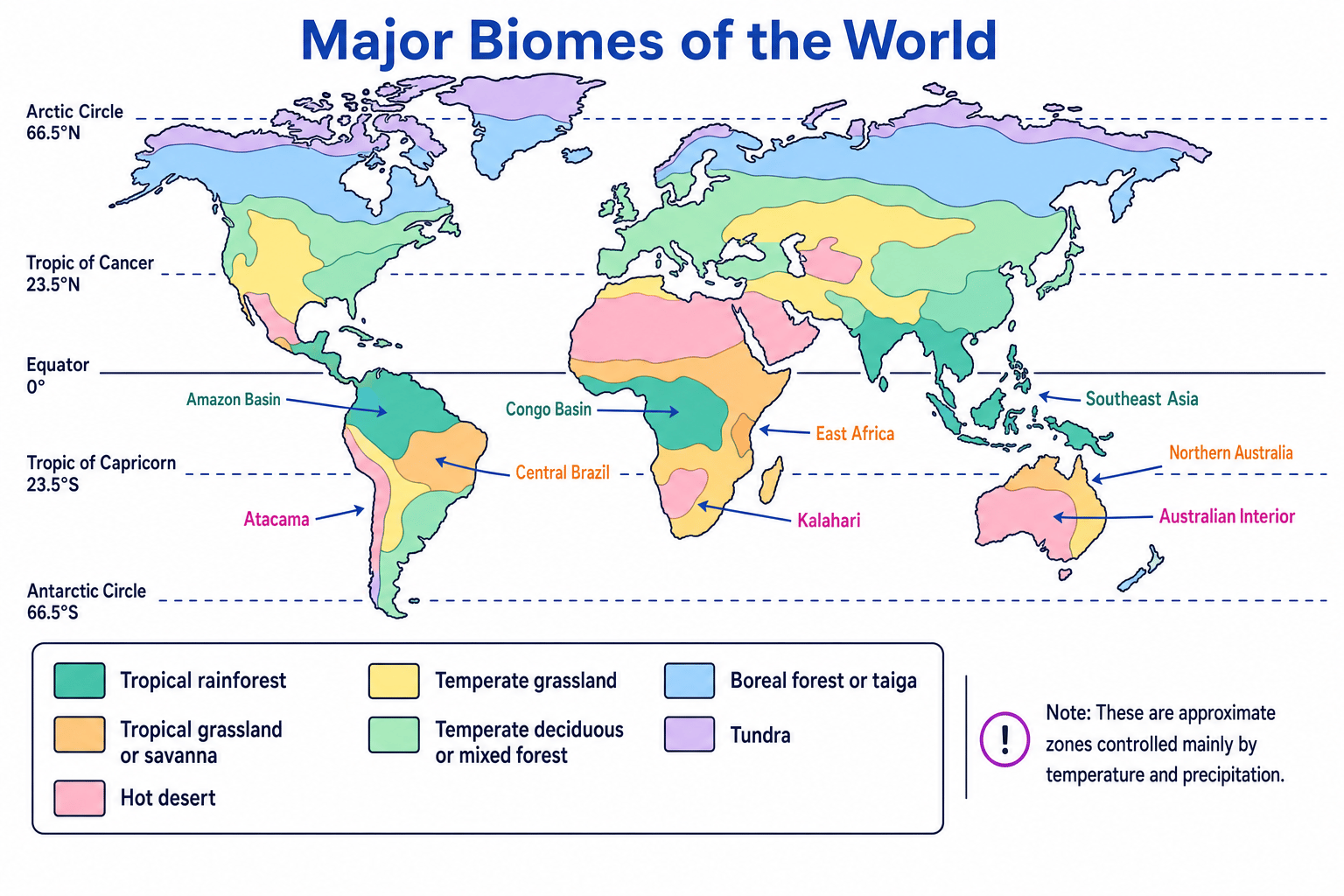
The world’s major biomes
Tropical forests
Tropical forests are found close to the Equator, especially in the Amazon Basin in South America, the Congo Basin in Africa and parts of Southeast Asia, including Indonesia and Malaysia.
They are hot and wet all year. Vegetation is dense, with tall evergreen trees, layered canopies and very high biodiversity. Soils can be surprisingly poor because nutrients are quickly recycled through plants, leaf litter and decomposers.
Temperate forests
Temperate forests are found in mid-latitude areas such as western and central Europe, eastern North America and eastern Asia. They have moderate temperatures and more seasonal change than tropical forests.
Many are deciduous, meaning trees lose their leaves in autumn, although some are mixed with evergreen trees. These forests often have relatively fertile soils and have been widely cleared for farming and settlement.
Boreal forests
Boreal forests, also called taiga, are found in high northern latitudes, especially across Canada, Scandinavia and Russia.
They have long, cold winters and short summers. Trees are mainly coniferous, such as pine, spruce and fir. Biodiversity is lower than in tropical forests, and decomposition is slow because of the cold.
Tropical grasslands
Tropical grasslands, also called savanna, are found between tropical rainforests and deserts, such as in East Africa, central Brazil and northern Australia.
They are warm all year but have a wet season and a dry season. Vegetation is mainly grasses with scattered trees. Many animals are adapted to seasonal water shortages and fire.
Temperate grasslands
Temperate grasslands occur in mid-latitude continental interiors, such as the Prairies in North America, the Pampas in Argentina and the Eurasian Steppe.
They have hot summers, cold winters and moderate rainfall. Trees are limited by low rainfall and fire, but grasses grow well. The soils can be very fertile, so many areas have been converted to commercial grain farming.
Deserts
Deserts are areas with very low rainfall, usually less than 250 mm per year. They include the Sahara, Arabian Desert, Atacama Desert and the Australian interior.
Hot deserts have very high daytime temperatures, but nights can be much cooler. Plants and animals are adapted to water shortage. Some deserts are cold deserts, but for IGCSE the focus is usually on hot arid environments.
Tundra
Tundra is found near the Arctic Circle, including northern Canada, Alaska, Greenland and northern Russia.
It has very low temperatures, a short growing season and often permafrost, which is permanently frozen ground. Vegetation is low-growing, such as mosses, lichens and small shrubs, because trees cannot easily grow.
Using climate clues to identify a biome
A place has average temperatures above 25°C all year, heavy rainfall every month and dense evergreen vegetation.
- Compare the temperature pattern with biome characteristics: temperatures above 25°C all year suggest a tropical location near the Equator.
- Compare the rainfall pattern: heavy rainfall every month rules out desert and savanna, because savanna has a dry season.
- Link the vegetation to climate: dense evergreen vegetation fits a hot, wet environment with year-round plant growth.
- The most likely biome is tropical rainforest.
Mixing up savanna and desert
Do not call all hot rural areas “desert”. Tropical savanna can be hot, but it has enough seasonal rainfall to support grasses, scattered trees and grazing animals.
Goods and services from natural ecosystems
Natural ecosystems are valuable because they provide goods and services for people.
Ecosystem goods and services
Ecosystem goods are physical resources people take from ecosystems, such as timber, food and water. Ecosystem services are benefits ecosystems provide, such as climate regulation, flood protection, tourism and health benefits.
Timber
Forests provide timber for building, furniture, paper and fuel. Boreal forests in Canada and Russia are important for softwood timber. Tropical forests also provide hardwoods, but logging can damage biodiversity if it is not managed sustainably.
Tourism
Ecosystems attract visitors. For example, savanna ecosystems in Kenya and Tanzania support safari tourism, while tropical forests in Costa Rica support ecotourism. Tourism can provide jobs and income, but too many visitors may damage fragile environments.
Food
Natural ecosystems provide food directly, such as fish, wild fruits, nuts, honey and game. They also support farming indirectly through pollination, soil formation and nutrient cycling.
Energy
Ecosystems provide energy resources such as fuelwood and biomass. Forested river catchments can also support hydroelectric power by regulating river flow, although dams themselves may flood habitats.
Water resources
Forests, wetlands and grasslands help store and filter water. Vegetation slows overland flow, allowing more water to infiltrate into the soil. This can improve water quality and reduce flood risk downstream.
Health services
Ecosystems support health by providing medicinal plants, clean air, clean water and spaces for recreation. Many medicines have been developed from natural plant compounds, especially from biodiverse ecosystems such as tropical rainforests.
Natural protection
Some ecosystems protect people from hazards. Mangroves, for example in the Sundarbans of Bangladesh and India, can reduce the impact of storm surges and coastal erosion. Forests on slopes can reduce landslide risk by binding soil with roots.
Climate regulation
Forests, peatlands and soils store carbon. This helps regulate the global climate because carbon stored in vegetation and soil is not in the atmosphere as carbon dioxide. Tropical forests such as the Amazon are important carbon stores, although exact estimates vary by source and method.
Ecosystems have economic value even when left standing
A forest may be worth money as timber, but it may also be worth money through tourism, water supply, carbon storage, flood reduction and health benefits.
How humans exploit rural ecosystems for food
People use rural environments to produce food through farming. Farming changes ecosystems because it often replaces natural vegetation with crops or grazing animals.
Farming system
A farming system is the way inputs, processes and outputs are organised on a farm. Inputs are what go into the farm, processes are the activities that happen, and outputs are what the farm produces.
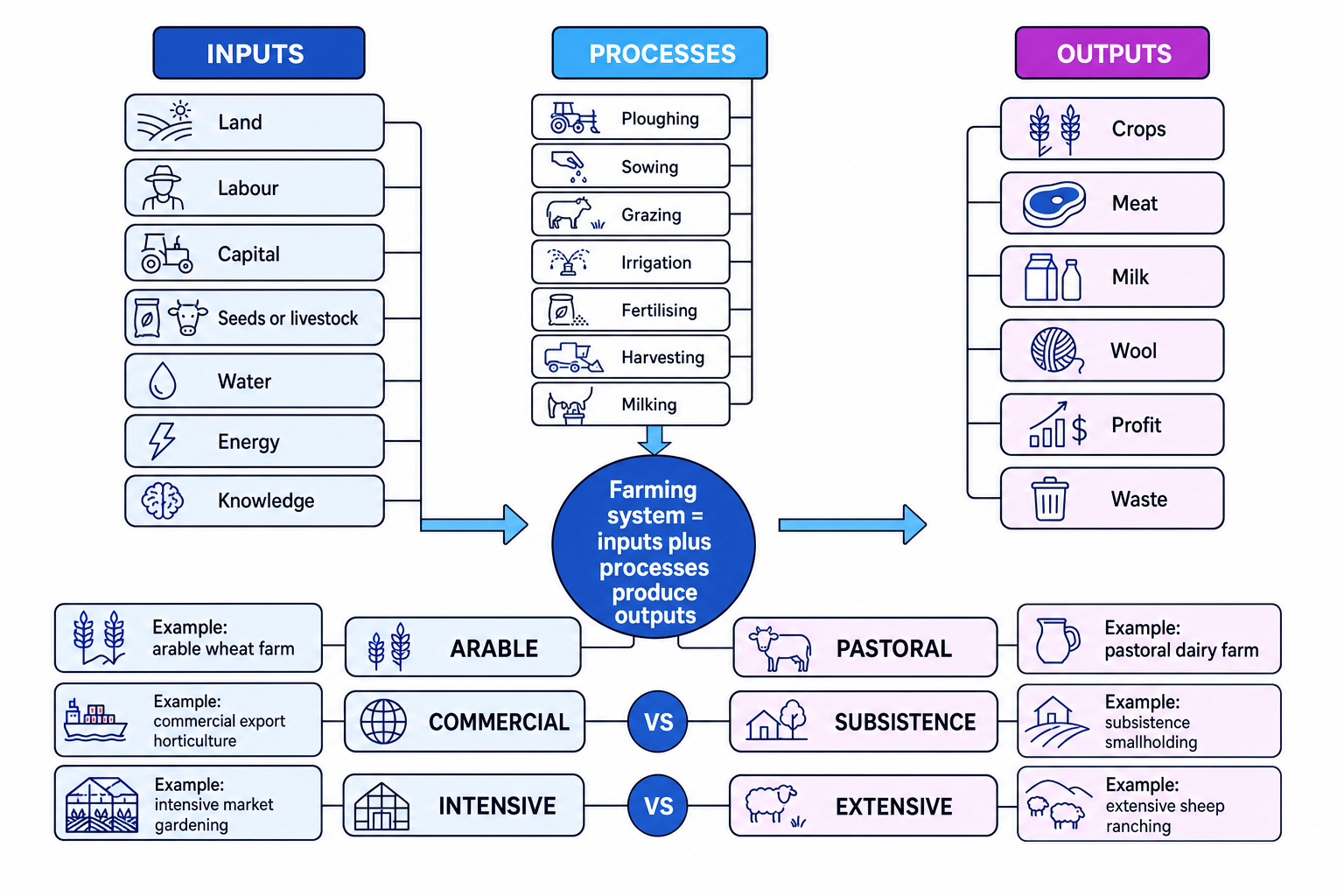
Typical inputs include land, labour, capital, machinery, seeds, livestock, water, fertiliser and knowledge. Typical processes include ploughing, sowing, irrigating, grazing, feeding animals, harvesting and milking. Typical outputs include crops, meat, milk, wool, profit and waste.
Main types of farming system
Arable and pastoral
Arable farming is the growing of crops. Examples include wheat farming in East Anglia in the UK, rice farming in Southeast Asia and maize farming in the USA.
Pastoral farming is the raising of animals. Examples include dairy farming in Devon, cattle ranching in Brazil and sheep farming in upland Wales.
Some farms are mixed farms, meaning they grow crops and keep animals.
Commercial and subsistence
Commercial farming produces food mainly for sale. It often uses machinery, fertilisers, transport networks and markets. Large wheat farms in the Canadian Prairies are commercial.
Subsistence farming produces food mainly for the farmer and their family. Surplus may be sold, but the main aim is survival and local food supply. Smallholder farms in parts of rural sub-Saharan Africa and South Asia may be partly subsistence.
Intensive and extensive
Intensive farming uses high inputs per hectare of land. Inputs may include labour, fertiliser, irrigation, machinery, animal feed or glasshouses. Market gardening and dairy farming can be intensive.
Extensive farming uses lower inputs per hectare and usually covers larger areas. Sheep ranching in dry parts of Australia or cattle ranching in parts of South America can be extensive.
Classifying a farming system
A farmer in East Anglia grows wheat on a large farm using tractors, fertilisers and pesticides. Most of the crop is sold to food companies.
- Decide whether it is crop-based or animal-based: wheat is a crop, so the system is arable.
- Decide the main purpose: most wheat is sold, so it is commercial rather than subsistence.
- Compare inputs with land area: tractors, fertilisers and pesticides show significant capital and chemical inputs, so it is relatively intensive compared with low-input farming.
- A strong classification is: commercial intensive arable farming.
Use pairs carefully
A farm can fit one term from each pair: arable or pastoral, commercial or subsistence, and intensive or extensive. These categories combine, so “commercial pastoral extensive” is possible.
How farming modifies ecosystems
To obtain food, humans often change the natural ecosystem in several ways.
Removing natural vegetation
Forests or grasslands may be cleared to create fields or pasture. For example, parts of the Amazon rainforest have been cleared for cattle ranching and soya farming. This can reduce biodiversity and disrupt nutrient cycling.
Changing water flows
Farmers may drain wetlands, irrigate dry land or build terraces on slopes. Irrigation can increase crop yields, but overuse of water can reduce river flow and lower groundwater levels.
Adding chemicals and nutrients
Fertilisers add nutrients to soil, while pesticides control pests. These can increase production, but runoff may pollute rivers and lakes, causing eutrophication.
Managing animals and crops
Farmers may fence land, control grazing, select high-yield crop varieties, use animal feed and protect crops from weeds. These changes make the ecosystem more productive for humans, but usually less natural.
Forgetting the direction of change
In exam answers, do not just write “farming affects ecosystems”. Say exactly what changes: for example, “forest is cleared, biodiversity falls, soil is exposed, and runoff increases.”
Why this topic matters
This section links physical and human geography. Biomes are shaped by climate, soil and vegetation, but rural environments are also shaped by human decisions about food, profit, energy, tourism and conservation.
A strong answer in this topic usually does two things:
- It uses accurate biome vocabulary, such as tundra, taiga, savanna and temperate grassland.
- It explains the trade-off between exploiting ecosystems for human benefit and protecting them for long-term environmental stability.
In the exam
- When describing biome distribution, refer to latitude, named regions and climate patterns, not just “it is found everywhere”.
- When explaining ecosystem value, include both goods such as timber and food, and services such as water regulation, natural protection and climate regulation.
- When classifying farming, build a combined description: for example, commercial extensive pastoral farming or subsistence intensive arable farming.
Check yourself
- Can you describe where tropical rainforest, desert, boreal forest and tundra are found?
- Can you give three ecosystem services that are not simply physical goods?
- Can you classify a named farm using arable/pastoral, commercial/subsistence and intensive/extensive?
