

Welcome to this section of your physical geography studies! Here, we will investigate why humans continue to interact with some of the most dangerous landscapes on Earth, how vulnerability to disasters differs across the globe, and the profound short-term and long-term consequences of tectonic and meteorological hazards.
What you'll learn
- Why millions of people choose to, or are forced to, live in high-risk hazard zones.
- How physical, social, and economic factors combine to make some countries more vulnerable to natural disasters than others.
- The immediate (short-term) and lasting (long-term) impacts of three distinct hazard types using real-world case studies.
1. Living on the Edge: Why People Live in Hazard Zones
It can seem puzzling why cities thrive in the shadows of active volcanoes, or why millions of people settle along tectonic fault lines and tropical storm pathways. The reasons are a complex mix of natural benefits, economic opportunities, and socio-economic constraints.
Natural and Economic Advantages
In many parts of the world, the hazards themselves create resources that make the area highly attractive:
- Fertile Volcanic Soils: Volcanic ash contains essential minerals like potassium, phosphorus, and calcium. Over time, weathering breaks this ash down into incredibly fertile soil (such as andosols), allowing intensive agriculture. For example, the slopes of Mount Merapi in Indonesia support multiple crop harvests per year, attracting dense farming communities.
- Geothermal Energy: Tectonically active areas allow countries to harness heat from the Earth's crust to generate electricity and heating. In Iceland, over 25% of the country’s electricity is generated through geothermal power, providing cheap, clean energy to residents.
- Mineral Resources: Volcanic activity can concentrate valuable minerals. Sulfur is mined directly from active craters (like Ijen in Indonesia), and precious metals like gold, copper, and silver are frequently found near ancient volcanic structures.
- Tourism: Spectacular volcanic landscapes and dramatic geological features are major tourist magnets. This creates thousands of jobs in hotels, guiding, and recreation.
Socio-Economic Constraints and Human Adaptation
Often, people do not stay by choice, or they accept the risk because of other factors:
- Poverty and Lack of Choice: In developing and emerging countries, many people cannot afford to move or buy land elsewhere. The immediate need for shelter and a livelihood outweighs a low-probability, high-impact future disaster.
- Inertia and Family Ties: Generations of families may have lived in an area. Deep cultural and emotional connections to land mean residents are reluctant to leave.
- Effective Prediction and Protection: In highly developed countries, advanced engineering and reliable warning systems make people feel safe. If you know your building is earthquake-resistant and that you will receive an evacuation warning hours before an eruption, the perceived risk of living in a hazard zone drops significantly.
Hazard Event
A hazard event is the physical occurrence of a natural phenomenon (such as an earthquake, volcanic eruption, or tropical cyclone) that has the potential to cause loss of life, injury, property damage, or environmental degradation.
2. Understanding Vulnerability
Not all countries suffer equally when a natural hazard strikes. The scale of a disaster is determined not just by the physical strength of the hazard, but by the vulnerability of the population experiencing it.
Vulnerability
Vulnerability is the conditions determined by physical, social, economic, and environmental factors which increase the susceptibility of an individual, a community, or a country to the impacts of hazards.
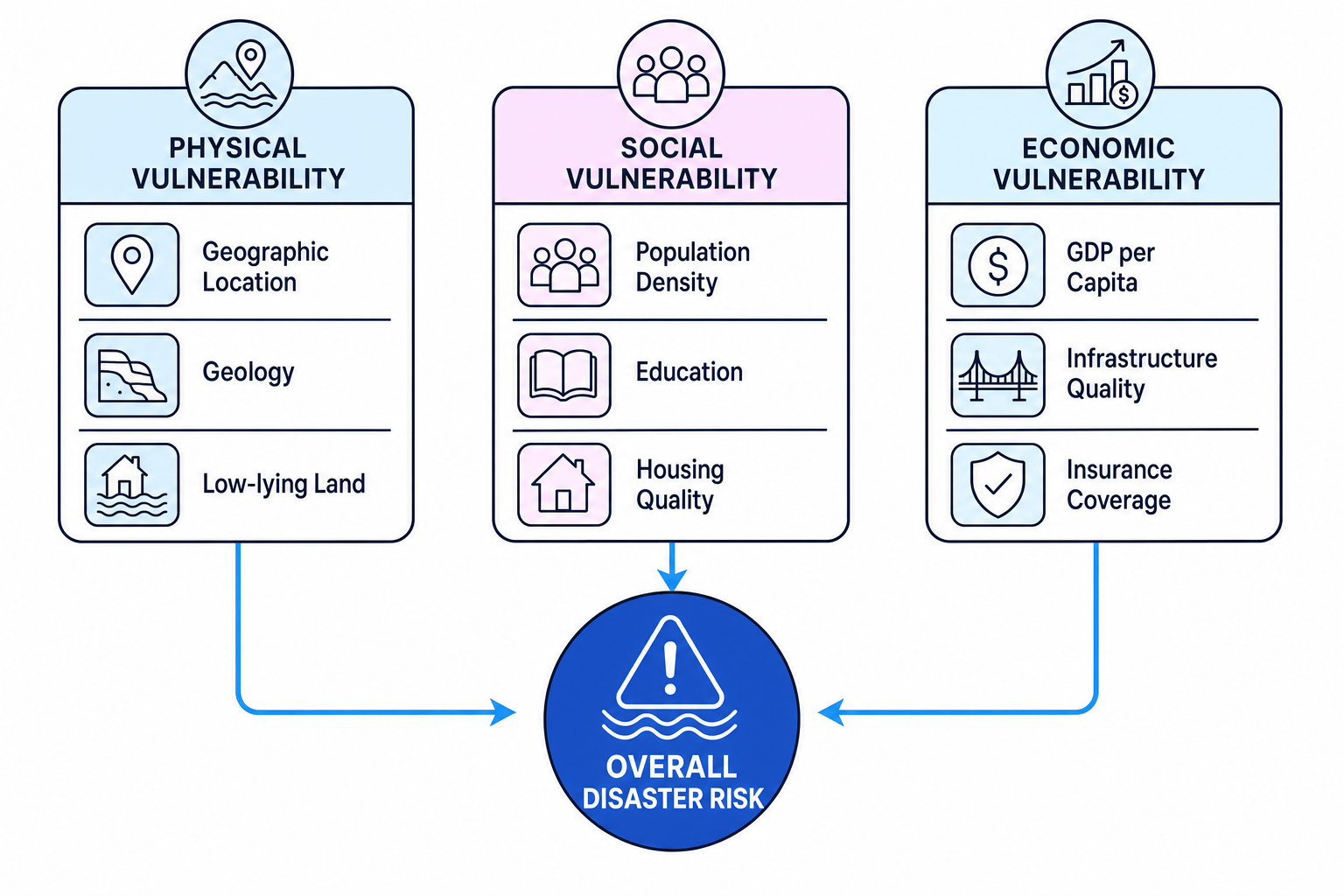
To understand why some places are hit harder than others, we break vulnerability down into three core dimensions:
Physical Vulnerability
This relates to a country’s geography and built environment:
- Location: Low-lying coastal zones (like the delta regions of Bangladesh) are highly exposed to coastal flooding and storm surges. Steep, mountainous slopes are highly prone to landslides triggered by rainfall or seismic shaking.
- Infrastructure Quality: Buildings made of unreinforced masonry or mud-brick collapse easily during earthquakes. High-quality, earthquake-resistant designs (using base isolators and cross-bracing) dramatically reduce casualties.
Social Vulnerability
This focuses on the makeup and well-being of the population:
- Population Density: Areas with highly concentrated populations (such as megacities like Manila or Tokyo) face much higher casualty risks.
- Education and Awareness: Communities that practice regular hazard drills and understand evacuation routes are far less vulnerable.
- Age and Health: Demographics with high proportions of very young, elderly, or sick individuals are less mobile and require more assistance during evacuations.
Economic Vulnerability
This is heavily tied to wealth and development levels:
- GDP per Capita: Wealthier countries can afford to invest in state-of-the-art early warning systems, coastal defenses, and highly trained emergency response teams.
- Insurance Coverage: In developed nations, private insurance helps businesses and individuals rebuild quickly. In developing nations, the uninsured must rely on slow international aid, causing long-term economic stagnation.
The Disaster Equation
A disaster only occurs when a natural hazard meets a vulnerable population. If a massive earthquake occurs in an uninhabited desert, it is a physical event, not a disaster.
Risk=Hazard×VulnerabilityCapacity to Cope \text{Risk} = \frac{\text{Hazard} \times \text{Vulnerability}}{\text{Capacity to Cope}} Risk=Capacity to CopeHazard×VulnerabilityQuantitative Skill: Assessing Economic Vulnerability
To illustrate how economic vulnerability alters the real-world impact of a disaster, let's look at how we calculate and compare the relative cost of reconstruction after an earthquake.
Calculating Relative Economic Impact
Two countries experience devastating earthquakes. We want to calculate the cost of reconstruction as a percentage of each country's annual Gross Domestic Product (GDP) to determine which nation suffered the greater relative economic impact.
- Country A (Developing Nation): Reconstruction cost is estimated at 10billionUSD.ItsannualGDPis10 billion USD. Its annual GDP is 10billionUSD.ItsannualGDPis20 billion USD.
- Country B (Developed Nation): Reconstruction cost is estimated at 235billionUSD.ItsannualGDPis235 billion USD. Its annual GDP is 235billionUSD.ItsannualGDPis5.9 trillion USD ($5,900 billion USD).
- Identify the formula for calculating relative economic impact:
- Calculate the relative impact for Country A (Developing Nation), ensuring both figures use the same units (billions of USD):
- Calculate the relative impact for Country B (Developed Nation), converting 5.9trillionUSDinto5.9 trillion USD into 5.9trillionUSDinto5,900 billion USD:
- Compare the results: While the absolute cost in Country B was over 23 times larger, the relative economic shock to Country A was vastly more severe, consuming half of its entire annual economic output.
Confusing Absolute and Relative Impacts
Do not assume developed countries always suffer more because their financial losses are higher in absolute terms (millions of dollars). Always look at the relative impact (cost as a % of GDP or percentage of the population affected). A loss of 10millioninapoorcountrycanbefarmorecatastrophicthanalossof10 million in a poor country can be far more catastrophic than a loss of 10millioninapoorcountrycanbefarmorecatastrophicthanalossof10 billion in a wealthy country.
3. Shorter-Term vs. Longer-Term Impacts
When investigating case studies of natural hazards, geographers categorize the impacts by time scale. This helps us understand the transition from emergency response to recovery.
- Shorter-Term Impacts: Occur during the event or in the immediate hours and days following it. These typically include deaths, injuries, structural collapse, and the immediate loss of clean water, power, and communications.
- Longer-Term Impacts: Unfold over weeks, months, or even years. These include disease outbreaks from contaminated water, long-term homelessness, loss of tourism revenue, the cost of rebuilding, and psychological trauma.
Let's study the specific impacts of three required hazard events.
Case Study 1: Earthquake Hazard 📍
Tohoku Earthquake and Tsunami, Japan (2011) – Developed Country Context 🌐
On March 11, 2011, a massive magnitude 9.0 under-sea megathrust earthquake struck off the northeast coast of Honshu, Japan. It triggered a devastating tsunami with waves reaching up to 40 meters in height.
       Tectonic Displacement (Magnitude 9.0)
                        │
                        ▼
         Displacement of Ocean Column
                        │
                        ▼
       Propagation of Rapid Tsunami Waves
                        │
                        ▼
    Inundation of Tohoku Coastline & Fukushima
Shorter-Term Impacts
- Loss of Life: Around 15,899 people were killed, mostly due to drowning from the tsunami.
- Infrastructure Destruction: Over 120,000 buildings were completely destroyed. Ports, roads, and rail lines along the Tohoku coast were washed away.
- Fukushima Daiichi Nuclear Disaster: The tsunami disabled the cooling systems of the Fukushima Daiichi nuclear power plant, leading to partial meltdowns in three reactors and the immediate release of radioactive material.
Longer-Term Impacts
- Economic Cost: The World Bank estimated the economic cost to be $235 billion USD, making it the costliest natural disaster in world history.
- Displacement and Exclusion Zones: Nearly 150,000 people were forced to evacuate due to radioactive contamination. A decade later, thousands were still unable to return to their homes within the exclusion zones.
- Energy Policy Shift: Japan shut down all of its nuclear reactors for safety inspections, forcing a temporary reliance on imported fossil fuels, which significantly increased carbon emissions and energy costs.
Case Study 2: Volcano Hazard 📍
Mount Merapi, Indonesia (2010) – Developing/Emerging Country Context 🌐
Mount Merapi is an active stratovolcano located in Central Java, Indonesia. In October and November 2010, it underwent a series of violent eruptions, characterized by explosive pyroclastic flows (superheated clouds of ash, gas, and rock) and volcanic mudflows known as lahars.
Shorter-Term Impacts
- Casualties: Pyroclastic flows killed 353 people and severely burned hundreds of others.
- Displacement: Over 350,000 people were urgently evacuated to temporary crowded shelters.
- Aviation Disruption: Volcanic ash plumes choked the skies, leading to the cancellation of hundreds of flights across Indonesia and Southeast Asia.
Longer-Term Impacts
- Agricultural Ruin: Thick layers of acidic volcanic ash smothered crops, leading to the immediate loss of livelihoods for thousands of vegetable and dairy farmers. However, in the very long term, this ash will weather into highly fertile soil.
- Infrastructure Damage: Subsequent heavy monsoon rains mixed with loose ash to create devastating lahars, which flowed down river valleys, destroying bridges and buried villages long after the eruption ended.
- Permanent Relocation: The Indonesian government established a permanent "red zone" where settlement is banned, forcing the long-term relocation of entire villages to safer ground.
Case Study 3: Tropical Cyclone Hazard 📍
Typhoon Haiyan, Philippines (2013) – Developing/Emerging Country Context 🌐
Typhoon Haiyan (locally named Yolanda) was one of the strongest Category 5 tropical cyclones ever recorded. It made landfall in November 2013, packing sustained winds of over 315 km/h and driving a massive 5-meter storm surge into coastal cities like Tacloban.
Shorter-Term Impacts
- Immediate Deaths: At least 6,300 people were killed, primarily drowned by the rapid storm surge.
- Widespread Flattening: High winds decimated up to 90% of Tacloban city. Over 1.1 million homes were damaged or completely destroyed.
- Loss of Services: Power lines were ripped down, water systems contaminated, and airport runways blocked by debris, preventing aid from reaching survivors for several days.
Longer-Term Impacts
- Livelihood Collapse: Typhoon Haiyan destroyed over 33 million coconut trees (a key export for the Philippines) and devastated fishing fleets, causing long-term economic hardship for millions of rural workers.
- Disease Outbreaks: Overcrowding in makeshift evacuation centers, combined with a lack of clean water, led to outbreaks of waterborne illnesses like cholera.
- The "Build Back Better" Program: The government initiated a massive long-term reconstruction plan to relocate coastal slum dwellers inland and build stronger, storm-resistant housing, though progress has been slow due to corruption and funding shortages.
Do Not Generalise Volcanoes and Cyclones
Volcanic hazards and tropical cyclones behave very differently. Volcanoes are highly localized, whereas tropical cyclones affect thousands of square kilometers of sea and land. When writing about impacts, ensure your vocabulary is specific: use lahars and pyroclastic flows for volcanoes, and storm surges and extreme wind speeds for tropical cyclones.
In the exam
- Contrast Short and Long-Term: If a question asks for both short- and long-term impacts, make sure your answer is explicitly divided. Do not let them blur together. Use terms like "immediate casualties" vs. "years of economic reconstruction."
- Be Specific with Case Study Data: Standard, well-documented figures (such as 6,300 deaths for Typhoon Haiyan or $235 billion USD for Tohoku) show the examiner that you have prepared your located examples thoroughly.
- Connect Development to Impacts: When explaining differences in impacts, connect them to the level of development. Explain why a developing country experiences higher social impacts (e.g., lack of concrete shelters, poor sanitation leading to long-term disease) and why developed nations suffer higher absolute economic costs (e.g., highly valued infrastructure).
Check yourself
- State three reasons why farming communities frequently choose to live near active volcanoes.
- Why is a country with a high debt-to-GDP ratio more economically vulnerable to a natural hazard than a wealthy nation?
- Distinguish between a short-term impact and a long-term impact of the 2011 Tohoku earthquake in Japan.
- Explain how the secondary hazard of a "lahar" differs from the primary hazard of a "pyroclastic flow" in terms of its timing and causes.
