

What you'll learn
- Why the rural-urban fringe is under pressure for new development.
- How to compare greenfield and brownfield sites.
- How cities can improve waste, transport, education, health, employment and housing sustainably.
- How different groups — planners, politicians, developers and industrialists — shape urban management.
Start point: what is being managed?
An urban environment is a built-up town or city area, including its people, buildings, services, transport systems, businesses and open spaces. Cities create opportunities, but they also create pressures.
Infrastructure means the basic systems that allow a place to function, such as roads, railways, water supply, sewers, electricity, schools and hospitals.
Urban challenges are usually grouped into three types:
- Social challenges: problems affecting people’s wellbeing, such as overcrowding, poor housing, crime, health or education inequality.
- Economic challenges: problems linked to jobs, income, investment, business costs and unemployment.
- Environmental challenges: problems linked to pollution, waste, traffic congestion, loss of green space and high resource use.
Sustainable urban management
Sustainable urban management means planning and running a city so that people’s needs are met now, while protecting resources, opportunities and environmental quality for the future.
The balancing act
A strategy is strongest when it improves quality of life, supports the urban economy, and reduces environmental damage — not just one of these.
The rural-urban fringe
The rural-urban fringe is the zone where the edge of a built-up area meets the surrounding countryside. It is often under pressure because land is usually cheaper and more available than in the city centre, while still being close to roads, workers and customers.
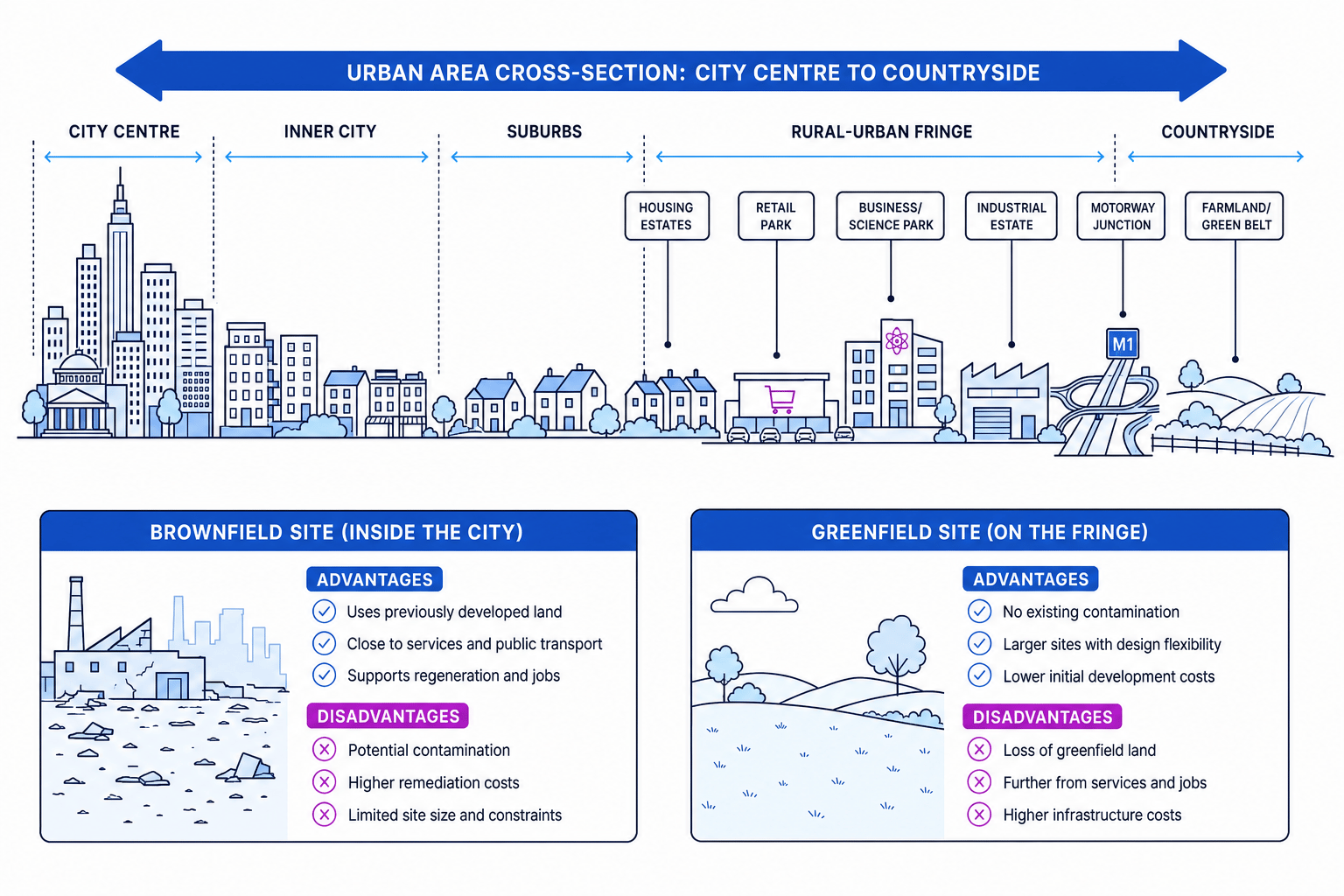
Common developments on the rural-urban fringe
- Housing estates: planned groups of houses, often built to meet rising demand as urban populations grow.
- Retail parks: out-of-town shopping areas with large stores and car parks.
- Business parks: planned areas of offices and commercial services, often near major roads.
- Science parks: business parks linked to research, technology or universities, such as Cambridge Science Park in the UK.
- Industrial estates: planned zones for factories, warehouses, logistics and manufacturing.
- Transport infrastructure: bypasses, motorway junctions and park-and-ride sites.
These developments can bring jobs and services, but they can also increase car use, reduce farmland and fragment habitats.
Greenfield versus brownfield sites
A greenfield site is land that has not previously been built on, such as farmland or countryside. A brownfield site is land that has been built on before and is now available for redevelopment, such as an old factory, dockland or railway yard.
A Green Belt is a protected planning zone around some UK cities where development is restricted to reduce urban sprawl. Urban sprawl means the outward spread of a city into surrounding countryside, often in low-density, car-dependent development.
Greenfield is not the same as Green Belt
A greenfield site is any previously undeveloped land. Green Belt is a legal planning designation. Some greenfield land is not Green Belt, and the two terms should not be used as if they mean the same thing.
The debate
Brownfield redevelopment is often more sustainable because it reuses land, reduces pressure on countryside and may help regenerate inner-city areas. Regeneration means improving an area through new investment, buildings, services and jobs.
However, brownfield sites can be expensive to clean up if the land is contaminated. They may also be small or surrounded by existing buildings, making construction more difficult.
Greenfield sites are often cheaper and easier to build on. They may allow larger housing estates or business parks. But they can cause loss of farmland, damage ecosystems, increase traffic and require new roads, pipes and services.
Choosing a site for new housing
A city needs new homes. Site A is a brownfield site near a railway station. Site B is a greenfield site on the rural-urban fringe near a motorway junction.
-
Compare the social effects: Site A gives residents easier access to public transport, shops and schools, but homes may be expensive if land cleanup costs are high. Site B may provide more space for family housing, but residents may depend on cars if services are far away.
-
Compare the economic effects: Site A may support regeneration and use existing infrastructure, but demolition and decontamination raise costs. Site B may be cheaper to build on, but new roads, water pipes and schools may be needed.
-
Compare the environmental effects: Site A reuses land and reduces pressure on countryside. Site B may remove habitats or farmland and increase carbon emissions through longer car journeys.
-
Make a judgement: Site A is usually more sustainable if cleanup is affordable and affordable housing is included. Site B may only be justified if the city has no realistic brownfield capacity and the development includes strong public transport and green space protection.
Strategies for sustainable urban living
Quality of life means people’s overall wellbeing, including housing, income, safety, health, education, transport access and environmental quality.
Sustainable urban management uses a package of strategies, not one “magic” solution.
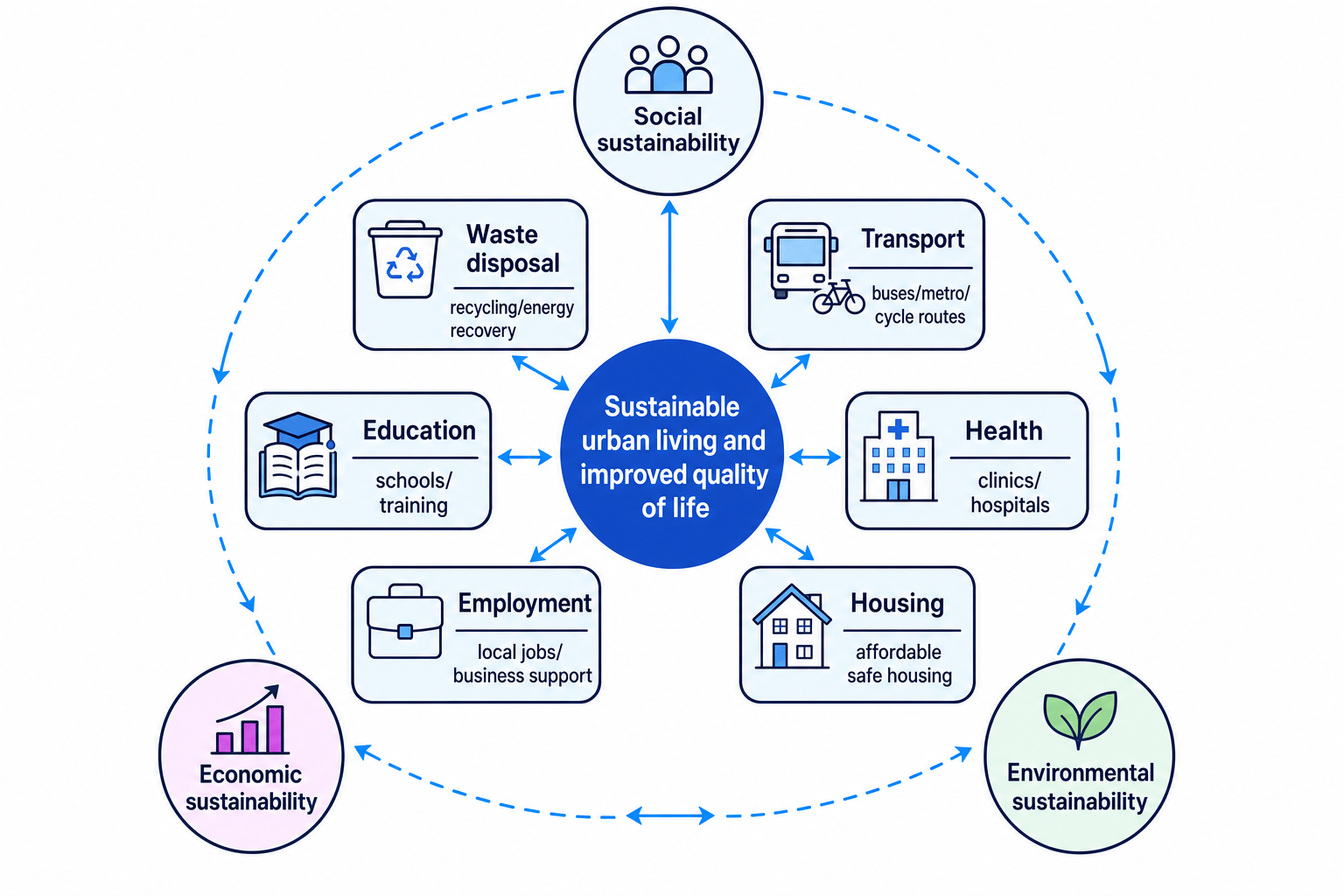
| Challenge area | Sustainable strategies | How this can improve quality of life |
|---|---|---|
| Waste disposal | Reduce waste, recycle, compost, collect waste safely, use energy-from-waste carefully | Cleaner streets, fewer disease risks, less landfill |
| Transport | Public transport, cycle routes, walking routes, low-emission zones, congestion charging | Less congestion, cleaner air, better access to jobs |
| Education | More school places, training centres, adult skills programmes | Better employment chances and social mobility |
| Health | Clinics, hospitals, clean water, sanitation, pollution control | Lower disease risk and longer life expectancy |
| Employment | Regeneration schemes, business parks, support for small firms | More jobs, higher incomes, stronger local economy |
| Housing | Affordable housing, upgrading informal settlements, higher-density housing near transport | Less overcrowding, safer homes, shorter journeys |
Use the sustainability triangle
When evaluating a strategy, ask: What are the social, economic and environmental benefits and costs? This helps you move beyond description into explanation and judgement.
Calculating change in waste sent to landfill
A city reduces waste sent to landfill from 500 000 tonnes to 350 000 tonnes after introducing recycling and energy recovery.
percentage change=new value−old valueold value×100\text{percentage change} = \frac{\text{new value} - \text{old value}}{\text{old value}} \times 100percentage change=old valuenew value−old value×100-
Substitute the values: 350000−500000500000×100=−150000500000×100\frac{350000 - 500000}{500000} \times 100 = \frac{-150000}{500000} \times 100500000350000−500000×100=500000−150000×100.
-
Calculate the result: −0.3×100=−30%-0.3 \times 100 = -30\%−0.3×100=−30%.
-
Interpret the answer: the negative sign shows a decrease, so landfill waste fell by 30%. You would still evaluate whether energy recovery creates air pollution or whether recycling is genuinely increasing.
Case study: London, UK — developed country urban environment
London is the capital of the UK, a developed high-income country. Greater London has over 9 million people, although exact figures vary by year and boundary. It is a global financial, cultural and transport centre, but it faces high housing costs, inequality, congestion, air pollution and pressure on land.
Useful strategies include:
- Transport: the Congestion Charge, Ultra Low Emission Zone, cycle routes, buses, the Underground and the Elizabeth Line aim to reduce congestion and improve access.
- Housing and regeneration: brownfield regeneration in areas such as Stratford and the Queen Elizabeth Olympic Park created homes, parkland, transport links and employment space.
- Employment: East London redevelopment has encouraged office, retail, tourism and technology jobs.
- Waste: recycling schemes and energy-from-waste facilities reduce landfill pressure, though incineration can be controversial.
- Health and education: new housing areas require schools, GP services and community facilities, often negotiated through planning agreements.
A key evaluation point is that London has strong planning powers and funding compared with many cities, but land values are so high that affordable housing remains difficult to deliver.
Case study: Mumbai, India — emerging country urban environment
Mumbai is India’s largest urban economy and part of an emerging country context. The wider metropolitan region has over 20 million people, depending on the boundary used. It is India’s financial and film-industry hub, but rapid growth has created severe housing shortages, traffic congestion, air and water pollution, flooding risk and inequality.
Useful strategies include:
- Housing: schemes such as the Slum Rehabilitation Authority aim to replace informal housing with apartment blocks, often funded by private developers. Results are mixed because residents may lose workspace, community networks or access to informal jobs.
- Transport: Mumbai Metro expansion and the suburban railway help move millions of people, but overcrowding and affordability remain issues.
- Waste disposal: formal waste collection, recycling and the work of informal waste pickers reduce some landfill pressure, but large disposal sites such as Deonar show the scale of the challenge.
- Health and sanitation: community toilet blocks, clinics and clean-water improvements reduce disease risk in dense settlements.
- Employment and education: supporting small businesses and skills training is important because areas such as Dharavi contain major informal industries, including recycling, pottery, textiles and leather work.
A key evaluation point is that Mumbai’s strategies must improve living conditions without destroying the informal economy that many residents depend on.
Who manages the challenges?
A stakeholder is a person or group with an interest in a decision. Urban management involves negotiation because different stakeholders want different outcomes.
| Group | Main role | Possible priority |
|---|---|---|
| Planners | Create land-use plans, control development, protect green space, coordinate transport and housing | Long-term sustainable growth |
| Politicians | Set laws, approve budgets, respond to voters, make major decisions | Balancing popularity, cost and development |
| Property developers | Buy land, finance construction, build housing, shops and offices | Profit, speed, market demand |
| Industrialists | Run factories, logistics, technology or manufacturing firms | Efficient sites, transport access, labour supply |
Planners may prefer brownfield regeneration, while developers may prefer cheaper greenfield land. Politicians may support new homes and jobs, but also face pressure from residents worried about traffic or countryside loss. Industrialists may bring employment, but their activities can increase pollution unless carefully regulated.
Balancing stakeholder priorities
A developer proposes a retail park on the rural-urban fringe.
-
Identify the benefits: the developer gains profit, local politicians may welcome jobs and business rates, and some residents gain more shopping choice.
-
Identify the costs: planners may worry about car dependency, loss of greenfield land and damage to the existing town centre economy.
-
Add sustainability conditions: the council could require bus links, cycle access, landscaping, local employment targets and sustainable drainage systems, which use features such as ponds and permeable surfaces to slow storm runoff.
-
Make a judgement: the scheme is more acceptable if it meets a real need and reduces environmental damage, but a brownfield town-centre option may be more sustainable.
In the exam
-
Use named places: compare a developed-country city, such as London, with a developing or emerging-country city, such as Mumbai.
-
Evaluate using all three parts of sustainability: social, economic and environmental.
-
For rural-urban fringe questions, always link land-use decisions to the greenfield versus brownfield debate.
-
For longer answers, include stakeholders: planners, politicians, property developers and industrialists may support or oppose different strategies.
Check yourself
- Why might a brownfield site be more sustainable than a greenfield site?
- How could transport improvements improve both quality of life and the urban economy?
- Why might slum redevelopment in Mumbai create both benefits and problems for residents?
