

What you'll learn
- Where the world’s main coastal ecosystems are found: coral reefs, mangroves, sand dunes and salt marshes.
- Why different stretches of coastline support different ecosystems.
- How to describe abiotic and biotic characteristics using one named ecosystem: the Sundarbans mangroves.
- How human activities such as industrialisation, agriculture, tourism and deforestation threaten coastal ecosystems at small and large scales.
1. What is a coastal ecosystem?
A coastline is not just waves, cliffs and beaches. It can also be a living system where plants, animals, water, sediment and climate all interact.
Ecosystem
An ecosystem is a community of living organisms interacting with each other and with their non-living physical environment.
A coastal ecosystem is an ecosystem found where the land and sea meet. It may be shaped by tides, salt water, wind, waves, sediment supply and temperature.
Abiotic and biotic
Abiotic means non-living parts of the environment, such as temperature, salinity, tides, rock type and sediment. Biotic means living parts, such as plants, animals, bacteria and fungi.
Coastal ecosystems are “distinctive” because they only develop where the physical conditions suit them. For example, a coral reef needs warm, clear, shallow tropical water, while a salt marsh needs sheltered muddy water with regular tidal flooding.
Why ecosystems vary along coasts
Different coastal ecosystems develop because each stretch of coastline has a different mix of temperature, wave energy, shelter, tidal range, salinity and sediment supply.
2. World distributions and features of coastal ecosystems
Distribution
Distribution means the pattern of where something is found across space, such as globally, nationally or along a coastline.
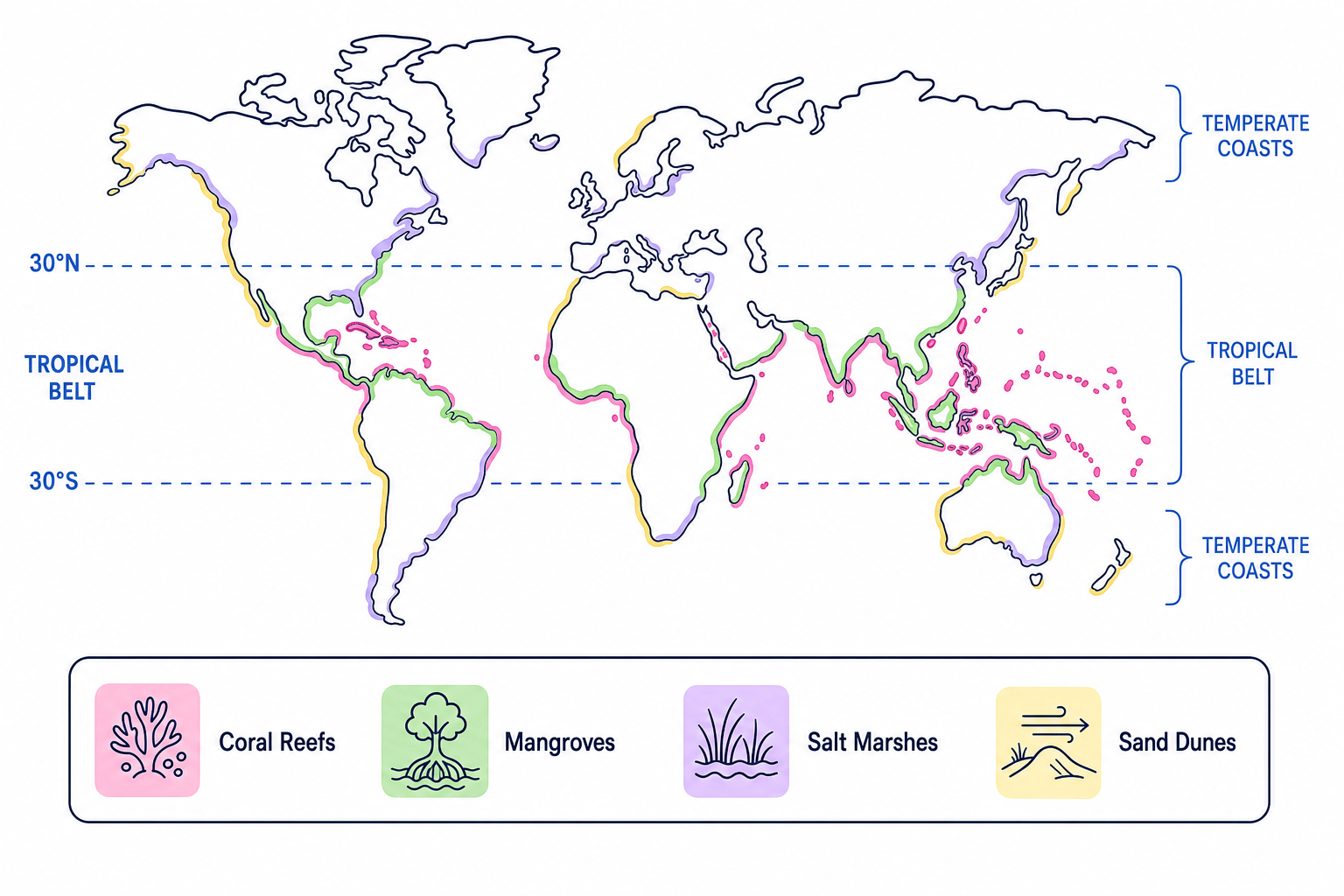
The map summarises the broad global pattern. These are not exact boundaries, but they show the typical environmental conditions each ecosystem needs.
Coral reefs
Coral reefs are mostly found in warm tropical seas, especially between about 30°N and 30°S. Major areas include the Great Barrier Reef in Australia, the Caribbean, the Red Sea and parts of Southeast Asia.
Coral reefs usually need:
- warm water, usually above about 18°C
- shallow water so sunlight can reach algae living in coral tissue
- clear water with low sediment
- salty marine water
- relatively low nutrient levels, because too many nutrients encourage algal growth that can smother coral
Coral
Coral is a tiny marine animal called a polyp. Many polyps live together in colonies and build hard limestone skeletons, creating reef structures over long periods.
Coral is not a plant
Coral is an animal, not a plant. It often looks plant-like because many corals contain algae that photosynthesise, but the coral itself is a living animal colony.
Mangroves
Mangroves are found on sheltered tropical and subtropical coasts, especially in estuaries, deltas and lagoons. Major areas include the Sundarbans in Bangladesh and India, Indonesia, Malaysia, West Africa and the Caribbean.
Mangroves usually need:
- warm temperatures
- sheltered, low-energy coasts
- muddy or silty sediment
- brackish water, where fresh and salt water mix
- regular tidal flooding
Mangrove trees have special adaptations, such as aerial roots that help them survive in waterlogged, salty mud.
Sand dunes
Sand dune ecosystems are found on sandy coasts where there is a good supply of dry sand and strong onshore winds. Examples include the Sefton Coast in northwest England, the Netherlands, Namibia and parts of Australia.
Sand dunes usually need:
- a wide sandy beach
- strong prevailing wind blowing inland
- dry sand above the high tide line
- pioneer plants, such as marram grass, to trap and stabilise sand
Pioneer species
A pioneer species is one of the first species to colonise a bare or difficult environment, such as sand, mud or rock.
Salt marshes
Salt marshes are found on sheltered temperate coasts, especially in estuaries and behind spits. Examples include The Wash in eastern England, the Essex marshes, the Wadden Sea in northwest Europe and parts of the eastern USA.
Salt marshes usually need:
- sheltered water with low wave energy
- fine mud and silt deposition
- regular tidal flooding
- salt-tolerant plants such as cordgrass and glasswort
Halophyte
A halophyte is a plant adapted to survive in salty conditions.
Choosing the likely coastal ecosystem
A coastline is described as a sheltered estuary in a temperate country. It has muddy sediment, low wave energy and plants that tolerate regular saltwater flooding. Which ecosystem is most likely?
- Compare the climate: temperate conditions make coral reefs and tropical mangroves less likely.
- Compare the sediment and wave energy: muddy sediment and low-energy sheltered water point towards deposition in an estuary.
- Match the vegetation: plants adapted to tidal saltwater flooding are typical of a salt marsh.
3. Named coastal ecosystem: the Sundarbans mangroves 🌐
For your named example, the Sundarbans mangrove ecosystem is a strong choice because it clearly shows the relationship between abiotic and biotic factors.
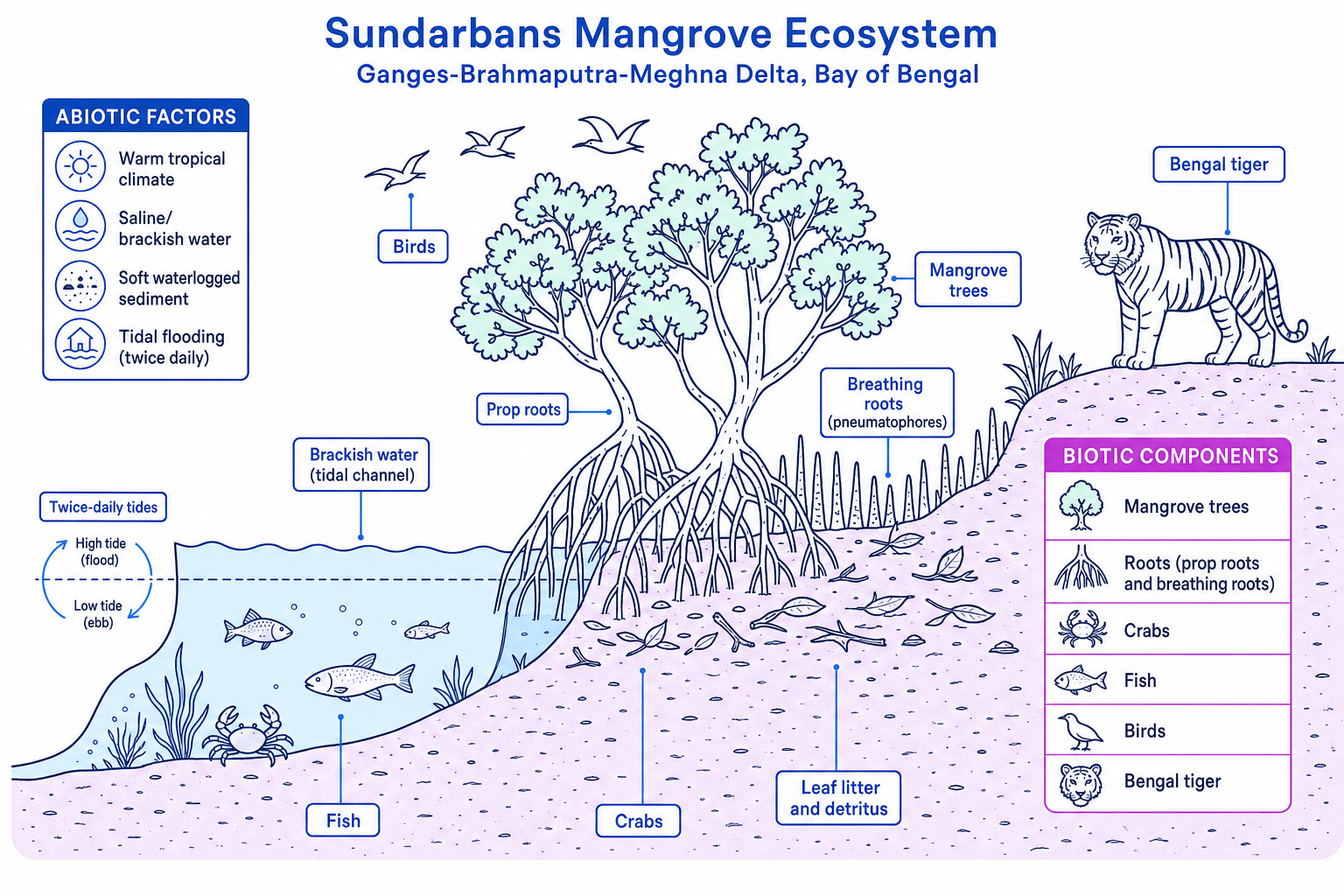
The Sundarbans are located in the Ganges-Brahmaputra-Meghna delta on the Bay of Bengal, across Bangladesh and eastern India. Bangladesh is a densely populated, lower-middle-income country with very low-lying coastal land, so the mangroves are nationally important for flood protection, fishing, timber, biodiversity and tourism. The Sundarbans are often described as the world’s largest continuous mangrove forest, roughly around 10,000 km², though exact figures vary by source and definition.
Abiotic characteristics of the Sundarbans
The Sundarbans’ non-living conditions are challenging:
- Climate: hot tropical monsoon climate, with high rainfall and high humidity.
- Water: brackish water because river water mixes with seawater.
- Tides: regular tidal flooding brings salt water and sediment into the forest.
- Sediment: soft mud and silt deposited by huge rivers.
- Soils: waterlogged and low in oxygen, making normal root growth difficult.
- Hazards: cyclones and storm surges from the Bay of Bengal can flood the area.
Brackish water
Brackish water is water that is partly salty, usually where freshwater from rivers mixes with seawater.
Biotic characteristics of the Sundarbans
The living parts of the Sundarbans are adapted to these difficult abiotic conditions.
Mangrove trees such as sundri have roots that help them cope with unstable, oxygen-poor mud. Some roots support the tree like stilts, while others stick up above the mud to take in oxygen.
Pneumatophores
Pneumatophores are upward-growing “breathing roots” that help mangrove trees absorb oxygen in waterlogged mud.
The Sundarbans also support crabs, prawns, fish, mudskippers, birds, crocodiles, spotted deer and the Bengal tiger. Fallen leaves and dead plant material become detritus, which feeds decomposers, crabs and small aquatic organisms. These then support larger fish, birds and mammals.
Detritus
Detritus is dead organic material, such as fallen leaves, dead roots and animal remains, that becomes an important food source in many ecosystems.
Classifying Sundarbans characteristics
A student writes: “The Sundarbans have brackish water, mudskipper fish, tidal flooding, sundri trees and soft silt.” Which are abiotic and which are biotic?
- Separate non-living conditions from living organisms: brackish water, tidal flooding and soft silt are physical conditions, so they are abiotic.
- Identify living organisms: mudskipper fish and sundri trees are living things, so they are biotic.
- Link them together: the biotic features survive because they are adapted to the abiotic conditions, such as salt water and waterlogged mud.
Easy structure for named ecosystem answers
Use the pattern location → abiotic conditions → biotic adaptations → why it matters. This helps you avoid writing a random list.
4. How people threaten coastal ecosystems
Coastal ecosystems are valuable, but they are often close to ports, tourist resorts, farms and cities. That means human pressure can be intense.
Threats can happen at different scales:
- Small-scale threats affect a local site, such as trampling on one dune system or clearing a small patch of mangrove for fuelwood.
- Large-scale threats affect whole stretches of coastline or river basins, such as industrial port expansion, mass tourism or agricultural runoff from a large catchment.
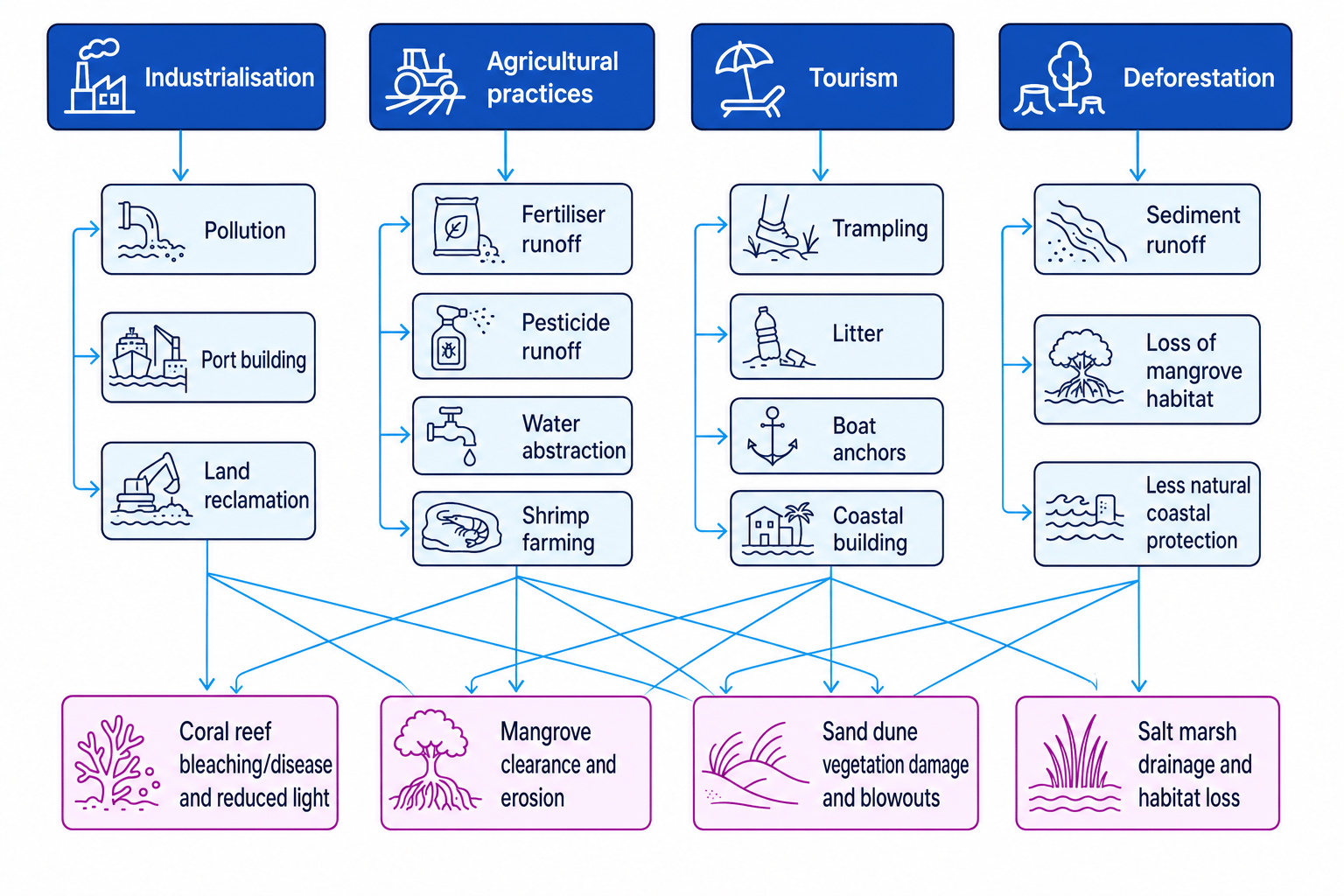
The diagram shows the main activity-to-impact links you should be able to explain.
Industrialisation
Industrialisation means the growth of manufacturing, ports, energy production and related infrastructure.
Industrialisation can threaten coastal ecosystems through:
- port building and dredging, which remove habitats and stir up sediment
- pollution from factories, oil spills and waste water
- land reclamation, where sea or wetland areas are filled in for development
- increased shipping, which can damage reefs and disturb wildlife
For example, port expansion near tropical coasts can increase sediment in the water. This reduces light, making it harder for coral algae to photosynthesise.
Agricultural practices
Agriculture affects coasts even when farms are inland, because rivers carry material from the catchment to the sea.
Main threats include:
- fertiliser runoff causing nutrient pollution
- pesticides harming aquatic organisms
- soil erosion increasing sediment in rivers and coastal waters
- irrigation changing river flow and salinity
- shrimp farming replacing mangrove forest in some tropical countries
Eutrophication
Eutrophication is when extra nutrients, often from fertilisers or sewage, cause rapid algal growth. When algae die and decompose, oxygen levels can fall, harming aquatic life.
Tourism
Tourism can bring jobs and conservation funding, but unmanaged tourism damages fragile ecosystems.
Examples include:
- trampling dune vegetation, causing sand to become unstable
- boats anchoring on coral reefs
- hotels and roads replacing mangroves, dunes or salt marsh
- litter and sewage pollution
- high water demand in dry coastal areas
Only naming the activity
Do not just write “tourism damages ecosystems”. Explain the process, such as: tourists trample marram grass → roots no longer bind the sand → wind erosion creates dune blowouts → habitats are lost.
Deforestation
Deforestation means the removal of trees. At the coast, it can mean direct mangrove clearance. Inland, it can increase soil erosion and sediment runoff into rivers.
In mangrove areas, deforestation removes:
- wildlife habitat
- nursery areas for fish and prawns
- natural protection against waves and storm surges
- carbon storage in trees and wet soils
In river catchments, deforestation increases sediment reaching reefs and estuaries, which can smother organisms and reduce light penetration.
Linking deforestation to coastal ecosystem damage
A tropical river catchment is deforested for farming. Downstream, a coral reef begins to decline. How are these linked?
- Removing trees leaves soil exposed, so heavy rain more easily washes sediment into rivers.
- Rivers carry this sediment to the coast, making seawater more cloudy and reducing light penetration.
- Coral depends on sunlight reaching algae living in its tissues, so reduced light weakens coral growth and can lead to reef decline.
Do not ignore the specified human activities
Climate change is very important for many coastal ecosystems, especially coral reefs, but this spec point specifically names industrialisation, agriculture, tourism and deforestation. Use these in your main explanation unless the question asks more broadly.
5. Bringing it together
Distinctive coastal ecosystems form where physical conditions allow them to survive. Coral reefs need warm, clear, shallow seas. Mangroves need warm, sheltered, muddy tidal coasts. Sand dunes need dry sand, wind and stabilising vegetation. Salt marshes need sheltered muddy tidal water in temperate areas.
For top marks, always connect the ecosystem to the process. The strongest answers explain how an abiotic condition shapes the living community, or how a human activity creates a chain of environmental impacts.
In the exam
- Use named examples where possible: Great Barrier Reef for coral, Sundarbans for mangroves, Sefton Coast for dunes, The Wash or Wadden Sea for salt marshes.
- Link cause and effect: activity → process → ecosystem impact. Avoid vague phrases like “it damages nature”.
- Separate abiotic and biotic clearly when asked: non-living conditions first, then living organisms and adaptations.
- Mention scale if relevant: local trampling is small-scale; catchment-wide agriculture or port expansion can be large-scale.
Check yourself
- Why are coral reefs usually found in warm, clear, shallow tropical seas?
- What are two abiotic and two biotic characteristics of the Sundarbans mangroves?
- How can agriculture inland damage a coastal ecosystem downstream?
