What you'll learn
- How urban land use patterns are shaped by locational needs, accessibility and land values.
- Why cities in developed countries still face major challenges with food, energy, transport, waste and segregation.
- How rapid growth in developing or emerging countries can lead to squatter settlements, informal work, pollution and low quality of life.
- How to build place-specific explanations using named cities such as London, UK and Lagos, Nigeria.
The starting point: cities grow because they concentrate opportunities
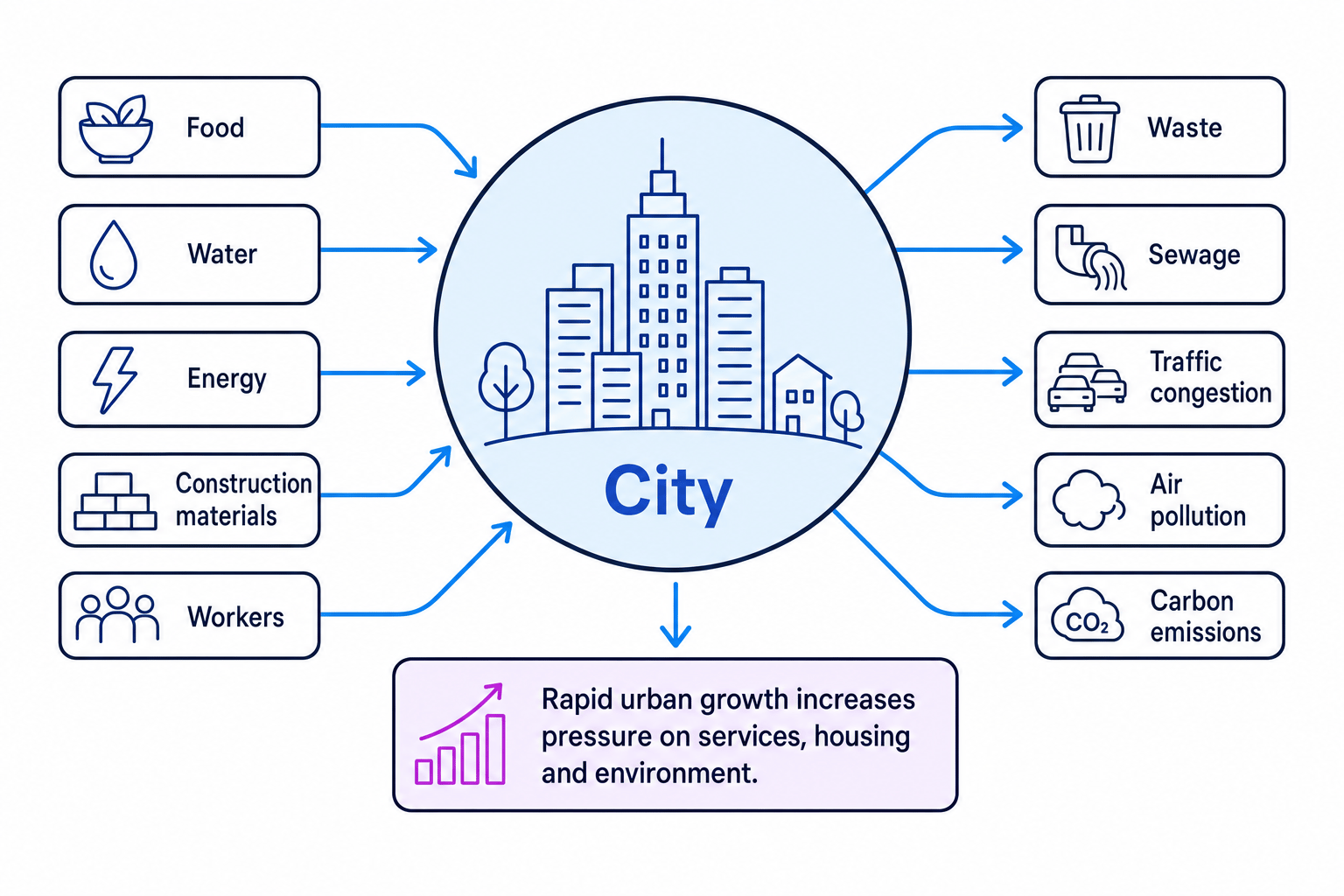
An urban area is a built-up place with a high density of people, buildings, jobs and services. Urban growth means an increase in the population or physical size of an urban area. This can happen through natural increase — births being greater than deaths — and rural-to-urban migration, where people move from countryside to towns or cities.
Cities grow because they offer advantages: jobs, education, healthcare, markets and transport links. But when growth is fast, demand for land, housing, food, energy, water, transport and waste services can rise faster than the city can manage.
Social challenges affect people’s lives, such as inequality, housing, services and quality of life. Environmental challenges affect the physical environment, such as air pollution, waste, energy use and damage to ecosystems.
Urban land use patterns
Urban land use
Urban land use means the way land is used within a town or city, for example for shops, offices, housing, industry, transport, parks or services. An urban land use pattern is the spatial arrangement of these uses across the city.
A common pattern in many cities is:
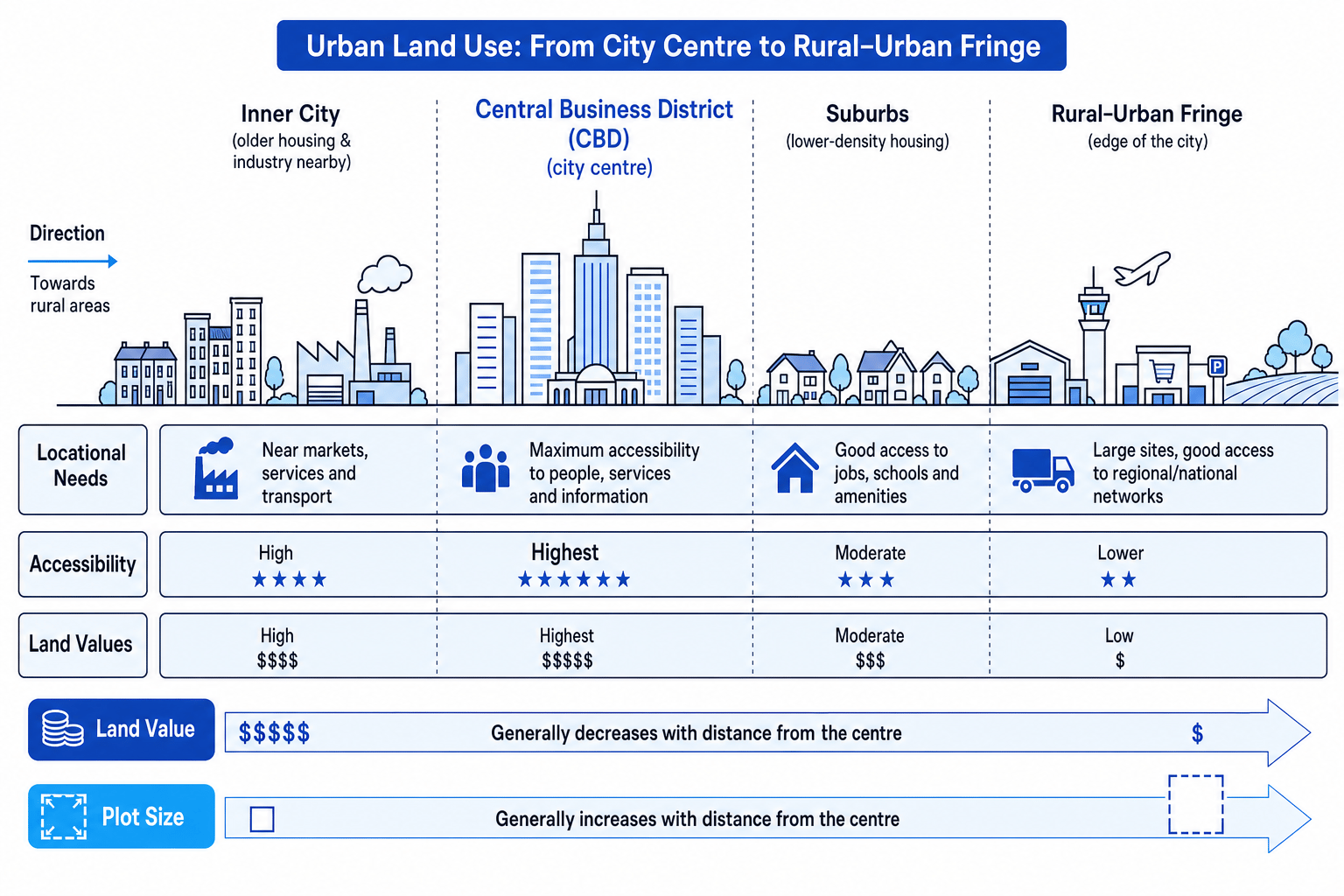
- the Central Business District (CBD) in the centre, with offices, shops, banks, restaurants and entertainment
- the inner city around the CBD, often with older housing, older industry and some regenerated areas
- the suburbs, usually lower-density housing with schools, parks and local shops
- the rural–urban fringe, the edge of the city where urban and rural uses mix, such as business parks, retail parks, airports, warehouses and farmland
This pattern is not perfect in every city. History, planning decisions, rivers, hills, coastlines, railways and regeneration can all change it.
Factor 1: locational needs
Locational needs are the requirements a land use has in order to work well.
For example, offices often need excellent access to workers, clients and information, so they cluster in the CBD. Warehouses need large plots and good access to motorways, so they often locate on the rural–urban fringe. Wealthier housing may be found in greener, quieter suburbs because residents value space and environmental quality.
Factor 2: accessibility
Accessibility means how easy it is to reach a place. The CBD is usually the most accessible part of a city because roads, railways, bus routes and underground or metro lines often meet there. High accessibility attracts shops and offices because more customers and workers can reach them.
Factor 3: land values
Land value means the price of land or the rent paid to use it. Land values are usually highest in the CBD because many businesses compete for central, accessible sites. This encourages high-rise buildings and intensive land use. Further from the centre, land is usually cheaper, so land uses needing more space become more likely.
The three controls
Urban land use is mainly shaped by the interaction of locational needs, accessibility and land values. The best explanation links all three, rather than describing city zones separately.
Explaining a land-use pattern
A large logistics warehouse is built on the edge of a city near a motorway junction. Explain why this location is suitable.
- The warehouse has a locational need for a large, flat site because goods must be stored, loaded and moved by lorries.
- The rural–urban fringe offers cheaper land than the CBD, so the company can afford a bigger plot and parking or loading space.
- The motorway junction gives high accessibility for regional deliveries, even though the site is less central for pedestrians than the CBD.
- Therefore, the edge-of-city location matches the warehouse’s needs better than a high-value city-centre site.
Forgetting land value
Do not just say “the CBD has shops because it is central”. Add the reason: central sites are highly accessible, so many businesses compete for them, which raises land values and encourages intensive uses such as offices and department stores.
Cities as resource concentrators
A city brings many people and businesses into a small area. This creates concentrated resource consumption, meaning large amounts of food, energy, water and materials are used in one place. It also concentrates outputs such as waste, sewage, traffic and pollution.
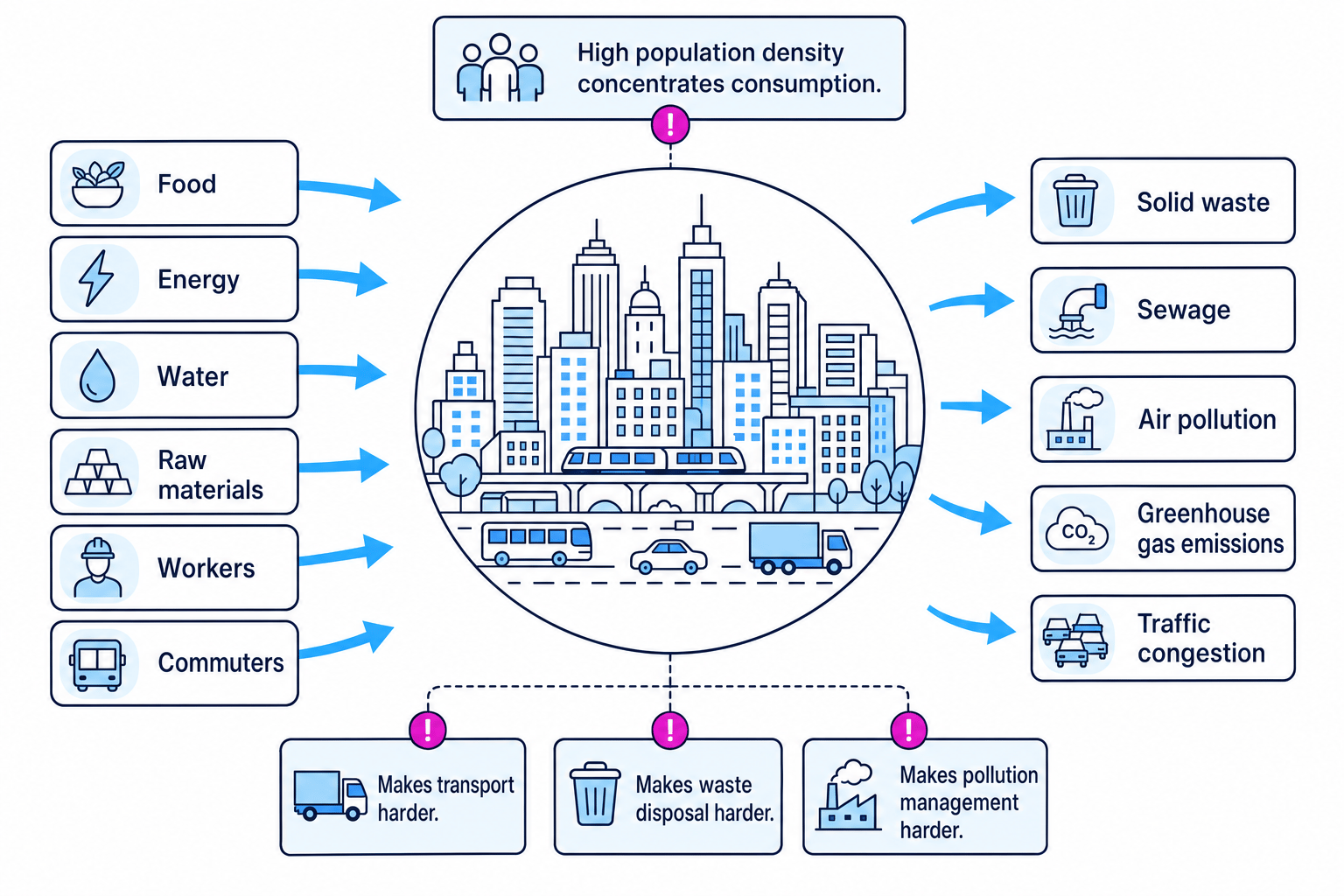
This is why urban challenges are often linked. More people can mean more transport demand, which can increase congestion and air pollution. More households and businesses can mean more waste, which needs collection, treatment, recycling or disposal.
Urban challenges in a developed country: London, UK
London is a named example in a developed country. It is the capital city of the United Kingdom, located in south-east England. The UK is a high-income country with a service-based economy, and London is its main financial, political and cultural centre. Greater London has about 9 million people, although the wider commuter region is larger.
Food demand
London depends on food brought in from across the UK and the world. Its large population creates huge demand for supermarkets, restaurants, food delivery and wholesale markets. This creates transport emissions, packaging waste and food waste. It can also create inequality: some low-income households struggle to afford healthy food, even in a wealthy city.
Energy demand
London needs large amounts of electricity and gas for homes, offices, shops, transport systems and data services. Tall buildings, heating, cooling, lighting and the Underground all add to demand. The challenge is to reduce carbon emissions while keeping energy reliable and affordable. Fuel poverty can still affect households in a developed city when energy bills are high.
Transport demand
London has an extensive public transport system, including the Underground, buses, trains and cycling routes. Even so, commuting creates congestion, crowding and air pollution. Road traffic contributes nitrogen dioxide and particulate pollution, especially near busy routes. Measures such as the Congestion Charge, Ultra Low Emission Zone and cycle lanes aim to manage this, but they can be controversial because they affect different groups in different ways.
Waste disposal demand
Millions of residents, commuters, tourists and businesses produce large quantities of waste. London must collect, sort, recycle, burn, landfill or export waste. Land for waste facilities is expensive and unpopular, so waste disposal is a planning challenge as well as an environmental issue.
Segregation
Segregation
Segregation means the separation of different groups of people within a city. It may be linked to income, housing cost, ethnicity, age or access to services.
London is highly diverse, but it is also unequal. Very wealthy areas, such as parts of Kensington and Chelsea or Westminster, are close to areas with much lower average incomes, such as parts of Newham or Barking and Dagenham. High house prices can push lower-income residents away from central areas, while regeneration can lead to gentrification, where wealthier residents and businesses move into an area, often increasing rents.
Developed cities still have serious challenges
In an exam, avoid implying that developed-country cities have “solved” urban problems. Their challenges are often about high consumption, inequality, affordability, congestion and managing environmental impacts.
Urban challenges in a developing or emerging country: Lagos, Nigeria
Lagos is a named example in an emerging/developing country context. It is Nigeria’s largest city and major economic centre, located on the south-west coast by the Lagos Lagoon and the Atlantic Ocean. Nigeria is Africa’s most populous country, with over 200 million people, and it has experienced rapid urbanisation. Lagos’s population is often estimated in the tens of millions depending on the boundary used, so exact figures vary by source.
Calculating urban population increase
If a data source shows Lagos growing from 8.0 million people to 15.0 million people, calculate the percentage increase.
-
Use the percentage change formula because you are comparing growth relative to the starting population:
Percentage change=new value−old valueold value×100\begin{aligned} \text{Percentage change} &= \frac{\text{new value} - \text{old value}}{\text{old value}} \times 100 \end{aligned}Percentage change=old valuenew value−old value×100 -
Substitute the values from the data source:
Percentage change=15.0−8.08.0×100\begin{aligned} \text{Percentage change} &= \frac{15.0 - 8.0}{8.0} \times 100 \end{aligned}Percentage change=8.015.0−8.0×100 -
Calculate and interpret the result:
Percentage change=87.5%\begin{aligned} \text{Percentage change} &= 87.5\% \end{aligned}Percentage change=87.5%The population has increased by 87.5%, so it has nearly doubled. This helps explain rising pressure on housing, transport, sanitation and jobs.
Squatter settlements
Squatter settlement
A squatter settlement is an area of informal housing built without legal ownership of the land or full planning permission. Homes are often built from low-cost materials and may lack safe water, sanitation or electricity.
In Lagos, informal settlements have developed on marginal land, including waterfront and lagoon areas such as Makoko. People live there because formal housing is too expensive or unavailable, and the location may be close to jobs. However, residents may face overcrowding, insecure land tenure, flood risk, fire risk and limited services.
Informal economy
The informal economy includes jobs that are not fully regulated, taxed or protected by the state. In Lagos, this includes street vending, small workshops, informal transport, domestic work and waste picking. It is important because it provides income for many people, but workers may have low pay, unsafe conditions and no sick pay or legal protection.
Urban pollution
Urban pollution in Lagos is linked to traffic congestion, old vehicles, diesel generators, waste burning, open drains, industrial activity and polluted water bodies. Air pollution can harm respiratory health. Water pollution can spread disease when drainage and sanitation systems are inadequate. Waste disposal is difficult because rapid growth can outpace collection services.
Low quality of life
Quality of life means people’s overall wellbeing, including housing, health, education, income, safety, services and environment. In parts of Lagos, quality of life is reduced by overcrowded housing, unreliable electricity, limited safe water, poor sanitation, long commuting times and flood risk. However, it is important to be balanced: Lagos also offers jobs, education, markets, community networks and opportunities that attract migrants.
Only describing poverty
For Lagos or any developing/emerging-city example, do not just list “poverty” repeatedly. Link specific causes and effects: rapid migration plus limited formal housing can create squatter settlements; traffic plus diesel generators can increase air pollution; informal jobs can provide income but lack security.
Comparing the two city contexts
London and Lagos both face urban challenges, but the causes and severity differ.
In London, the challenge is often managing high consumption in a wealthy, service-based city: energy demand, waste, congestion, emissions and inequality linked to housing costs. The city has strong institutions and infrastructure, but demand is very high.
In Lagos, the challenge is often that growth is faster than formal housing, infrastructure and employment provision. This makes informal settlements, informal work, pollution and low quality of life more visible and widespread, even while the city remains economically important for Nigeria.
Same theme, different context
All large cities create pressure on resources and space. The key difference is whether infrastructure, planning and incomes can keep up with the speed of growth and the scale of demand.
In the exam
- Name the city and country early, then set it in national context: for example, “London, the UK’s capital in a high-income country” or “Lagos, Nigeria’s largest economic centre in a rapidly urbanising country”.
- Build explanation chains: rapid growth or high consumption → pressure on services/resources → social or environmental impact → place-specific detail.
- For land-use questions, link locational needs, accessibility and land values instead of only naming zones like CBD, suburbs and fringe.
Check yourself
- Why are land values usually highest in the CBD, and how does this affect building height and land use?
- How can London have serious urban challenges even though the UK is a developed country?
- Why can the informal economy in Lagos be both helpful and problematic for residents?