Welcome to your study guide for William Blake’s masterpiece, "The Tyger". Published in 1794 as part of his collection Songs of Experience, this poem is one of the most famous, scrutinized, and powerful works in the English literary canon.
At first glance, the poem is about a majestic, terrifying wild cat. But beneath the surface, it is a profound philosophical inquiry into the nature of creation, God, and the coexistence of good and evil in the universe.
The Central Question
The core of "The Tyger" is not about the tiger itself, but its creator. Blake asks: how can the same God who created the gentle, innocent lamb also create a terrifying, lethal predator like the tiger?
What you'll learn
- How Blake uses form and structure to mimic the industrial process of creation.
- The symbolic contrast between Innocence and Experience (essential for your AO3 comparison).
- How to analyse Blake's vivid lexical fields of fire and metalwork (AO2).
- Strategies to structure a top-grade comparative response in your exam.
Understanding the Poem: Meaning & Context
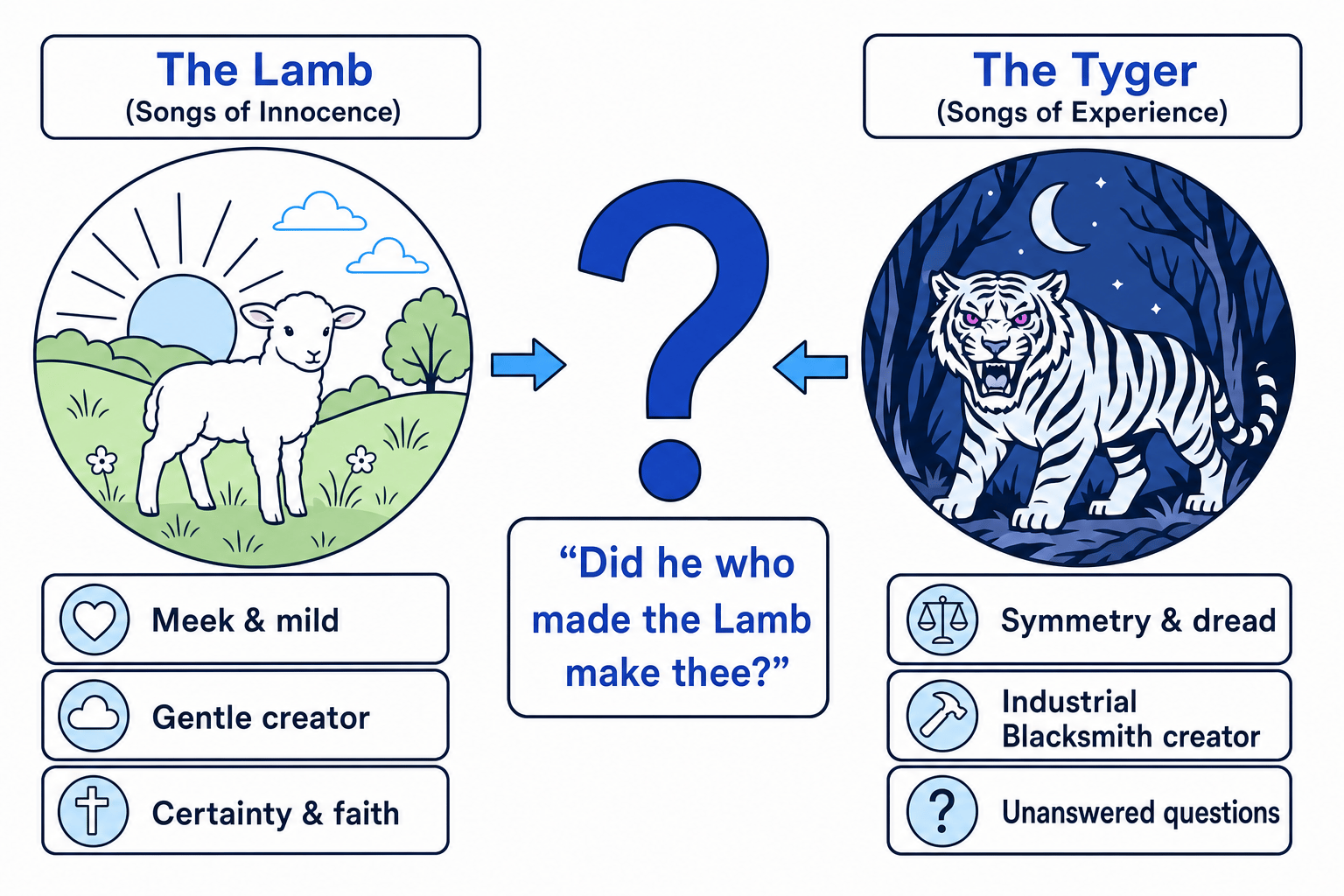
To write about "The Tyger" effectively, you must understand its sister poem, "The Lamb" (which is also in your Edexcel Anthology). Blake designed these two poems to be read against one another.
Songs of Innocence and of Experience
This is a two-part collection of poems by William Blake.
- Innocence represents a state of untouched, pure, childhood-like perspective, where the world is safe, moral, and ruled by a loving God.
- Experience represents the fallen, adult world, corrupted by social injustice, suffering, industry, and a deeper, darker understanding of reality.
While "The Lamb" represents Innocence (gentle, simple, and certain of God’s love), "The Tyger" represents Experience (fierce, complex, and filled with terrifying questions that have no easy answers).
The Concept of the "Sublime"
During the Romantic period, writers were obsessed with the sublime.
The Sublime
An aesthetic concept denoting a greatness beyond all possibility of calculation, measurement, or imitation. It is a mixture of awe, overwhelming beauty, and terrifying power—often found in wild nature.
The Tyger is the ultimate symbol of the sublime. It is "burning bright" with exquisite beauty, yet possesses "fearful symmetry"—a physical perfection that is deeply intimidating.
Form and Structure (AO2)
Blake's structural choices are highly deliberate. He uses rhythm and rhyme to evoke physical sensations.
The Driving Beat: Trochaic Tetrameter
Most of the poem is written in catalectic trochaic tetrameter.
Trochaic Tetrameter & Catalexis
- Trochee: A metrical foot consisting of a stressed syllable followed by an unstressed syllable (DUM-da).
- Tetrameter: A line of poetry containing four metrical feet.
- Catalexis: The dropping of the final unstressed syllable in a line, leaving a hanging stressed syllable.
Let’s look at how this sounds in the opening line:
Ty-ger! Ty-ger! burn-ing bright
(DUM-da\text{DUM-da}DUM-da / DUM-da\text{DUM-da}DUM-da / DUM-da\text{DUM-da}DUM-da / DUM\text{DUM}DUM)
This heavy, driving downward meter mimics the rhythmic, heavy strikes of a blacksmith’s hammer hitting an anvil. It is loud, repetitive, and relentless, immediately immersing the reader in a scene of industrial creation.
Ignoring the Metrical Shift in Line 4
Many students assume the whole poem is perfectly regular. It isn't! Look at Stanza 1, line 4: "Could frame thy fearful symmetry?" This line shifts to iambic tetrameter (da-DUM da-DUM da-DUM da-DUM). By breaking the established trochaic pattern, Blake draws absolute attention to the word "symmetry". The rhythm itself falters slightly, hinting that the "symmetry" of this beast is so complex it disrupts natural order.
Cyclical Structure & Unanswered Questions
The poem contains 13 questions, but not a single answer is provided.
The structure is highly symmetrical and cyclical:
- Stanza 1 asks: "What immortal hand or eye / Could frame thy fearful symmetry?"
- Stanza 6 repeats Stanza 1 almost word-for-word, but changes one crucial verb: "Dare frame thy fearful symmetry?"
This subtle shift from "Could" (having the physical power to create) to "Dare" (having the moral audacity/courage to create) represents the ultimate transition from innocence to experience. We go from wondering how God made such a beast, to wondering how He dared unleash such danger upon the world.
Language and Imagery (AO2)
Blake uses two dominant patterns of imagery (lexical fields) to bring the Tyger and its creation to life.
The Divine Blacksmith
Instead of depicting God as a gentle gardener or a loving father, Blake portrays the creator as an industrial craftsman: a divine blacksmith.
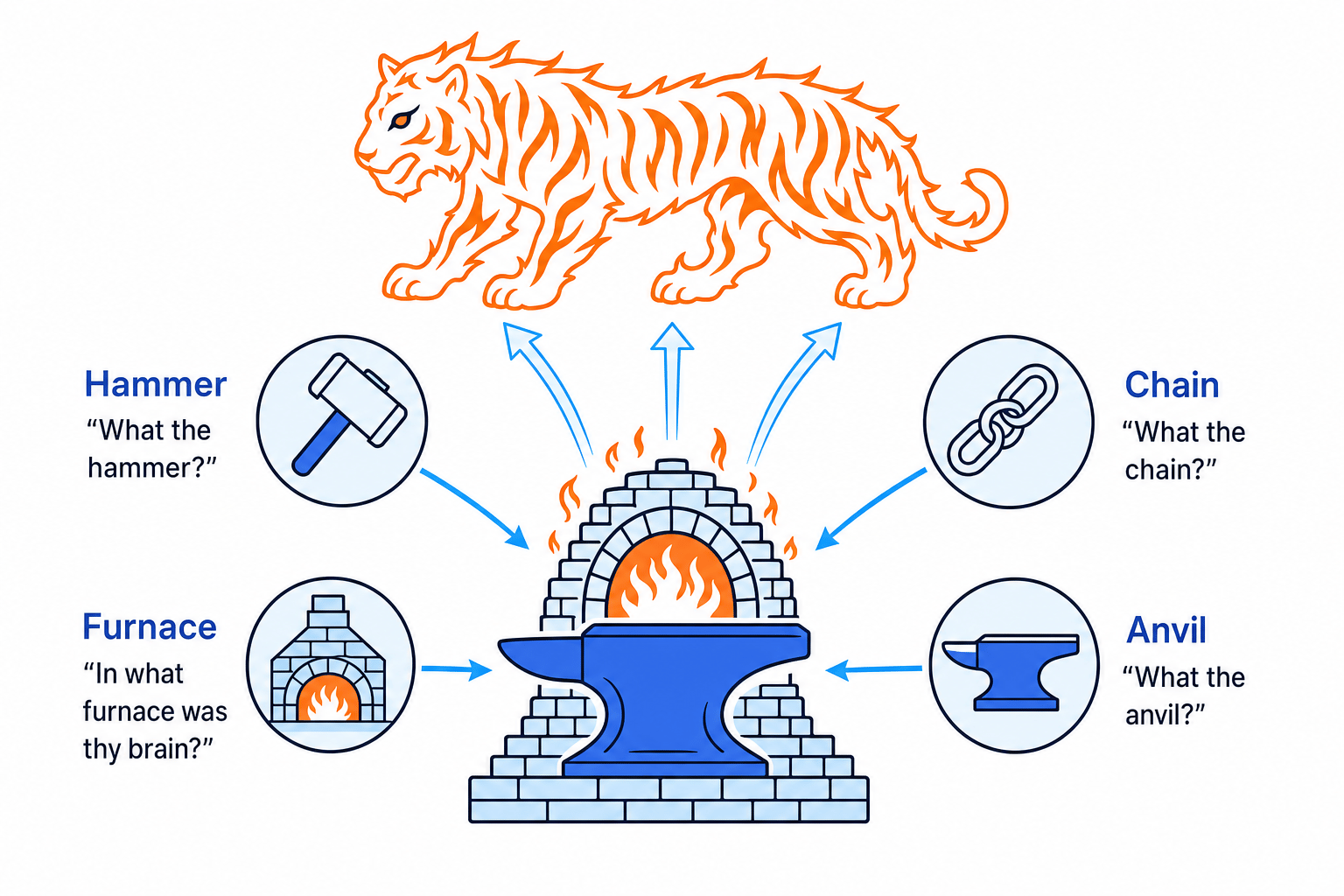
This is a direct reflection of Blake’s context. Writing during the dawn of the Industrial Revolution in London, he saw dark, smoke-belching factories (which he called "dark Satanic Mills") reshaping the landscape. He applies this industrial violence to the creation of the tiger:
- "What the hammer? what the chain?" — Suggested tools of violent restriction and heavy shaping.
- "In what furnace was thy brain?" — Suggests the tiger's mind was forged in extreme, dangerous heat.
- "What the anvil?" — The heavy iron block where raw material is beaten into shape.
This imagery suggests that the creation of the tiger was an act of raw, mechanical force and immense struggle.
Light and Darkness
Blake relies on sharp chiaroscuro (the contrast of bright light and dark shadows) to capture the tiger's sublime essence:
- "Burning bright / In the forests of the night": The tiger is a source of intense, dangerous light (fire) set against a backdrop of absolute darkness ("forests of the night", symbolising ignorance, confusion, or spiritual lostness).
- "Burnt the fire of thine eyes": The tiger is alive with internal, predatory energy.
Do not simplify 'burning bright'
Avoid writing that "burning bright" just means the tiger has orange fur. It is a metaphor for spiritual energy, destruction, and danger. Fire purifies, but it also destroys.
Step-by-Step Analysis
Let's look at how to unpack a complex quotation and transform it into a top-grade analytical point for your exam.
Analysing Metaphor and Tone in Stanza 5
We will analyse the lines:
"When the stars threw down their spears, And water'd heaven with their tears:"
- Identify the literal meaning and context within the poem: This couplet occurs in Stanza 5, immediately before the ultimate question: "Did he who made the Lamb make thee?". The "stars" are reacting to the creation of the Tyger.
- Deconstruct the key poetic devices (methods):
- Personification: Stars are given human actions ("threw down their spears", "water'd... with their tears").
- Connotation: "Spears" are weapons of war, suggesting battle, conflict, or rebellion. "Tears" signify sorrow, regret, or absolute terror.
- Connect the imagery to wider thematic/mythological context: In Christian mythology (which Blake knew deeply), the fall of the rebel angels (led by Lucifer) is often described as stars falling from heaven. The "stars" throwing down their spears represents the moment the rebel angels conceded defeat or surrendered in horror at the sheer power of God's new creation.
- Explain the effect on the reader: This creates an epic, cosmic scale. The creation of the tiger is so momentous and terrifying that even the heavens weep and soldiers of light drop their weapons. It highlights the cosmic significance of evil and terror.
Comparative Connections (AO3)
In Paper 1, Section B of your Edexcel IGCSE, you must compare two poems from the Anthology. "The Tyger" is highly versatile. Here are some key ways to link it to other poems in the anthology:
| Theme | Common Points of Comparison |
|---|---|
| Power of Nature | * "The Tyger" vs. "Storm on the Island": Both present nature as an untamable, violent force. While Blake uses industrial/religious metaphor, Heaney uses military imagery ("salvo", "strafes") to describe the storm. |
| Religious/Spiritual Enquiry | * "The Tyger" vs. "The Lamb": The ultimate companion comparison. Compare Blake's secure, comforting theology in "The Lamb" with the terrifying, unanswered doubts in "The Tyger". |
| Identity and Creation | * "The Tyger" vs. "Checking Out Me History": Both poems use highly distinctive rhythm and oral performance techniques to challenge established narratives (John Agard challenges colonial history; Blake challenges traditional views of a solely gentle God). |
The Edexcel AO3 Trap
When comparing, never just write a list of similarities followed by a list of differences. Instead, write synthesised paragraphs that compare the methods the poets use to achieve their effects.
- Bad: "The Tyger has stanzas. Storm on the Island is one big block."
- Good: "While Blake uses a highly regular, driving trochaic structure to evoke the mechanical, rhythmic process of creation, Heaney utilises unpredictable enjambment in blank verse to reflect the chaotic, uncontrollable violence of the storm."
In the exam
- Focus on the Question's Key Concept: If the question is about "Nature" or "Power," tailor your analysis of the tiger's creation to match that concept. Don't just dump everything you know about blacksmiths.
- Do Not Focus on AO4 (Historical Context) details: Remember that Paper 1, Section B (Anthology Poetry) does not assess AO4. You do not get marks for biographical details about William Blake's life, his printing shop, or his visions of angels. You only get marks for close analysis of language, form, and structure (AO2) and comparison (AO3). Keep your context strictly tied to explaining the meaning of the poem (e.g., how the Industrial Revolution informs the blacksmith metaphor).
- Use Structural Terminology: Impress the examiner by correctly naming the meter (catalectic trochaic tetrameter) and explaining why Blake uses it (to sound like the beating of a hammer).
- Integrate Short Quotations: Never quote more than one line at once. Instead of writing out a whole stanza, weave single words or short phrases into your sentences: Blake's use of harsh plosives in "brain", "chain", and "anvil" emphasizes the violent physicality of the creation.
Check yourself
- Why does Blake change the word "Could" in Stanza 1 to "Dare" in Stanza 6?
- What are the three main tools associated with the "Divine Blacksmith" metaphor, and what do they represent?
- How does the meter of the poem change in the line "Could frame thy fearful symmetry?" and what is the structural effect of this change?
