What you'll learn
- What happens in Carol Ann Duffy’s “War Photographer” and what the poem is really about.
- How Duffy uses form, structure, imagery and tone to present war, trauma and responsibility.
- Key quotations you can learn for the closed-book Edexcel IGCSE anthology poetry comparison.
- How to write about the poem for AO2 and connect it to another poem for AO3.
Big picture: what happens?
“War Photographer” presents a photographer who has returned from conflict zones to develop his photographs in a dark room. As the images appear, he remembers the suffering he witnessed, especially one dying man and the man’s wife. By the end, his editor selects only a few photographs for a Sunday newspaper supplement, and readers feel brief sadness before returning to comfortable routines.
Speaker and stanza
The speaker is the voice telling the poem; it is not automatically the same as the poet. A stanza is a grouped section of lines, like a paragraph in a poem.
The poem is written in the third person, meaning the photographer is described as “he” rather than speaking as “I”. This creates some distance, as if we are quietly observing him at work.
Core meaning
Duffy presents the war photographer as a serious witness to suffering, but she criticises the way distant readers briefly consume images of war and then return to comfort: “they do not care”.
The poem’s journey
The poem moves from a private, controlled space — “In his dark room” — to memories of violent places, then to the public world of newspapers and indifferent readers. This movement is important because the photographer’s careful work cannot make society truly respond to suffering.
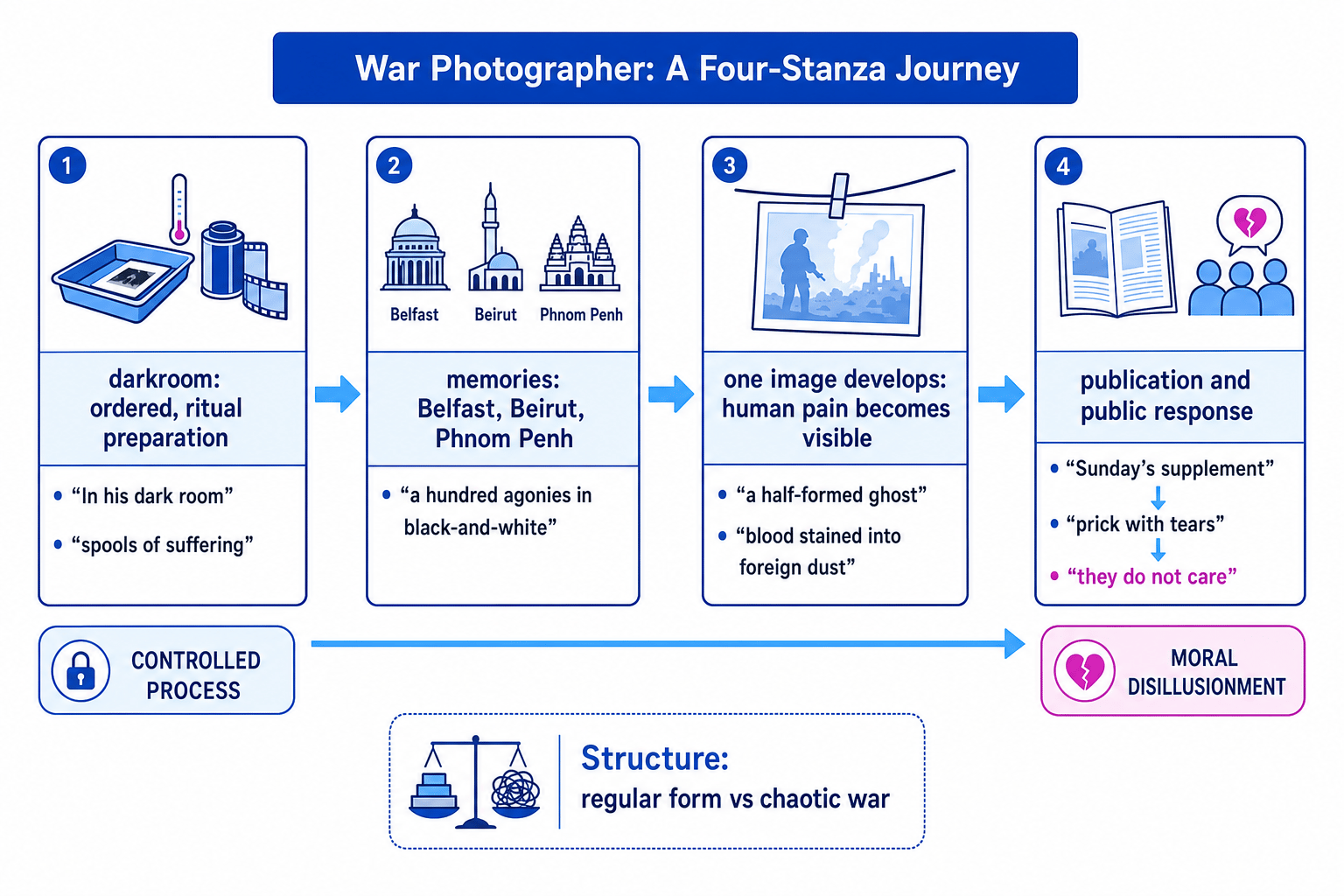
Form and structure: order against chaos
Form and structure
Form means the overall type and shape of a poem; structure means the order, pattern and development of its ideas.
“War Photographer” has four regular six-line stanzas. A six-line stanza is called a sestet. This regular shape contrasts with the chaos of war: the poem looks controlled, but the memories inside it are disturbing.
A rhyme scheme is the pattern of rhyming sounds at the ends of lines. Duffy uses a fairly controlled pattern with rhyming pairs, such as “rows” / “glows”, “feet” / “heat”, and “must” / “dust”. A pair of rhyming lines is called a couplet. These couplets can suggest the photographer’s attempt to impose order on terrible events.
The structure also creates a tightening emotional journey:
- Stanza 1: the photographer works alone in the dark room.
- Stanza 2: memories of conflict interrupt the calm.
- Stanza 3: one photograph develops, bringing back a specific death.
- Stanza 4: the photos are reduced to newspaper content, and the public response is brief.
Tracing the structural movement
- Start with the setting: the poem begins “In his dark room”, a private and enclosed space where the photographer seems physically safe.
- Notice the interruption: the list “Belfast. Beirut. Phnom Penh.” uses full stops to create abrupt pauses, pushing war memories into the dark room.
- Follow the emotional focus: in stanza 3, the general idea of war becomes personal through “A stranger’s features” and the memory of “this man’s wife”.
- Link the ending back to the whole poem: the final judgement, “they do not care”, shows that the photographer’s painful witness has not changed the comfortable readers.
Regular structure does not mean peaceful meaning
Do not say the poem is calm just because it is regular. A stronger point is that Duffy uses a controlled form to highlight the photographer’s attempt to process chaotic, traumatic memories.
Language and imagery
Imagery
Imagery is language that creates a vivid picture or sensory impression in the reader’s mind.
Religious imagery
The opening presents the dark room “as though this were a church and he / a priest preparing to intone a Mass.” A simile is a comparison using “like”, “as” or similar wording; here “as though” compares the dark room to a church. The comparison makes the photographer’s work seem solemn and morally serious.
The religious language also suggests guilt, ritual and respect for the dead. He is not simply producing pictures; he is handling human suffering.
Analysing the opening comparison
- Identify the literal action: the photographer is developing film in a dark room, with “spools” set out carefully.
- Interpret the comparison: “as though this were a church” turns the workspace into a sacred place, suggesting silence, reverence and moral weight.
- Connect the role: calling him “a priest” implies that he performs a serious ritual for the dead, almost like a funeral or act of remembrance.
- Link to Duffy’s message: this respect contrasts with the later readers, whose tears come “between the bath and pre-lunch beers”.
War, suffering and memory
The phrase “spools of suffering” is a metaphor, meaning it describes one thing as if it is another. The film spools do not literally contain suffering, but they hold images of human pain. The soft s sounds also create sibilance, a repeated hissing sound, which can make the line feel hushed and tense.
“Belfast. Beirut. Phnom Penh.” uses a list of real places associated with conflict. The full stops create caesura, a pause within a line. These sharp pauses make the names feel like separate shocks, as if the photographer’s memories arrive in flashes.
“All flesh is grass” is a biblical allusion, which means a reference to another text or idea. It suggests that human life is fragile and temporary. Duffy uses this to make the suffering universal, not limited to one place.
Contrast between England and war zones
Duffy uses juxtaposition, meaning placing contrasting ideas side by side, when she moves from conflict to “Rural England. Home again”. In England, “ordinary pain” can be dispelled by “simple weather”, but in war zones there are “fields which don’t explode beneath the feet / of running children”.
This contrast exposes the protected comfort of the photographer’s home society. The image of children running through exploding fields is especially disturbing because childhood is associated with innocence and play.
The developing photograph
In stanza 3, “A stranger’s features / faintly start to twist” as the image develops. The verb “twist” suggests both the physical shape of the photograph appearing and the pain of the dying man. The phrase “a half-formed ghost” makes the image seem haunted, as if the dead man is returning through the photograph.
The line “how the blood stained into foreign dust” is powerful because “stained” suggests permanence. The suffering cannot simply be washed away, even if readers later forget it.
Tone: serious, haunted, then bitter
Tone
Tone is the attitude or emotional feeling created by a writer’s language.
The poem’s tone begins as solemn and ritualistic. Words such as “church”, “priest” and “Mass” make the atmosphere respectful and grave.
The tone then becomes haunted as the photographer remembers what he saw. His hands “did not tremble then / though seem to now”, suggesting delayed trauma: he stayed professional in danger, but the memory affects him afterwards.
By the final stanza, the tone becomes quietly bitter. The readers’ “eyeballs prick / with tears” sounds like a small, temporary reaction. The phrase “between the bath and pre-lunch beers” makes their sadness seem shallow because it is surrounded by comfort and leisure.
Calling the photographer emotionless
The word “impassively” at the end does not mean he has no feelings. The poem has already shown his trembling hands and painful memories. It suggests he has learned to hide or control emotion because he must keep returning to war.
Themes to revise
Witness and responsibility
The photographer records suffering so that others cannot claim ignorance. The phrase “what someone must” suggests a moral duty: someone has to witness and document the truth.
Trauma and memory
Duffy shows trauma as delayed. The photographer’s hands “did not tremble then / though seem to now”, implying that danger is not always processed at the moment it happens.
Distance and indifference
The readers are physically and emotionally distant from war. Their tears happen “between the bath and pre-lunch beers”, and the poem ends with the blunt judgement “they do not care”.
Media and selection
The editor will “pick out five or six” from “A hundred agonies in black-and-white”. This reduces large-scale suffering to a small number of publishable images, raising questions about how media packages pain for public consumption.
Key quotations to learn
Because Component 1 is closed book, learn short, accurate quotations rather than trying to memorise whole lines.
| Quotation | Method | Effect |
|---|---|---|
| “In his dark room” | Setting / symbolism | Suggests isolation, secrecy and the private burden of his work. |
| “spools of suffering” | Metaphor / sibilance | Turns film into concentrated human pain; the sound is hushed and tense. |
| “as though this were a church” | Simile / religious imagery | Presents the work as sacred, serious and morally responsible. |
| “Belfast. Beirut. Phnom Penh.” | List / caesura | Creates abrupt flashes of conflict and shows the global scale of violence. |
| “hands, which did not tremble then / though seem to now” | Contrast / enjambment | Shows delayed trauma and the split between professional control and private distress. |
| “a half-formed ghost” | Metaphor | Makes the developing photograph feel like a haunting return of the dead. |
| “they do not care” | Blunt declarative sentence | Leaves the reader with a harsh criticism of public indifference. |
Quotation clusters
Group quotations by idea: for moral seriousness, learn “church”, “priest” and “Mass”; for public indifference, learn “Sunday’s supplement”, “pre-lunch beers” and “they do not care”.
Writing about methods: AO2 and AO3
For Edexcel IGCSE anthology poetry, you need to analyse AO2 — language, form and structure — and make AO3 connections between poems. Do not just say two poems are “about war”. Compare how the writers present ideas.
Building an AO3 comparison point
- Choose a shared idea, such as suffering, memory, conflict or responsibility.
- Pin down Duffy’s specific angle: in “War Photographer”, suffering is mediated through photographs and briefly consumed by distant readers.
- Compare methods, not just themes: Duffy’s regular sestets suggest control, while another poem may use a different structure to present chaos, grief or protest.
- Explain the significance: Duffy’s method makes the reader question their own role as a spectator of suffering.
Context is not the main mark here
For anthology comparison, do not let background information replace close analysis. A brief awareness of war photography or media response can help, but your marks mainly come from analysing Duffy’s methods and comparing them with another poem.
Mini model paragraph
Duffy presents the photographer’s work as morally serious rather than sensational. In the opening stanza, the dark room is described “as though this were a church” and the photographer is compared to “a priest”. This simile, supported by the religious imagery of “Mass”, makes the act of developing photographs seem like a solemn ritual. The effect is to show that he treats the victims of war with reverence, even though the newspaper readers later respond only briefly. Duffy therefore contrasts genuine witness with shallow public sympathy.
In the exam
- Start with the poem’s main idea: Duffy presents the photographer as a witness to war and criticises public indifference.
- Use short embedded quotations and always name the method before explaining the effect.
- For comparison, connect both poems through a shared theme, then compare how each poet’s language, form or structure shapes the reader’s response.
Check yourself
- How does Duffy make the dark room seem like a sacred space?
- Why is the final phrase “they do not care” such a powerful ending?
- Which quotation would you use to discuss delayed trauma, and why?
