Form and Structure (AO2)
Browning's structural choices in "My Last Duchess" are highly deliberate. He uses structural techniques to mimic the Duke's psychology:
1. One Continuous Stanza
The poem is written in a single block of 56 lines without any stanza breaks.
- Effect: This creates a claustrophobic, overwhelming tone. The Duke dominates the physical and verbal space completely. The reader (and the envoy) cannot escape or interrupt his flow of speech, reflecting how he suffocates his victims.
2. Enjambment vs. Heroic Couplets
The poem is written in iambic pentameter and rhyming heroic couplets (AABBCC...).
Normally, tight rhyme schemes like this sound structured and neat. However, Browning uses heavy enjambment (where sentences run over the ends of the lines) to mask the rhymes.
Heroic Couplets
Pairs of rhyming lines written in iambic pentameter (lines of ten syllables with an alternating unstressed-stressed beat pattern: dadada-DUM daDUM\ daDUM da-DUMDUMDUM).
The Paradox of Form
The tension between the strict rhyming couplets and the wild enjambment mirrors the Duke’s character. The rhymes show his rigid, neurotic need for control, while the enjambment represents his chaotic, jealous emotions spilling out. It makes his speech sound like natural, conversational prose, hiding his sinister meticulousness.
Close Language Analysis (AO2)
Let's look at the key quotes you must memorize for the Edexcel exam, analyzing how their language works.
"That’s my last Duchess painted on the wall, / Looking as if she were alive."
- "my": The possessive pronoun immediately establishes his view of her as his property.
- "last": This is highly sinister. It implies she is just one in a sequence of wives, hinting at his pattern of disposal.
- "Looking as if she were alive": This introduces a chilling gothic undertone. It alerts the reader that she is dead, but also hints at his preference for her as a lifeless portrait rather than a living human.
"(since none puts by / The curtain I have drawn for you, but I)"
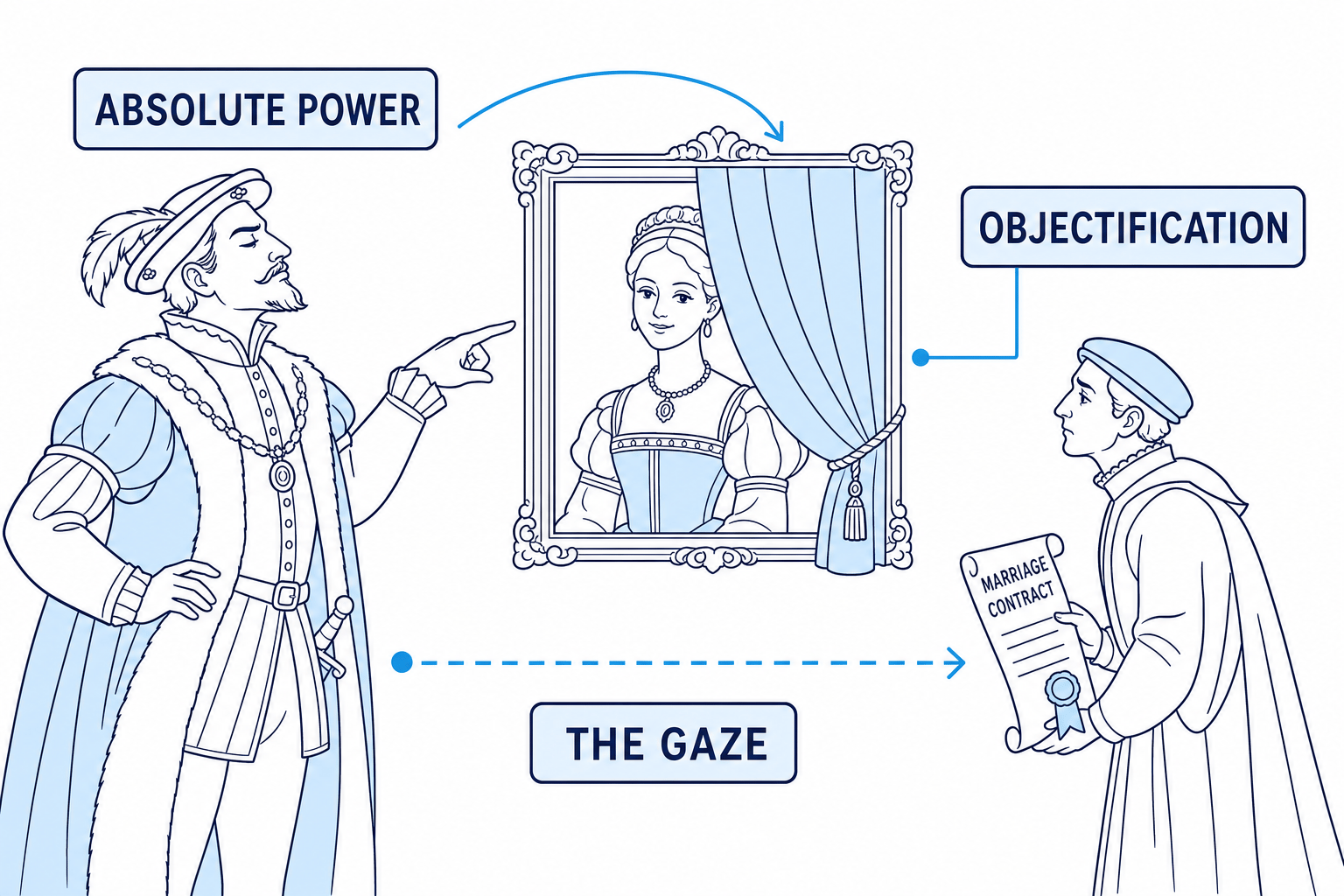
- The Curtain: This is a physical symbol of absolute control. When she was alive, her warm glances were shared with everyone. Now, the Duke is the sole gatekeeper of her smile. He controls exactly who gets to look at her.
"She liked whate’er / She looked on, and her looks went everywhere."
- "looks went everywhere": The Duke's jealousy is rooted in his inability to monopolize her attention. He interprets her natural, warm-hearted joy and appreciation of life as flirting or lack of respect for his "nine-hundred-years-old name."
Misinterpreting the Duchess's character
Do not write that the Duchess was actually unfaithful. Browning leaves no evidence of this. Her "crimes" in the Duke's eyes were innocent: enjoying a sunset, riding her white mule, or accepting a branch of cherries from an officer. The infidelity exists entirely within the Duke's paranoid, narcissistic mind.
Worked Example: Analyzing the Duke's Power
Let's walk through how to construct a high-scoring analytical paragraph on a pivotal moment in the poem. We will focus on the climax of the Duke's monologue:
"This grew; I gave commands; / Then all smiles stopped together."
Analyzing the Duke's power through syntax and punctuation
- Identify the core method and its immediate effect: Begin by identifying how Browning uses syntax (sentence structure) and punctuation to signal the Duke’s lethal authority. The line is split into three distinct, abrupt clauses by semi-colons (caesura). This mimics a cold, calculated step-by-step procedure: problem ("This grew"), action ("I gave commands"), result ("Then all smiles stopped together").
- Examine the language and tone of the middle clause: Analyze the chillingly passive and vague phrasing of "I gave commands." By refusing to name the actual act of execution, the Duke uses a clinical euphemism. This emphasizes his extreme aristocratic privilege—he does not have to dirty his own hands; he merely speaks, and life is ended.
- Connect the structural pause to the Duke's psychological control: Explore the impact of the finality in the monosyllabic phrase "all smiles stopped together." The heavy, flat rhythm contrasts sharply with the earlier enjambment of his speech. This sudden structural stop represents the literal termination of the Duchess's life and the absolute silencing of her voice, leaving her frozen forever as a passive art object on his wall.
Comparative Connections (AO3)
In your Pearson Edexcel Section B exam, you will have to compare "My Last Duchess" with another poem from the Anthology. Here are some of the strongest pairings:
| Comparative Theme | Comparison Poem | Key Analytical Connection |
|---|---|---|
| Abuse of Power & Pride | Ozymandias (by Percy Bysshe Shelley) | Both poems feature arrogant, tyrannical rulers who seek to immortalize their power through art (a statue vs. a painting). Both rulers are ultimately exposed by the writers as deeply flawed, although Ozymandias's power is destroyed by time, while the Duke’s power remains temporarily unchecked. |
| Jealousy & Dark Psychology | Medusa (by Carol Ann Duffy) | Both poems explore the destructive nature of jealousy and the desire to control a partner. While the Duke uses physical murder to silence his wife, Medusa’s jealousy physically transforms others into stone, turning living beings into lifeless art, much like the Duke’s portrait. |
Drafting an AO3 comparison paragraph
Always start your paragraphs with a conceptual point that applies to both poems (e.g., "Both Browning and Shelley explore how powerful men use art as a tool to project their authority..."). Then, use transition words like "Similarly," "In contrast," or "Whereas" to move smoothly between your analysis of the Duke and your analysis of the second poem.
In the exam
- Never feature-dump: Do not just point out "this is a dramatic monologue" or "there is enjambment here." Always follow up with why the writer used it and how it affects the reader's view of the Duke's psychology.
- Anchor your context (AO4): Integrate context smoothly. Instead of a separate paragraph about the Renaissance, weave it into your close reading: "The Duke's obsession with his 'nine-hundred-years-old name' reflects both the rigid class hierarchies of the Renaissance and the Victorian anxiety surrounding familial reputation."
- Track the shift at the end: Note how the Duke moves smoothly from discussing his dead wife to looking at a bronze statue of "Neptune... taming a sea-horse." Point out that this statue is a metaphor for how he views himself: a god-like figure taming a wild, beautiful creature.
Check yourself
- Why is it significant that the Duke is the only speaker we hear throughout the entire poem?
- How does the physical symbol of the "curtain" reflect the theme of control?
- What are the major similarities and differences between the presentation of power in "My Last Duchess" and "Ozymandias"?
