What you'll learn
- How the poem presents ordinary life and young love continuing during the siege of Sarajevo.
- How Tony Harrison uses contrast, sensory imagery and rhyming couplets to show resilience.
- How the poem shifts from daytime hardship to night-time hope, then to a troubling final image.
- How to write about the poem for AO1 and AO2 in a Component 2 Section A essay.
The poem at a glance
Tony Harrison’s The Bright Lights of Sarajevo is set during the siege of Sarajevo in the 1990s, when civilians lived under shelling, sniper fire, shortages of food, water and fuel, and constant danger.
The poem focuses on a surprising scene: after a day of extreme hardship, young people still go out walking in the dark streets. In particular, Harrison watches a young couple flirting. Their romance is set against the memory of a massacre, as they stand near “shell scars” left by mortar fire.
The central idea
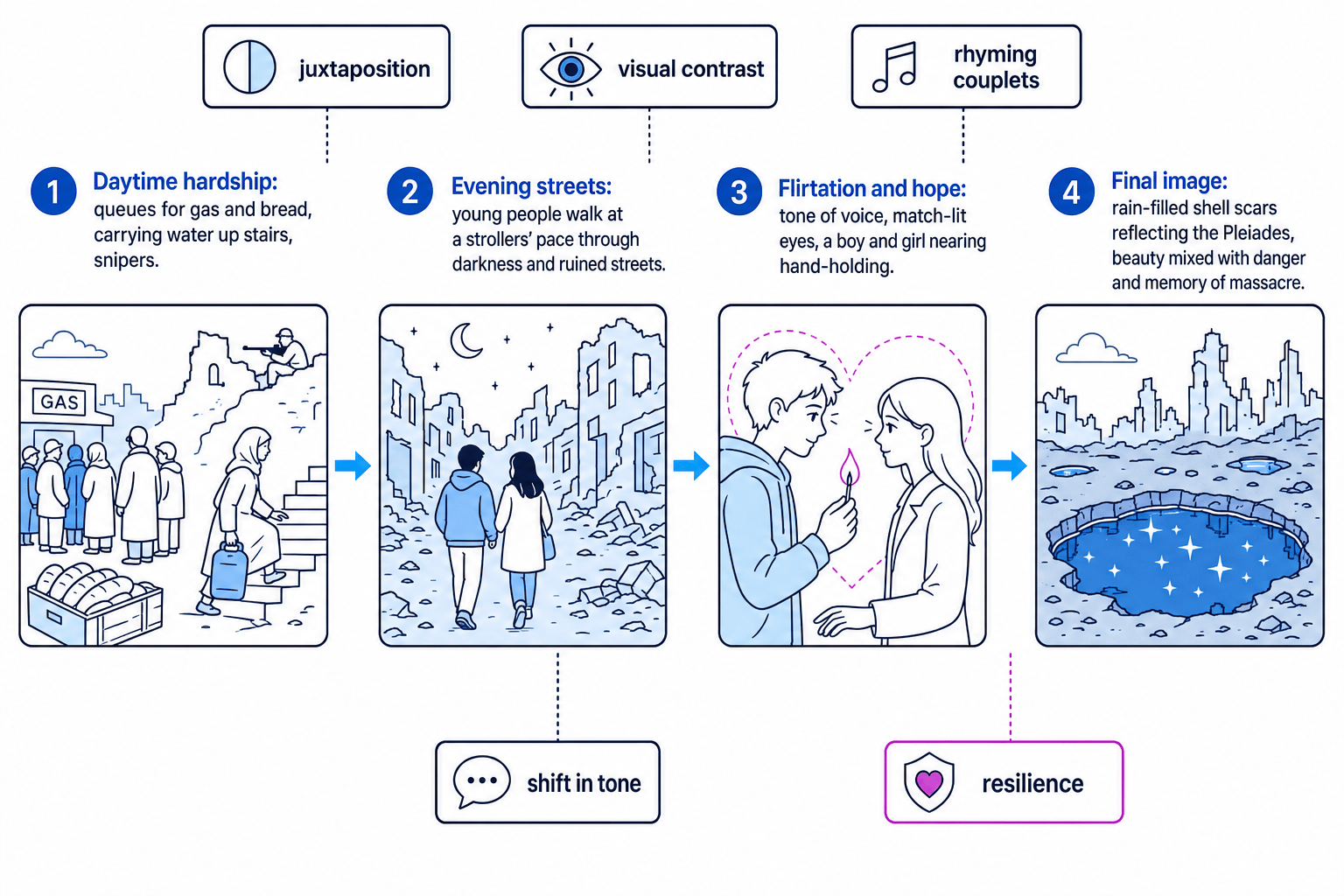
Harrison shows that war damages ordinary life, but does not completely destroy it. The poem’s power comes from the contrast between violence and tenderness: queues, snipers and massacre exist alongside walking, flirting, hand-holding and starlight.
The poem’s movement is important: it begins with survival, moves into social life and romance, and ends with beauty reflected in wounds left by war.
Context: Sarajevo under siege
Sarajevo is the capital of Bosnia and Herzegovina. During the Bosnian War, the city was besieged from 1992 to 1996. Civilians had to queue for basic supplies while exposed to snipers and shelling.
You do not need to write a history essay, but a little context helps your AO1 understanding. Harrison is not describing an abstract war zone: he is showing a real city where everyday actions — getting bread, carrying water, going for a walk — have become dangerous.
AO1
AO1 means showing clear understanding of the text and supporting your ideas with relevant references or quotations. For this poem, AO1 includes understanding the siege setting, the hardship of civilians, and the continuing human need for love and normality.
Summary: what happens in the poem
The poem begins with a list of what “Sarajevans” endure during the day. They queue for gas, bread and water. Harrison mentions “precious meagre grams” of bread, making the ration seem tiny and valuable. People may also be “dodging snipers”, so ordinary errands become life-threatening.
Then the poem turns. The speaker says you might expect the nights to be empty, but “that’s just not the case”. Instead, young people walk through the ruined streets at a “strollers’ pace”. The darkness makes it impossible to tell whether someone is “Muslim, Serb or Croat”, so the poem briefly emphasises shared humanity rather than division.
The focus narrows to flirtation. A boy and girl move towards each other through voice, gesture and a small flame from a match or lighter. Finally, the speaker notices that they are standing near “shell scars” from a massacre at a bread queue. Rainwater in the holes reflects the stars, including the “splintered Pleiades”. The ending is beautiful but disturbing because the reflected stars appear inside wounds made by violence.
Theme 1: resilience and normality in wartime
Resilience
Resilience means the ability to keep going, recover, or preserve hope under pressure. In this poem, resilience is shown through ordinary behaviour continuing in extraordinary danger.
The young people’s walk is not heroic in a loud or dramatic way. Its courage lies in being ordinary. They walk at a “strollers’ pace”, a phrase that suggests leisure and calm. This is striking because the streets have been destroyed by “Serb shells”.
Harrison therefore shows normality as an act of resistance. The young people are not soldiers; they are civilians reclaiming the city by using its streets for social life rather than only for fear.
Analysing resilience in a quotation
- Start with the ordinary action: “The young go walking at a strollers’ pace” presents walking as relaxed and social, not frantic.
- Set it against the context: this happens after queues for supplies and the danger of “dodging snipers”, so the calm pace becomes surprising.
- Explain the effect: Harrison suggests that resilience can be quiet and everyday; the young people preserve a sense of normal life even when war tries to control their movements.
Theme 2: hope and humanity surviving conflict
The poem repeatedly pushes against division. In the dark, the walkers are “black shapes impossible to mark / as Muslim, Serb or Croat”. Harrison is not saying identity does not matter. Instead, he is showing that in this moment of darkness and shared vulnerability, ethnic and religious labels become less visible than common human behaviour.
The references to different words for bread — “hjleb”, “hleb” and “kruh” — are especially effective. Bread is a basic human need, but language reveals cultural difference. By placing these words in the same line, Harrison shows both difference and shared need.
A strong theme sentence
Instead of writing “the poem is about war”, try: “Harrison presents war as a force that threatens ordinary life, but he also shows human connection surviving through shared needs, social rituals and young love.”
Theme 3: suffering contrasted with ordinary life
Juxtaposition
Juxtaposition is when a writer places two contrasting things close together so that each one affects how we understand the other.
This poem is built on juxtaposition. Harrison places queues and snipers beside flirting; ruined streets beside strolling; shell holes beside stars. The contrast makes the romance more moving because it is fragile. It also makes the violence more shocking because it has invaded ordinary spaces.
A key example is the couple standing on “two shell scars”. The word “scars” suggests that the city itself has been wounded. Yet the couple’s possible hand-holding suggests tenderness and new life. Harrison does not let either image cancel the other out: both exist at once.
Making the poem too simple
Do not write as if the poem is only hopeful or only tragic. The best answers notice that Harrison holds both together: the poem is hopeful because love continues, but tragic because that love exists beside massacre and danger.
Language: vivid visual and sensory contrasts
Harrison’s imagery is strongly visual. Early in the poem, the city feels dark, ruined and dangerous: “unlit streets”, “black shapes”, and “Serb shells destroyed”. Later, small sources of light become important: a match or lighter, the “star-filled evening sky”, and the reflection of the Pleiades.
Imagery
Imagery is language that appeals to the senses, especially sight, sound, touch, taste or smell. In this poem, visual imagery is central because light and darkness help carry the poem’s meaning.
The phrase “tender radar of the tone of voice” is unusual. “Radar” belongs to the world of detection and war technology, but “tender” belongs to romance and emotion. This mixed image suggests that in darkness, the young people read tiny signals from each other. Even the language of war is softened into courtship.
The ending is one of the poem’s most important images. The “rain-full shell-holes” reflect “fragments of the splintered Pleiades”. The Pleiades are a cluster of stars. Harrison makes the sky seem broken into fragments, as if even beauty has been shattered by war. The shell holes become “death-deep, death-dark wells”, linking visual darkness with death and memory.
Explaining the final image
- Identify the image: the boy sees the reflected Pleiades in rainwater collected inside shell holes.
- Notice the contrast: stars usually suggest beauty, distance and wonder, while shell holes suggest violence, death and damage.
- Link to meaning: Harrison suggests that hope and beauty still exist, but they are seen through the physical wounds of war, so the ending remains unsettling rather than purely comforting.
Form: rhyming couplets
Rhyming couplet
A rhyming couplet is a pair of lines placed together where the final words rhyme or nearly rhyme. Harrison uses couplets throughout the poem, such as “pass” / “gas” and “day” / “way”.
The couplets give the poem a controlled, flowing movement. This matters because the subject is chaotic: siege, shortages, snipers and shelling. The regular rhyme can suggest the persistence of order and rhythm in a damaged city.
However, the couplets are not light or comic. Sometimes the rhyme makes the horror more memorable, as in “bread” / “dead”. The rhyme links food, a symbol of survival, with death, showing how war has contaminated the most basic parts of life.
Structure: from hardship to hope to haunted beauty
The poem begins with a long build-up: “After the hours…” Harrison delays the main point while listing hardships. This makes you feel the weight of daily survival before you see the surprising night-time scene.
The turning point comes with “but tonight in Sarajevo that’s just not the case”. This shift changes the poem from expectation to surprise. Instead of empty streets, we see young people walking, flirting and seeking connection.
The final movement narrows from the crowd to one couple, then from the couple to the ground beneath them. This zooming-in structure makes the ending powerful: the private romantic moment is literally positioned over a public memory of massacre.
Tone
Tone means the attitude or mood created by the writer’s choices. In this poem, the tone shifts from bleak and documentary-like to tender, then to haunted and reflective.
Tracing the structural shift
- At the start, focus on the list of hardships: gas, bread, water, stairs and snipers create a tone of endurance and danger.
- At the turn, compare expectation with reality: the speaker says you would think the streets were empty, “but” young people are walking.
- At the end, connect the couple to the shell scars: the structure moves from public suffering to private hope, then back to collective trauma.
Key moments to remember
| Moment | Brief quotation | Why it matters |
|---|---|---|
| Daily hardship | “precious meagre grams” | Shows scarcity and the struggle for survival. |
| Constant danger | “dodging snipers” | Turns ordinary journeys into acts of risk. |
| Evening surprise | “that’s just not the case” | Marks the shift from expected emptiness to life continuing. |
| Shared humanity | “Muslim, Serb or Croat” | Suggests darkness temporarily blurs divisions. |
| Romance | “tender radar” | Blends danger and intimacy in one image. |
| Memory of violence | “blood-dunked crusts” | Makes the massacre graphic and shocking. |
| Final contrast | “splintered Pleiades” | Shows beauty reflected in the wounds of war. |
Writing about the poem for Component 2 Section A
For Edexcel International GCSE English Language A, this poem belongs to Anthology Part 2, assessed in Component 2 or Component 3. In the examined Component 2, Section A is worth 30 marks. For an essay on this poem, you mainly need AO1 and AO2: understand the poem clearly, select relevant evidence, and analyse Harrison’s methods.
AO2
AO2 means analysing how writers use language and structure to create meanings and effects. In this poem, useful AO2 methods include juxtaposition, imagery, rhyming couplets, tone shifts, and the movement from public hardship to private romance.
A strong paragraph should not just spot a technique. It should connect method to meaning. For example, if you mention the rhyming couplet “bread” / “dead”, explain how the rhyme forces together survival and death.
Building an AO2 paragraph
- Make a focused point: Harrison presents ordinary life as permanently marked by violence.
- Choose short evidence: the phrase “blood-dunked crusts” links bread with the aftermath of massacre.
- Analyse the method: the shocking compound image turns a basic symbol of survival into something stained by death.
- Link to the poem’s wider meaning: this prepares us for the final shell-hole image, where beauty and horror also exist in the same place.
In the exam
- Start with the poem’s big contrast: hardship and danger are set against youth, flirtation and hope.
- Use short quotations and analyse the words closely; do not retell the whole poem.
- Track the structure: daytime hardship, evening life, the young couple, then the haunted final image.
- Keep AO2 tied to meaning: name methods such as juxtaposition or couplets only when you explain their effect.
- Aim for a balanced interpretation: the poem is both a tribute to resilience and a reminder of trauma.
Check yourself
- How does Harrison make the young people’s ordinary walk seem brave?
- Why is the final image of the Pleiades beautiful but disturbing?
- What is the effect of placing romance beside references to shells, snipers and massacre?
