What you'll learn
- What happens in An Unknown Girl and why the henna moment matters.
- How Alvi presents identity, belonging, heritage and longing.
- How to analyse key methods: extended metaphor, sensory imagery, repetition, refrain, tone and structure.
- How to write about the poem for Edexcel IGCSE English Language A Component 2 Section A, using AO1 and AO2.
The poem at a glance
An Unknown Girl is spoken by a speaker who has her hand decorated with henna in an Indian bazaar. The girl applying the henna is not named, but she becomes very important: she represents a living connection to Indian culture, tradition and belonging.
The poem begins with a vivid public scene — “In the evening bazaar” — but gradually turns inward. The speaker focuses on her hand, the henna pattern, and what it means to feel connected to a place and culture that may also feel distant or uncertain.
Use this map to keep the whole poem in your head: what happens, what methods Alvi uses, and what big ideas you can connect in an essay.
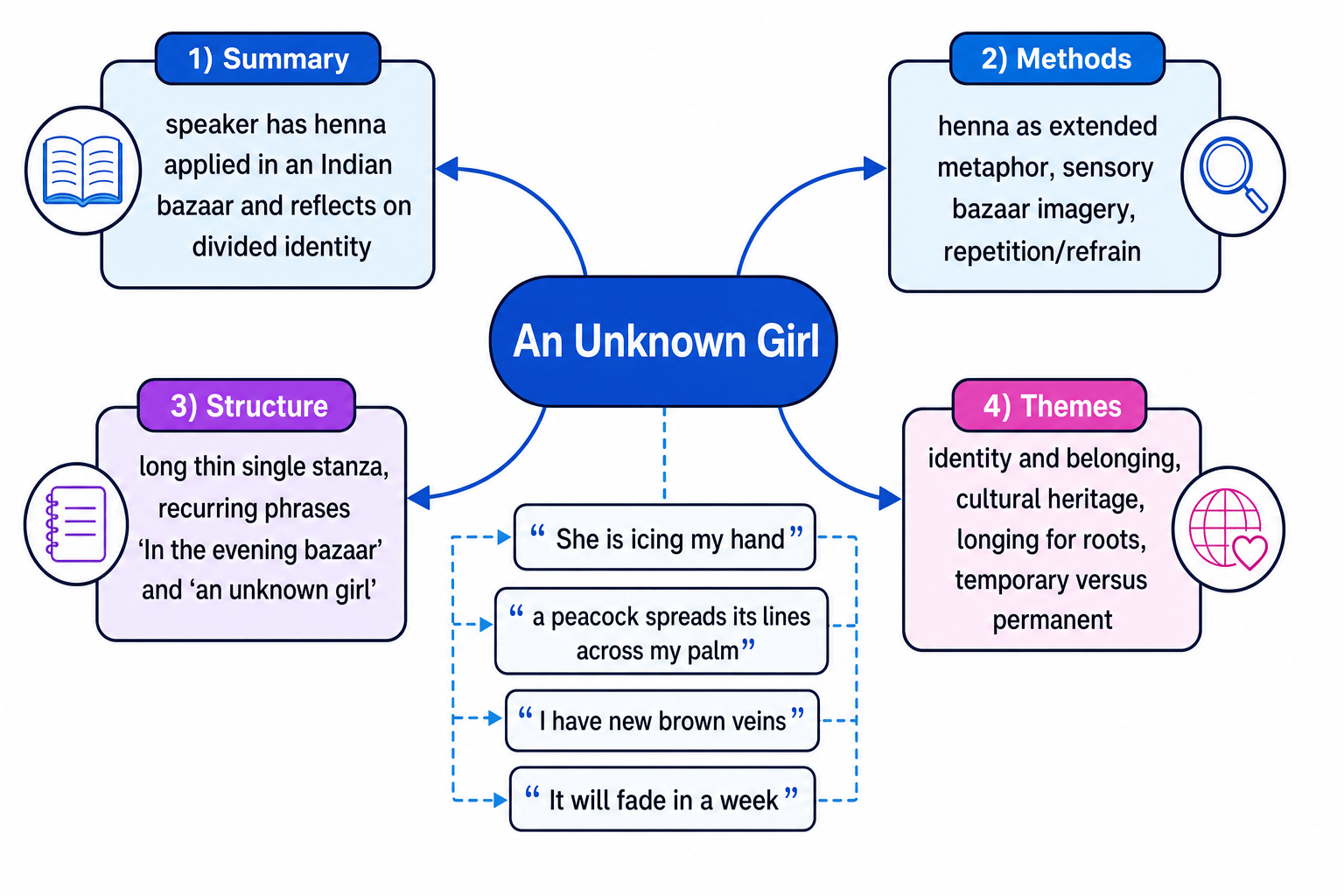
Speaker
The speaker is the voice we hear in a poem. The speaker is not automatically the poet, although the poem may draw on the poet’s experiences, memories or cultural background.
The core meaning
The henna design is temporary, but the speaker’s longing for cultural connection feels deep and lasting.
Exam focus: AO1 and AO2
For Edexcel IGCSE English Language A, Component 1 is worth 60%. Component 2, the examined Poetry and Prose plus Imaginative Writing route, is worth 40%; Section A is 30 marks and Section B is 30 marks. In Component 2 Section A, An Unknown Girl belongs to Anthology Part 2.
For this poem, your essay mainly needs:
- AO1: show you understand the poem, select relevant references, and interpret ideas.
- AO2: analyse how Alvi uses language, structure and form to create meaning.
Method
A method is a deliberate choice made by the writer. In poetry, this could be a word choice, image, metaphor, repeated phrase, line break, stanza shape, contrast, tone or structure.
Summary: what happens?
The poem opens in a busy bazaar at evening. An “unknown girl” is “hennaing” the speaker’s hand. The process is intimate: the girl steadies the speaker’s hand and carefully draws a “wet brown line”.
The henna pattern becomes more than decoration. It forms a “peacock” across the speaker’s palm, then becomes “new brown veins”, suggesting that culture, ancestry and belonging are entering the speaker’s body.
However, the poem also reminds us that henna is temporary. The speaker says, “It will fade in a week.” By the end, she imagines reaching across India with “hands outstretched”, still “longing for the unknown girl”.
Moving from summary to interpretation
-
Start with the literal event: the speaker has henna applied to her hand in an Indian bazaar by an unnamed girl.
-
Ask what the event begins to represent: the henna is not just decoration; it becomes a sign of cultural connection because it is placed directly onto the speaker’s skin.
-
Link this to the ending: because the henna will “fade”, the poem becomes about the speaker’s fear that this connection may be temporary, fragile or hard to keep.
Theme 1: identity and belonging
The speaker seems caught between connection and distance. She is physically in the bazaar, receiving a traditional design, but the phrase “an unknown girl” suggests separation. The girl is close enough to touch the speaker’s hand, yet still unknown.
This creates a powerful tension: the speaker longs to belong, but belonging is not simple. The henna lets her feel connected for a moment, but it cannot permanently solve her divided identity.
Identity
Identity means the way a person understands who they are. In literature, identity can be shaped by culture, family, language, place, memory, gender, class and personal experience.
The line “I have new brown veins” is especially important. “Veins” suggests blood, ancestry and something inside the body. The adjective “new” suggests that the speaker is gaining or rediscovering a connection to Indian heritage.
Theme 2: cultural heritage and longing
Cultural heritage
Cultural heritage means the traditions, customs, beliefs, art, language and shared memories passed down through a culture or community.
The bazaar is full of Indian cultural detail: henna, rupees, kameez, peacock imagery and shop-fronts. These details make the setting feel vivid and alive.
However, Alvi also includes modern and Westernised images, such as “Western perms” and “Miss India 1993”. This suggests India is not shown as a frozen, traditional place. It is layered, commercial, modern, changing and complex.
Making India too simple
Do not write as if the poem presents India only as “colourful” or “exotic”. Alvi’s bazaar is lively and sensory, but it is also commercial, modern, Western-influenced and emotionally complicated.
Henna as an extended metaphor
Extended metaphor
An extended metaphor is a comparison that continues across several lines or through a whole text. It helps the writer develop a bigger idea, not just a single image.
The henna is the poem’s central extended metaphor. Literally, it is a temporary body decoration. Symbolically, it represents the speaker’s relationship with Indian culture: beautiful, intimate and meaningful, but also fragile and temporary.
At first, the henna is described almost like cake decoration: “She is icing my hand”. This makes the action feel delicate and careful. Later, the design becomes natural and bodily: “a peacock spreads its lines / across my palm” and “I have new brown veins”.
The metaphor grows as the poem continues:
- decoration becomes art;
- art becomes a bird;
- the bird becomes veins;
- the veins become cultural belonging.
Analysing the henna metaphor
-
Choose a short quotation with a strong image: “I have new brown veins”.
-
Identify the method: this is metaphorical because the henna lines are not literally veins, but they are being described as if they are part of the speaker’s body.
-
Explain the effect: “veins” suggests blood, ancestry and inherited identity, so the henna briefly makes cultural heritage feel physical and internal rather than distant.
-
Add the complication: because henna fades, the metaphor also suggests that the speaker’s sense of belonging is precious but unstable.
Sensory imagery: bringing the bazaar to life
Sensory imagery
Sensory imagery is descriptive language that appeals to the senses: sight, sound, touch, taste or smell.
Alvi’s bazaar is strongly visual and tactile. We see “neon”, “wet brown” henna, “balloons”, “shop-fronts” and banners. We also feel the physical closeness of the girl steadying the speaker’s hand.
The phrase “satin-peach knee” is tactile and visual. “Satin” suggests smoothness and softness, while “peach” suggests warmth and colour. The henna process is therefore not cold or distant; it is intimate and human.
There is also a strong contrast between the “furious streets” and the moment when they are “hushed”. The outside world is noisy and chaotic, but the speaker’s emotional focus makes the scene feel suddenly quiet.
Repetition and refrain
Repetition
Repetition is when a writer deliberately uses the same word, phrase or idea more than once.
Refrain
A refrain is a repeated line or phrase in a poem, often returning like a chorus in a song.
The poem repeats phrases such as “In the evening bazaar” and “an unknown girl / is hennaing my hand”. This creates a circular feeling, as if the speaker keeps returning to the same moment because it matters so much.
The repetition also makes the “unknown girl” feel symbolic. She is one person in the bazaar, but she comes to represent a wider connection to heritage, place and belonging.
Writing about repetition
Do not just say “the repetition emphasises it”. Say what is being emphasised: the speaker’s fixation on the moment, the importance of the girl, and the desire to hold onto cultural connection.
Structure and form
Form
Form means the type and overall shape of a text. In poetry, form includes features such as stanza arrangement, line length, rhyme pattern and whether the poem uses regular rhythm.
The poem is written as one long, thin stanza.
Stanza
A stanza is a group of lines in a poem, similar to a paragraph in prose.
Because An Unknown Girl is one continuous stanza, the poem can feel like one flowing memory or one uninterrupted emotional experience. The narrow lines may also visually echo thin henna lines being drawn across the hand.
The poem uses free verse.
Free verse
Free verse is poetry without a regular rhyme scheme or fixed rhythm. It can feel more natural, like thought or speech.
The free verse suits the speaker’s reflective voice. Her thoughts seem to move through the bazaar, then into memory, identity and longing.
Enjambment
Enjambment happens when a sentence or phrase runs over from one line into the next without a strong pause.
Alvi’s line breaks often make the poem feel delicate and unfolding, like the henna pattern itself. For example, “a peacock spreads its lines / across my palm” lets the image expand across the line break, just as the design expands across the speaker’s skin.
Linking structure to meaning
-
Notice the visual shape: the poem is long and narrow, with short lines.
-
Connect the shape to the central action: henna is applied in thin lines, so the poem’s form can mirror the careful drawing of the pattern.
-
Connect the form to the speaker’s feelings: the single stanza makes the experience feel continuous, as though the speaker is caught inside one intense moment of memory and longing.
Tone and key moments
Tone
Tone is the attitude or emotional mood created by the writer’s language.
The tone changes across the poem. At first, it is observant and fascinated. The speaker notices the girl’s movements, the henna line and the bazaar around her.
Then the tone becomes more intense and emotional. The speaker says she is “clinging” to the “firm peacock lines”, comparing herself to “people who cling / to the sides of a train”. This simile suggests desperation, danger and need. She is not casually enjoying the henna; she is holding onto what it represents.
By the end, the tone becomes wistful and melancholic. The line “It will fade in a week” is simple and painful. The final image of “hands outstretched” presents longing as physical reaching — a desire that remains unfinished.
Simile
A simile compares one thing to another using “like” or “as”.
Writing a strong paragraph
A good paragraph should not just feature-spot. You need to connect reference, method and meaning.
Building an AO1 and AO2 paragraph
-
Make an interpretive point: Alvi presents cultural identity as something the speaker longs to feel physically connected to.
-
Select precise evidence: the speaker says, “I have new brown veins”.
-
Analyse the method: the metaphor turns the henna lines into “veins”, linking the decoration to blood, ancestry and the body.
-
Explain the effect: this suggests the speaker briefly experiences heritage as something internal and alive, rather than distant or abstract.
-
Develop the idea: however, because the henna will “fade in a week”, Alvi also shows that this sense of belonging is fragile and temporary.
In the exam
-
Start with the poem’s main conflict: the speaker feels both drawn to and separated from her cultural roots.
-
Use short quotations and analyse individual words, such as “unknown”, “veins”, “clinging”, “fade” and “longing”.
-
Keep linking AO2 methods to meaning: henna is an extended metaphor, repetition returns us to the bazaar, and the long thin form mirrors the drawn henna lines.
Check yourself
- How does the “unknown girl” become more than just a character in the bazaar?
- Why is “I have new brown veins” such an important metaphor?
- How does the poem’s ending change or deepen the meaning of the henna?
