Welcome to your study guide for Maya Angelou’s powerful and celebrated poem, "Still I Rise". This text is part of Section A (Poetry and Prose Texts) of your Pearson Edexcel International GCSE English Language A specification (Specification 4EA1, Component 2).
In the exam, you will be assessed on your ability to read, understand, and select material from this poem (AO1), and to analyse how Angelou uses language and structure to achieve her effects (AO2).
What you'll learn
By the end of these study notes, you will:
- Understand the core themes of resilience, historical oppression, black identity, and womanhood within the poem.
- Be able to identify and analyse Angelou’s key linguistic devices, including her defiant similes, rhetorical questions, and the progressive pattern of physical violence.
- Master the structural shift of the poem as it transitions from a structured, confrontational dialogue to a triumphant, lyrical chant.
- Know how to construct a high-scoring, analytical response that satisfies the AO1 and AO2 assessment criteria.
1. Getting to Grips with the Basics: Summary and Themes
Before diving into the complex linguistic machinery Angelou uses, we need to understand the poem's foundational message and context. Written in 1978, "Still I Rise" is a lyrical, defiant assertion of self-worth, survival, and empowerment.
Lyrical poetry
Lyrical poetry is a formal type of poetry which expresses personal emotions or feelings, typically spoken in the first person ("I").
At its heart, the poem is a direct confrontation between the speaker (representing both Angelou herself and the collective voice of black women and historically oppressed peoples) and an unnamed oppressor addressed directly as "You".
Core Themes
- Oppression and Resistance: The speaker acknowledges the systematic attempt to hold her down—historically, socially, and physically—yet demonstrates an unbreakable will to resist.
- Pride and Self-Belief: Angelou uses symbols of wealth (oil, gold, diamonds) to illustrate the inherent value of her body, her laughter, and her spirit.
- Black Identity and Womanhood: The poem celebrates the strength of black women, subverting historical prejudices into sources of power and beauty.
- Hope and History: The closing stanzas explicitly connect the speaker's personal resilience to the historical struggles of her ancestors, transforming personal triumph into a collective victory over the legacy of slavery.
The dual nature of 'I'
While the poem uses the first-person singular pronoun "I", this "I" is not solitary. It is a collective pronoun representing generations of oppressed ancestors. The speaker's individual survival is the vindication of their historical suffering.
2. Analysing Maya Angelou's Language (AO2)
Angelou uses language not just to describe her resilience, but to actively perform it. She employs several key linguistic techniques that you must be ready to identify and analyse in your exam.
A. Similes of Inherent Value
Angelou uses vivid, hyperbolic similes to contrast her actual social standing with her internal sense of worth.
- "Cause I walk like I've got oil wells / Pumping in my living room"
- "Cause I laugh like I've got gold mines / Diggin’ in my own back yard"
- "That I dance like I've got diamonds / At the meeting of my thighs"
These resources (oil, gold, diamonds) are extracted from the earth, often associated with colonization and exploitation. By claiming ownership of these valuable resources within her own body and home, she subverts the history of exploitation and assets her absolute, untameable self-worth.
B. Rhetorical Questions and Direct Address
The poem relies heavily on second-person address ("You"), forcing the reader/oppressor to confront their own prejudice.
Direct Address
Direct address is a rhetorical technique where the writer speaks directly to the reader or an imagined listener using pronouns like "you", creating an immediate, personal, and sometimes confrontational dynamic.
Angelou pairs this with biting rhetorical questions:
- "Does my sassiness upset you?"
- "Does my haughtiness offend you?"
- "Does my sexiness upset you?"
These questions mock the oppressor's discomfort. The words "sassiness", "haughtiness", and "sexiness" are qualities historically weaponized against black women to label them as "difficult" or "inappropriate". Angelou reclaims them as badges of pride.
C. The Pattern of Physical Escalation
One of the most crucial linguistic sequences noted in the Edexcel syllabus is the rapid escalation of physical violence in the sixth stanza:
"You may shoot me with your words, You may cut me with your eyes, You may kill me with your hatefulness, But still, like air, I’ll rise."
Note how the verbs progress in severity: shoot →\to→ cut →\to→ kill. This triadic structure represents the absolute limit of the oppressor’s power. Yet, the final line dissolves this violence entirely with a simple simile: "like air, I'll rise". Air cannot be shot, cut, or killed; it is omnipresent and weightless.
Look for the shift in elements
Notice how the speaker compares herself to different elements throughout the poem. Early on, she rises like "dust" (earthy, low, but inescapable). By the end, she rises like "air" (invisible, infinite, and impossible to trap).
3. Structural & Formal Mastery (AO2)
How a poem is built is just as important as the words used. Angelou carefully designs the structure of "Still I Rise" to mirror the physical and emotional act of rising.
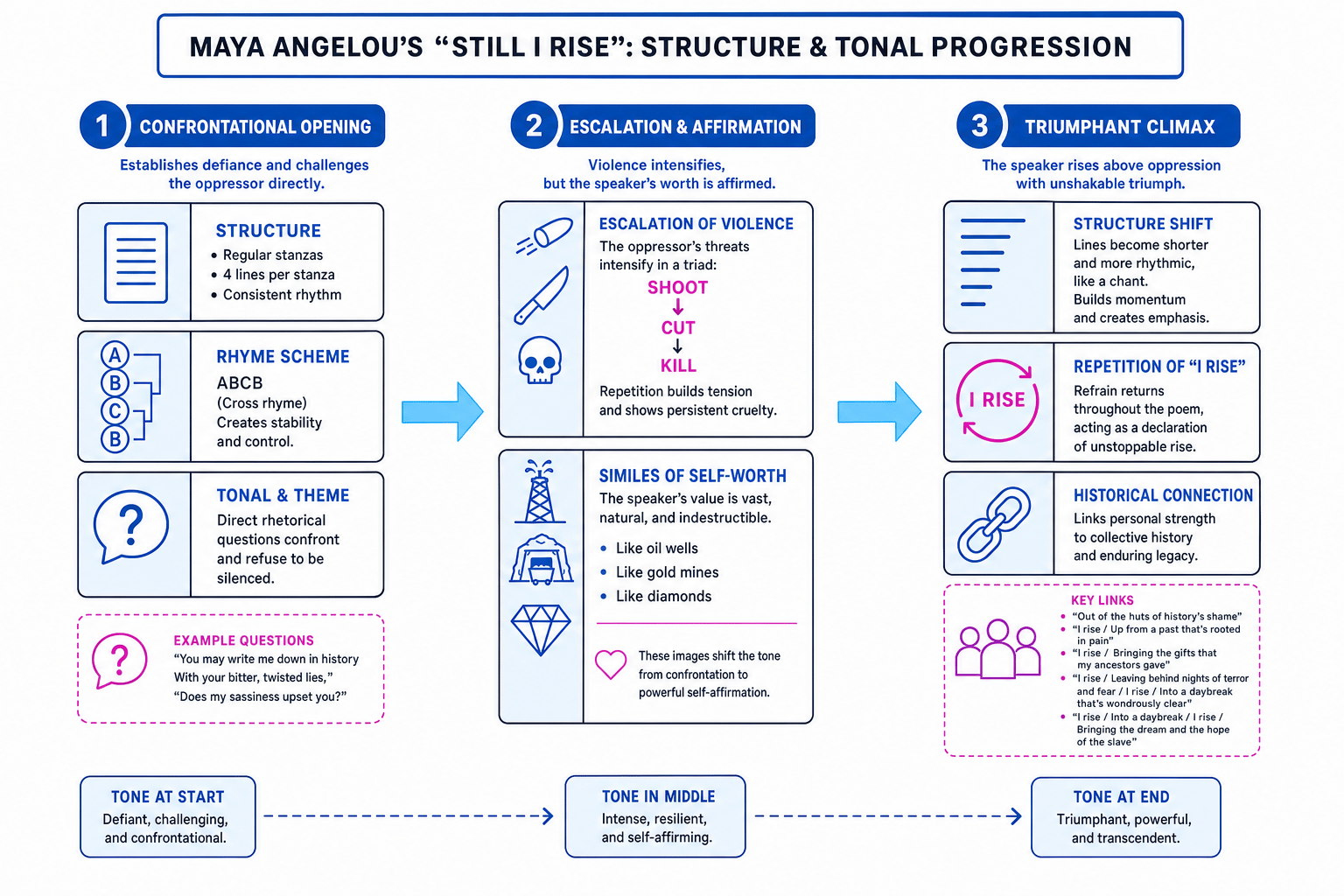
The Structural Shift
As illustrated above, the poem undergoes a dramatic structural transition. Let's break this down:
- Stanzas 1–7: These are highly ordered, traditional quatrains (four-line stanzas). They utilize a steady ABCB or AABB rhyme scheme and a regular, driving rhythm. This rigid structure represents the speaker's total control; she will not let her emotions boil over into chaos. She plays by the rules of formal poetry while dismantling her oppressor.
- Stanzas 8–9: The structure breaks open. The stanzas become longer (six and fifteen lines respectively). The strict rhyme scheme dissolves into a looser, more organic rhythm. The lines shorten, transforming the poem from a standard literary piece into an oral chant or a gospel song.
The Refrain
At the end of the poem, the phrase "I rise" becomes a structural anchor, repeating like a musical chorus.
Refrain
A refrain is a line, group of lines, or part of a line that is repeated at key intervals throughout a poem, particularly at the end of stanzas, to build rhythm and reinforce central themes.
In the final stanza, the words "I rise" are repeated five times. This repetitive chanting builds a powerful momentum, suggesting that her triumph is continuous, infinite, and unstoppable.
Ignoring the historical shift in Stanza 8
Many students focus entirely on the personal triumph in the poem and forget to discuss the profound historical shift in the final stanzas. In Stanza 8, the speaker moves from her personal body to the history of slavery: "Out of the huts of history’s shame" and "I’m a black ocean, leaping and wide". Do not miss this connection to collective transgenerational trauma and survival!
4. Worked Example: Analysing a Language Device
Let's walk through how to construct an analytical paragraph analyzing Angelou’s language to secure high marks for AO2 (Analysis of Language and Structure).
Analysing linguistic patterns of defiance
Task: Analyse how Maya Angelou uses language in the sixth stanza to convey her resilience.
- State your point clearly, linking to the question and identifying a specific technique:
- Angelou employs a pattern of escalating metaphorical violence in the sixth stanza to demonstrate that no amount of systematic prejudice can suppress her spirit.
- Introduce your evidence cleanly and accurately, embedding the quote:
- The speaker addresses her oppressor directly, declaring, "You may shoot me with your words, / You may cut me with your eyes, / You may kill me with your hatefulness."
- Analyse the specific language choices, explaining their meaning and linguistic class:
- The use of the modal verb "may" suggests permission, implying that while the oppressor has the capacity to attempt these acts, they do not have the power to control the outcome. Furthermore, the triadic progression of the active verbs—"shoot", "cut", and "kill"—escalates from physical wounding to absolute destruction. Angelou metaphorically associates everyday human actions ("words", "eyes", "hatefulness") with lethal weapons, highlighting how deeply ingrained and hostile social prejudice is.
- Analyse the structural or linguistic resolution and its emotional effect on the reader:
- However, this cumulative tension is immediately dissolved in the final line: "But still, like air, I’ll rise." The conjunction "But" signals a volta, and the simile "like air" contrasts the heavy, destructive imagery of the preceding lines with an element that is weightless, life-giving, and completely immune to physical destruction. This reassures the reader of her ultimate triumph.
5. Summary Reference Cards
Use this quick summary table to revise the structural and language patterns of the poem before your exam.
| Section of Poem | Primary Technique | Structural Feature | Key Quote | Core Effect |
|---|---|---|---|---|
| Stanzas 1–4 (The Challenge) | Rhetorical questions, subverted similes of wealth. | Regular quatrains, ABCB rhyme scheme. | "Does my sassiness upset you?" | Establishes absolute control and confronts the oppressor's fragility. |
| Stanzas 5–7 (The Resilience) | Triadic escalation, natural imagery (moons, suns). | Steady rhythm, continuation of regular stanzas. | "But still, like air, I'll rise." | Asserts that her survival is as natural and inevitable as the tides. |
| Stanzas 8–9 (The Legacy) | Historical metaphors, chanting repetition. | Breakdown of rigid stanzas, introduction of refrain. | "I am the dream and the hope of the slave." | Elevates her personal victory to a historic redemption for her ancestors. |
In the exam
When writing about "Still I Rise" in your Section A essay:
- Integrate Language and Structure: Do not write a paragraph only on language and then a separate paragraph on structure. Instead, show how they work together. For instance, explain how the escalating vocabulary of violence in Stanza 6 is resolved structurally by the short, punchy refrain of "I rise" in the final lines.
- Be Precise with Terminology: Avoid generic terms like "the writer uses imagery". Instead, use precise descriptors like "hyperbolic similes of wealth", "triadic escalation", "direct second-person address", and "cross-rhyming quatrains transitioning to free-verse refrains".
- Address the 'Why': Always link the technique back to Angelou's purpose. She isn't just using a refrain to make the poem sound catchy; she is using it to mimic the repetitive, unstoppable nature of her rise against systematic racism.
- Link to the Historical Context: Ensure your reading of the poem acknowledges both the personal perspective (Angelou as a woman) and the collective perspective (the legacy of American slavery and the Civil Rights movement).
Check yourself
Before closing this topic, make sure you can answer these questions confidently:
- Why does Angelou transition from regular four-line stanzas to the repetitive chanting style at the end of the poem?
- What is the symbolic significance of comparing her value to "oil wells", "gold mines", and "diamonds"?
- How does the verb progression "shoot" →\to→ "cut" →\to→ "kill" function structurally to build tension in the poem?
