What you'll learn
- What a review is and how it differs from a plain description.
- How to structure a review for Component 1 Section B.
- How to balance opinion, evidence, tone and recommendation.
- How to adapt your review to the audience, publication and purpose in the question.
Where reviews fit in the course
In Pearson Edexcel International GCSE English Language A, Component 1 is worth 60% of the qualification. It has Section A: Non-fiction Reading and Section B: Transactional Writing, each worth 45 marks.
A review is one of the transactional writing forms you may be asked to write in Section B. This task rewards AO4 and AO5: communicating effectively for the task, audience and purpose, while writing clearly and accurately.
Transactional writing
Transactional writing is writing that has a practical purpose in the real world, such as informing, persuading, advising, arguing, reviewing or explaining.
A review is not just “what happened” or “what something is like”. It is a controlled piece of writing that describes, evaluates and recommends.
Review
A review is a piece of writing that gives an informed judgement about something — such as a book, film, restaurant, product, performance, exhibition, game or place — using description, evidence and evaluation.
The review’s main job: judge, don’t just describe
A common weak review sounds like a list:
- The restaurant is in town.
- It has pasta.
- The staff were friendly.
- I liked it.
That is not enough for high marks. A strong review explains how far something succeeds, why it succeeds or fails, and who it would suit.
The review triangle
A successful review balances three things: description of the subject, evaluation of its quality, and a recommendation for the reader.
Description
Description means giving enough detail for the reader to understand what you are reviewing. For example, if you review a film, the reader needs to know its genre, basic premise and perhaps its main performances — but not the whole plot.
Evaluation
Evaluation means making a reasoned judgement about quality. You are not just saying “good” or “bad”; you are explaining what works, what does not, and why.
Recommendation
A recommendation tells the reader whether they should try it, avoid it, or approach it with certain expectations.
Turning description into evaluation
A plain description says: “The café has a small menu and modern seating.”
A stronger review evaluates that detail:
- Decide what the detail suggests about the experience: a small menu could mean focus and quality, or lack of choice.
- Connect it to the likely audience: busy students may prefer quick, simple options; families may want more variety.
- Make a judgement: “The compact menu works well for a quick lunch, but anyone hoping for a wide choice of hot meals may feel short-changed.”
Audience, purpose, form, tone and register
Before you write, read the task carefully. The best reviews sound as if they belong in the publication named in the question.
Audience, purpose, form, tone and register
Audience means who will read your writing. Purpose means why you are writing. Form means the type of writing, such as a review. Tone is your attitude or mood. Register is the level of formality you choose.
For example, a review for a school magazine can be lively and direct. A review for a local newspaper may sound more balanced and polished. A review for a teenage website might be more conversational, but it still needs control and accuracy.
Ask three questions first
Before writing, ask: Who is reading this? Where will it appear? What do they need from me before deciding?
Adapting a review to publication and audience
Suppose the task asks you to review a new leisure centre for a local newspaper.
- Choose a suitable register: a local newspaper needs a clear, balanced, semi-formal voice rather than slang-heavy enthusiasm.
- Select relevant details for the audience: local readers will care about price, facilities, accessibility, cleanliness, staff and value for money.
- Shape the judgement around usefulness: “For regular swimmers, the centre is a genuine improvement; for families, however, the high weekend prices may be harder to justify.”
A strong review structure
You do not need a rigid formula, but a clear shape helps the examiner see that you can organise ideas. The structure below is a useful planning skeleton.
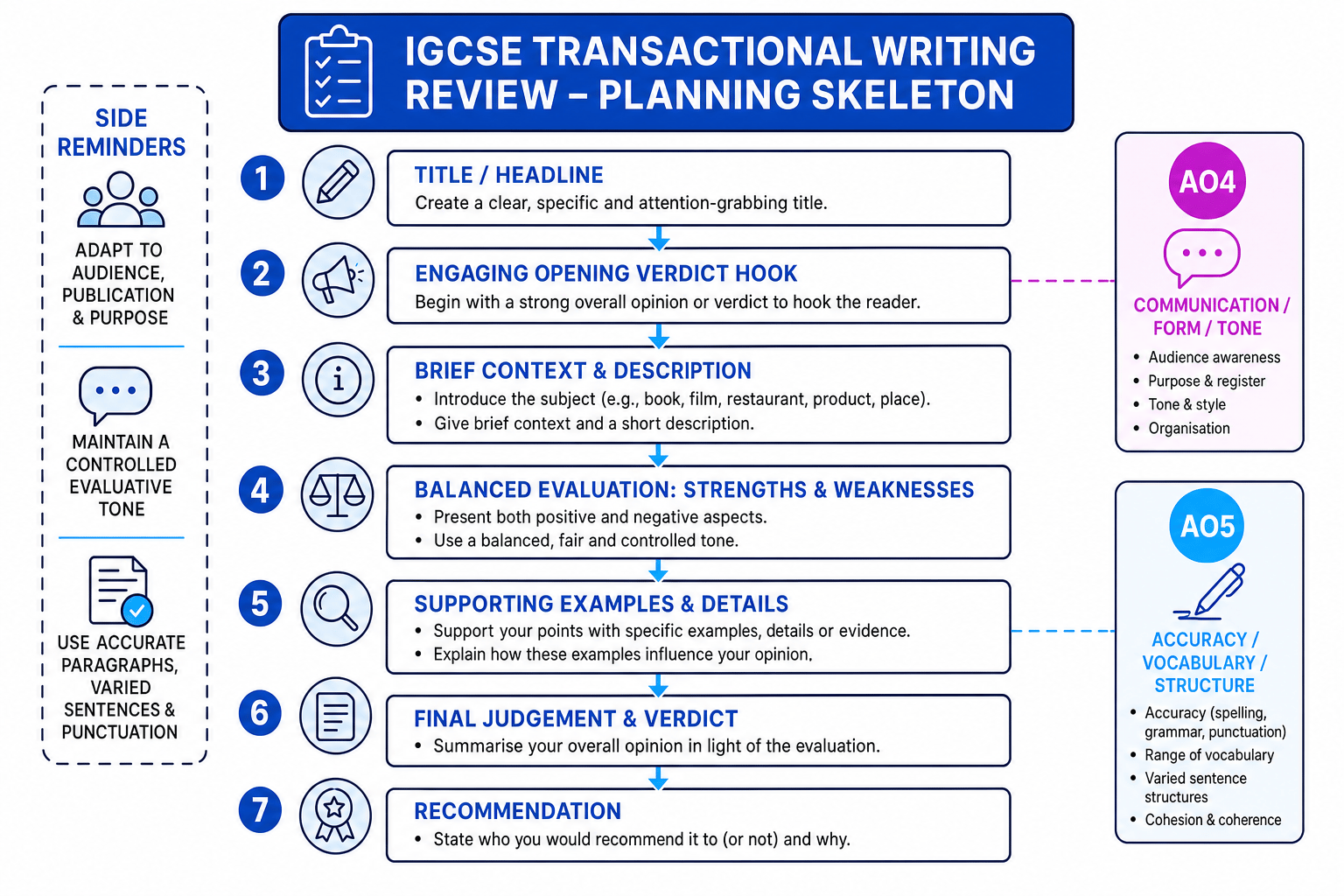
1. Title or headline
A review often begins with a title. It should be specific and suggest your judgement.
Weak: A Review of the Film
Stronger: Big Ideas, Uneven Ending: A Review of The Latest Sci-Fi Release
You do not need to overdo wordplay. Clarity matters more than trying to be clever.
2. Engaging opening
The opening should quickly establish your overall response. You can begin with:
- a bold judgement
- a question
- a contrast
- a vivid first impression
- a brief anecdote
For example: “At first glance, the new town-centre café looks like another forgettable lunch spot; after one visit, it proves to be far more thoughtful than its modest exterior suggests.”
3. Brief context and description
Give the reader enough background. What is it? Where is it? What type of thing is it? What should the reader expect?
Do not spend half the review retelling the plot of a film or listing every item on a menu. Description should support evaluation.
Retelling instead of reviewing
In a film or book review, do not narrate the whole plot. Select only the details needed to support your judgement.
4. Balanced evaluation
A high-quality review usually includes both strengths and limitations. “Balanced” does not mean pretending both sides are equal. It means your judgement feels fair.
You might write:
- “Although the service is slow at peak times, the food is fresh enough to make the wait bearable.”
- “The game’s visuals are impressive, but its repetitive missions prevent it from becoming truly memorable.”
- “The exhibition is not perfect, yet its best displays are thoughtful, moving and accessible.”
Balanced evaluation
Balanced evaluation means weighing positives and negatives fairly before reaching a clear overall judgement.
Building a balanced review paragraph
Imagine you are reviewing a school production.
- Start with a clear judgement: decide whether the production mostly succeeded, partly succeeded, or disappointed.
- Choose one strength and one limitation that genuinely connect: for example, confident performances but uneven pacing.
- Explain the effect on the audience: “The lead actors kept the energy high, but scene changes were slow enough to weaken the tension.”
- End with a mini-verdict: “Even so, the production remained enjoyable because the cast’s commitment carried the weaker moments.”
5. Supporting detail and examples
Your opinions need proof. In a review, proof usually means specific detail, not quotations from a text.
Instead of: “The hotel was bad.”
Write: “The hotel promises ‘luxury’, but the cramped rooms, patchy Wi-Fi and indifferent breakfast make that description difficult to accept.”
Specific examples make your judgement more convincing.
Specific beats vague
A review becomes persuasive when every major opinion is backed by a precise detail, example or comparison.
The language of reviews
Reviews often combine description, evaluation and persuasion. Your language should be lively, but not careless.
Useful evaluative vocabulary
Try to move beyond “good”, “bad” and “nice”. Depending on the subject, you might use words such as:
- convincing, imaginative, polished, ambitious
- predictable, uneven, overpriced, underwhelming
- memorable, thoughtful, accessible, refreshing
- frustrating, rushed, limited, inconsistent
The best word is not always the fanciest word. It is the most accurate word.
Sentence variety
Use a mix of sentence types to control pace and emphasis.
A short sentence can make a judgement punchy: “It works.”
A longer sentence can develop evaluation: “While the opening scenes are visually impressive, the film struggles to maintain emotional depth once the action takes over.”
Rhetorical questions
A rhetorical question is a question asked for effect, not because you expect a direct answer. Reviews sometimes use them to involve the reader.
Example: “Is it worth the price of a weekend ticket? For most families, probably not.”
Use them sparingly. Too many can make your writing sound like an advert.
Sounding like a sales pitch
A review can recommend something, but it should not become pure advertising. Keep enough balance and evidence to sound trustworthy.
Reaching a clear final judgement
Your ending should not simply stop. It should return to the main judgement and make a recommendation.
A strong final paragraph often answers:
- Overall, how successful is it?
- Who would enjoy or benefit from it?
- Who might not?
- Is it worth the time, money or attention?
For example: “Overall, the museum’s new exhibition is not flawless, but it is thoughtful, accessible and surprisingly moving. History enthusiasts will find plenty to admire, while younger visitors may need more interactive displays to stay fully engaged. For a quiet weekend afternoon, it is well worth a visit.”
Use a qualified recommendation
A mature review often recommends with conditions: ideal for…, best avoided by…, worth it if…, less suitable for…
Quick planning method
You can plan a review in a few minutes using this order:
- Verdict: What is your overall judgement?
- Audience: What will this reader care about?
- Criteria: What standards are you judging it by? For example, value, quality, originality, atmosphere, usefulness or entertainment.
- Evidence: What details will support your judgement?
- Ending: What recommendation will you make?
Planning a review response
Suppose you are asked to review a new app for a student website.
- Decide the overall verdict: the app is useful for organising homework, but its design is cluttered.
- Choose criteria that suit students: ease of use, reminders, reliability, cost and whether it saves time.
- Match evidence to each criterion: useful calendar alerts support the positive judgement; confusing menus support the criticism.
- Form a recommendation: “Recommended for organised students who want reminders, but not for anyone looking for a simple, distraction-free planner.”
Accuracy and control
AO5 rewards clear, accurate writing. In a review, accuracy includes spelling, punctuation, paragraphing, sentence control and precise vocabulary.
Paragraphing is especially important. Each paragraph should have a clear job:
- opening judgement
- context and description
- first area of evaluation
- second area of evaluation
- final verdict and recommendation
Check that your tone stays consistent. A review can be witty, but it should not become rude or chaotic.
Humour needs control
Sarcasm can be effective in a review, but too much can sound immature or unfair. Use humour only if it supports your judgement.
In the exam
- Read the task carefully and identify the subject, audience, publication and purpose before you plan.
- Open with a clear, engaging judgement rather than a slow introduction.
- Balance description with evaluation: do not just list features or retell events.
- Support opinions with specific details, examples and comparisons.
- End with a clear recommendation that suits the audience and sounds fair.
Check yourself
- Can you explain the difference between describing something and evaluating it?
- Does your review include both supporting detail and a clear overall judgement?
- Have you adapted your tone and register to the audience and publication in the task?
