What you'll learn
- What Edexcel means by “the text of a leaflet” in Component 1 Section B.
- How to adapt a leaflet to its audience, purpose, tone and register.
- The key leaflet conventions: headings, subheadings, short sections, direct address and a call to action.
- How to plan and write a leaflet that earns marks for AO4 and AO5.
Where this fits in the exam
In Pearson Edexcel International GCSE English Language A, Component 1 is worth 60% of the qualification. It has two sections: Section A is Non-fiction Reading, and Section B is Transactional Writing, worth 45 marks.
A leaflet is one of the named transactional writing forms you may be asked to produce. This task assesses AO4 — communicating effectively and adapting form, tone and register — and AO5 — writing clearly and accurately, including vocabulary, sentence structure, paragraphing, spelling, grammar and punctuation.
Transactional writing
Transactional writing is writing that has a practical real-world purpose: for example, to inform, explain, advise, argue, persuade or encourage action.
What is the text of a leaflet?
A leaflet is a short, organised piece of writing designed to give information, advice or persuasion to a specific group of readers. It is usually easy to skim, with a clear heading, subheadings and short sections.
The phrase “text of a leaflet” is important. You are being marked on the words, structure and control of form — not on artwork. You can use layout features in your writing, but you should not waste exam time drawing pictures, logos, folded pages or decorative borders.
Leaflet form
The form of a leaflet means the typical features that make it recognisable as a leaflet: a clear heading, subheadings, short accessible paragraphs, direct address, bullet-style guidance and a final call to action.
Here is a simple planning skeleton for a leaflet:
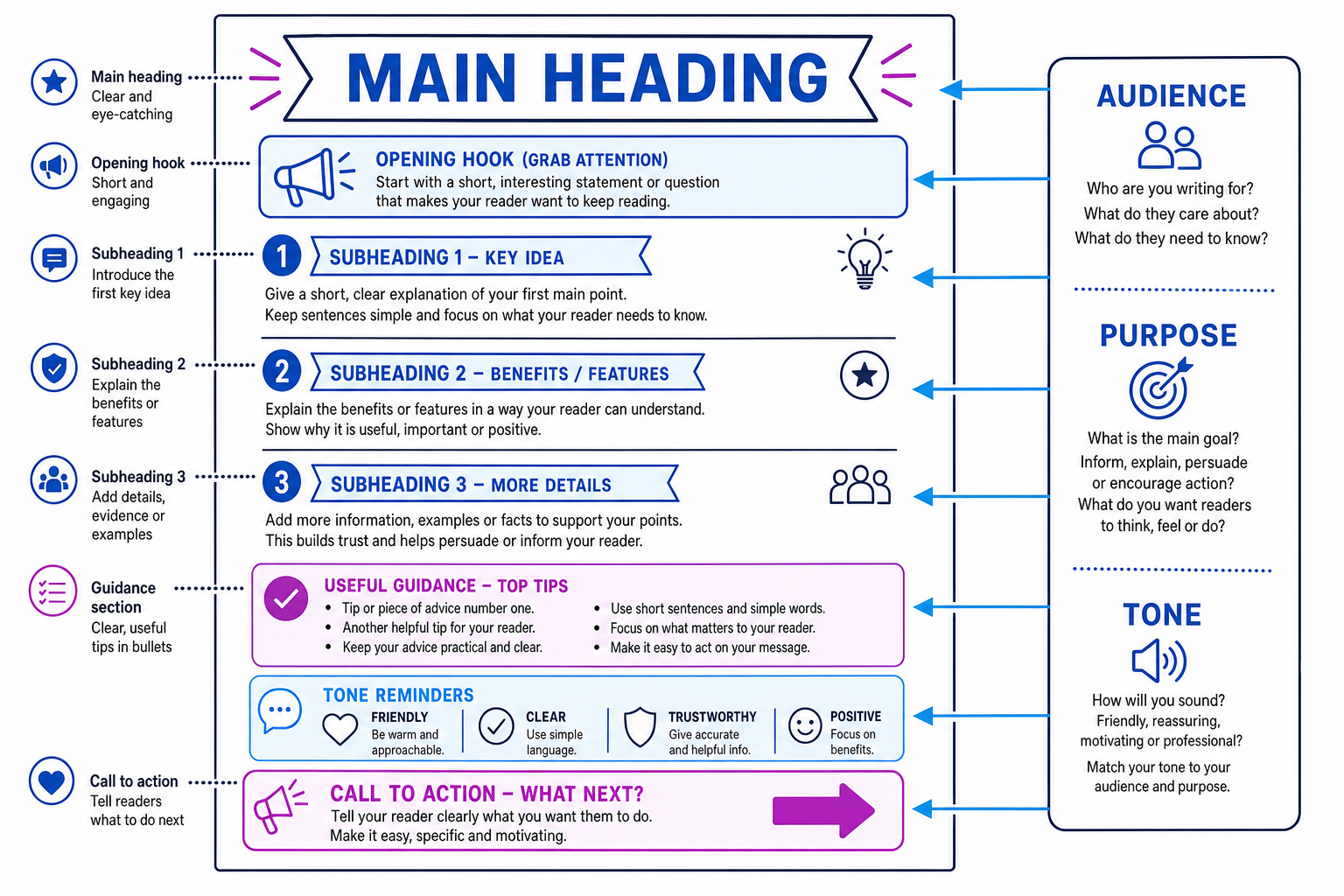
Form supports purpose
A leaflet should look and sound easy to use. Every structural choice — heading, subheading, short paragraph, bullet point — should help the reader understand what to think, know or do next.
Start with audience, purpose, tone and register
Before writing, make four decisions.
Audience
The audience is the person or group you are writing for. A leaflet for parents will sound different from a leaflet for teenagers, tourists, new students or local residents.
Ask: What do they already know? What might they care about? What might worry them?
Purpose
The purpose is what your writing is trying to achieve. A leaflet might aim to:
- inform readers about an event or service
- advise readers on how to solve a problem
- persuade readers to support a cause
- encourage readers to change their behaviour
Tone
The tone is the attitude or feeling your writing creates. It might be friendly, urgent, reassuring, enthusiastic, serious or motivational.
Register
The register is the level of formality. A school leaflet for younger pupils may use a warm, simple register. A leaflet for local councillors or employers may need a more formal, professional register.
Adapting audience, purpose and tone
Suppose the task is to write the text of a leaflet for local families, encouraging them to reduce food waste at home.
-
Decide what the audience needs. Local families are likely to need practical ideas that fit busy routines, so the leaflet should avoid sounding judgemental or unrealistic.
-
Match the purpose to the content. Because the purpose is to encourage action, include benefits and specific suggestions: planning meals, using leftovers and checking dates before shopping.
-
Choose a suitable tone. A friendly, reassuring tone works better than blame. “You can make a difference with one small change this week” is more effective than “Families are wasting too much food and must stop.”
-
Turn the decisions into leaflet features. Use subheadings such as “Why it matters”, “Simple swaps” and “Start today”, then end with a clear call to action.
The main conventions of a leaflet
1. A clear main heading
Your heading should immediately tell the reader what the leaflet is about. It can be persuasive or catchy, but clarity matters most.
Strong leaflet headings often use:
- a direct command: “Protect Your Local Park”
- a question: “Ready to Travel Smarter?”
- a benefit: “Feel Safer on Your Journey”
- a clear topic: “A Guide to Healthy Revision Habits”
Avoid vague headings such as “Important Information” unless the task itself demands a very formal tone.
2. A short opening hook
The opening hook is the first sentence or short paragraph that grabs attention and sets up the purpose. In a leaflet, it should be brief. You are not writing a long story or a slow introduction.
Useful openings might:
- speak directly to the reader
- identify a problem
- promise a benefit
- create urgency
- ask a rhetorical question
Rhetorical question
A rhetorical question is a question asked for effect rather than because the writer expects a direct answer. In a leaflet, it can make the reader pause and feel personally involved.
For example: “Could one small change make your journey safer?” This invites the reader to think, while leading them towards your message.
3. Subheadings to organise information
Subheadings are smaller headings used to divide the leaflet into clear sections. They help the reader skim the text and help the examiner see that your writing is controlled.
Good subheadings are specific. Instead of writing “Information”, try:
- “Why it matters”
- “What you can do”
- “How we can help”
- “Three simple steps”
- “Join us this week”
Subheading shortcut
Plan three subheadings before you write the full leaflet. If your subheadings make sense in order, your whole leaflet is likely to be organised.
4. Short accessible paragraphs
Leaflets are designed to be read quickly. Use short paragraphs, usually two to four sentences, and keep each paragraph focused on one point.
Accessible writing means writing that is easy for the intended reader to understand. This does not mean childish. It means clear, purposeful and reader-friendly.
You can still show skill through:
- varied sentence openings
- precise vocabulary
- controlled punctuation
- persuasive phrasing
- links between ideas
5. Bullet-style guidance
In a real leaflet, bullet points are common because they make advice quick to follow. In the exam, you may use bullet points, but do not rely on them for the whole answer. You still need developed writing to show AO4 and AO5.
Bullet points work well for:
- practical steps
- key benefits
- short reminders
- lists of services or features
For example:
- Bring a reusable bottle.
- Plan your route before you leave.
- Ask a member of staff if you need help.
6. Direct address
Direct address means speaking straight to the reader using words such as “you” and “your”. It helps the leaflet feel personal and relevant.
For example: “Your choices can help protect the area for everyone.”
Direct address is especially useful in persuasive or advisory leaflets because it makes the reader feel involved.
Writing a poster, not a leaflet
A poster is usually very brief and visual, with slogans and minimal detail. A leaflet needs more developed sections, clear information and a sense of progression from opening to final action.
Persuasive and informative techniques
A leaflet often mixes information and persuasion. You may need to explain facts clearly while also encouraging the reader to act.
Useful techniques include:
- Imperative verbs: command words such as “visit”, “join”, “try”, “remember”.
- Modal verbs: words such as “can”, “could”, “should” and “must”, which show possibility or obligation.
- Emotive language: words chosen to create feeling, such as “safe”, “valued”, “lonely”, “thriving”.
- Inclusive pronouns: words such as “we”, “our” and “together”, which create shared responsibility.
- Statistics or facts: only use these if they are provided, widely believable, or clearly reasonable in the context of the task.
- Anecdotal examples: brief realistic examples that help the reader imagine the issue.
The best technique depends on the audience. A leaflet for young children might need simple, upbeat wording. A leaflet for adults about a serious issue might need a calmer, more authoritative tone.
Building a leaflet section
Suppose you are writing a leaflet encouraging teenagers to use a new community library.
-
Choose the section’s job. This section should persuade teenagers that the library is useful to them, not just generally “good”.
-
Select audience-friendly content. Teenagers may care about revision spaces, free Wi-Fi, study support and somewhere calm to meet friends, so those details are more relevant than a long history of the building.
-
Shape it with a subheading. A suitable subheading could be: “A space that works for you”. This uses direct address and suggests a benefit.
-
Draft the section in leaflet style.
A space that works for you
Whether you are revising for exams, finishing homework or looking for a quiet place to think, the new community library can help. You can use the study area, borrow books for free and ask staff for support when you need it. Drop in after school this week and see what is available.
Ending with a clear call to action
A call to action tells the reader what to do next. It is usually placed at the end and should be specific.
Weak ending: “Thank you for reading.”
Stronger leaflet ending: “Visit the community centre on Saturday, speak to a volunteer, and find out how you can get involved.”
Your call to action might ask readers to:
- attend an event
- visit a website or place
- change a habit
- speak to someone
- sign up, volunteer or support a campaign
- remember key advice
Call to action
A call to action is a direct final instruction or invitation that tells the reader what step to take after reading.
A simple leaflet structure you can use
You do not have to use this exact structure, but it is a reliable exam plan:
| Section | What it does |
|---|---|
| Main heading | Makes the topic and angle clear |
| Opening hook | Grabs attention and introduces the purpose |
| Subheading 1 | Explains the issue, event or idea |
| Subheading 2 | Gives benefits, advice or key details |
| Subheading 3 | Adds practical guidance or reassurance |
| Bullet section | Makes steps, tips or reminders easy to follow |
| Call to action | Tells the reader what to do next |
What to avoid
Do not begin a leaflet with “Dear Sir or Madam” — that belongs to a letter. Do not write it like an article with one long title and continuous paragraphs. Do not spend time describing images, colours or folds. You can suggest leaflet layout through headings and spacing, but the marks come from the quality of your writing.
Also avoid overloading the leaflet with disconnected slogans. A few punchy phrases can help, but you still need developed ideas.
Do not let layout replace writing
Headings and bullet points help the form, but they cannot carry the whole answer. You still need controlled sentences, developed content and accurate paragraphing for AO4 and AO5.
Final checklist for a strong leaflet
A successful leaflet should feel:
- clear — the reader quickly understands the topic
- organised — subheadings guide the reader through the content
- audience-aware — vocabulary and tone suit the specified readers
- purposeful — every section supports the task
- action-focused — the ending tells the reader what to do next
- accurate — spelling, punctuation and grammar are secure
In the exam
-
Read the task carefully and underline the audience, purpose and form before you plan.
-
Plan a heading, three subheadings and a final call to action before writing full paragraphs.
-
Use leaflet conventions, but keep the focus on AO4 and AO5: effective communication, suitable tone, accurate sentences and controlled structure.
Check yourself
- Could you explain the difference between a leaflet, a poster and a letter?
- Can you create three suitable subheadings for a leaflet aimed at a specific audience?
- Does your final paragraph tell the reader exactly what to do next?
