What you'll learn
- What a guide is and where it fits in Edexcel IGCSE English Language A.
- How to adapt a guide for a specific audience, purpose, tone and register.
- How to structure a guide using headings, sequencing and practical advice.
- How to show AO4 and AO5 skills in a guide without making it look like a random list.
Where guides fit in the exam
Edexcel International GCSE English Language A is split into Component 1, worth 60%, and Component 2 or 3, worth 40%. A guide belongs to Component 1 Section B: Transactional Writing, which is worth 45 marks.
Transactional writing
Transactional writing is writing that communicates with a reader for a clear real-world purpose, such as advising, informing, persuading, explaining or arguing.
In Section B, you are assessed on AO4 and AO5. AO4 rewards how effectively you communicate and adapt your form — the type of text you are writing — as well as your tone and register. AO5 rewards accurate, controlled writing: vocabulary, sentence structures, paragraphing, spelling, grammar and punctuation.
Guide
A guide is a practical, informative piece of writing that helps a reader understand what to do, how to do it, or how to think about a situation. It should feel clear, useful and supportive.
A guide is not just “some advice”. It needs to be shaped so that the reader can follow it easily.
The core job: help a specific reader
A guide begins with the reader’s needs.
The audience is the person or group you are writing for. The purpose is what your writing is trying to achieve. The tone is your attitude towards the reader and topic. The register is the level of formality you choose.
For example, a guide for new students should sound welcoming and reassuring. A guide for parents might be more formal and detailed. A guide for young volunteers could be friendly, direct and encouraging.
Guides are reader-first
A successful guide makes the reader think: “This understands my situation, gives me clear steps, and makes the task feel manageable.”
Matching the task to the reader
Task: Write a guide for new students on how to settle into school.
-
Identify the audience: new students are likely to feel nervous, confused or unsure about routines, so the writing should be reassuring rather than bossy.
-
Identify the purpose: the guide needs to help them settle in, so it should give practical advice about friendships, organisation, asking for help and managing the first few weeks.
-
Choose the tone and register: use a friendly, accessible tone with direct address, such as “you” and “your”, but avoid slang that might sound forced or childish.
-
Choose useful sections: headings such as Finding your way around, Making the first conversation, and What to do if you feel overwhelmed would directly match the reader’s needs.
Structure: make help easy to find
A guide should have a clear, accessible structure. Accessible means easy for the reader to navigate and understand. In a guide, structure matters because the reader is often looking for help quickly.
You do not need a decorative layout, but you should make the form obvious. A strong guide usually has:
- a clear title
- a short opening that explains what the guide will help with
- organised sections, often with headings
- logical sequencing
- practical advice and examples
- a closing paragraph that leaves the reader encouraged or ready to act
The planning skeleton below shows how the parts of a guide can fit together.
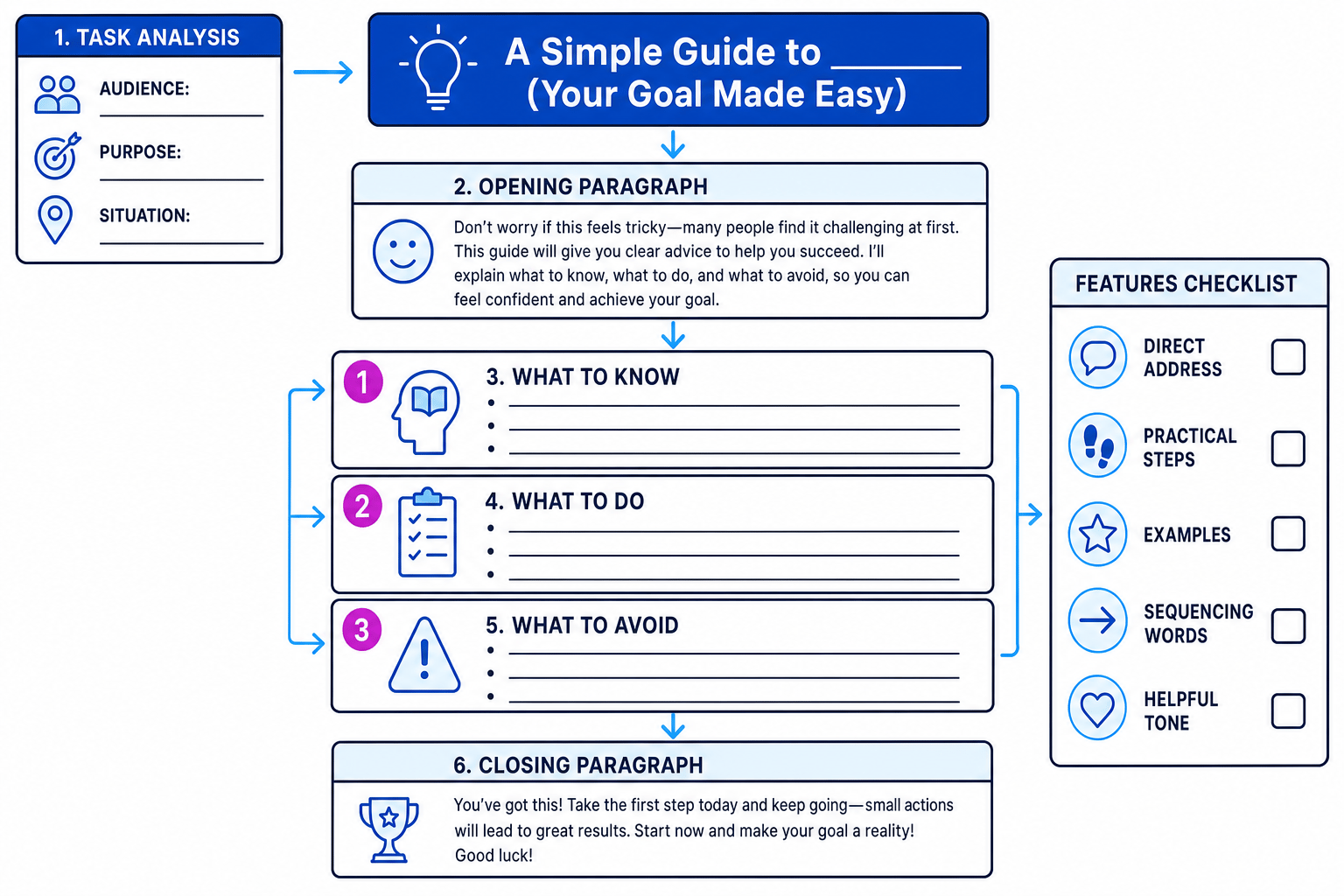
The 3H plan
- Headline: make the topic and purpose clear.
- Headings: divide the advice into useful sections.
- Helpfulness: give specific actions, not vague encouragement.
The main conventions of a guide
A useful title
A guide title should tell the reader what the writing will help them do. It can be simple and direct:
- A Guide to Starting Revision Without Stress
- How to Stay Safe Online: A Guide for Beginners
- Your First Week at Work: A Practical Guide
Avoid titles that are too vague, such as Advice or Some Ideas. They do not clearly signal the topic or purpose.
A reassuring opening
The opening should welcome the reader into the topic. It can acknowledge the problem, reassure the reader and preview the advice.
For example:
Starting at a new school can feel overwhelming, especially when everything from the timetable to the lunch queue seems unfamiliar. This guide will help you take the first few days step by step, so you can feel more confident and in control.
This opening works because it recognises the reader’s feelings and explains what the guide will do.
Headings and logical sequencing
A heading is a short label for a section. Headings help the reader locate information. Sequencing means putting ideas in a sensible order.
A guide might move from basic information to practical steps, then to common problems:
- What you need to know first
- What to do next
- What to avoid
- Where to get help
You can also organise by time: Before you start, On the day, Afterwards.
Planning useful sections
Task: Write a guide for older relatives on staying safe online.
-
Consider what the reader may need first: if they are less confident with technology, they need simple foundations before detailed warnings.
-
Put the advice in a helpful order: start with passwords, then move to suspicious messages, then explain privacy settings and where to ask for help.
-
Turn the order into headings: Create strong passwords, Spot suspicious messages, Protect your personal information, and Ask before you click.
-
Add practical content under each heading: instead of saying “be careful”, explain actions such as checking the sender’s email address or refusing to share bank details over a message.
Direct address
Direct address means speaking straight to the reader using words such as “you” and “your”. It is useful in a guide because it makes the advice feel personal and relevant.
For example:
If you feel unsure, ask a member of staff before you make a decision.
This is clearer and more helpful than:
People should ask staff if they are unsure.
Practical and informative content
A guide must give the reader something they can use. Practical content includes actions, steps, examples, reminders and warnings.
Weak guide writing often stays too general:
Try your best and be organised.
Stronger guide writing is specific:
Pack your bag the night before, check your timetable, and put the books for your first two lessons at the top so you are not searching in a corridor.
The second version gives the reader a clear action and shows you understand the situation.
Generic advice
Avoid advice that could fit any topic, such as “work hard”, “stay positive” or “be careful”. A guide needs precise details that match the task.
A helpful tone
A guide should usually sound calm, encouraging and knowledgeable. It should not sound superior, sarcastic or panicked.
The best tone depends on the task:
| Audience | Suitable tone | Avoid |
|---|---|---|
| Younger students | Warm, clear, reassuring | Patronising language |
| Parents | Respectful, informative, balanced | Childish jokes |
| New employees | Professional, organised, supportive | Over-casual slang |
| Local community | Inclusive, practical, motivating | Aggressive lecturing |
Tone is part of AO4 because it shows you can adapt your writing to the reader.
Language choices that sound like a guide
You do not need to label techniques in your answer, but you should use them deliberately.
- An imperative verb gives an instruction, such as “check”, “choose”, “ask” or “prepare”.
- A modal verb shows possibility or advice, such as “can”, “could”, “should” or “might”.
- A discourse marker is a linking word or phrase that guides the reader through the writing, such as “first”, “next”, “however”, “as a result” or “finally”.
- A rhetorical question is a question asked for effect rather than because the writer expects an answer, such as “Not sure where to begin?”
Use these features because they help the reader, not just because you want to “add techniques”.
Improving a guide paragraph
Weak version: Revision is important. Make a timetable. Do not waste time on your phone. Try hard.
-
Diagnose the problem: the paragraph is too vague and slightly nagging, so it does not fully help the reader understand what to do.
-
Add specific actions: instead of “make a timetable”, explain how to begin with manageable blocks of time and clear subjects.
-
Adapt the tone: use direct address and reassurance so the guide sounds helpful rather than critical.
-
Improve the paragraph:
Start with a realistic plan
Choose two subjects for tonight and give each one a short, focused slot. Put your phone in another room for twenty minutes, then allow yourself a brief break. This makes revision feel less overwhelming and helps you build a routine you can actually keep.
AO5: accuracy still matters
A guide can use headings and even occasional bullet points, but it still needs controlled writing. Paragraphs should be developed, punctuation should be secure, and sentences should be varied.
Try to mix:
- short sentences for emphasis: Start small.
- compound sentences for linking ideas: Pack your bag early, and check your timetable before bed.
- complex sentences for explanation: If you feel unsure, speak to someone before the problem becomes bigger.
Bullet-point-only answers
A guide may include bullets, but an answer made almost entirely of bullet points often lacks development. For 45 marks, you need shaped paragraphs that explain ideas clearly.
A simple guide structure you can reuse
You can adapt this structure to many guide tasks:
Title
Make the topic clear and useful.
Opening paragraph
Acknowledge the situation and explain how the guide will help.
Section 1: What the reader needs to know
Give essential background or reassurance.
Section 2: What the reader should do
Give practical steps, examples and advice.
Section 3: What to avoid or how to solve problems
Include warnings, common mistakes or support options.
Closing paragraph
End with encouragement, a final reminder or a clear next step.
Do not over-design the form
In the exam, content and control matter more than decorative layout. Headings can help, but do not waste time drawing boxes, logos or complicated formatting.
In the exam
-
Read the task carefully and identify the audience, purpose and situation before you start writing.
-
Plan a title, opening, three useful sections and a closing paragraph so the guide feels organised from the beginning.
-
Make every section practical: include actions, examples, warnings or explanations that genuinely help the reader.
-
Leave time to check AO5 basics: paragraphing, sentence control, spelling, punctuation and any repeated words.
Check yourself
- How is a guide different from a general article or essay?
- What headings would you use for a guide to managing exam stress?
- How would your tone change when writing a guide for younger pupils compared with writing one for parents?
