What you'll learn
- What Assignment A asks you to do in the coursework route.
- How to choose three valid texts from Anthology Part 2.
- How to create a clear focus such as setting, character, event or theme.
- How to make early notes and plan towards AO1 and AO2.
Where Assignment A fits
Assignment A belongs to the coursework route for Pearson Edexcel International GCSE English Language A. The qualification has Component 1, worth 60%, and either Component 2 or Component 3, worth 40%. Component 3 is the non-examined coursework alternative to Component 2.
Assignment A is the Poetry and Prose Texts coursework assignment. It is separate from Assignment B, which is imaginative writing.
Coursework
Coursework is assessed work completed over time rather than in a timed exam. It still has strict rules: the final response must be your own independent and authentic work.
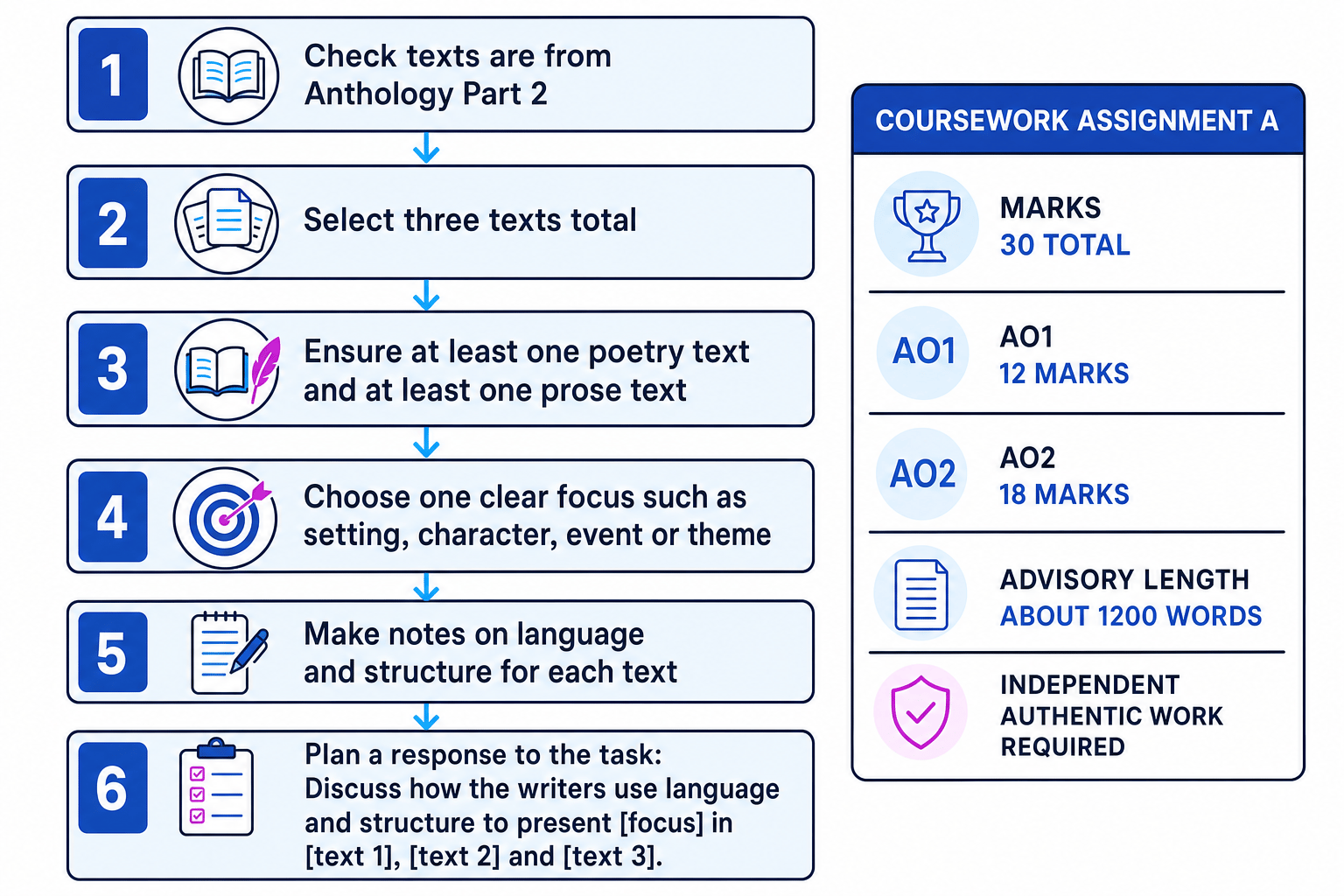
For Assignment A, you choose three texts from Part 2 of the Pearson Edexcel International GCSE English Anthology. You then write about how the writers use language and structure to present one chosen focus.
Assignment A in one sentence
You write a focused discussion of how the writers use language and structure to present one idea, theme, character, event or setting across three Part 2 anthology texts.
The basic requirements
Your Assignment A task normally follows this format:
Discuss how the writers use language and structure to present [focus] in [text 1], [text 2] and [text 3].
The square brackets are placeholders. Your centre will help you replace them with your chosen focus and your three selected texts.
What you must include
You need:
- three texts in total
- all three from Part 2 of the Pearson Edexcel anthology
- at least one poetry text
- at least one prose text
- one clear focus, such as setting, character(s), event(s) or theme(s)
- discussion of both language and structure
Assignment A is marked out of 30 marks:
- 12 marks for AO1
- 18 marks for AO2
AO1 and AO2
AO1 rewards your understanding of the texts: selecting relevant references, interpreting ideas and showing clear knowledge of what is happening. AO2 rewards your analysis of language and structure: explaining how writers’ methods create meanings and effects.
The advisory length is about 1200 words. There is no automatic penalty for going over the advisory length, but a very long response can become unfocused. Aim for quality of analysis rather than quantity of pages.
Treating 1200 words as a target to beat
Writing much more than 1200 words does not automatically improve your mark. If extra words are mostly plot summary, repeated points or long quotations, they can weaken the focus of your assignment.
Choosing valid texts
A text is one complete item from the anthology, such as a poem or a prose extract. For this assignment, every text must come from Part 2: Poetry and Prose Texts.
Poetry and prose
Poetry is writing arranged in lines and often shaped by rhythm, sound, imagery, stanza form or pattern. Prose is writing arranged in sentences and paragraphs, such as fiction extracts or short prose passages.
Valid and invalid combinations
These combinations are valid:
- one poem and two prose texts
- two poems and one prose text
These combinations are not valid:
- three poems only
- three prose texts only
- any text from Part 1
- any text from outside the anthology
Checking a text combination
A student wants to write about one poem from Part 2, one prose text from Part 2 and one non-fiction text from Part 1.
-
Check the anthology section. The poem and prose text are from Part 2, so they could be used. The non-fiction text is from Part 1, so it cannot be used for Assignment A.
-
Check the genre balance. The student has at least one poem and at least one prose text, which is good, but the Part 1 choice still makes the selection invalid.
-
Fix the selection. The student should replace the Part 1 non-fiction text with another Part 2 poem or Part 2 prose text, while still keeping at least one poem and at least one prose text overall.
Choosing a strong focus
Your focus is the main idea your assignment investigates. It is the thing you are asking, “How do the writers present this?”
Good focus areas include:
- a theme, such as power, childhood, conflict, memory or identity
- a character or type of character
- a relationship between characters or voices
- a setting, such as a threatening place or a remembered home
- an event, such as a moment of discovery, loss, fear or change
Focus
A focus is the central idea your whole assignment explores. It should be broad enough to connect all three texts, but specific enough to allow detailed analysis.
A focus like “love” may be too broad. A sharper version might be “the pain of lost love”, “conflicting attitudes to love” or “love as a source of power”. A focus like “setting” is also broad; a sharper version might be “hostile settings”, “places of memory” or “settings that create danger”.
Narrowing a focus
A student begins with the broad idea of conflict.
-
Test what the three texts actually share. The student notices that all three texts involve conflict, but in different ways: one shows inner conflict, one shows conflict between people, and one shows conflict with society.
-
Choose a clearer angle. Instead of writing about “conflict” in general, the student refines the focus to “personal struggle”, because that idea can include emotional, social and moral struggle.
-
Check that each text gives enough material. The student makes sure each text has at least two or three useful moments where language or structure clearly presents personal struggle.
-
Turn it into the assignment wording. The focus becomes: “Discuss how the writers use language and structure to present personal struggle in [text 1], [text 2] and [text 3].”
Selecting texts that work well together
Do not choose texts only because you like them. You are choosing them because they can support a strong analytical assignment.
A good set of three texts usually has:
- a shared focus
- enough differences to make the discussion interesting
- clear language methods to analyse
- clear structural choices to discuss
- short, memorable references you can use accurately
- a balance of poetry and prose
The three-question selection test
Before committing to your texts, ask: Do they all connect to the same focus? Can I analyse language in each one? Can I analyse structure in each one? If any answer is “not really”, reconsider your selection.
Understanding “language and structure”
Your assignment is not just about what happens in the texts. It is about how the writers create meaning.
Language
Language means the writer’s choice of words and verbal techniques. This can include:
- imagery, such as metaphor, simile and personification
- word classes, such as verbs, adjectives, nouns and adverbs
- semantic fields, where several words link to the same idea
- sound effects in poetry, such as alliteration or sibilance
- dialogue or narrative voice in prose
- tone, such as bitterness, nostalgia, fear or admiration
Structure
Structure means the way the text is organised. This can include:
- beginnings and endings
- shifts in tone, time, mood or viewpoint
- stanza structure in poetry
- paragraphing in prose
- sentence length and pace
- repetition or contrast
- narrative perspective
- climactic moments or turning points
AO2 is the heavier weighting
AO2 is worth 18 of the 30 marks, so your assignment needs detailed analysis of writer’s methods, not just explanation of plot, character or theme.
Feature-spotting without effect
Do not simply write, “The writer uses a metaphor.” You need to explain what the metaphor suggests, how it shapes the reader’s understanding, and why it matters to your focus.
Making useful first notes
Once you have chosen possible texts, make notes before you start drafting. Your notes should help you decide whether the selection is strong enough.
A simple planning grid might look like this:
| Text | Link to focus | Language methods | Structure methods | Best brief references |
|---|---|---|---|---|
| Text 1 | What does it show about the focus? | Key words, imagery, tone | Opening, ending, shift, stanza/paragraph pattern | Short quotations or precise moments |
| Text 2 | What is similar or different? | Key words, imagery, tone | Viewpoint, pace, contrast, turning point | Short quotations or precise moments |
| Text 3 | What extra angle does it add? | Key words, imagery, tone | Order of ideas, form, ending | Short quotations or precise moments |
You do not need to collect huge quotations. Short, accurate references are usually more useful because they leave you more space to analyse.
Building a planning grid
A student has chosen three valid Part 2 texts and wants to write about fear.
-
Separate ideas from methods. The student writes one column for what each text suggests about fear, and another column for how the writer creates that effect through language and structure.
-
Look for method variety. If one text only offers obvious word choices but no structural points, the student checks whether there is a shift in mood, a tense change, a repeated pattern or a significant ending to analyse.
-
Choose the strongest evidence. The student selects two or three short references per text, making sure each one can support a point about fear and a point about method.
-
Spot the best order. The student decides whether to discuss the texts one by one or organise the essay around different aspects of fear, such as fear of place, fear of people and fear of memory.
Planning the response
A clear plan stops the assignment becoming three separate mini-essays with no overall direction.
You can structure your response in two main ways.
Option 1: Text-by-text structure
This is often the clearest approach:
- Short introduction to your focus.
- Paragraphs on Text 1.
- Paragraphs on Text 2.
- Paragraphs on Text 3.
- Brief conclusion linking the texts back to the focus.
This works well if you keep linking each text back to the same central focus.
Option 2: Aspect-by-aspect structure
This is more ambitious:
- Short introduction to your focus.
- Paragraphs on one aspect of the focus across the texts.
- Paragraphs on a second aspect across the texts.
- Paragraphs on a third aspect across the texts.
- Brief conclusion.
This can be effective, but only if you stay clear and avoid jumping around confusingly.
Comparison is useful, but not the main mark
You may make links between the texts, but Assignment A is assessed through AO1 and AO2, not AO3. Do not let comparison replace close analysis of language and structure.
Authenticity and independent work
Because this is coursework, authenticity matters. Your centre must be confident that the work is genuinely yours.
Authenticity
Authenticity means the submitted assignment reflects your own reading, thinking, planning and writing. Help from teachers should guide your learning, not replace your independent work.
You should not copy from websites, revision guides, AI tools, other students or model essays. You can discuss ideas in class and receive general guidance from your teacher, but the final wording and analysis must be your own.
Plagiarism risk
If you copy phrases, interpretations or paragraphs from another source and present them as your own, your coursework may not be accepted as authentic. Keep your notes honest and write in your own voice.
What a strong setup looks like
Before you begin drafting, you should be able to say:
- my three texts are all from Anthology Part 2
- I have at least one poem and at least one prose text
- my focus is clear and specific
- each text gives me enough material for AO1 and AO2
- I can discuss both language and structure in each text
- I understand that the advisory length is about 1200 words
- my work will be independent and authentic
In the exam
-
Treat the coursework task like an assessor would: keep checking that every paragraph answers the exact wording about language, structure and your chosen focus.
-
Prioritise AO2: after every reference, explain how the writer’s method shapes meaning, mood or the reader’s response.
-
Stay controlled: cover all three texts, but do not waste words on long plot summary or copied background information.
Check yourself
- Have you chosen three texts from Part 2, with at least one poem and at least one prose text?
- Can you state your assignment focus in one clear phrase?
- For each text, can you identify at least one language method and one structural method linked to that focus?
