What you'll learn
- How AO5 fits into Edexcel IGCSE English Language A imaginative writing.
- How to choose vocabulary that is precise, not just “fancy”.
- How to control sentence length, structure and punctuation for effect.
- How to paragraph, proofread and reduce technical errors under timed conditions.
Where AO5 fits
In Pearson Edexcel International GCSE English Language A, Component 2 or Component 3 is worth 40% of the qualification. In the examined route, Component 2 Section B is Imaginative Writing and is worth 30 marks. Your writing is rewarded for AO4 and AO5: AO4 is about communicating ideas imaginatively; AO5 is about the technical control that makes those ideas clear and effective.
This note focuses on AO5: the “control panel” of your writing.
AO5
AO5 means writing clearly and accurately, using a range of vocabulary and sentence structures, with appropriate paragraphing and accurate spelling, grammar and punctuation.
At lower levels, writing may rely on repetitive sentences and basic punctuation. At higher levels, you manipulate complex ideas confidently, using extensive vocabulary, varied sentence structures and precise punctuation.
The big idea: control, not decoration
AO5 is not about stuffing your work with long words, semicolons and dramatic exclamation marks. It is about making deliberate choices so the reader can follow, feel and trust your writing.
Use this reference card as a quick overview of the three main areas you are controlling: vocabulary, sentence structures and technical accuracy.
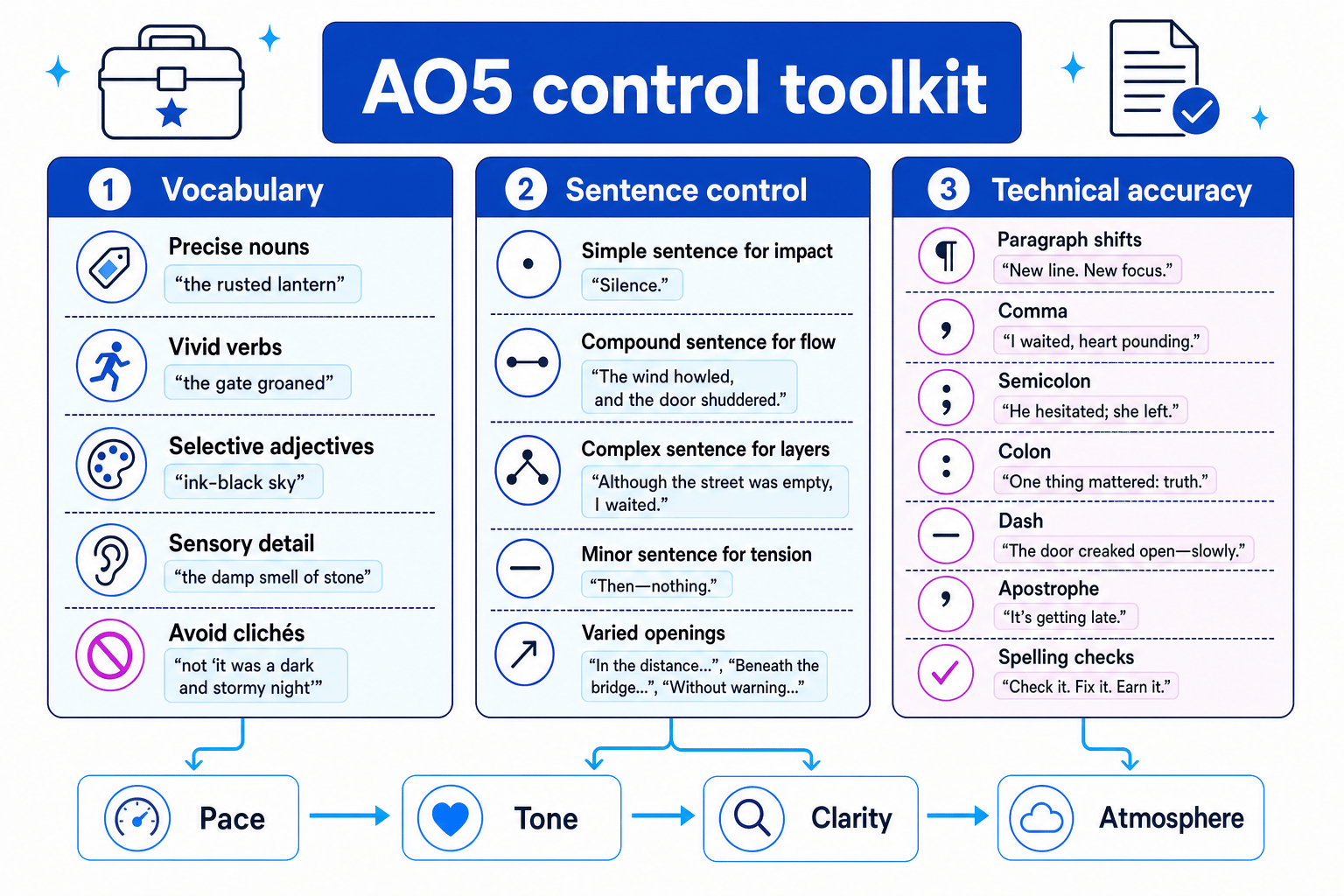
The six-month memory
Strong AO5 writing sounds controlled. Every word, sentence and punctuation mark should help create clarity, pace, tone or atmosphere.
Vocabulary: wide, precise and selective
Vocabulary means the words you choose. In imaginative writing, strong vocabulary is usually specific rather than simply unusual.
Key word classes
A noun names a person, place, thing or idea; a verb shows an action or state; an adjective describes a noun; an adverb modifies a verb, adjective or another adverb.
A common mistake is to think “better vocabulary” means “longer vocabulary”. Actually, the best choice is often the word that creates the clearest image.
Compare these:
- Vague: “The man went into the old building.”
- More precise: “The caretaker limped into the abandoned chapel.”
The second version gives more information through specific nouns and vivid verbs, not by adding lots of adjectives.
Connotation and register
Connotation
A connotation is the feeling or association a word suggests beyond its literal meaning. For example, “slim”, “thin” and “scrawny” have similar basic meanings but different emotional effects.
Register
Register means the level of formality or style of language chosen for the situation, narrator or character.
A child narrator, a frightened traveller and an elderly neighbour should not all sound exactly the same. Your vocabulary helps create voice.
Upgrade verbs first
Before adding three adjectives, check your verb. “The door groaned” is usually stronger than “The old, creepy, scary door opened slowly.”
Refining vague vocabulary
Original sentence: “The scary house was very old and bad.”
- Choose the intended effect: the house should feel neglected and unsettling, not cartoonishly “scary”.
- Replace vague adjectives with a precise noun phrase: “house” becomes “weather-beaten cottage”, which suggests age and exposure.
- Replace the weak verb “was” with an active or atmospheric verb: “leaned” suggests instability.
- Add one sensory detail that deepens the atmosphere without overloading the sentence: “damp timber” gives smell and texture.
- Final version: “The weather-beaten cottage leaned over the lane, breathing out the smell of damp timber.”
Thesaurus overload
Do not replace every simple word with a rare one. If the word sounds unnatural, distracts from the mood or does not quite mean what you intend, it lowers control rather than raising it.
Sentence control: structure creates pace
A sentence is a complete unit of meaning. Most full sentences contain at least one main clause, which is a group of words built around a verb that can stand alone.
Clause
A clause is a group of words containing a verb. A main clause can stand alone as a sentence; a subordinate clause depends on another clause to make full sense.
You should know four useful sentence types.
Simple sentence
A simple sentence has one main clause.
Example: “The lantern flickered.”
Simple sentences are excellent for clarity, impact and tension.
Compound sentence
A compound sentence joins two or more main clauses, often with “and”, “but” or “or”.
Example: “The lantern flickered, and the walls seemed to move.”
Compound sentences can create flow or show actions happening together.
Complex sentence
A complex sentence contains a main clause and at least one subordinate clause.
Example: “Although the lantern flickered, I stepped inside.”
Complex sentences help you layer time, cause, contrast or condition.
Minor sentence
A minor sentence is a deliberate fragment used for effect.
Example: “Nothing.”
Minor sentences can create shock, fear, speed or emphasis, but they should be used sparingly.
Varying sentence pace
Aim: move from calm observation to sudden tension.
- Use a complex sentence to slow the pace and layer detail: “As the evening settled over the square, the fountain murmured in the dark.”
- Use a compound sentence to keep the scene moving: “The shops closed their shutters, and the last bus sighed away from the kerb.”
- Switch to a simple sentence for sudden focus: “A bell rang.”
- Add a minor sentence to sharpen the tension: “Once.”
- The rhythm now moves from long to medium to short, matching the shift from calm description to unease.
Sentence variety with purpose
A range of sentence structures only earns credit when it shapes meaning. Do not vary sentences randomly; vary them to control pace, focus and mood.
Punctuation: marks that guide meaning
Punctuation is not decoration. It tells the reader how ideas connect and how the writing should sound.
Important marks for imaginative writing include:
- Comma: separates parts of a sentence, especially after fronted phrases or around extra information.
- Full stop: ends a complete sentence and creates control.
- Semicolon: links two closely related complete sentences.
- Colon: introduces an explanation, list or reveal.
- Dash: adds interruption, afterthought or dramatic pause.
- Apostrophe: shows possession or missing letters.
Semicolons need complete sentences
A semicolon should usually join two complete sentences that are closely linked. “The room was silent; the clock had stopped” works. “The room was silent; and cold” does not.
Punctuating complete ideas
Original: “I opened the door it was dark I could hear something moving.”
- Separate the complete ideas: “I opened the door”, “it was dark” and “I could hear something moving” each need clear boundaries.
- Join the first two closely connected ideas with a semicolon: “I opened the door; it was dark.”
- Use a dash to delay and dramatise the final detail: “Behind the stairs, something moved—slowly.”
- Final version: “I opened the door; it was dark. Behind the stairs, something moved—slowly.”
Comma splicing
A comma splice happens when two complete sentences are joined only by a comma: “The rain stopped, the road glittered.” Fix it with a full stop, semicolon or conjunction.
Paragraphing and cohesion
A paragraph is a group of sentences focused on one stage, idea, moment or shift. In imaginative writing, paragraphing controls the reader’s journey.
Start a new paragraph when there is a change in:
- time
- place
- focus
- speaker
- mood
- action
- viewpoint
Cohesion
Cohesion means the way ideas link smoothly across sentences and paragraphs, so the writing feels connected rather than like a list of separate moments.
You can create cohesion by repeating a key image, using pronouns clearly, echoing a sound or object, or letting one paragraph’s ending lead naturally into the next.
Planning paragraph movement
Aim: write the opening of a tense narrative set near the sea.
- Give paragraph 1 a clear external focus: describe the beach at dusk, using details such as the tide, gulls and empty promenade.
- Shift paragraph 2 inward: let the narrator notice one unsettling detail, such as a light moving in an abandoned kiosk.
- Use paragraph 3 for action or decision: the narrator moves closer, changing the pace from description to suspense.
- Link the paragraphs with a repeated motif, such as the tide “dragging” at the stones, so the piece feels connected as tension rises.
Grammar and spelling under pressure
Grammar is the system that makes sentences work. For AO5, the most important grammar issues are usually:
- keeping tense consistent
- matching subjects and verbs
- making pronouns clear
- avoiding run-on sentences
- controlling sentence fragments
Spelling also matters because repeated errors can make your writing seem less controlled. You do not need every word to be ambitious; you need your chosen words to be accurate.
Editing high-value errors
Draft sentence: “I was walking towards the beach, the waves crashes loudly and its getting colder.”
- Fix tense consistency: “crashes” becomes “crashed” to match “was walking”.
- Fix the comma splice by separating the first complete idea: “I was walking towards the beach. The waves crashed loudly…”
- Fix the apostrophe: “its” becomes “it’s” because it means “it is”.
- Final version: “I was walking towards the beach. The waves crashed loudly, and it’s getting colder.”
Proofread in passes
If you have a few minutes left, do not reread vaguely. First check sentence endings, then apostrophes and commas, then spellings you know you often miss.
Bringing AO5 together
The strongest imaginative writing usually combines:
- precise vocabulary for atmosphere and voice
- sentence variety for pace and emphasis
- accurate punctuation for clarity and control
- secure paragraphs for structure and movement
- careful proofreading to remove avoidable errors
Remember: AO5 supports AO4. Your imaginative ideas can only have full impact if the reader can follow them easily.
In the exam
- Spend a few minutes planning the shape of the piece: opening focus, main shift, ending effect.
- During writing, vary sentence length deliberately: longer sentences for reflection or description, shorter ones for impact or tension.
- Leave time to proofread for high-value errors: full stops, comma splices, apostrophes, tense shifts and repeated spellings.
Check yourself
- Can you explain the difference between a simple, compound and complex sentence?
- Can you improve a weak sentence by changing the noun and verb before adding adjectives?
- Can you identify where a new paragraph would help control time, focus or mood?
