What you'll learn
- What Assignment A is actually rewarding in AO1 and AO2.
- How to move from “I understand the text” to “I can analyse how the writer creates meaning”.
- How to use precise references and specific examples from all three Part 2 texts.
- How to avoid common coursework weaknesses like plot summary and technique-spotting.
Where Assignment A fits
Assignment A is the Poetry and Prose Texts response for the coursework route, Component 3. Component 2 or Component 3 makes up 40% of the overall Edexcel International GCSE English Language A qualification.
For Assignment A, you write about three texts from Part 2 of the Pearson Edexcel International GCSE English Anthology. The response is marked out of 30:
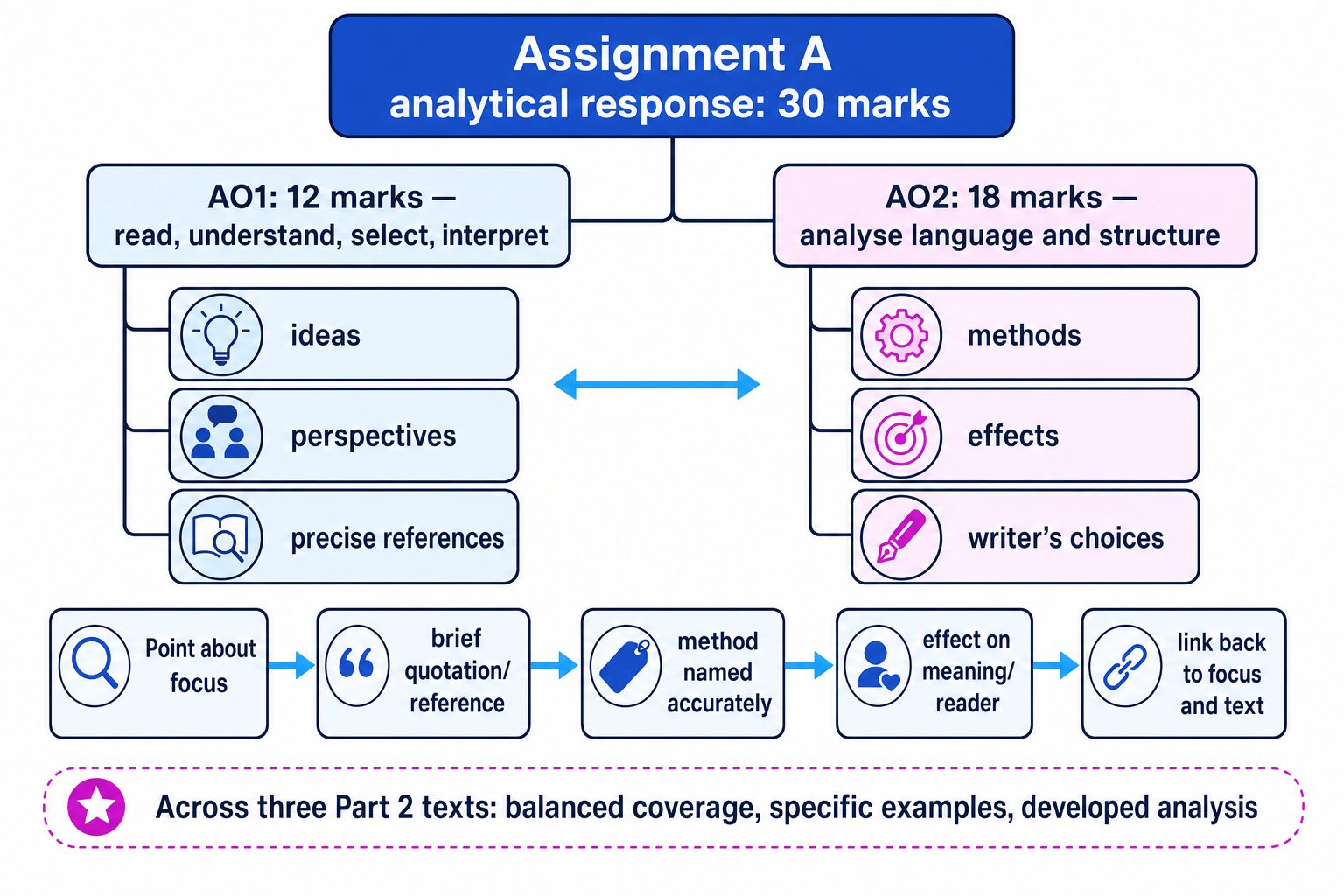
- AO1: 12 marks — read and understand, selecting and interpreting information, ideas and perspectives.
- AO2: 18 marks — understand and analyse how writers use linguistic and structural devices to achieve their effects.
So, although you must show secure understanding, the larger share of the marks rewards analysis of writers’ methods.
Assessment objective
An assessment objective, often shortened to AO, is a skill the mark scheme is designed to reward. In Assignment A, the relevant reading objectives are AO1 and AO2.
The diagram below shows the basic balance: AO1 gives you the meaning and interpretation; AO2 explains how that meaning is created.
The core job: respond to the focus
Your Assignment A response should not be a general essay on three texts. It should answer the chosen focus.
Focus
The focus is the central idea, issue or task your response is built around, such as how writers present identity, power, conflict, freedom, fear, place, relationships or change.
Every paragraph should help answer that focus. If a point is interesting but does not connect to the focus, it will probably not help much.
A strong response usually does three things at once:
- explains what the writer presents about the focus;
- supports that explanation with a precise reference;
- analyses the language or structure that creates the effect.
The main rule
Do not write everything you know about the texts. Select the best evidence for the focus, then explain how the writer’s choices shape meaning.
AO1: understanding, selection and interpretation
AO1 is about proving that you understand the texts. But at coursework level, “understanding” means more than knowing the plot or literal meaning.
You need to show that you can select and interpret:
- information — what happens, what is described, or what situation is presented;
- ideas — the big meanings or concerns in the text;
- perspectives — the attitudes, viewpoints or beliefs suggested by the writer, narrator or speaker.
Interpretation
An interpretation is a supported explanation of what a detail suggests or implies. It goes beyond “what happens” and explains what the reader understands from it.
For example, if a poem presents a speaker repeatedly resisting oppression, AO1 is not just saying “the speaker is strong”. A stronger AO1 interpretation would explain what kind of strength is shown: emotional resilience, political defiance, self-belief, or refusal to be silenced.
What AO1 looks like in a paragraph
AO1 often appears in your point and your explanation of the quotation. It might sound like:
- “The writer presents freedom as both exciting and unsettling…”
- “The speaker’s perspective suggests that memory is fragile but powerful…”
- “This moment shows how social expectations limit the character’s choices…”
These are not just factual comments. They interpret the writer’s ideas.
Retelling the story
A paragraph that only explains what happens in the text is mostly summary. Summary can show basic understanding, but it does not usually reach the higher marks unless it becomes interpretation.
AO2: analysing language and structure
AO2 is about how writers create meanings and effects.
Linguistic device
A linguistic device is a deliberate choice of language, such as a word, phrase, image, sound pattern, sentence type, metaphor, simile, repetition, contrast, pronoun, verb, adjective or rhetorical question.
Structural device
A structural device is a deliberate choice about organisation, such as the order of events, shifts in time or tone, stanza or paragraph structure, beginnings and endings, repetition across a text, contrast between sections, narrative perspective, or the pace of a passage.
A good AO2 point does not simply name a technique. It explains what the technique does.
For example, instead of writing:
The writer uses repetition.
You would develop it into:
The repetition makes the idea feel insistent, suggesting that the speaker is trying to convince both the reader and themselves.
That second version is analysis because it links method to meaning.
Effect
An effect is the impact of a writer’s choice. It can mean the effect on the reader, but it can also mean the effect on tone, character, theme, atmosphere, pace or viewpoint.
Technique-spotting
Do not collect technique names as if they earn marks by themselves. A term like “metaphor” or “enjambment” only helps if you explain how it shapes meaning.
How AO1 and AO2 work together
The strongest Assignment A paragraphs usually begin with AO1 and then deepen into AO2.
You first say what the writer presents. Then you show where this appears in the text. Then you analyse how the writer’s language or structure creates that meaning.
Developing a reference into analysis
-
Start with an AO1 interpretation: in Kate Chopin’s “The Story of an Hour”, Louise’s reaction to her husband’s supposed death can be interpreted as a sudden awareness of personal freedom, not simply grief.
-
Select a precise reference: the repeated phrase “free, free, free!” captures the moment when this realisation becomes conscious and intense.
-
Analyse the language: the repetition of “free” makes the idea feel urgent and overwhelming, while the exclamatory punctuation suggests emotion breaking through restraint.
-
Add structural understanding: because this moment comes after Louise’s initial shock but before the final reversal, Chopin places freedom at the centre of the story’s tension.
-
Combine the thinking into an analytical point: Chopin presents freedom as emotionally overpowering through the repeated cry “free, free, free!”, making Louise’s private response seem instinctive and urgent; structurally, its position before the ending complicates the reader’s judgement of marriage and independence.
Notice how the example does not stop at “there is repetition”. It explains the meaning created by the repetition and links it to the structure of the story.
Using precise textual references
A textual reference is a specific piece of evidence from the text. It may be a short quotation, or a precise mention of a moment, image, action or structural feature.
Textual reference
A textual reference is evidence from the text used to support a point. It should be specific enough that the examiner can see exactly what you are discussing.
In Assignment A, you should aim to support every main point with a reference or example. This mirrors the mark-scheme expectation that ideas are illustrated with textual references and specific examples.
Strong references are usually:
- brief;
- accurate;
- embedded smoothly into your sentence;
- chosen because they help answer the focus.
A short phrase is often better than a long quotation. Long quotations can make your writing descriptive because you spend too much space copying rather than analysing.
Quote small, analyse big
A single word or short phrase can be enough if you analyse it closely. The quality of your explanation matters more than the length of the quotation.
Discussing all three texts
Your response must cover three Part 2 texts. That does not mean every paragraph must give exactly equal space to each text, but the final response should feel balanced.
You can organise your response in different ways. For example:
- one section or paragraph cluster on each text;
- thematic paragraphs where each paragraph explores one part of the focus across two or three texts;
- a mixed structure, where one text is treated in depth before being linked to the others.
Because Assignment A is marked for AO1 and AO2, not AO3, you are not being rewarded mainly for comparison. However, brief links can still help your argument feel coherent.
For instance, you might write:
While Text A presents freedom as joyful resistance, Text B presents it as private and unsettling.
That kind of link is useful because it sharpens your interpretation. But you would still need to analyse the language and structure of each text.
Do not let linking replace analysis
A response that constantly says “similarly” and “whereas” but does not analyse methods will not fully meet AO2. Links are helpful, but close analysis is essential.
What developed analysis sounds like
Developed analysis often asks “why this choice?” and “why here?”
Instead of only identifying a method, explore the effect of the writer’s choice in context.
Useful angles include:
- connotation — the associations or suggestions of a word;
- tone — the attitude or mood created by the writing;
- contrast — how differences between words, images, characters or sections create meaning;
- shift — a change in tone, perspective, time, pace or emotion;
- pattern — repeated words, images, ideas or structures across the text.
Connotation
A connotation is an idea or feeling associated with a word beyond its literal meaning. For example, “home” may connote comfort, safety, belonging or memory, depending on context.
A strong analytical sentence might use wording like:
- “The verb suggests…”
- “The image implies…”
- “The shift from … to … changes the reader’s understanding because…”
- “By placing this moment at the end, the writer emphasises…”
- “The repeated structure makes the speaker’s experience seem…”
These sentence patterns help you connect method to meaning, but they are not a formula. The important thing is that your explanation is specific to the text and the focus.
What the finished response should show
By the end, the examiner should be able to see that you can:
- understand the three texts in relation to the chosen focus;
- select relevant references and examples rather than retelling everything;
- interpret the writers’ ideas and perspectives;
- analyse language choices precisely;
- analyse structural choices, not just individual words;
- explain effects clearly and specifically;
- write a coherent argument across the whole response.
AO1 plus AO2
AO1 proves you understand what the writers are presenting. AO2 proves you understand how the writers create those meanings through language and structure.
In the exam
-
Check each paragraph against the focus: if it does not answer the task, reshape it or remove it.
-
Make sure every main point has a precise textual reference or specific example from the relevant text.
-
Balance your response: cover all three texts, but spend most of your energy analysing how language and structure create effects.
Check yourself
-
Can you explain the difference between AO1 interpretation and AO2 analysis?
-
Does each of your main points include a precise reference or example?
-
Have you analysed both language and structure across the three texts?
