What you'll learn
- What happens in "Out, Out–" and why the ending feels so shocking.
- How Frost presents death, childhood, work, and the fragility of life.
- How to analyse key methods: personification, violent verbs, allusion, blank verse, tone, and structure.
- How to write about the poem for Edexcel IGCSE English Language A Component 2 Section A, using AO1 and AO2.
Where this poem fits in the course
"Out, Out–" is one of the poetry and prose anthology texts in Part 2 of the Pearson Edexcel International GCSE English Anthology. In the examined route, Component 2 is worth 40% of the qualification. Section A is the poetry/prose essay section and is worth 30 marks.
For this poem, you are mainly rewarded for AO1 and AO2.
AO1 and AO2
AO1 means showing clear understanding of the text: what happens, what ideas are being explored, and what evidence supports your reading. AO2 means analysing how the writer uses language, form, and structure to create meaning and effects.
The story of the poem
The poem tells a short, tragic story. A young boy is cutting wood with a buzz-saw on a farm in Vermont. The saw is dangerous from the beginning: it “snarled and rattled” as it worked. Near the end of the day, the boy’s sister calls “Supper.” At that moment, the saw seems to “leap” at the boy’s hand.
The boy realises the seriousness of the injury and pleads, “Don’t let him cut my hand off”. A doctor arrives, gives him ether, and monitors his pulse. Then the boy dies: “Little—less—nothing!” The poem ends with the others returning to ordinary life because they “Were not the one dead”.
Use this timeline to keep the poem’s movement clear: ordinary work, sudden accident, fear and death, then the bleak aftermath.
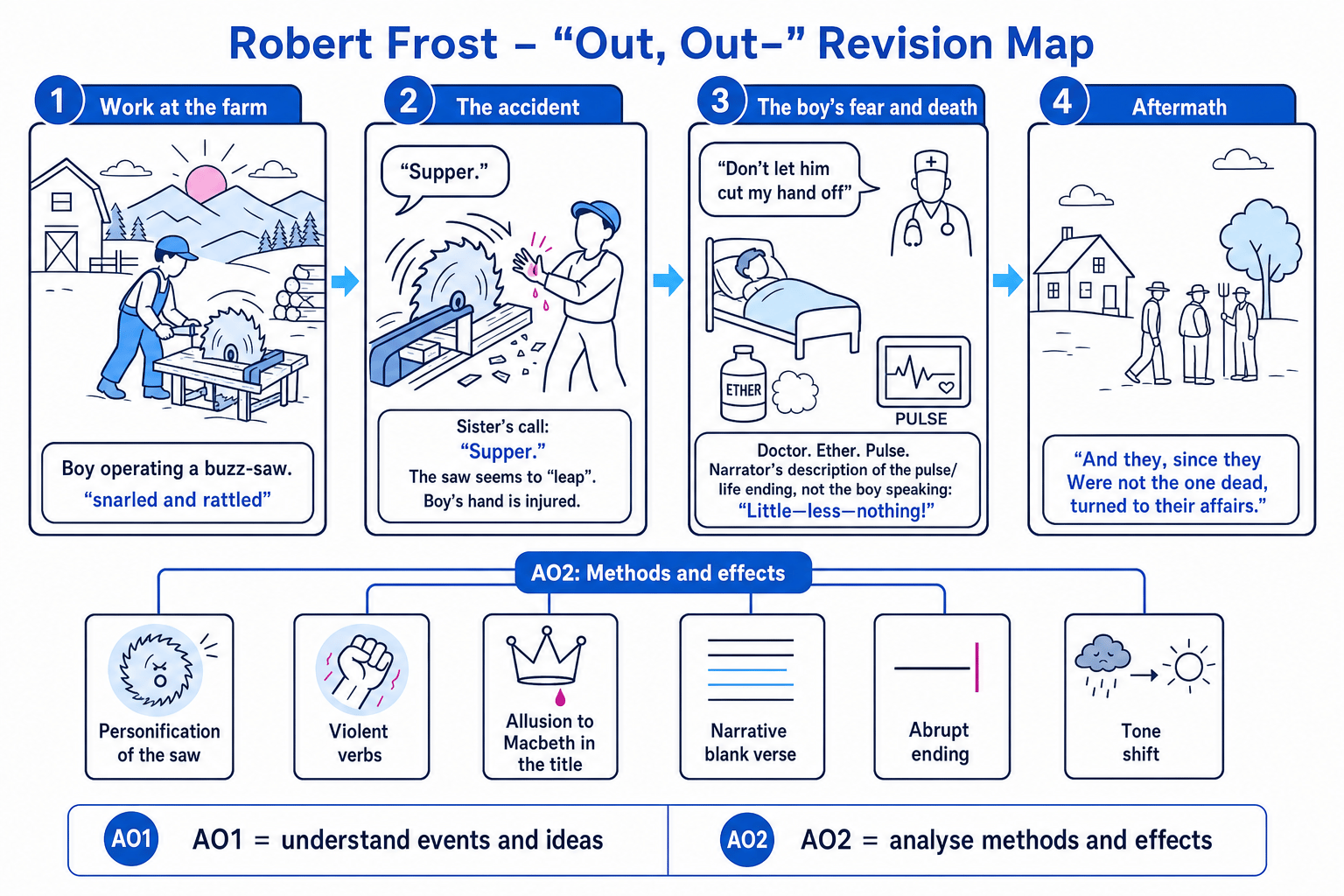
The central tragedy
Frost presents the boy’s death as sudden, brutal, and almost casually absorbed back into everyday life. The shock comes not only from the accident, but from how quickly the world continues afterwards.
The title and the Macbeth allusion
Allusion
An allusion is a reference to another text, story, person, or event. Writers use allusions to add extra layers of meaning.
The title "Out, Out–" alludes to Shakespeare’s Macbeth, where Macbeth says, “Out, out, brief candle!” after hearing of Lady Macbeth’s death. In that speech, life is compared to something short, fragile, and easily extinguished.
Frost’s title therefore prepares us for a poem about life being cut off suddenly. The dash after “Out, Out–” also feels unfinished, as if the boy’s life has been interrupted mid-moment.
Over-explaining Macbeth
You do not need to retell the plot of Macbeth. In an essay on Frost, simply explain that the allusion links the boy’s life to a “brief candle” being suddenly put out.
Theme 1: the suddenness and indifference of death
Death arrives with almost no warning. Frost builds an ordinary working scene, then lets the accident happen in a single terrible moment. The phrase “At the word” makes the sister’s call of “Supper.” seem like the trigger, even though the real danger has been present all along.
The ending is especially cold. The final statement that the others “turned to their affairs” can feel emotionally harsh. Frost does not give us a long funeral scene or a dramatic moral speech. Instead, the poem stops almost as abruptly as the boy’s life.
Death in the poem
Death is presented as sudden and impersonal: it does not wait for the boy to grow up, and it does not stop the wider world from carrying on.
Theme 2: lost childhood
The boy is trapped between childhood and adult responsibility. Frost calls him a “big boy / Doing a man’s work, though a child at heart”. This contrast is vital: physically, he is expected to work like an adult; emotionally, he is still a child.
Earlier, the speaker wishes someone had ended the workday early: “Call it a day, I wish they might have said”. That wish is painful because it comes too late. The “half hour” the boy might have had away from work becomes symbolic of the childhood he loses completely.
Linking childhood to tragedy
- Start with the contrast in Frost’s description: the boy is “Doing a man’s work” but remains “a child at heart”. This shows he is being placed in an adult world before he is ready.
- Connect that contrast to the accident: the buzz-saw belongs to the world of dangerous labour, not play or childhood.
- Explain the effect: the reader feels that the boy’s death is not just a personal tragedy, but also a loss of innocence caused by adult demands.
Theme 3: the demands of labour
The poem is set in a working environment. The saw makes “stove-length sticks of wood”, so the boy’s work is practical and necessary. Frost does not present the farm as evil, but he does show how labour can become more important than a child’s safety.
The final line, “turned to their affairs”, suggests that work and responsibility continue even after tragedy. This may seem cruel, but it also reflects a hard rural world where people cannot stop for long.
A balanced interpretation
Do not simply write, “Everyone is heartless.” A stronger answer recognises the ambiguity: the ending is emotionally shocking, but it may also show the harsh necessity of survival and work.
Personification of the saw
Personification
Personification is when a writer gives human or living qualities to something non-human.
Frost makes the buzz-saw seem alive. It “snarled and rattled” and later “Leaped out at the boy’s hand, or seemed to leap”. These descriptions make the saw feel like a threatening animal rather than a neutral tool.
The repeated “snarled and rattled” also creates sound. The words imitate the harsh, mechanical noise of the saw, making the danger feel constant.
Analysing the personified saw
- Select a precise quotation: “snarled and rattled” makes the saw sound aggressive and noisy.
- Identify the method: “snarled” personifies the saw because snarling is usually associated with a threatening animal.
- Explain the effect: Frost makes the machine seem predatory, so the accident feels both shocking and horribly foreshadowed.
- Link to a theme: the personification supports the idea that the boy is vulnerable in a world of dangerous labour.
Violent verbs and physical shock
Verb
A verb is a word that expresses an action, state, or process. In poetry analysis, strong verbs often reveal energy, violence, or movement.
Frost uses violent or sudden verbs to make the accident feel brutal. The saw “Leaped”; the boy fears the doctor will “cut” his hand off; his life seems to be “spilling”. These words turn the scene into something physical and frightening.
The phrase “Neither refused the meeting” is disturbingly calm. It describes the contact between saw and hand almost politely, which makes the horror worse. Frost often controls emotion by using plain, restrained language.
Form: narrative blank verse
Narrative blank verse
A narrative poem tells a story. Blank verse is poetry written in unrhymed lines, often with a flexible five-beat rhythm called iambic pentameter.
"Out, Out–" is a narrative poem because it follows events in sequence: work, accident, medical response, death, aftermath. It is written in blank verse, which makes it sound closer to natural speech than a strongly rhymed poem would.
This matters because the tragedy feels realistic. Frost does not make the poem neat or musical in a comforting way. The form helps the story feel immediate, plain, and believable.
Only spotting the form
Do not just write, “The poem is in blank verse.” Add why it matters: the unrhymed, speech-like form makes the accident feel realistic and avoids comforting neatness.
Structure: the abrupt ending
Structure
Structure means how a text is organised: the order of events, shifts in focus, pace, openings, endings, and changes in tone.
The structure is deliberately abrupt. The boy’s death is reduced to “Little—less—nothing!” The dashes slow the phrase down, as if life is disappearing in stages. Then the poem ends almost immediately.
Caesura
A caesura is a pause within a line of poetry, often created by punctuation such as a comma, full stop, colon, or dash.
In “Little—less—nothing!”, the dashes act like caesurae. They make the reader pause between each shrinking stage of life. The line sounds like a pulse fading.
Writing about the final movement
- Notice the sequence in “Little—less—nothing!”: the words move from smallness to absence, suggesting life reducing to zero.
- Analyse the punctuation: the dashes create pauses, so the reader experiences the slowing rhythm of the boy’s death.
- Connect this to the ending: Frost then moves quickly to “turned to their affairs”, making the aftermath feel brutally sudden and emotionally detached.
Tone and key shifts
Tone
Tone is the attitude or mood created by the writer’s choice of words and details.
The tone changes across the poem. At first, it is descriptive and almost beautiful: Frost shows “Five mountain ranges” and a sunset. However, the saw’s “snarled and rattled” noise creates an ominous undertone.
After the accident, the tone becomes urgent and fearful. The boy’s plea, “Don’t let him cut my hand off”, reveals panic and childish vulnerability. By the ending, the tone becomes detached and bleak. Frost’s restraint makes the tragedy more powerful because he refuses to soften it.
How to shape an essay paragraph
A strong paragraph should not retell the whole poem. It should make a clear point, support it with a short quotation, identify a method, and explain the effect.
You might write:
Frost presents the saw as a constant threat through personification. The repeated phrase “snarled and rattled” gives the machine animal-like aggression, suggesting it is not just a tool but a predator in the workplace. This makes the boy seem vulnerable even before the accident, especially because he is “a child at heart” while doing adult labour. The reader is therefore prepared for tragedy, but still shocked by the suddenness of the saw’s “leap”.
In the exam
- Begin with a clear argument about the poem, such as how Frost presents life as fragile or labour as dangerously demanding.
- Use short, accurate quotations and zoom in on methods: verbs, personification, punctuation, tone, form, and the abrupt ending.
- Keep linking AO2 back to AO1: every technique you analyse should help explain Frost’s ideas about death, childhood, work, or human indifference.
Check yourself
- How does Frost make the buzz-saw seem alive and dangerous?
- Why is the phrase “Doing a man’s work, though a child at heart” important?
- What is the effect of the poem ending with the others turning “to their affairs”?
