

What you'll learn
- What atoms and molecules are.
- The positions, relative masses and relative charges of protons, neutrons and electrons.
- What atomic number, mass number, isotopes and relative atomic mass mean.
- How to calculate ArA_rAr from isotopic abundances.
Atoms and molecules
Chemistry is the study of substances, and substances are made from tiny particles. The most important starting particle is the atom.
Atom
An atom is the smallest particle of an element that can take part in chemical reactions.
An element is a substance made from only one type of atom. For example, copper is made from copper atoms, and helium is made from helium atoms.
Some atoms join together in fixed groups called molecules.
Molecule
A molecule is a group of two or more atoms chemically bonded together. The atoms may be the same element, such as oxygen, O2O_2O2, or different elements, such as water, H2OH_2OH2O.
A molecule does not have to contain different elements. For example, O2O_2O2 is a molecule but not a compound, because it only contains oxygen atoms. Water, H2OH_2OH2O, is both a molecule and a compound, because it contains hydrogen and oxygen atoms chemically bonded together.
Molecule does not always mean compound
A compound contains two or more different elements chemically combined. A molecule just means two or more atoms bonded together, so O2O_2O2 and N2N_2N2 are molecules but not compounds.
The structure of an atom
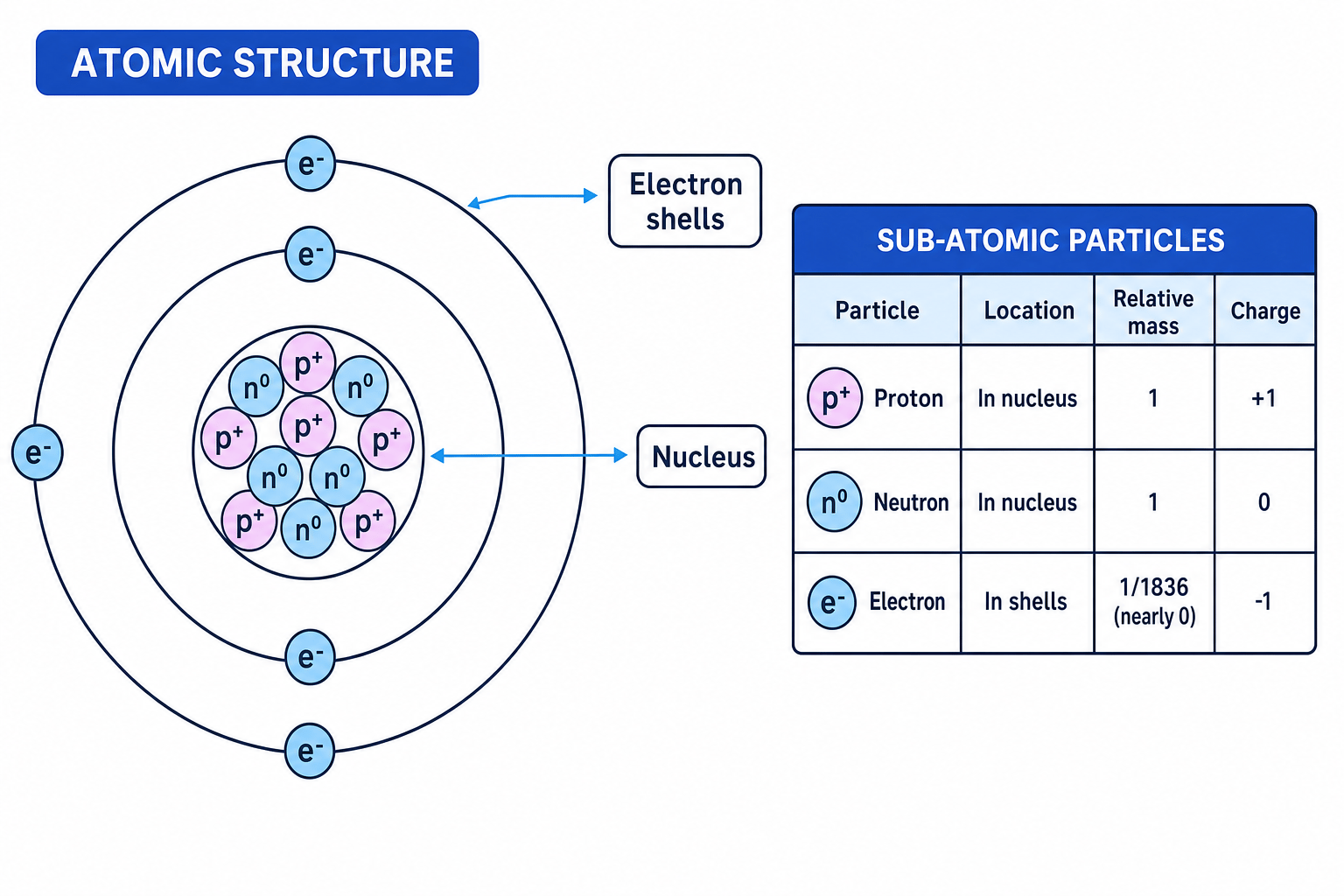
Atoms are made from smaller particles called sub-atomic particles. The three sub-atomic particles you need are:
- Protons
- Neutrons
- Electrons
The nucleus is the tiny central part of the atom. It contains protons and neutrons. Electrons are found outside the nucleus in electron shells, which are energy levels around the nucleus.
Most of the atom’s mass is in the nucleus, because protons and neutrons are much heavier than electrons.
Relative mass and relative charge
In IGCSE Chemistry, you do not need the actual masses of the particles. You compare them using relative mass.
Relative mass and relative charge
Relative mass compares the mass of a sub-atomic particle with other sub-atomic particles. Relative charge compares the electrical charge on a particle.
You need to know:
- A proton is in the nucleus, has relative mass 1 and relative charge +1.
- A neutron is in the nucleus, has relative mass 1 and relative charge 0.
- An electron is in shells around the nucleus, has relative mass 1/1836, often treated as nearly 0, and relative charge -1.
Atoms are normally neutral, meaning they have no overall charge. This is because a neutral atom has the same number of protons and electrons, so the positive and negative charges cancel out.
Atoms are mostly nucleus plus shells
The nucleus contains the heavy particles, protons and neutrons. Electrons are much lighter and are found in shells around the nucleus.
Atomic number and mass number
To describe a particular atom, chemists use two important numbers.
Atomic number and mass number
The atomic number, ZZZ, is the number of protons in the nucleus of an atom. The mass number, AAA, is the total number of protons and neutrons in the nucleus.
So:
mass number=number of protons+number of neutrons\text{mass number} = \text{number of protons} + \text{number of neutrons}mass number=number of protons+number of neutronsand rearranging:
number of neutrons=mass number−atomic number\text{number of neutrons} = \text{mass number} - \text{atomic number}number of neutrons=mass number−atomic numberThe atomic number identifies the element. Every carbon atom has 6 protons. Every oxygen atom has 8 protons. If the number of protons changes, it is a different element.
Quick particle rules
For a neutral atom: protons = atomic number, electrons = protons, and neutrons = mass number − atomic number.
Finding numbers of sub-atomic particles
A neutral sodium atom has atomic number 11 and mass number 23. Find the numbers of protons, neutrons and electrons.
-
Use the atomic number to find the number of protons: sodium has 11 protons.
-
Use the mass number to find the number of neutrons:
neutrons=23−11=12\text{neutrons} = 23 - 11 = 12neutrons=23−11=12 -
Use the fact that the atom is neutral, so electrons equal protons: sodium has 11 electrons.
So the atom contains 11 protons, 12 neutrons and 11 electrons.
Atoms and ions
These rules are for neutral atoms. In an ion, the number of electrons has changed, but the number of protons stays the same.
Isotopes
Not all atoms of the same element have exactly the same mass. This is because they can have different numbers of neutrons.
Isotopes
Isotopes are atoms of the same element with the same number of protons but different numbers of neutrons.
Because isotopes of an element have the same number of protons, they have the same atomic number. Because they have different numbers of neutrons, they have different mass numbers.
For example:
- Carbon-12 has 6 protons and 6 neutrons.
- Carbon-14 has 6 protons and 8 neutrons.
Both are carbon because both have 6 protons. They are isotopes because they have different numbers of neutrons.
Isotopes of the same element usually have very similar chemical properties because they have the same number of electrons in a neutral atom. Their masses are different because they contain different numbers of neutrons.
Deciding whether atoms are isotopes
Atom X has atomic number 17 and mass number 35. Atom Y has atomic number 17 and mass number 37. Decide whether they are isotopes.
-
Compare atomic numbers: both atoms have atomic number 17, so both have 17 protons and are the same element.
-
Calculate neutrons in each atom:
neutrons in X=35−17=18neutrons in Y=37−17=20\begin{aligned} \text{neutrons in X} &= 35 - 17 = 18 \\ \text{neutrons in Y} &= 37 - 17 = 20 \end{aligned}neutrons in Xneutrons in Y=35−17=18=37−17=20 -
They have the same number of protons but different numbers of neutrons, so they are isotopes.
Changing neutrons does not change the element
An atom’s element is decided by its number of protons, not its number of neutrons. Different neutrons make isotopes, not new elements.
Relative atomic mass, ArA_rAr
The atoms in a sample of an element may be a mixture of isotopes. Because isotopes have different masses, chemists use an average value called the relative atomic mass.
Relative atomic mass
The relative atomic mass, ArA_rAr, is the weighted mean mass of the atoms of an element compared with one-twelfth of the mass of a carbon-12 atom.
That definition sounds formal, but the calculation idea is straightforward: ArA_rAr is an average that takes account of how common each isotope is.
The word weighted means that more abundant isotopes have a bigger effect on the average. If 75% of chlorine atoms are chlorine-35 and 25% are chlorine-37, the average will be much closer to 35 than to 37.
is an average
Relative atomic mass is usually not a whole number because it is a weighted average of the masses of naturally occurring isotopes.
Calculating ArA_rAr from percentage abundances
When the abundances are percentages, use:
Ar=∑(isotope mass×percentage abundance)100A_r = \frac{\sum(\text{isotope mass} \times \text{percentage abundance})}{100}Ar=100∑(isotope mass×percentage abundance)At IGCSE, the isotope’s mass number is usually used as its isotope mass in these calculations.
Calculating relative atomic mass
Chlorine has two main isotopes: chlorine-35 with abundance 75% and chlorine-37 with abundance 25%. Calculate the relative atomic mass of chlorine.
-
Multiply each isotope mass by its percentage abundance:
35×75=262537×25=925\begin{aligned} 35 \times 75 &= 2625 \\ 37 \times 25 &= 925 \end{aligned}35×7537×25=2625=925 -
Add the weighted values:
2625+925=35502625 + 925 = 35502625+925=3550 -
Divide by 100 because the abundances are percentages:
Ar=3550100=35.5A_r = \frac{3550}{100} = 35.5Ar=1003550=35.5
So the relative atomic mass of chlorine is 35.5. It has no units.
Check your answer
Your calculated ArA_rAr should lie between the isotope masses. For chlorine-35 and chlorine-37, an answer like 35.5 makes sense; an answer like 72 or 17.5 would not.
If abundances are given as a ratio
Sometimes abundances are given as a ratio instead of percentages. In that case, divide by the total number of ratio parts, not by 100.
For example, if two isotopes are in the ratio 3:1, the total number of parts is 4.
Ar=∑(isotope mass×relative abundance)∑relative abundancesA_r = \frac{\sum(\text{isotope mass} \times \text{relative abundance})}{\sum \text{relative abundances}}Ar=∑relative abundances∑(isotope mass×relative abundance)Forgetting the weighted average
Do not simply add the isotope masses and divide by the number of isotopes unless the isotopes are equally abundant. Most ArA_rAr calculations need a weighted average.
In the exam
- For atomic structure descriptions, include positions, relative masses and relative charges of protons, neutrons and electrons.
- For particle-count questions, use: protons = atomic number, neutrons = mass number − atomic number, and electrons = protons for a neutral atom.
- For isotope questions, compare protons first, then neutrons: same protons but different neutrons means isotopes.
- For ArA_rAr calculations, multiply each isotope mass by its abundance, add the results, then divide by the total abundance.
Check yourself
- What are the relative charge and relative mass of a proton, neutron and electron?
- An atom has atomic number 12 and mass number 24. How many protons, neutrons and electrons does a neutral atom contain?
- Why is the relative atomic mass of chlorine 35.5 rather than a whole number?
