

What you'll learn
- How solids, liquids and gases differ in particle arrangement, movement and energy.
- The names of the changes of state, and how heating or cooling causes them.
- How particle movement explains dilution of coloured solutions and diffusion of gases.
- How to use solubility, solubility curves and the named solubility practical.
The particle model
Chemists use a particle model to explain what matter is like. It is a simplified picture: instead of drawing every detail, we imagine substances as tiny particles with spaces between them.
Particle and kinetic energy
- A particle is a tiny unit of matter. In chemistry this could mean an atom, molecule or ion, depending on the substance.
- Kinetic energy is the energy a particle has because it is moving or vibrating.
Heating a substance transfers energy to its particles. Cooling a substance removes energy from its particles. This changes how strongly particles can stay together and how freely they move.
The three states of matter
The three common states of matter are solid, liquid and gas. A state of matter is the physical form a substance has.
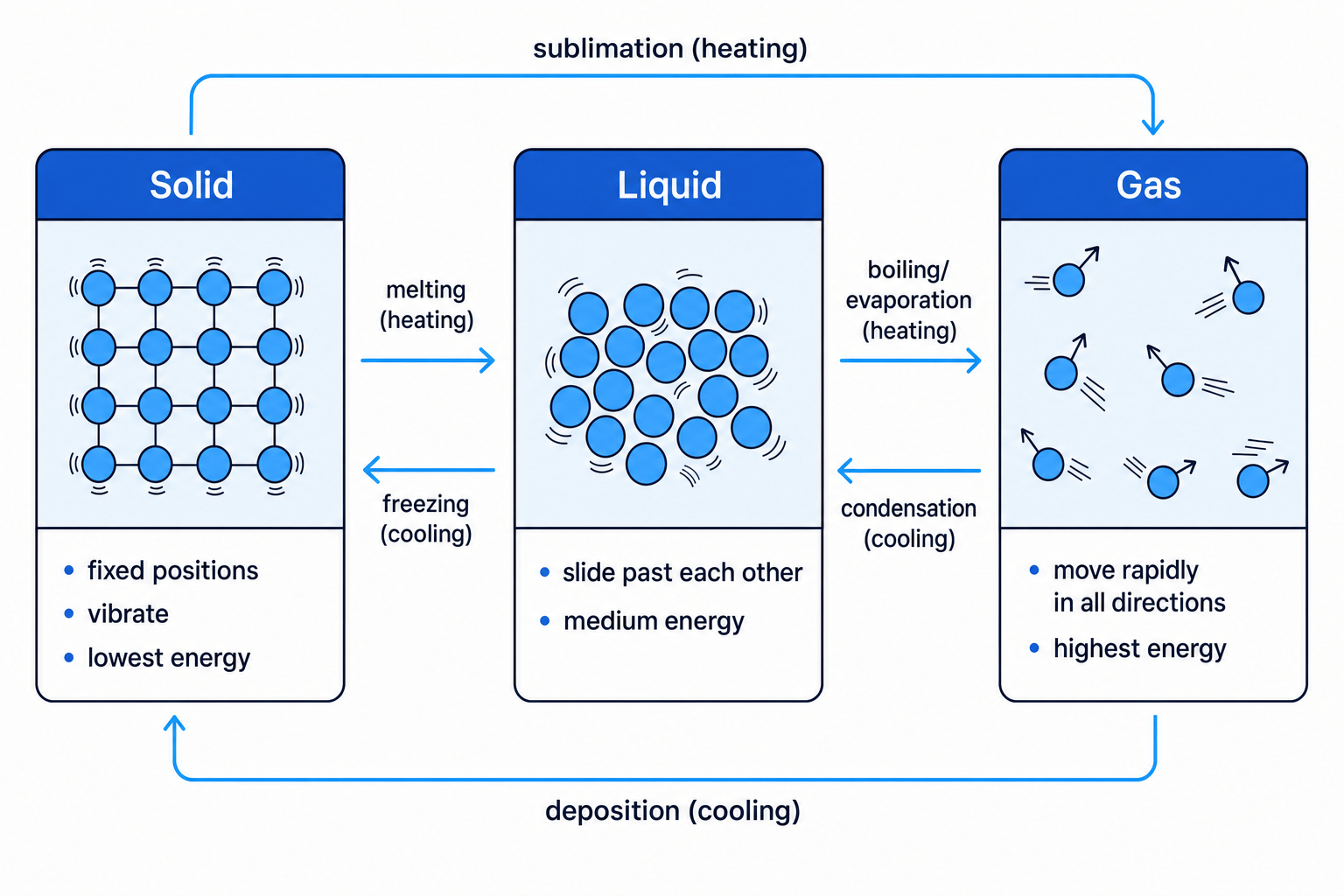
| State | Arrangement of particles | Movement of particles | Energy of particles |
|---|---|---|---|
| Solid | Very close together, usually in a regular pattern | Vibrate about fixed positions | Lowest, compared with the same substance as a liquid or gas |
| Liquid | Close together, but irregularly arranged | Move and slide past each other | More than in a solid |
| Gas | Far apart, randomly arranged | Move rapidly in all directions | Highest, compared with the same substance as a solid or liquid |
A solid has a fixed shape and a fixed volume because its particles are held in fixed positions. A liquid has a fixed volume but takes the shape of its container because its particles can slide past each other. A gas fills the container because its particles move freely and are far apart.
State depends on particles
For a substance changing state, particles generally become less ordered, more spread out and more energetic as you go from solid to liquid to gas.
Interconversions between states
An interconversion is a change from one state of matter to another. These are physical changes: the particles are rearranged, but no new substance is made.
| Change of state | Direction | How it is achieved | Particle explanation |
|---|---|---|---|
| Melting | solid to liquid | Heating | Particles gain energy and leave their fixed positions |
| Freezing or solidifying | liquid to solid | Cooling | Particles lose energy and become fixed in place |
| Boiling or evaporation | liquid to gas | Heating | Particles gain enough energy to separate and move far apart |
| Condensation | gas to liquid | Cooling | Particles lose energy and come closer together |
| Sublimation | solid to gas | Heating | Particles go straight from fixed positions to far apart |
| Deposition | gas to solid | Cooling | Particles go straight from far apart to fixed positions |
A melting point is the temperature at which a solid changes to a liquid. A boiling point is the temperature at which a liquid boils.
Particles do not expand
When a substance is heated, the particles themselves do not get bigger. The particles move more and may become further apart.
Evaporation versus boiling
Boiling happens throughout a liquid at its boiling point. Evaporation happens only at the surface and can happen below the boiling point.
Solutions, solvents and solutes
Before we explain dilution, you need the solution vocabulary.
Solution terms
- A solvent is the liquid that dissolves another substance.
- A solute is the substance that dissolves in the solvent.
- A solution is the mixture formed when a solute dissolves in a solvent.
- A saturated solution contains as much dissolved solute as possible at that temperature.
If water is the solvent, the solution is called an aqueous solution. In equations, aqueous is shown using the state symbol (aq).
Dissolving happens when solute particles become separated and spread out among solvent particles.
Dissolving is not melting
Melting is a change of state caused by heating one substance. Dissolving is when a solute spreads through a solvent to make a solution.
Dilution and diffusion
Concentration means how much solute is present in a certain volume of solution. Dilution means adding more solvent to make a solution less concentrated.
For example, if you add water to a purple solution of potassium manganate(VII), the purple colour becomes paler. The coloured particles have not disappeared — they are just spread through a larger volume, so there are fewer coloured particles in each cm³ of solution.
Diffusion
Diffusion is the net spreading of particles from an area of higher concentration to an area of lower concentration because the particles move randomly.
Diffusion happens most quickly in gases because gas particles are far apart and move rapidly. It also happens in liquids, but usually more slowly. In solids at room temperature, diffusion is extremely slow because the particles are held in fixed positions.
Explaining gas diffusion
A small amount of brown bromine vapour is released into a gas jar of air. After some time, the brown colour is spread throughout the jar.
- At the start, bromine particles are concentrated in one region, while the rest of the jar has little or no bromine.
- The bromine particles move randomly and rapidly, so more particles move away from the high-concentration region than move back into it.
- Over time, the bromine particles become evenly mixed with the air particles, so the brown colour appears throughout the jar.
Solubility
In Edexcel 4CH1, the solubility definition, solubility curves and solubility practical are marked C, so they are Paper 2 only. They are still worth learning carefully because the questions are very methodical.
Solubility
Solubility is the maximum mass of solute that dissolves in 100 g of solvent at a stated temperature, forming a saturated solution.
The unit used here is g per 100 g of solvent. If the solvent is water, you may see this written as g per 100 g of water.
solubility=mass of solute dissolved in a saturated solutionmass of solvent×100\text{solubility} = \frac{\text{mass of solute dissolved in a saturated solution}}{\text{mass of solvent}} \times 100solubility=mass of solventmass of solute dissolved in a saturated solution×100Temperature must be stated because solubility often changes when the temperature changes.
Solvent, not solution
Solubility in this topic is measured per 100 g of solvent, not per 100 g of solution.
Solubility curves
A solubility curve is a graph showing how solubility changes with temperature.
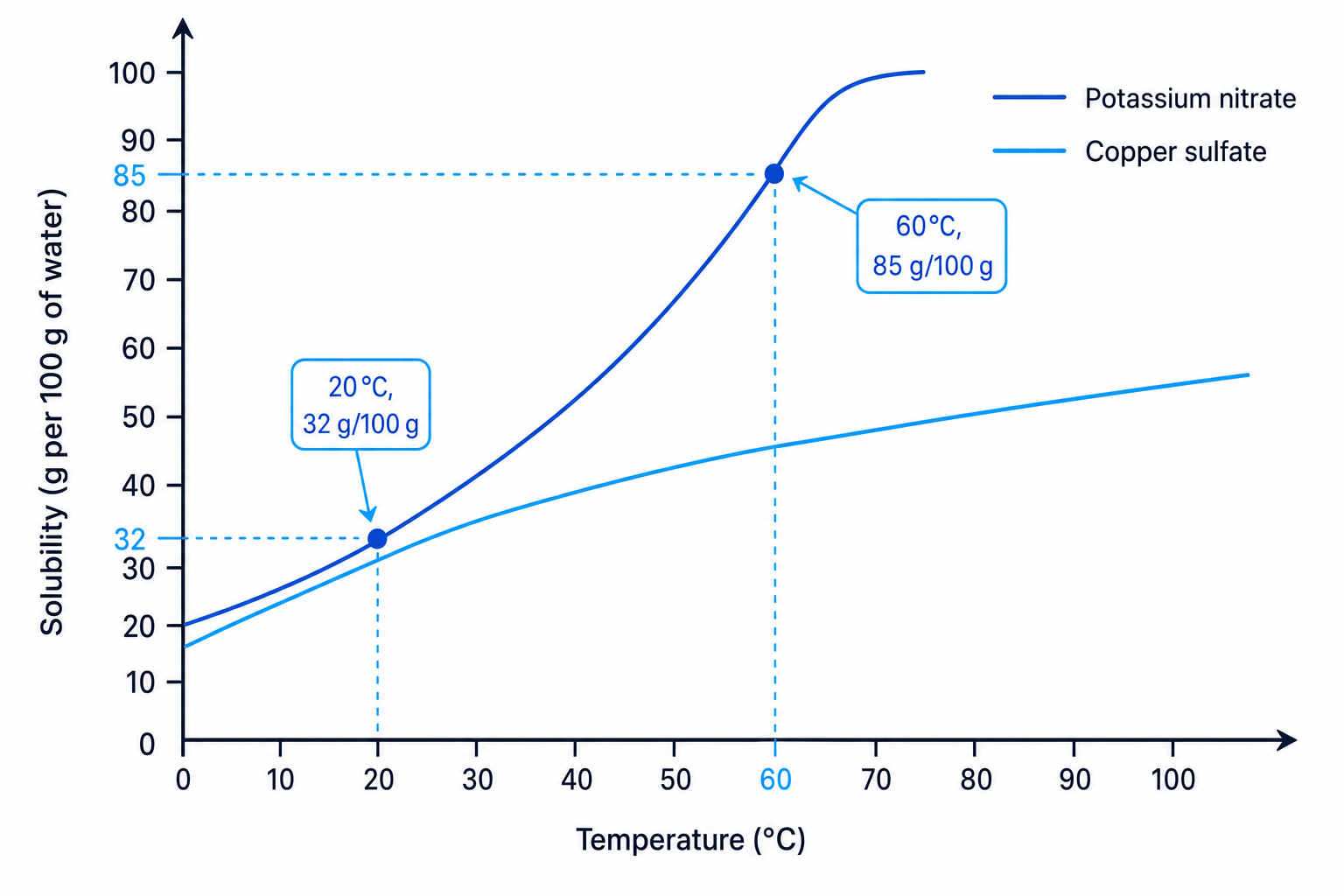
When reading a solubility curve:
- The x-axis shows temperature in °C.
- The y-axis shows solubility in g per 100 g of solvent.
- A point on the curve represents a saturated solution.
- A point below the curve represents an unsaturated solution.
- A point above the curve means that not all the solute can stay dissolved; some solid would remain undissolved or crystallise out.
Plotting curves
Plot the experimental points accurately, then draw a smooth curve of best fit. Do not just join dots with straight lines unless the trend really is straight.
Using a solubility curve to predict crystals
A saturated potassium nitrate solution contains 50.0 g of water at 60°C. It is cooled to 20°C. Use the curve values: 85 g per 100 g water at 60°C, and 32 g per 100 g water at 20°C.
-
Scale the 60°C solubility to 50.0 g of water:
85 g×50.0100=42.5 g85\,\text{g} \times \frac{50.0}{100} = 42.5\,\text{g}85g×10050.0=42.5gSo 42.5 g of potassium nitrate is dissolved at 60°C.
-
Scale the 20°C solubility to 50.0 g of water:
32 g×50.0100=16.0 g32\,\text{g} \times \frac{50.0}{100} = 16.0\,\text{g}32g×10050.0=16.0gSo only 16.0 g can stay dissolved at 20°C.
-
Find the mass that crystallises:
42.5 g−16.0 g=26.5 g42.5\,\text{g} - 16.0\,\text{g} = 26.5\,\text{g}42.5g−16.0g=26.5gTherefore, 26.5 g of potassium nitrate crystallises out, assuming no water evaporates.
Practical: investigating solubility at a fixed temperature
The aim is to find the solubility of a solid in water at a specific temperature.
Apparatus
You may use:
- solid solute
- distilled water
- balance
- beaker or conical flask
- thermometer
- water bath, which keeps the water at a chosen temperature
- glass rod or stirrer
- filter funnel and filter paper
- evaporating basin
- heat source, such as a Bunsen burner or hot plate
Method
- Add a measured mass of water to a beaker and place it in a water bath at the chosen temperature.
- Add the solid in small portions, stirring each time, until a small amount remains undissolved. This shows the solution is saturated.
- Keep the mixture at the chosen temperature and filter it to remove the undissolved solid. The liquid that passes through the filter paper is the filtrate.
- Weigh an empty evaporating basin, then add a measured mass of the saturated solution and weigh again.
- Heat gently to evaporate the water, leaving the dissolved solid behind.
- Heat, cool and reweigh until the mass is constant. Constant mass means repeated weighing gives the same mass, showing the solid is dry.
- Use the mass of dry solid and the mass of water in the sample to calculate the solubility.
Variables and expected results
- The independent variable is the temperature if you repeat the experiment at different temperatures.
- The dependent variable is the solubility.
- Control variables include the solute used, the solvent used, the temperature during filtering, and the method of drying.
- At a higher temperature, many solids become more soluble, so their solubility curves slope upwards.
Common practical errors
- If the solution cools during filtering, crystals may form too early.
- If water evaporates before measuring the saturated solution, the calculated solubility may be too high.
- If the solid is not fully dry, its measured mass will be too high.
- If the solution was not actually saturated, the calculated solubility will be too low.
Calculating solubility from practical data
A student takes 25.00 g of saturated solution. The empty evaporating basin has a mass of 42.10 g. After evaporating the water and drying the solid, the basin plus dry solid has a mass of 48.60 g.
-
Calculate the mass of dissolved solid:
48.60 g−42.10 g=6.50 g48.60\,\text{g} - 42.10\,\text{g} = 6.50\,\text{g}48.60g−42.10g=6.50g -
Calculate the mass of water in the solution sample:
25.00 g−6.50 g=18.50 g25.00\,\text{g} - 6.50\,\text{g} = 18.50\,\text{g}25.00g−6.50g=18.50g -
Convert to g per 100 g of water:
6.50 g18.50 g×100=35.1\frac{6.50\,\text{g}}{18.50\,\text{g}} \times 100 = 35.118.50g6.50g×100=35.1The solubility is 35.1 g per 100 g of water.
In the exam
- For state changes, always mention arrangement, movement and energy of particles.
- Do not say particles expand, disappear or turn into new particles during physical changes.
- For solubility, include the temperature and the unit g per 100 g of solvent.
- For practical questions, describe how you make a saturated solution, keep the temperature constant, remove excess solid and calculate from masses.
Check yourself
- What happens to particle arrangement, movement and energy when a liquid boils?
- Why does a coloured solution become paler when more water is added?
- How would you use a solubility curve to find the mass of crystals formed when a saturated solution cools?

