What you'll learn
- How to classify substances as elements, compounds or mixtures.
- Why pure substances have fixed melting and boiling points, while mixtures often do not.
- How to choose separation techniques such as filtration, crystallisation, distillation and paper chromatography.
- How to interpret a chromatogram and calculate an RfR_fRf value.
Starting point: what is a substance?
Matter is anything that has mass and takes up space. In chemistry, matter is made from tiny particles, such as atoms, molecules or ions.
An atom is the smallest particle of an element that can take part in chemical reactions. Atoms can join together to form molecules, which are groups of atoms chemically bonded together.
Elements, compounds and mixtures
Element, compound and mixture
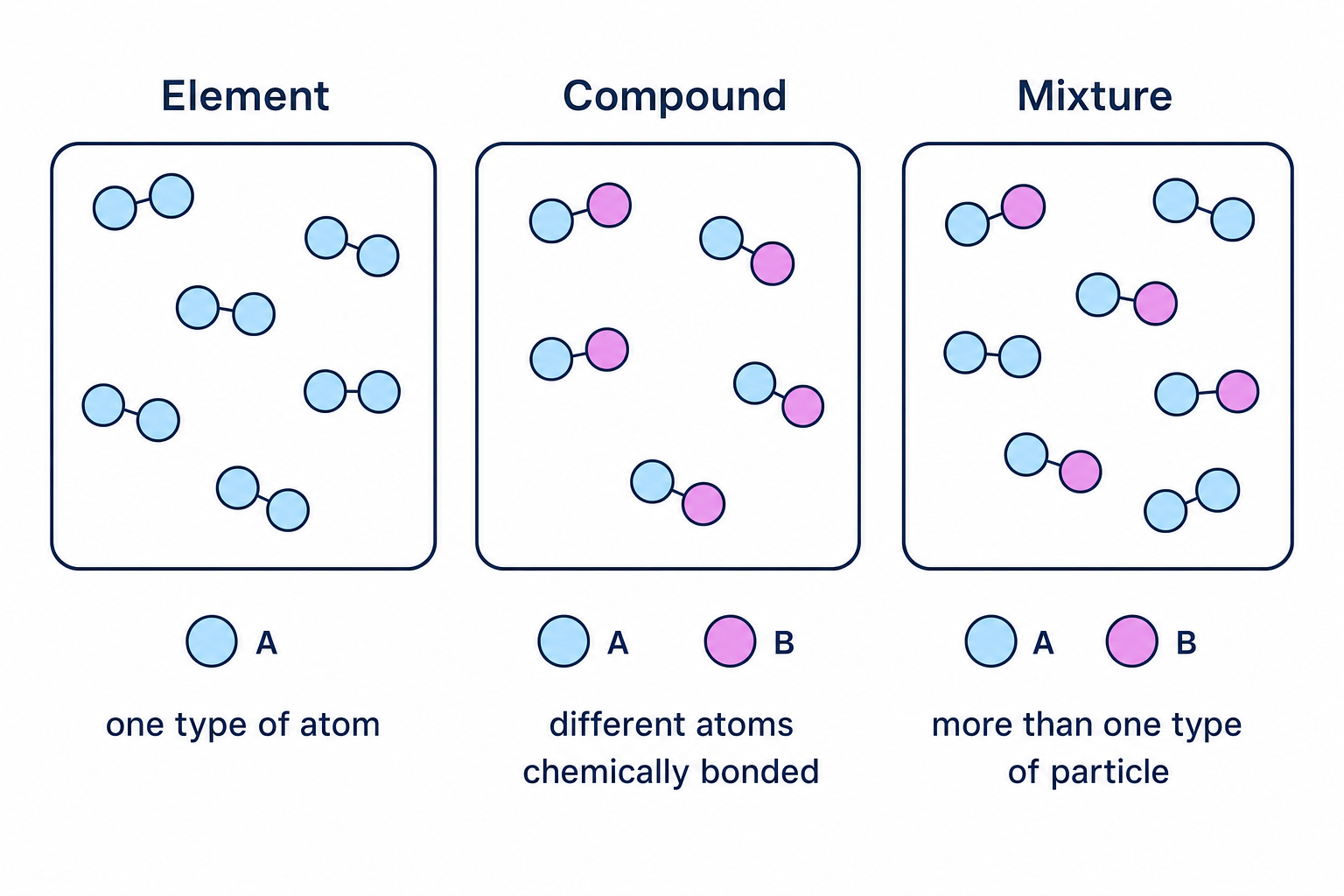
- An element is a substance made from only one type of atom.
- A compound is a substance made from two or more different elements chemically combined in a fixed ratio.
- A mixture contains two or more substances that are not chemically combined.
For example, oxygen gas, O2(g)O_2(g)O2(g), is an element because it contains only oxygen atoms. Water, H2O(l)H_2O(l)H2O(l), is a compound because it contains hydrogen and oxygen atoms chemically bonded in a fixed ratio. Air is a mixture because it contains several gases, such as nitrogen, oxygen, carbon dioxide and argon, mixed together but not chemically bonded.
Hydrogen and oxygen can chemically react to form the compound water:
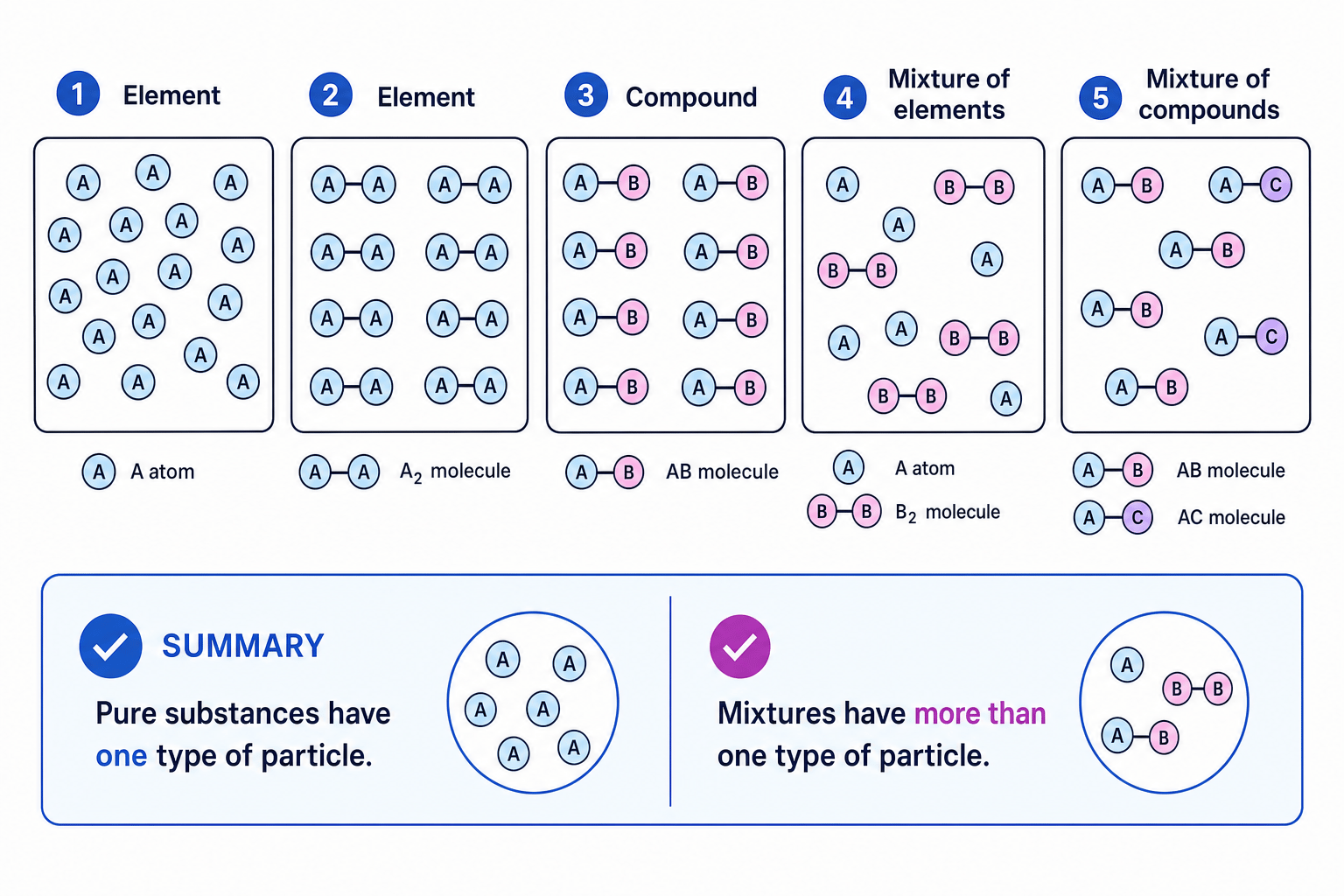
2H2(g)+O2(g)→2H2O(l)2H_2(g) + O_2(g) \rightarrow 2H_2O(l)2H2(g)+O2(g)→2H2O(l)The particle diagrams below show the key difference: a pure element or pure compound has one type of particle, but a mixture has more than one type of particle.
How to classify a substance
Ask two questions: Are all the particles the same? If yes, it is a pure substance. Then ask: Do the particles contain one type of atom or different types of atom chemically bonded? That tells you whether it is an element or a compound.
Classifying a particle diagram
A sample contains some ABABAB particles and some A2A_2A2 particles. Classify the sample.
- ABABAB particles contain two different atoms chemically bonded, so each ABABAB particle is a compound particle.
- A2A_2A2 particles contain only one type of atom, so each A2A_2A2 particle is an element molecule.
- The sample contains two different types of particle, so the whole sample is a mixture.
Pure does not mean safe
In chemistry, pure means “only one substance present”. It does not mean clean, healthy, natural or harmless. Pure chlorine gas is chemically pure, but it is still dangerous.
Pure substances and melting/boiling points
A pure substance contains only one substance: either a single element or a single compound.
Melting point and boiling point
The melting point is the temperature at which a solid changes to a liquid. The boiling point is the temperature at which a liquid changes to a gas throughout the liquid.
A pure substance has a fixed melting point and a fixed boiling point. For example, pure water melts at 0 °C and boils at 100 °C at normal atmospheric pressure.
A mixture may melt or boil over a range of temperatures because its different substances affect one another’s particle arrangements and attractions.
Using temperature data
A sharp melting or boiling point suggests a pure substance. A melting or boiling range suggests a mixture or an impure sample.
Using melting point data
A student tests a sample that should be pure benzoic acid, which melts at 122 °C. Their sample melts from 116 °C to 120 °C. Decide whether the sample is pure.
- A pure substance should melt at a fixed temperature, close to its known melting point.
- This sample melts over a range, from 116 °C to 120 °C, rather than sharply at 122 °C.
- The sample is likely to be impure or a mixture, not pure benzoic acid.
Real laboratory readings
In school experiments, a “fixed” melting point may appear as a very small range because thermometers and heating rates are not perfect. In exam answers, link a wide range to impurity or mixture.
Separating mixtures
Mixtures can often be separated by physical methods because the substances in a mixture are not chemically bonded to each other.
A solution is a mixture where a solute is dissolved in a solvent. For example, salt water is a solution: salt is the solute and water is the solvent.
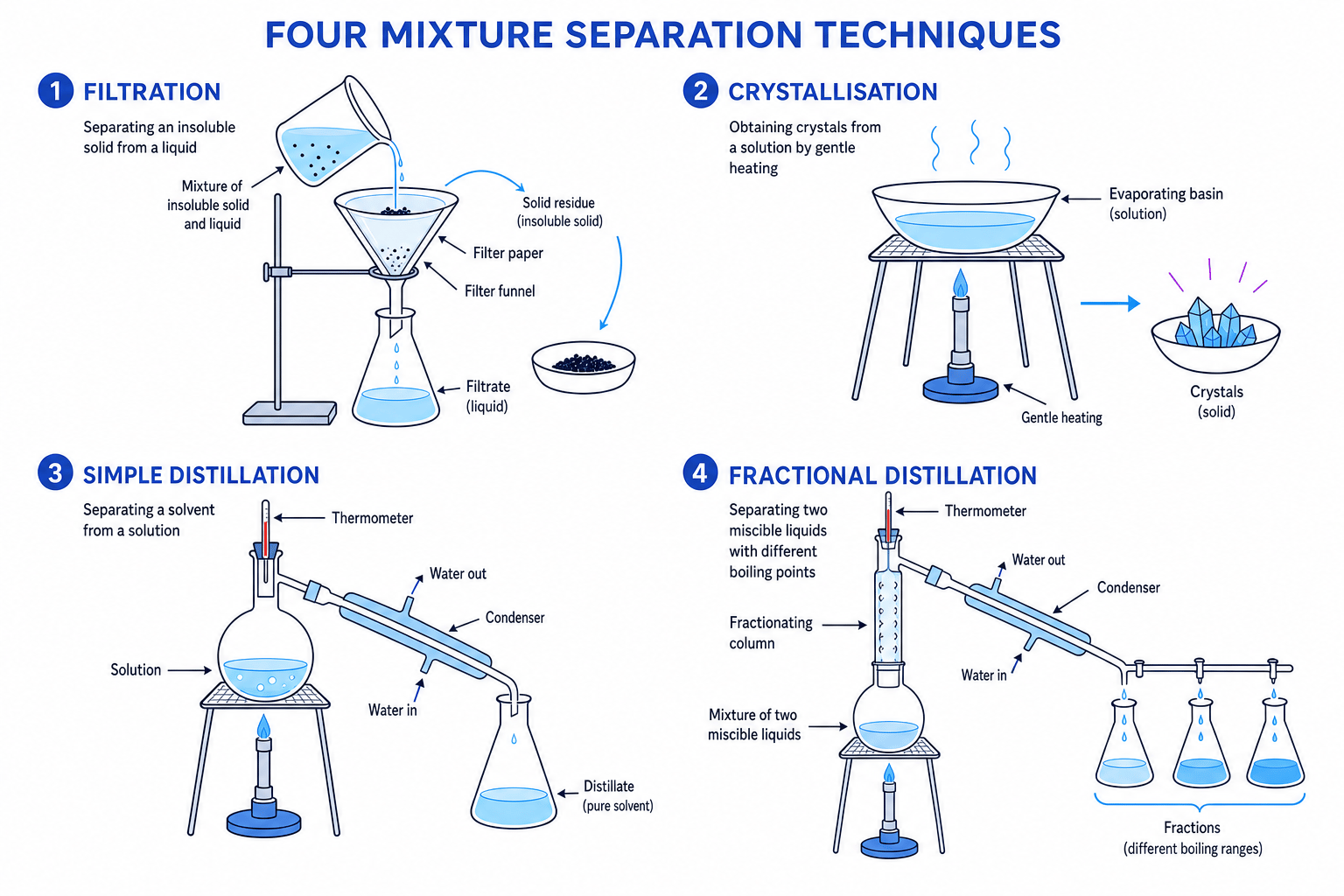
The main separation techniques in this topic are shown below.
Filtration
Filtration separates an insoluble solid from a liquid. Insoluble means it does not dissolve.
The mixture is poured through filter paper in a funnel. The solid left on the paper is the residue. The liquid that passes through is the filtrate.
Use filtration for mixtures such as sand and water.
Crystallisation
Crystallisation separates a dissolved solid from a solution.
The solution is heated gently to evaporate some solvent and make the solution more concentrated. When the solution is nearly saturated, it is left to cool. Crystals form because less solute can stay dissolved in the cooler solution. The crystals can then be filtered and dried.
Use crystallisation when you want to collect the dissolved solid, such as copper(II) sulfate crystals from copper(II) sulfate solution.
Simple distillation
Simple distillation separates a solvent from a solution, or separates liquids with very different boiling points.
The solution is heated. The substance with the lower boiling point evaporates first. Its vapour passes into a condenser, where it cools and condenses back into a liquid. The collected liquid is the distillate.
Use simple distillation to obtain pure water from salty water.
Fractional distillation
Fractional distillation separates two or more miscible liquids with different boiling points. Miscible liquids mix completely with each other.
A fractionating column gives vapours repeated chances to condense and evaporate. The liquid with the lower boiling point reaches the top first and is collected first. Different parts collected at different temperatures are called fractions.
Use fractional distillation for mixtures of liquids such as ethanol and water, or for separating crude oil into fractions later in the course.
Choosing a separation method
A mixture contains sand, salt and water. Describe how to obtain dry salt crystals.
- Sand is insoluble in water, but salt is soluble, so first use filtration. The sand remains as the residue and the salt solution passes through as the filtrate.
- The salt is dissolved in the filtrate, so heat the filtrate gently to evaporate some water until the solution is concentrated.
- Leave the concentrated solution to cool so salt crystals form, then filter and dry the crystals.
Filtering a solution
Filtration cannot separate dissolved salt from water because dissolved salt particles pass through the filter paper with the water. Use crystallisation or distillation instead.
Paper chromatography
Paper chromatography separates substances dissolved in a solvent, such as dyes in ink or food colourings.
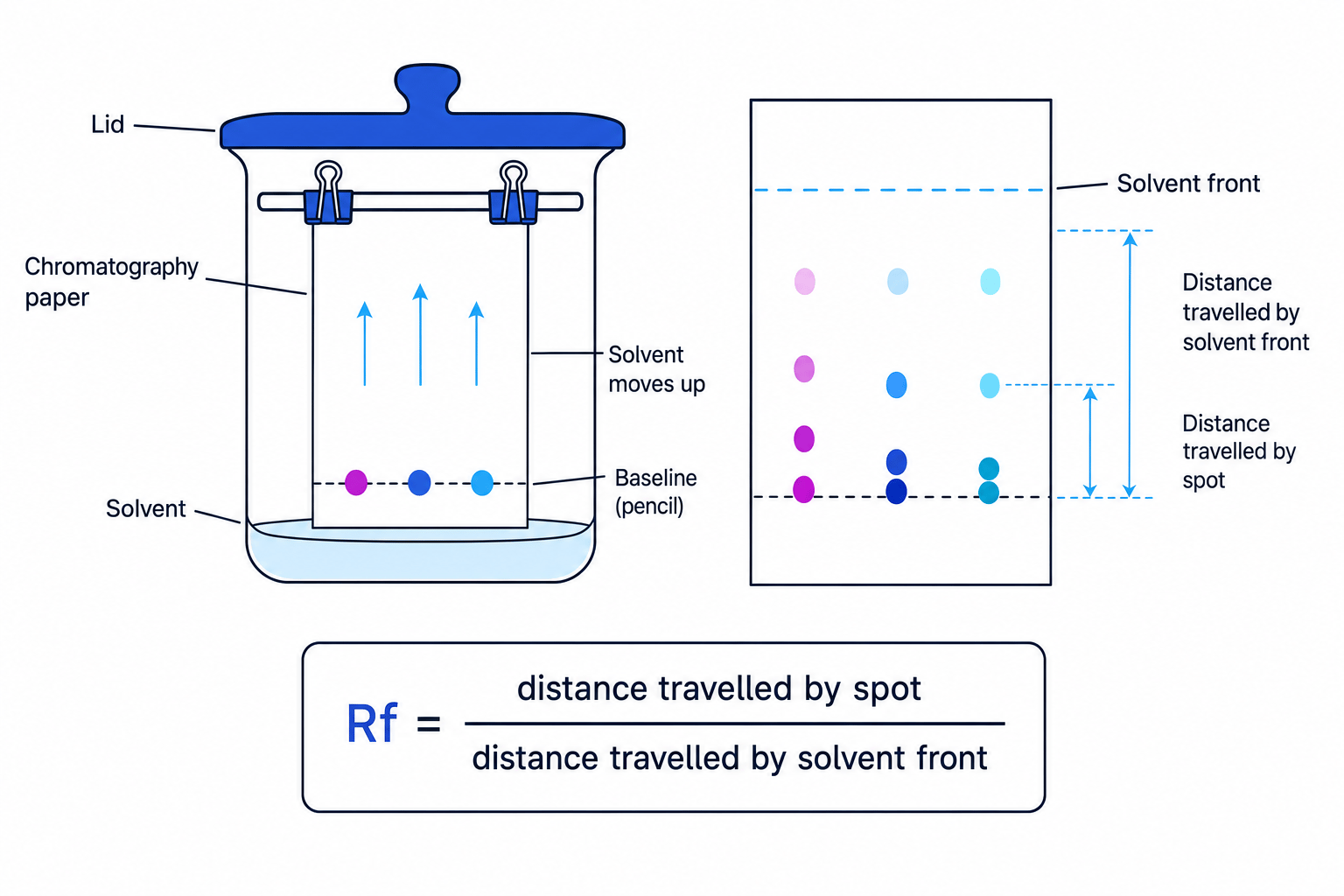
The solvent moves up the paper and carries the dissolved substances with it. Different substances travel different distances because they have different solubilities in the solvent and different attractions to the paper.
A chromatogram is the pattern of spots produced after chromatography. It gives information about the composition of a mixture: one spot usually suggests one component, while several spots suggest a mixture.
The diagram shows the set-up and the key distances used to calculate an RfR_fRf value.
Rf value
An RfR_fRf value compares how far a substance travels with how far the solvent travels:
Rf=distance travelled by spotdistance travelled by solvent frontR_f = \frac{\text{distance travelled by spot}}{\text{distance travelled by solvent front}}Rf=distance travelled by solvent frontdistance travelled by spotRfR_fRf values have no units because the distance units cancel. They can be used to identify substances by comparing them with known reference substances run under the same conditions.
Calculating an Rf value
A blue spot travels 3.2 cm from the baseline. The solvent front travels 8.0 cm from the baseline. Calculate the RfR_fRf value and identify the dye if a known blue dye has Rf=0.40R_f = 0.40Rf=0.40.
-
Use the correct distances, both measured from the baseline: spot distance = 3.2 cm and solvent front distance = 8.0 cm.
-
Substitute into the formula:
Rf=3.2 cm8.0 cm=0.40R_f = \frac{3.2\ \text{cm}}{8.0\ \text{cm}} = 0.40Rf=8.0 cm3.2 cm=0.40 -
The calculated value matches the known blue dye’s RfR_fRf value, so the spot is likely to be that dye.
Rf values depend on conditions
Only compare RfR_fRf values from chromatograms run using the same solvent, paper and temperature. Changing the solvent can change how far each substance travels.
Practical: chromatography of inks or food colourings
For the named practical, you need to know the method, apparatus, variables, expected results and common errors.
Apparatus
- Chromatography paper
- Beaker or chromatography tank
- Solvent, such as water for many food colourings
- Pencil and ruler
- Capillary tube or spotting stick
- Lid or watch glass
- Samples of ink or food colouring
Method
- Draw a pencil baseline near the bottom of the chromatography paper.
- Place small spots of each ink or food colouring on the baseline. Let the spots dry; repeat if a stronger spot is needed.
- Add a shallow layer of solvent to the beaker. The solvent level must be below the baseline.
- Suspend the paper in the beaker and cover with a lid.
- Allow the solvent to rise up the paper until it is near the top.
- Remove the paper and immediately mark the solvent front in pencil.
- Let the chromatogram dry, then compare spots and calculate RfR_fRf values if needed.
Variables and results
The independent variable is usually the ink or food colouring being tested. The dependent variable is the pattern of spots or the RfR_fRf values. Important control variables include the solvent, paper type, solvent depth, temperature and time allowed for the solvent to rise.
A pure dye usually gives one spot. A mixture gives several spots. If a spot from an unknown sample has the same colour and RfR_fRf value as a known dye, the unknown likely contains that dye.
Putting the baseline in the solvent
If the solvent starts above the baseline, the original spots dissolve into the solvent reservoir instead of travelling up the paper. Keep the solvent level below the pencil baseline.
Why use pencil?
Use pencil for the baseline because pencil marks do not dissolve in the solvent. Ink pen may separate into dyes and interfere with your chromatogram.
In the exam
- For classification questions, decide whether there is one type of particle or more than one type of particle before naming element, compound or mixture.
- For separation questions, link the method to the property used: insoluble solid, dissolved solid, different boiling points, or different movement on chromatography paper.
- For chromatography calculations, measure both distances from the baseline, calculate RfR_fRf, and compare only with results from the same solvent conditions.
Check yourself
- How can you tell from a particle diagram whether a sample is a compound or a mixture?
- Why does an impure substance often melt over a range of temperatures?
- In paper chromatography, why must the solvent level start below the baseline?