

What you'll learn
- How metals are ordered by their reactions with water, acids, metal oxides and salt solutions.
- The reactivity order you need to know for Edexcel IGCSE Chemistry.
- Why iron rusts, and how rusting can be prevented.
- How to describe oxidation, reduction, redox, oxidising agents and reducing agents.
What is the reactivity series?
Metals do not all react in the same way. Some, such as potassium, react violently with water. Others, such as gold, are so unreactive that they can be found naturally as the metal.
Reactivity series
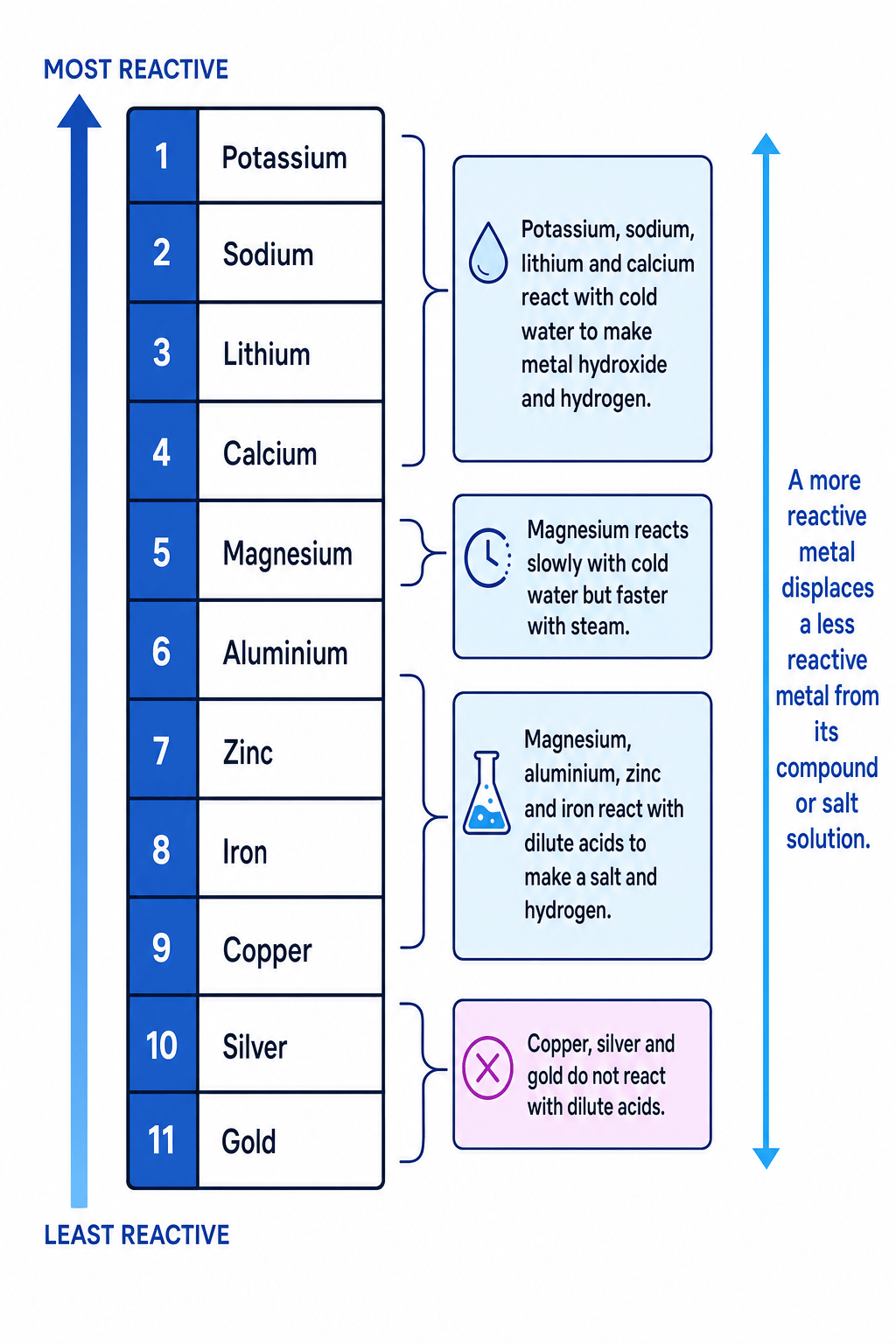
The reactivity series is a list of metals arranged in order of how easily they react, from most reactive to least reactive.
For this specification, you need to know this order:
Potassium, sodium, lithium, calcium, magnesium, aluminium, zinc, iron, copper, silver, gold.
Memory hook
Try: Please Send Little Cats, Monkeys And Zebras Into Copper Silver Gold
Potassium, sodium, lithium, calcium, magnesium, aluminium, zinc, iron, copper, silver, gold.
Reactions of metals with water
The most reactive metals react with cold water to form a metal hydroxide and hydrogen gas.
For sodium:
2Na(s)+2H2O(l)→2NaOH(aq)+H2(g)2\text{Na}(s) + 2\text{H}_2\text{O}(l) \rightarrow 2\text{NaOH}(aq) + \text{H}_2(g)2Na(s)+2H2O(l)→2NaOH(aq)+H2(g)Calcium reacts less vigorously than sodium, but still reacts with cold water:
Ca(s)+2H2O(l)→Ca(OH)2(aq)+H2(g)\text{Ca}(s) + 2\text{H}_2\text{O}(l) \rightarrow \text{Ca(OH)}_2(aq) + \text{H}_2(g)Ca(s)+2H2O(l)→Ca(OH)2(aq)+H2(g)Magnesium reacts very slowly with cold water, but reacts more readily with steam:
Mg(s)+H2O(g)→MgO(s)+H2(g)\text{Mg}(s) + \text{H}_2\text{O}(g) \rightarrow \text{MgO}(s) + \text{H}_2(g)Mg(s)+H2O(g)→MgO(s)+H2(g)Water reactions show relative reactivity
The faster and more vigorous the reaction with water, the more reactive the metal is.
Reactions of metals with dilute acids
A dilute acid is an acid mixed with plenty of water, so its concentration is relatively low. In this topic, the important acids are dilute hydrochloric acid and dilute sulfuric acid.
Metals such as magnesium, aluminium, zinc and iron react with dilute acids to form a salt and hydrogen gas.
General pattern:
metal + acid → salt + hydrogen
For magnesium and hydrochloric acid:
Mg(s)+2HCl(aq)→MgCl2(aq)+H2(g)\text{Mg}(s) + 2\text{HCl}(aq) \rightarrow \text{MgCl}_2(aq) + \text{H}_2(g)Mg(s)+2HCl(aq)→MgCl2(aq)+H2(g)For zinc and sulfuric acid:
Zn(s)+H2SO4(aq)→ZnSO4(aq)+H2(g)\text{Zn}(s) + \text{H}_2\text{SO}_4(aq) \rightarrow \text{ZnSO}_4(aq) + \text{H}_2(g)Zn(s)+H2SO4(aq)→ZnSO4(aq)+H2(g)Iron reacts slowly:
Fe(s)+2HCl(aq)→FeCl2(aq)+H2(g)\text{Fe}(s) + 2\text{HCl}(aq) \rightarrow \text{FeCl}_2(aq) + \text{H}_2(g)Fe(s)+2HCl(aq)→FeCl2(aq)+H2(g)Copper, silver and gold do not react with dilute hydrochloric or sulfuric acid.
Test for hydrogen
Hydrogen gas gives a squeaky pop when a lighted splint is placed near it.
Using observations to rank metals
Magnesium fizzes rapidly with dilute hydrochloric acid, zinc fizzes steadily, and iron fizzes slowly.
- Compare the rate of fizzing because fizzing shows hydrogen gas is being produced.
- The fastest reaction means the metal is the most reactive, so magnesium is more reactive than zinc.
- Zinc reacts faster than iron, so zinc is more reactive than iron.
- The order is therefore: magnesium, zinc, iron.
Confusing amount with rate
A faster reaction means hydrogen is produced more quickly. It does not always mean more hydrogen is produced overall, because the total amount can depend on the mass and moles of metal used.
Displacement reactions
A displacement reaction happens when a more reactive element takes the place of a less reactive element in a compound.
Displacement
In the reactivity series, a more reactive metal can displace a less reactive metal from its oxide or from an aqueous solution of its salt.
Displacement from metal oxides
A metal oxide is a compound containing a metal and oxygen.
For example, magnesium displaces copper from copper(II) oxide because magnesium is more reactive than copper:
Mg(s)+CuO(s)→MgO(s)+Cu(s)\text{Mg}(s) + \text{CuO}(s) \rightarrow \text{MgO}(s) + \text{Cu}(s)Mg(s)+CuO(s)→MgO(s)+Cu(s)Magnesium takes the oxygen from copper(II) oxide. Copper is left as the metal.
Displacement from salt solutions
A salt solution is an aqueous solution containing dissolved ions from a salt, such as copper(II) sulfate solution.
Zinc displaces copper from copper(II) sulfate solution:
Zn(s)+CuSO4(aq)→ZnSO4(aq)+Cu(s)\text{Zn}(s) + \text{CuSO}_4(aq) \rightarrow \text{ZnSO}_4(aq) + \text{Cu}(s)Zn(s)+CuSO4(aq)→ZnSO4(aq)+Cu(s)You would see the blue copper(II) sulfate solution fade, and a reddish-brown copper solid form.
Copper cannot displace zinc from zinc sulfate solution, because copper is less reactive than zinc.
Predicting a displacement reaction
Will iron react with copper(II) sulfate solution?
- Compare the two metals in the reactivity series: iron is above copper.
- A metal higher in the series displaces a metal lower in the series from its salt solution.
- Iron displaces copper, so a reaction occurs.
- The word equation is: iron + copper(II) sulfate → iron(II) sulfate + copper.
- The balanced symbol equation is:
Rusting of iron
Rusting is the corrosion of iron or steel. The rust formed is hydrated iron(III) oxide, often written as Fe2O3⋅xH2O\text{Fe}_2\text{O}_3 \cdot x\text{H}_2\text{O}Fe2O3⋅xH2O.
Corrosion
Corrosion is the gradual destruction of a metal by chemical reactions with substances in its surroundings.
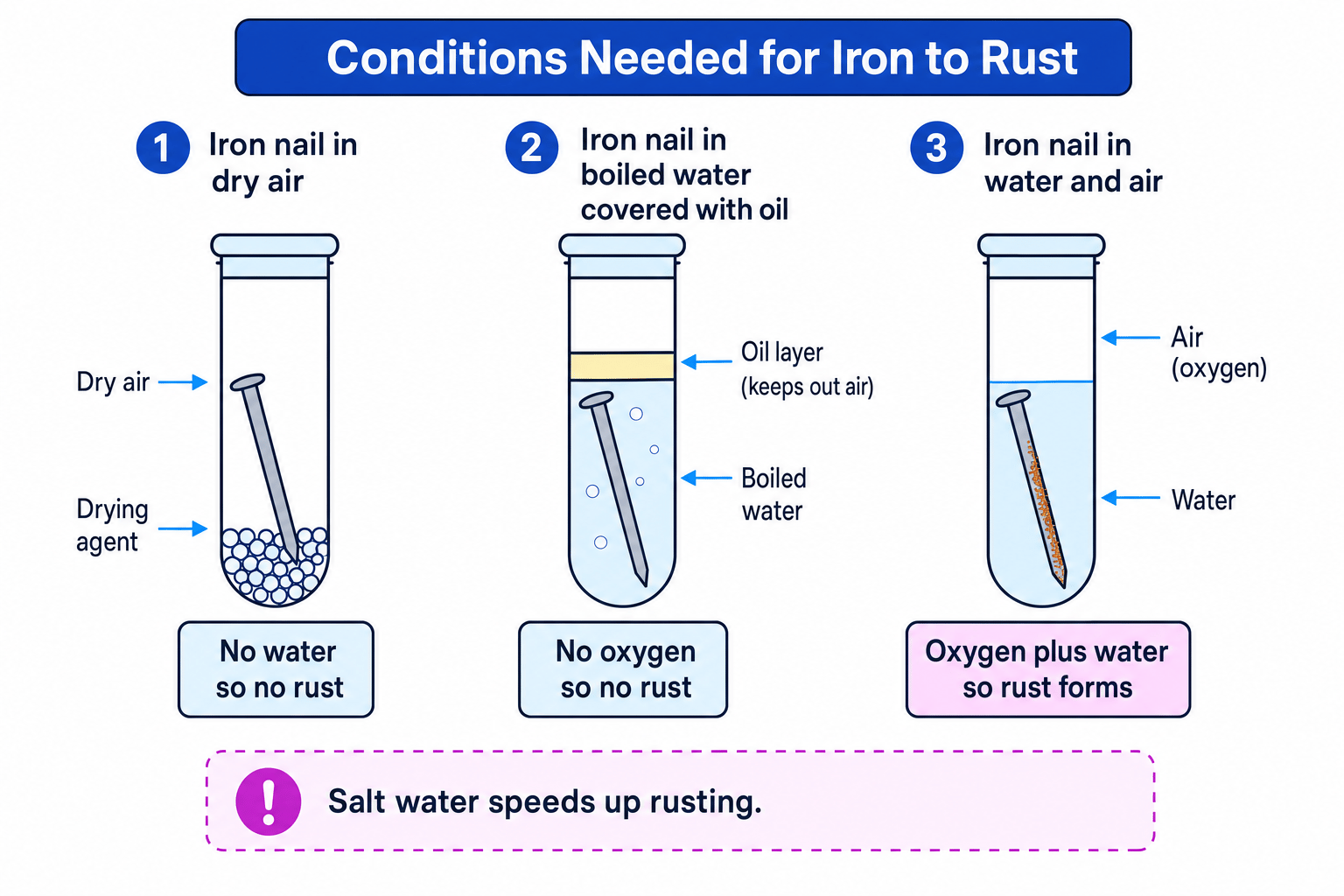
Iron rusts only when both oxygen and water are present. Salt water speeds up rusting, but salt is not required.
Conditions for rusting
Iron needs oxygen and water to rust. Remove either one, and rusting is prevented.
Preventing rust
Rusting can be prevented by stopping oxygen and water reaching the iron, or by using a more reactive metal to protect it.
Barrier methods
A barrier method covers the iron so oxygen and water cannot reach it. Examples include painting, oiling, greasing and plastic coating.
If the barrier is scratched, rusting can start at the exposed iron.
Galvanising
Galvanising means coating iron or steel with zinc.
Zinc helps in two ways:
- It forms a physical barrier.
- It provides sacrificial protection because zinc is more reactive than iron.
Sacrificial protection
In sacrificial protection, a more reactive metal is attached to iron. The more reactive metal reacts instead of the iron, so the iron is protected.
For example, zinc or magnesium blocks can be attached to steel ships or underground iron pipes.
Thinking any coating works after scratching
Paint protects only while it stays intact. Zinc can still protect scratched iron because zinc is more reactive than iron and reacts first.
Oxidation, reduction and redox
You need two ways to define oxidation and reduction: using oxygen, and using electrons.
Oxidation and reduction
Oxidation is gain of oxygen or loss of electrons.
Reduction is loss of oxygen or gain of electrons.
A redox reaction is a reaction where oxidation and reduction happen at the same time.
OIL RIG
Oxidation Is Loss of electrons. Reduction Is Gain of electrons.
In the reaction between magnesium and copper(II) oxide:
Mg(s)+CuO(s)→MgO(s)+Cu(s)\text{Mg}(s) + \text{CuO}(s) \rightarrow \text{MgO}(s) + \text{Cu}(s)Mg(s)+CuO(s)→MgO(s)+Cu(s)Magnesium is oxidised because it gains oxygen. Copper(II) oxide is reduced because it loses oxygen.
Oxidising and reducing agents
An oxidising agent causes another substance to be oxidised, and is itself reduced.
A reducing agent causes another substance to be reduced, and is itself oxidised.
So in the magnesium and copper(II) oxide reaction:
- Magnesium is the reducing agent because it reduces copper(II) oxide.
- Copper(II) oxide is the oxidising agent because it oxidises magnesium.
Identifying oxidation and reduction by electrons
In this displacement reaction:
Zn(s)+CuSO4(aq)→ZnSO4(aq)+Cu(s)\text{Zn}(s) + \text{CuSO}_4(aq) \rightarrow \text{ZnSO}_4(aq) + \text{Cu}(s)Zn(s)+CuSO4(aq)→ZnSO4(aq)+Cu(s)- Focus on the metal particles that change: zinc atoms become zinc ions, and copper ions become copper atoms.
- Zinc loses electrons:
- Loss of electrons is oxidation, so zinc is oxidised.
- Copper ions gain electrons:
- Gain of electrons is reduction, so copper ions are reduced.
Practical: acids and metals
You may be asked about the named practical investigation of reactions between dilute hydrochloric or sulfuric acids and metals such as magnesium, zinc and iron.
Apparatus
You can use:
- test tubes or a conical flask
- dilute hydrochloric acid or dilute sulfuric acid
- magnesium ribbon, zinc granules and iron filings or small iron pieces
- delivery tube and gas syringe, if measuring gas volume
- stopwatch
- measuring cylinder or pipette
- balance, if measuring equal masses
- lighted splint to test hydrogen safely using a small sample
Method
- Add a measured volume of dilute acid to a test tube or conical flask.
- Add a measured mass or similar-sized piece of metal.
- If collecting gas, quickly fit the bung and connect to a gas syringe.
- Record the volume of hydrogen produced at regular time intervals, or observe the rate of fizzing.
- Repeat with different metals, keeping the other conditions the same.
Variables
The independent variable is the metal used, such as magnesium, zinc or iron.
The dependent variable is the rate of reaction, often measured by the volume of hydrogen produced per unit time.
Control variables include:
- acid concentration
- acid volume
- temperature
- mass of metal
- surface area of metal
- whether the metal surface has been cleaned
Expected results
Magnesium reacts fastest, zinc reacts more slowly, and iron reacts slowest. The reactions produce hydrogen gas and a salt.
For sulfuric acid:
Mg(s)+H2SO4(aq)→MgSO4(aq)+H2(g)\text{Mg}(s) + \text{H}_2\text{SO}_4(aq) \rightarrow \text{MgSO}_4(aq) + \text{H}_2(g)Mg(s)+H2SO4(aq)→MgSO4(aq)+H2(g) Zn(s)+H2SO4(aq)→ZnSO4(aq)+H2(g)\text{Zn}(s) + \text{H}_2\text{SO}_4(aq) \rightarrow \text{ZnSO}_4(aq) + \text{H}_2(g)Zn(s)+H2SO4(aq)→ZnSO4(aq)+H2(g) Fe(s)+H2SO4(aq)→FeSO4(aq)+H2(g)\text{Fe}(s) + \text{H}_2\text{SO}_4(aq) \rightarrow \text{FeSO}_4(aq) + \text{H}_2(g)Fe(s)+H2SO4(aq)→FeSO4(aq)+H2(g)Unfair comparisons in the practical
Different-sized pieces of metal have different surface areas. A larger surface area can make a reaction look faster even if the metal is not more reactive.
Common errors include gas escaping from a loose bung, starting the stopwatch late, using metals with oxide coatings, and letting the temperature change between trials.
In the exam
- For displacement questions, first compare the two metals in the reactivity series; the higher metal displaces the lower metal.
- For rusting questions, always name both required conditions: oxygen and water.
- For redox questions, state exactly what is gained or lost: oxygen or electrons.
Check yourself
- Which metal is more reactive: zinc or iron, and how could you show this using an acid?
- Why does galvanising still protect iron even if the zinc layer is scratched?
- In Mg(s)+CuO(s)→MgO(s)+Cu(s)\text{Mg}(s) + \text{CuO}(s) \rightarrow \text{MgO}(s) + \text{Cu}(s)Mg(s)+CuO(s)→MgO(s)+Cu(s), which substance is reduced?
