

What you'll learn
- The approximate composition of dry air by volume.
- How to estimate the percentage of oxygen in air using a metal or a non-metal.
- What happens when magnesium, hydrogen and sulfur burn in oxygen.
- How carbon dioxide forms from metal carbonates, and why it matters for climate.
Starting point: air is a mixture
Air is not a single substance. It is a mixture of gases, which means the gases are physically mixed together and are not chemically bonded to each other.
Dry air and percentage by volume
Dry air is air with the water vapour removed. Percentage by volume means the volume of one gas compared with the total volume of the gas mixture, measured under the same conditions of temperature and pressure.
For oxygen in air, the calculation is:
percentage of oxygen by volume=volume of oxygentotal volume of air×100\text{percentage of oxygen by volume} = \frac{\text{volume of oxygen}}{\text{total volume of air}} \times 100percentage of oxygen by volume=total volume of airvolume of oxygen×100The main gases in dry air
You need to know the approximate percentages by volume of the four most abundant gases in dry air:
- Nitrogen, N2N_2N2: about 78%
- Oxygen, O2O_2O2: about 21%
- Argon, Ar: about 0.9%
- Carbon dioxide, CO2CO_2CO2: about 0.04%
The remaining tiny amount is made up of other trace gases.
Composition of dry air
The big numbers to remember are 78% nitrogen and 21% oxygen. Oxygen is about one-fifth of dry air by volume.
Determining the percentage of oxygen in air
The basic idea is simple: start with a known volume of air, react away the oxygen, then measure how much the gas volume has decreased.
If the experiment is set up correctly, the decrease in gas volume is the volume of oxygen that was originally present.
The diagram shows two common versions of the practical: one using a metal, such as damp iron wool, and one using a non-metal, such as phosphorus.
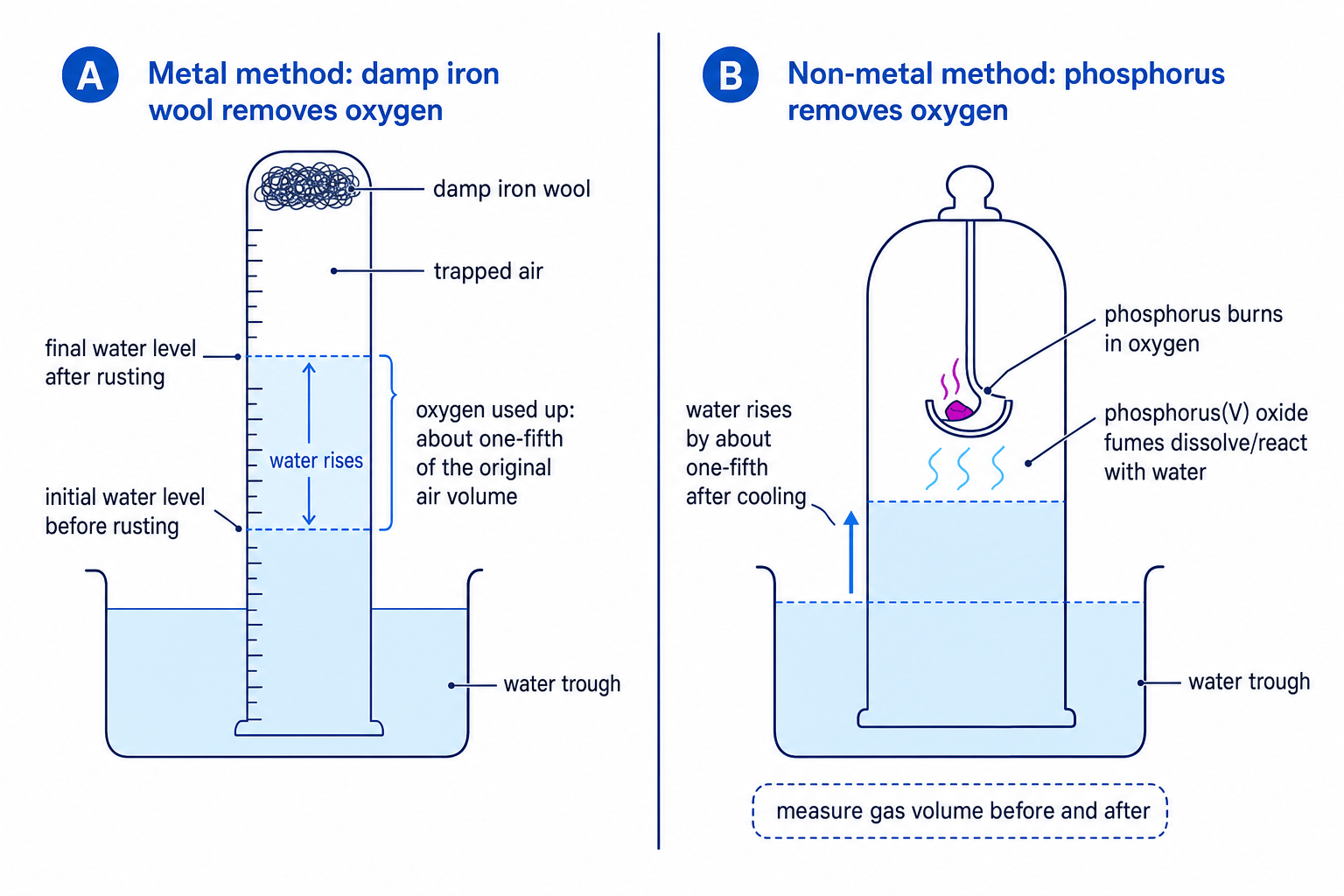
How the oxygen experiment works
A substance reacts with oxygen in the trapped air. Because oxygen is removed from the gas mixture, the gas volume falls, so water rises to take its place.
Metal method: damp iron wool
A common safer method uses damp iron wool. The water is needed because iron rusts much more readily when moisture is present.
Simplified reaction:
4Fe(s)+3O2(g)→2Fe2O3(s)4Fe(s) + 3O_2(g) \rightarrow 2Fe_2O_3(s)4Fe(s)+3O2(g)→2Fe2O3(s)In reality, rust is hydrated iron(III) oxide, but this simplified equation shows the key point: oxygen gas is removed.
Apparatus
You would use:
- damp iron wool
- an inverted measuring cylinder or gas jar
- a water trough or beaker of water
- a clamp or stand if needed
Method
- Put damp iron wool at the top of an inverted measuring cylinder.
- Stand the cylinder in water so a known volume of air is trapped inside.
- Record the initial volume of trapped air.
- Leave the apparatus for several days until the water level stops rising.
- Record the final volume of gas.
- Calculate the percentage of oxygen using the decrease in volume.
Expected result
The gas volume should decrease by about one-fifth, giving an oxygen percentage close to 21%.
Non-metal method: phosphorus
Phosphorus burns in oxygen to form phosphorus(V) oxide.
One balanced equation for this reaction is:
P4(s)+5O2(g)→P4O10(s)P_4(s) + 5O_2(g) \rightarrow P_4O_{10}(s)P4(s)+5O2(g)→P4O10(s)The phosphorus(V) oxide fumes dissolve or react with water, so they do not remain as a gas.
Phosphorus safety
White phosphorus is very hazardous, so this method is usually a teacher demonstration or appears as provided experimental data. In exam questions, focus on the chemistry: phosphorus removes oxygen, and the final gas volume is measured after cooling.
Key variables and accuracy
To get a reliable result:
- Use excess iron wool or phosphorus, so all the oxygen can react.
- Keep the apparatus sealed, so no gas escapes and no extra air enters.
- Measure gas volumes at the same temperature and pressure as far as possible.
- For phosphorus, allow the apparatus to cool before measuring.
- Read the measuring cylinder scale at eye level to avoid parallax error.
Measuring hot gas
If you measure the gas straight after phosphorus burns, the gas is still hot and expanded. This makes the final volume too large, so the calculated oxygen percentage is too low.
Calculating percentage of oxygen in air
A student traps 80.0 cm³ of air over damp iron wool. After rusting is complete, the gas volume is 63.5 cm³.
-
Calculate the volume of oxygen used up by finding the decrease in gas volume:
80.0 cm3−63.5 cm3=16.5 cm380.0\ \text{cm}^3 - 63.5\ \text{cm}^3 = 16.5\ \text{cm}^380.0 cm3−63.5 cm3=16.5 cm3 -
Substitute into the percentage by volume equation:
16.5 cm380.0 cm3×100=20.625%\frac{16.5\ \text{cm}^3}{80.0\ \text{cm}^3} \times 100 = 20.625\%80.0 cm316.5 cm3×100=20.625% -
Round the answer sensibly and compare with the expected value: 20.6%, which is close to the accepted value of about 21%.
Combustion of elements in oxygen
Combustion is a reaction in which a substance reacts with oxygen, usually releasing heat and light.
Combustion is usually more vigorous in pure oxygen than in air, because air is only about 21% oxygen.
Magnesium burning in oxygen
Magnesium burns with a bright white flame and forms a white solid, magnesium oxide.
2Mg(s)+O2(g)→2MgO(s)2Mg(s) + O_2(g) \rightarrow 2MgO(s)2Mg(s)+O2(g)→2MgO(s)Hydrogen burning in oxygen
Hydrogen burns with a pale blue flame and forms water. A burning splint gives a characteristic squeaky pop with hydrogen.
2H2(g)+O2(g)→2H2O(l)2H_2(g) + O_2(g) \rightarrow 2H_2O(l)2H2(g)+O2(g)→2H2O(l)Sulfur burning in oxygen
Sulfur burns with a blue flame and forms sulfur dioxide, a choking acidic gas.
S(s)+O2(g)→SO2(g)S(s) + O_2(g) \rightarrow SO_2(g)S(s)+O2(g)→SO2(g)Predicting oxide products
When an element burns in oxygen, the product is usually an oxide. Metals form metal oxides, such as magnesium oxide, while non-metals form non-metal oxides, such as sulfur dioxide.
Balancing a combustion equation
Write a balanced equation for magnesium burning in oxygen.
-
Identify the reactants and product: magnesium reacts with oxygen to form magnesium oxide, so start with Mg+O2→MgOMg + O_2 \rightarrow MgOMg+O2→MgO.
-
Balance oxygen first: oxygen is diatomic as O2O_2O2, so place 2 in front of MgOMgOMgO to give two oxygen atoms on the right.
-
Balance magnesium: there are now two magnesium atoms on the right, so place 2 in front of MgMgMg.
-
Add state symbols for the final equation:
2Mg(s)+O2(g)→2MgO(s)2Mg(s) + O_2(g) \rightarrow 2MgO(s)2Mg(s)+O2(g)→2MgO(s)
Carbon dioxide from metal carbonates
A metal carbonate is a compound containing a metal ion and the carbonate ion, CO32−CO_3^{2-}CO32−.
Thermal decomposition
Thermal decomposition is the breaking down of a compound into simpler substances by heating.
Many metal carbonates decompose when heated to form a metal oxide and carbon dioxide.
General pattern:
metal carbonate→metal oxide+carbon dioxide\text{metal carbonate} \rightarrow \text{metal oxide} + \text{carbon dioxide}metal carbonate→metal oxide+carbon dioxideCopper(II) carbonate
Copper(II) carbonate is green. When heated, it decomposes to form black copper(II) oxide and carbon dioxide gas.
CuCO3(s)→CuO(s)+CO2(g)CuCO_3(s) \rightarrow CuO(s) + CO_2(g)CuCO3(s)→CuO(s)+CO2(g)You can test for carbon dioxide by bubbling the gas through limewater. Limewater turns milky because calcium carbonate forms.
Ca(OH)2(aq)+CO2(g)→CaCO3(s)+H2O(l)Ca(OH)_2(aq) + CO_2(g) \rightarrow CaCO_3(s) + H_2O(l)Ca(OH)2(aq)+CO2(g)→CaCO3(s)+H2O(l)Writing a carbonate decomposition equation
Predict the products when zinc carbonate is heated.
-
Apply the general pattern: metal carbonate forms metal oxide and carbon dioxide.
-
Keep the same metal: zinc carbonate forms zinc oxide, so the products are ZnOZnOZnO and CO2CO_2CO2.
-
Write and check the equation:
ZnCO3(s)→ZnO(s)+CO2(g)ZnCO_3(s) \rightarrow ZnO(s) + CO_2(g)ZnCO3(s)→ZnO(s)+CO2(g) -
Count atoms to confirm it is balanced: one zinc, one carbon and three oxygen atoms on each side.
Carbon dioxide and climate change
Carbon dioxide is a greenhouse gas. A greenhouse gas absorbs infrared radiation, which is heat energy radiated from the Earth’s surface, and re-emits it in all directions.
This is part of the natural greenhouse effect, which helps keep Earth warm enough for life. However, increasing amounts of carbon dioxide in the atmosphere may contribute to climate change.
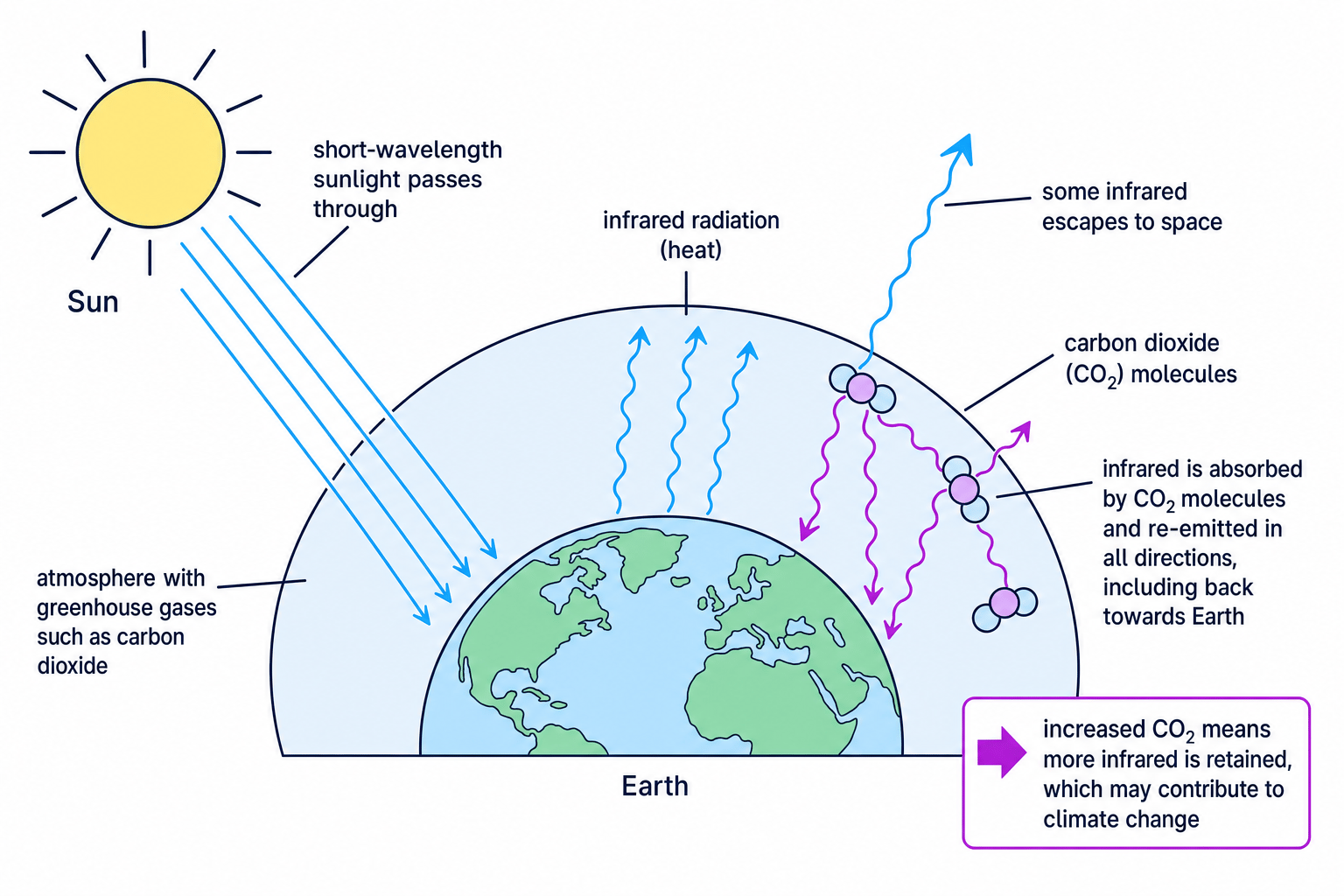
Climate change
Climate change means long-term changes in climate patterns, such as average temperature, rainfall patterns and sea level. It is not the same as a single day of weather.
Explaining how increased carbon dioxide affects temperature
-
Short-wavelength radiation from the Sun passes through the atmosphere and warms the Earth’s surface.
-
The warm Earth emits infrared radiation back towards space.
-
Carbon dioxide molecules absorb some of this infrared radiation and re-emit it in all directions, including back towards Earth.
-
If the amount of carbon dioxide increases, more infrared radiation may be retained, increasing average global temperature and contributing to climate change.
Confusing greenhouse effect with the ozone layer
The greenhouse effect is about gases such as carbon dioxide absorbing infrared radiation. The ozone layer is a different idea: it absorbs harmful ultraviolet radiation from the Sun.
In the exam
- For dry air composition, quote the approximate values: 78% nitrogen, 21% oxygen, 0.9% argon and 0.04% carbon dioxide.
- For the oxygen practical, use the volume decrease: initial volume−final volumeinitial volume×100\frac{\text{initial volume} - \text{final volume}}{\text{initial volume}} \times 100initial volumeinitial volume−final volume×100.
- For reaction questions, include observations, products and balanced equations with state symbols when asked.
Check yourself
- What are the approximate percentages by volume of the four most abundant gases in dry air?
- In the damp iron wool experiment, why does the water level rise?
- Write the balanced equation for the thermal decomposition of copper(II) carbonate.
