

What you'll learn
- How to tell whether a reaction is exothermic or endothermic.
- How simple calorimetry experiments measure temperature changes.
- How to calculate heat energy using Q=mcΔTQ = mc\Delta TQ=mcΔT and molar enthalpy change, ΔH\Delta HΔH.
- How energy level diagrams and bond energies explain reaction energy changes (Paper 2 only).
Energy changes in chemical reactions
Chemical reactions involve energy transfers. Often we notice this as a temperature change in the surroundings: the reaction mixture, thermometer, cup, air, or water being heated.
Exothermic and endothermic reactions
An exothermic reaction gives out heat energy to the surroundings, usually causing a temperature rise. An endothermic reaction takes in heat energy from the surroundings, usually causing a temperature fall.
Common exothermic reactions include combustion, many neutralisation reactions, and many displacement reactions. For example:
CH4(g)+2O2(g)→CO2(g)+2H2O(l)CH_4(g) + 2O_2(g) \rightarrow CO_2(g) + 2H_2O(l)CH4(g)+2O2(g)→CO2(g)+2H2O(l)
Common endothermic changes include some salts dissolving in water, such as ammonium nitrate:
NH4NO3(s)→NH4+(aq)+NO3−(aq)NH_4NO_3(s) \rightarrow NH_4^+(aq) + NO_3^-(aq)NH4NO3(s)→NH4+(aq)+NO3−(aq)
Temperature change tells you the direction of heat transfer
If the reaction mixture gets warmer, heat has been released by the reaction: it is exothermic. If it gets colder, heat has been absorbed by the reaction: it is endothermic.
Using temperature change to identify the energy transfer
A student mixes two solutions. The temperature changes from 19.5 °C to 31.0 °C.
- Compare the final temperature with the initial temperature: 31.0 °C is higher than 19.5 °C, so the mixture warmed up.
- A temperature rise means heat energy was transferred from the reacting chemicals to the surroundings.
- Therefore, the reaction is exothermic.
Calorimetry: measuring heat changes
Calorimetry
Calorimetry is the experimental measurement of heat energy changes, usually by measuring the temperature change of water or a solution.
For reactions in solution, you usually use an insulated polystyrene cup. The cup reduces heat transfer to the room, so the measured temperature change is closer to the true value.
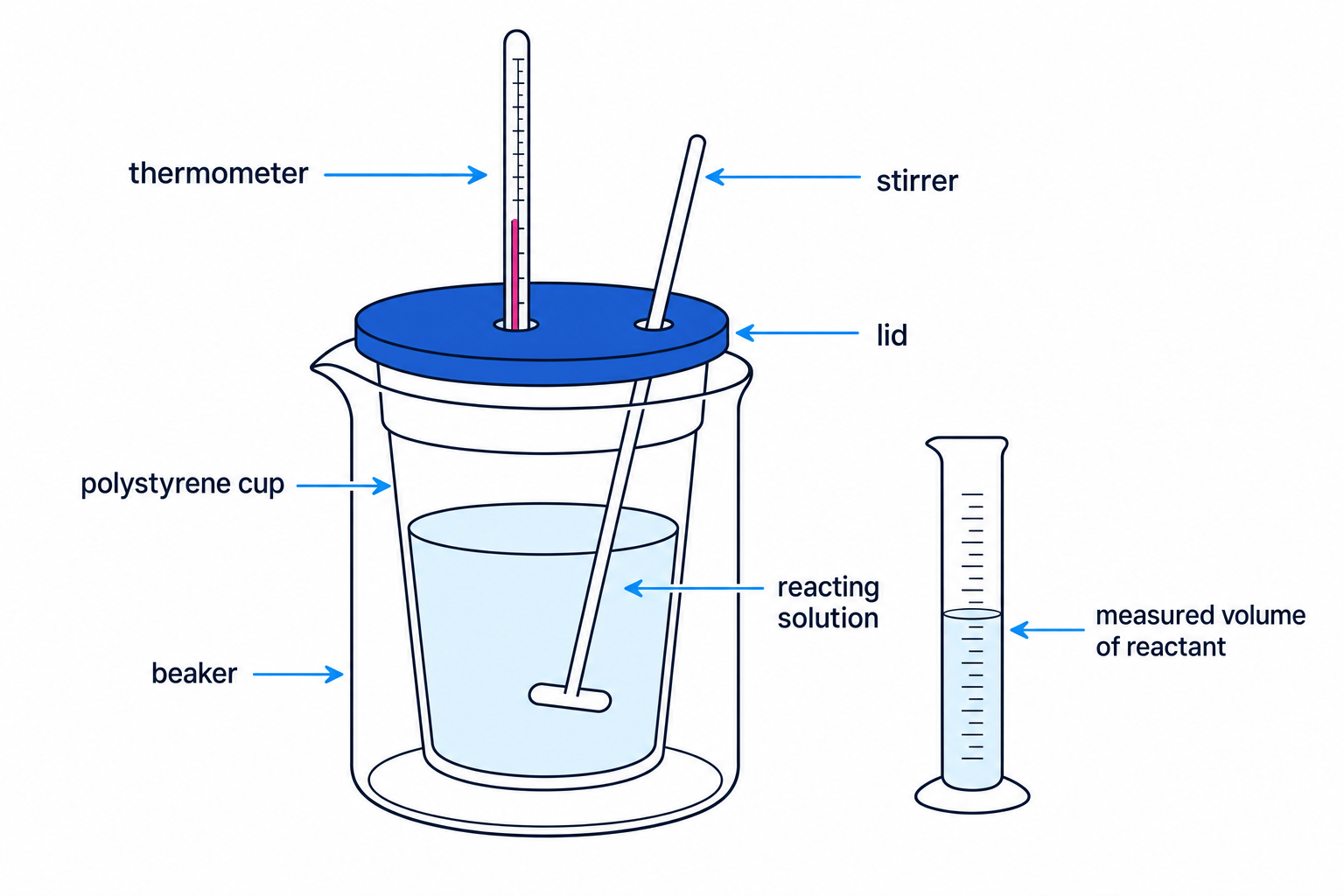
Practical method: reactions in solution
This method can be used for salts dissolving, neutralisation reactions, and displacement reactions.
- Measure a known volume of solution or water into a polystyrene cup.
- Record the initial temperature.
- Add the second reactant, such as a salt, an alkali, or a metal powder.
- Quickly replace the lid, stir gently, and record the highest or lowest temperature reached.
- Calculate the temperature change, ΔT\Delta TΔT.
Examples you might meet:
- Salt dissolving: add a measured mass of salt to water. Some salts cause a temperature fall; others cause a temperature rise.
- Neutralisation: mix an acid and alkali, such as HCl(aq)HCl(aq)HCl(aq) and NaOH(aq)NaOH(aq)NaOH(aq). These usually give a temperature rise.
- Displacement: add a metal to a salt solution, such as magnesium to copper(II) sulfate solution:
Mg(s)+CuSO4(aq)→MgSO4(aq)+Cu(s)Mg(s) + CuSO_4(aq) \rightarrow MgSO_4(aq) + Cu(s)Mg(s)+CuSO4(aq)→MgSO4(aq)+Cu(s)
Practical method: combustion
In combustion calorimetry, a fuel is burned to heat water. The temperature rise of the water is used to estimate the energy released by the fuel.
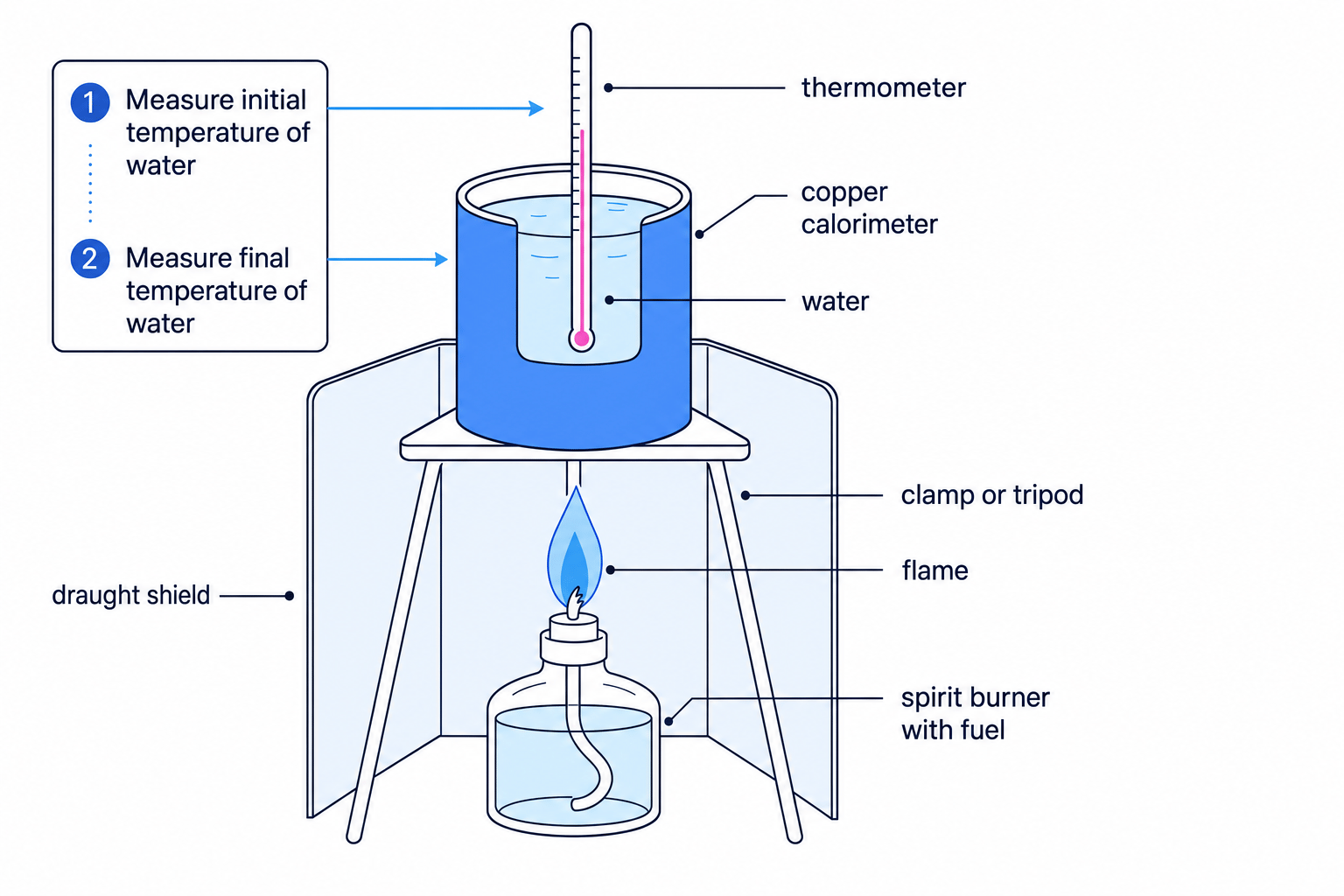
A typical method is:
- Put a known mass or volume of water in a copper calorimeter.
- Record the initial temperature of the water.
- Weigh the spirit burner and fuel.
- Burn the fuel to heat the water, stirring gently.
- Record the final temperature of the water.
- Reweigh the burner to find the mass of fuel burned.
Key variables in calorimetry practicals
Keep the volume of solution, concentration, starting temperature, insulation, stirring method, and apparatus the same when comparing reactions. For combustion, keep the mass of water and the distance between flame and calorimeter constant.
Heat loss to the surroundings
Calorimetry experiments are often inaccurate because heat is lost to the air, cup, thermometer, or bench. In combustion, incomplete combustion and heat escaping around the calorimeter make the calculated energy released too small.
Calculating heat energy: Q=mcΔTQ = mc\Delta TQ=mcΔT
The heat energy transferred to or from water or solution is calculated using:
Q=mcΔTQ = mc\Delta TQ=mcΔTWhere:
- QQQ is the heat energy change in joules, J.
- mmm is the mass of water or solution in grams, g.
- ccc is the specific heat capacity. For water and dilute solutions, use 4.18 J/g °C.
- ΔT\Delta TΔT is the temperature change in °C.
For dilute aqueous solutions, you usually assume the density is 1 g/cm³. So 50 cm³ of solution has a mass of about 50 g.
Specific heat capacity
Specific heat capacity is the energy needed to raise the temperature of 1 g of a substance by 1 °C.
Calculating heat energy from a temperature change
50 cm³ of acid is mixed with 50 cm³ of alkali. The temperature rises from 20.0 °C to 26.8 °C. Calculate the heat energy transferred to the solution.
- Find the total mass of solution. The total volume is 100 cm³, so the mass is approximately 100 g.
- Calculate the temperature change:
ΔT=26.8−20.0=6.8 ∘C\Delta T = 26.8 - 20.0 = 6.8\ ^\circ\text{C}ΔT=26.8−20.0=6.8 ∘C - Substitute into Q=mcΔTQ = mc\Delta TQ=mcΔT:
Q=100×4.18×6.8=2842.4 JQ = 100 \times 4.18 \times 6.8 = 2842.4\ \text{J}Q=100×4.18×6.8=2842.4 J - Convert to kilojoules if needed:
2842.4 J=2.84 kJ2842.4\ \text{J} = 2.84\ \text{kJ}2842.4 J=2.84 kJ
Using the wrong mass
Use the mass of the water or solution being heated, not the mass of the solid reactant or the mass of the fuel. For aqueous solutions, volume in cm³ is usually taken as mass in g.
Molar enthalpy change, ΔH\Delta HΔH
Molar enthalpy change
The molar enthalpy change, ΔH\Delta HΔH, is the heat energy change per mole of substance reacting or formed. It is usually measured in kJ/mol.
For a reaction mixture that warms up, the solution gains heat, so the reaction has released heat. That means the reaction’s ΔH\Delta HΔH is negative.
A useful relationship is:
ΔH=−Qn\Delta H = -\frac{Q}{n}ΔH=−nQfor an exothermic reaction where QQQ is the heat gained by the solution and nnn is the number of moles of the chosen reactant.
Calculating molar enthalpy of neutralisation
50.0 cm³ of 1.00 mol/dm³ hydrochloric acid reacts with 50.0 cm³ of 1.00 mol/dm³ sodium hydroxide. The temperature rises by 6.8 °C. Calculate ΔH\Delta HΔH for the neutralisation.
HCl(aq)+NaOH(aq)→NaCl(aq)+H2O(l)HCl(aq) + NaOH(aq) \rightarrow NaCl(aq) + H_2O(l)HCl(aq)+NaOH(aq)→NaCl(aq)+H2O(l)
- Calculate the heat transferred to the solution. From the previous method:
Q=2.84 kJQ = 2.84\ \text{kJ}Q=2.84 kJ - Calculate moles of acid used. Convert 50.0 cm³ to 0.0500 dm³:
n=cV=1.00×0.0500=0.0500 moln = cV = 1.00 \times 0.0500 = 0.0500\ \text{mol}n=cV=1.00×0.0500=0.0500 mol - Divide heat energy by moles and include the sign. The temperature rose, so the reaction is exothermic:
ΔH=−2.840.0500=−56.8 kJ/mol\Delta H = -\frac{2.84}{0.0500} = -56.8\ \text{kJ/mol}ΔH=−0.05002.84=−56.8 kJ/mol
Sign of enthalpy change
Temperature rise means ΔH\Delta HΔH is negative. Temperature fall means ΔH\Delta HΔH is positive.
Energy level diagrams (Paper 2 only)
Energy level diagrams show the energy of reactants and products during a reaction.
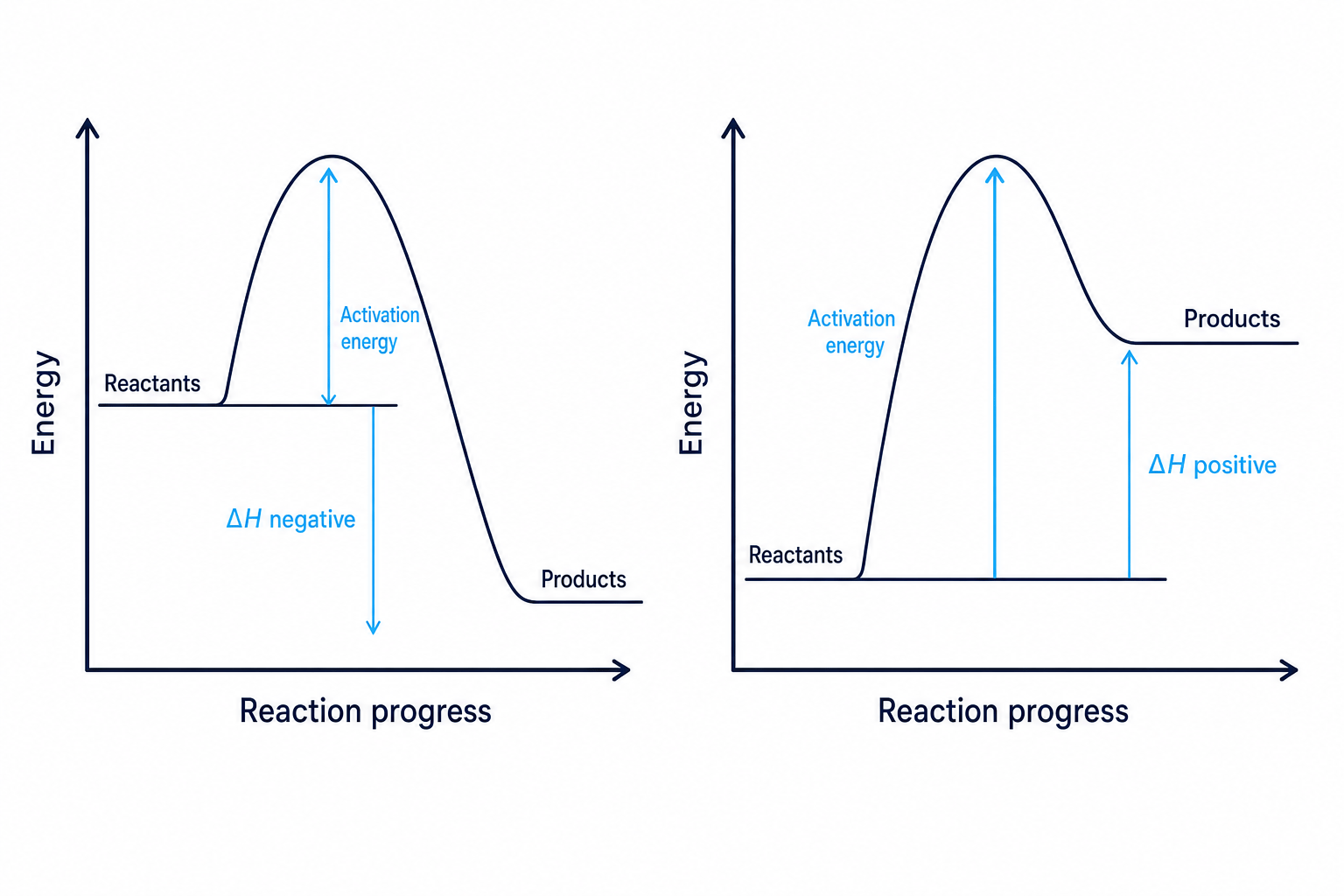
Activation energy
Activation energy is the minimum energy particles need for a successful reaction to occur.
In an exothermic energy level diagram:
- Reactants are higher in energy than products.
- The arrow for ΔH\Delta HΔH points down.
- ΔH\Delta HΔH is negative.
In an endothermic energy level diagram:
- Reactants are lower in energy than products.
- The arrow for ΔH\Delta HΔH points up.
- ΔH\Delta HΔH is positive.
Reading energy diagrams
The vertical gap between reactants and products is the enthalpy change, ΔH\Delta HΔH. The hump shows the activation energy needed before the reaction can happen.
Bond energies (Paper 2 only)
Chemical reactions involve breaking bonds in the reactants and making new bonds in the products.
Breaking and making bonds
Bond-breaking is endothermic because energy is needed to break attractions between atoms. Bond-making is exothermic because energy is released when new attractions form.
To estimate the enthalpy change from bond energies:
ΔH=energy to break bonds−energy released making bonds\Delta H = \text{energy to break bonds} - \text{energy released making bonds}ΔH=energy to break bonds−energy released making bondsSo:
- If more energy is released making bonds than is taken in breaking bonds, ΔH\Delta HΔH is negative: exothermic.
- If more energy is taken in breaking bonds than is released making bonds, ΔH\Delta HΔH is positive: endothermic.
Using bond energies to calculate enthalpy change
Use these bond energies to calculate ΔH\Delta HΔH for:
H2(g)+Cl2(g)→2HCl(g)H_2(g) + Cl_2(g) \rightarrow 2HCl(g)H2(g)+Cl2(g)→2HCl(g)
Bond energies: H–H = 436 kJ/mol, Cl–Cl = 242 kJ/mol, H–Cl = 431 kJ/mol.
- Identify bonds broken in the reactants: one H–H bond and one Cl–Cl bond.
Energy absorbed = 436+242=678 kJ/mol436 + 242 = 678\ \text{kJ/mol}436+242=678 kJ/mol - Identify bonds made in the products: two H–Cl bonds.
Energy released = 2×431=862 kJ/mol2 \times 431 = 862\ \text{kJ/mol}2×431=862 kJ/mol - Calculate the enthalpy change:
ΔH=678−862=−184 kJ/mol\Delta H = 678 - 862 = -184\ \text{kJ/mol}ΔH=678−862=−184 kJ/mol - Interpret the sign: ΔH\Delta HΔH is negative, so the reaction is exothermic.
Reversing the bond energy calculation
Do not do “made minus broken”. For bond energy calculations, use broken minus made: energy taken in to break bonds minus energy released when bonds form.
In the exam
- For calorimetry calculations, write down Q=mcΔTQ = mc\Delta TQ=mcΔT, use mass in g, and convert J to kJ before calculating ΔH\Delta HΔH.
- Always link a temperature rise to exothermic and a temperature fall to endothermic.
- For energy diagrams, check whether products are above or below reactants before deciding the sign of ΔH\Delta HΔH.
- For bond energies, count every bond carefully, then use broken minus made.
Check yourself
- Why does a reaction mixture get colder during an endothermic reaction?
- In a calorimetry experiment, why is a polystyrene cup used instead of a glass beaker?
- For CH4+2O2→CO2+2H2OCH_4 + 2O_2 \rightarrow CO_2 + 2H_2OCH4+2O2→CO2+2H2O, which bonds are broken and which bonds are made?
