An experiment is conducted to study the rate of reaction between calcium carbonate and dilute hydrochloric acid. Carbon dioxide gas is collected using a gas syringe.
Write a balanced chemical equation for the reaction between calcium carbonate and hydrochloric acid. Include state symbols.
Describe a chemical test to show that the gas collected in the syringe is carbon dioxide.
State and explain the effect of increasing the temperature on the rate of this reaction, in terms of collision theory.
The graph below shows the results from an experiment using excess calcium carbonate and 50 cm350\text{ cm}^350 cm3 of 1.0 mol/dm31.0\text{ mol/dm}^31.0 mol/dm3 hydrochloric acid at 20 ∘C20\ ^\circ\text{C}20 ∘C.
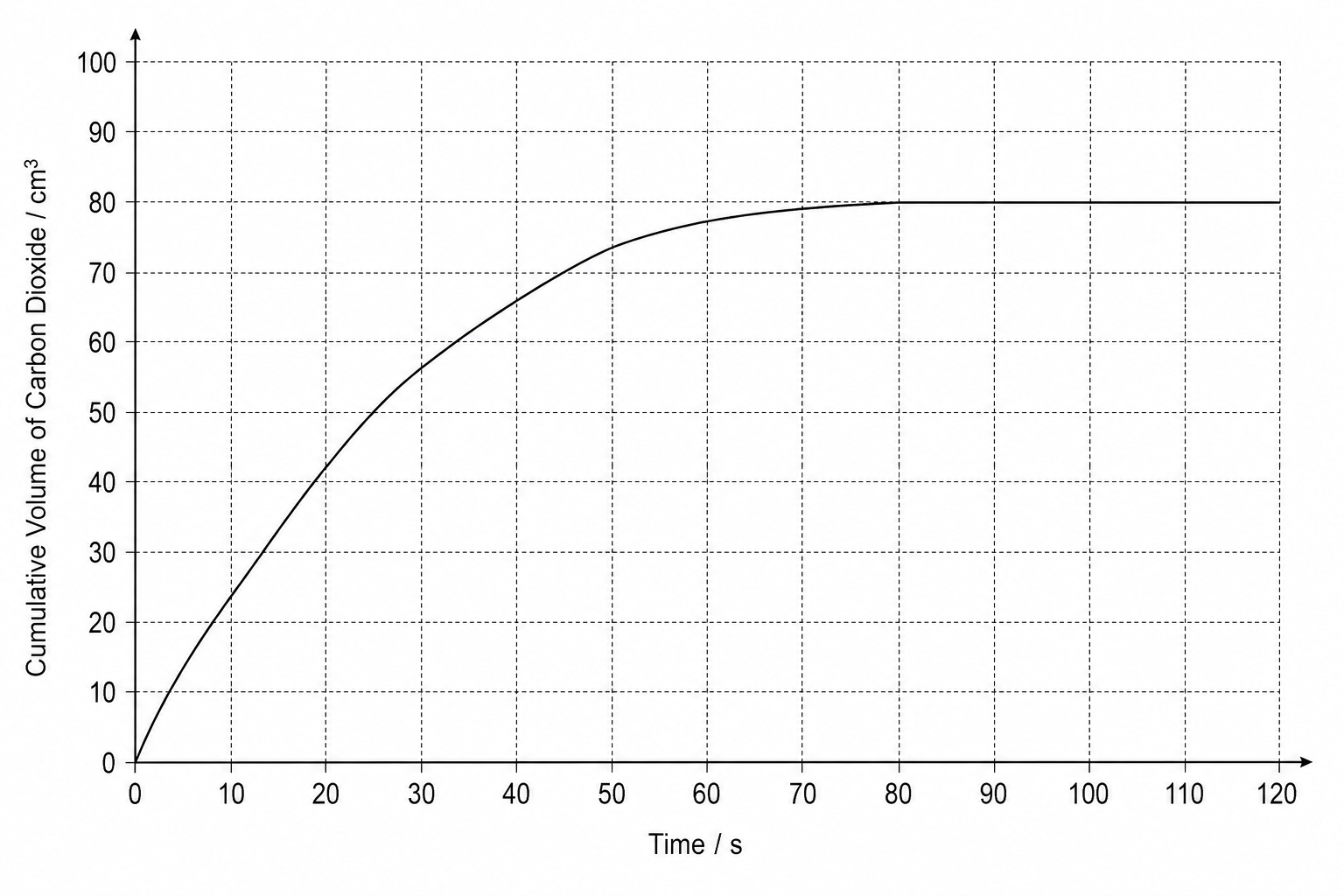
On the same axes, sketch the curve you would expect with excess calcium carbonate and 50 cm350\text{ cm}^350 cm3 of 0.5 mol/dm30.5\text{ mol/dm}^30.5 mol/dm3 hydrochloric acid at 20 ∘C20\ ^\circ\text{C}20 ∘C. Label this curve A.
On the same axes, sketch the curve you would expect with excess calcium carbonate and 50 cm350\text{ cm}^350 cm3 of 1.0 mol/dm31.0\text{ mol/dm}^31.0 mol/dm3 hydrochloric acid at 35 ∘C35\ ^\circ\text{C}35 ∘C. Label this curve B.

