A student investigates the rate of the reaction between magnesium ribbon and dilute hydrochloric acid. The products are magnesium chloride and hydrogen.
The equation for the reaction is:
Mg(…… )+2HCl(…… )→MgCl2(…… )+H2(…… ) \text{Mg}(\dots\dots) + 2\text{HCl}(\dots\dots) \rightarrow \text{MgCl}_2(\dots\dots) + \text{H}_2(\dots\dots) Mg(……)+2HCl(……)→MgCl2(……)+H2(……)Complete the equation by adding the state symbols.
The student uses standard laboratory apparatus including a conical flask, a bung connected to a gas syringe, and a stopwatch. This is their method:
Suggest why the student cleans the magnesium to remove the oxide layer.
Suggest why the student needs to put the bung into the flask quickly.
Suggest when the student should start the stopwatch.
The graph shows the results of the student's experiment.
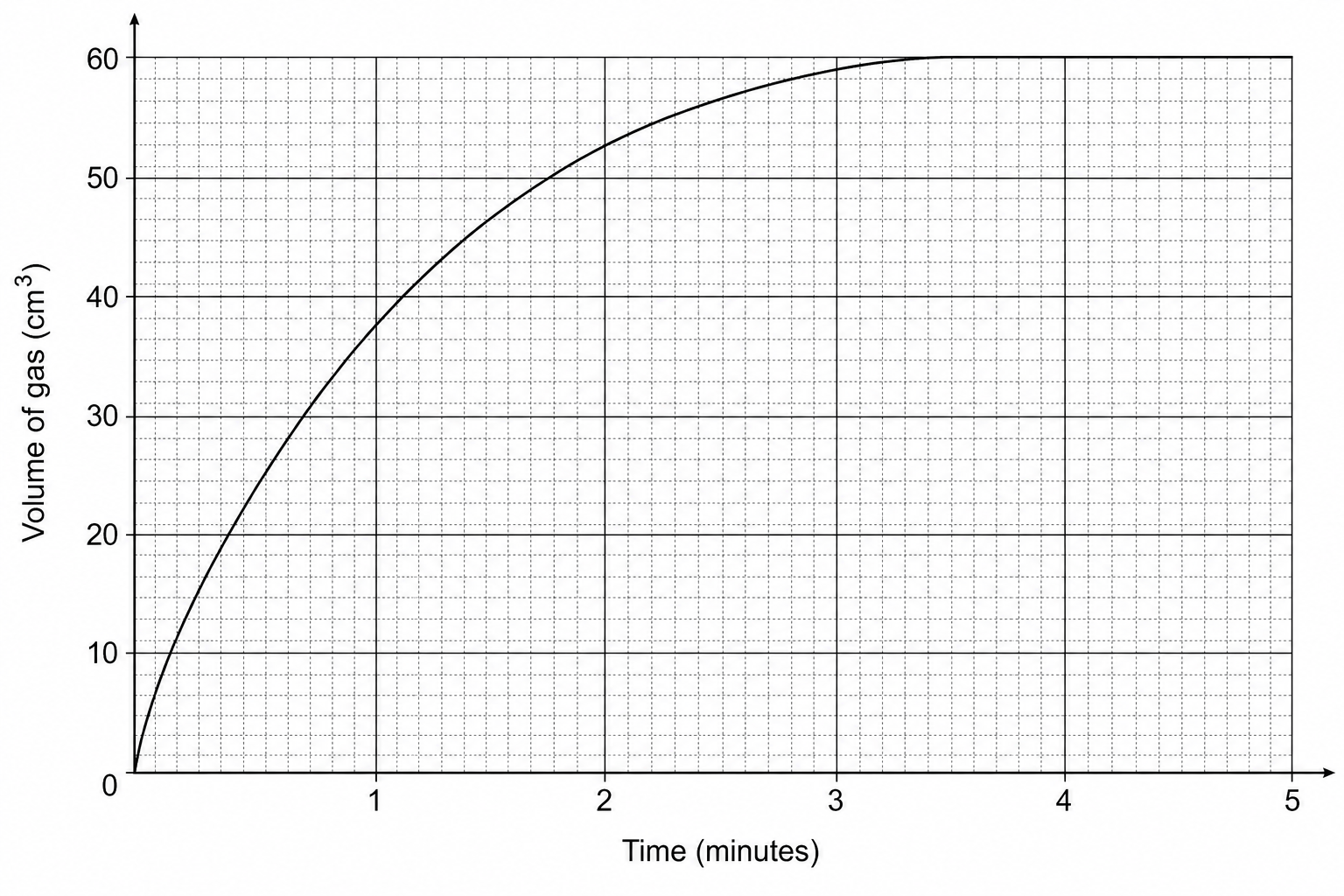
Use the graph to find the volume of gas in the syringe at 2 minutes. Show on the graph how you obtained your answer.
Use the graph to find the time when the reaction stops.
Suggest two possible reasons why the reaction stops.
Explain when the rate of reaction is greatest.
Explain how increasing the concentration of the hydrochloric acid affects the rate of the reaction with magnesium. Refer to particle collision theory in your answer.

