

What you'll learn
- How atoms form covalent bonds by sharing pairs of electrons.
- How to draw dot-and-cross diagrams for common covalent molecules.
- Why simple molecular substances usually have low melting and boiling points.
- How diamond, graphite and C60C_{60}C60 fullerene get their different properties from their structures.
Before covalent bonding: outer electrons
Atoms have a small positive nucleus surrounded by negative electrons in shells. The outer-shell electrons are the electrons in the highest occupied shell, and these are the electrons involved in chemical bonding.
For the atoms you meet here, the group number in the Periodic Table tells you the number of outer-shell electrons:
- Group 1 atoms have 1 outer electron.
- Group 4 atoms, such as carbon, have 4 outer electrons.
- Group 5 atoms, such as nitrogen, have 5 outer electrons.
- Group 6 atoms, such as oxygen, have 6 outer electrons.
- Group 7 atoms, the halogens, have 7 outer electrons.
Most non-metal atoms become more stable by getting a full outer shell. Hydrogen is full with 2 electrons; carbon, nitrogen, oxygen and the halogens are usually full with 8 electrons in these IGCSE examples.
Using the group number
For main-group elements, the group number helps you count outer electrons quickly. For example, oxygen is in Group 6, so each oxygen atom has 6 outer-shell electrons.
What is a covalent bond?
Covalent bonding usually happens between non-metal atoms. Instead of one atom transferring electrons to another, the atoms share electrons.
Covalent bond
A covalent bond is formed between atoms by the sharing of a pair of electrons.
A shared pair of electrons counts towards the outer shell of both bonded atoms. One shared pair makes a single covalent bond. Two shared pairs make a double covalent bond. Three shared pairs make a triple covalent bond.
The electrostatic attraction in a covalent bond
An electrostatic attraction is an attraction between opposite charges. In a covalent bond, the shared pair of negative electrons is attracted to the positive nuclei of both atoms.
What actually holds the atoms together
A covalent bond is the electrostatic attraction between the shared pair of electrons and the nuclei of the bonded atoms.
So, the “sharing” idea is helpful, but the force holding the atoms together is still an attraction between positive and negative charges.
Dot-and-cross diagrams
A dot-and-cross diagram shows the outer electrons in a covalent molecule. Dots and crosses are just a drawing convention: they show which atom the electrons originally came from.
Dots and crosses are not different types of electron
All electrons are identical. A dot and a cross only help you track electrons in the diagram; they do not mean the electrons behave differently.
To draw a dot-and-cross diagram:
- Count the outer electrons on each atom.
- Arrange atoms so that each bond contains one shared pair of electrons.
- Add any non-bonding outer electrons as lone pairs, which are pairs of electrons not used in bonding.
- Check that hydrogen has 2 electrons and most other atoms have 8 electrons in their outer shell.
The diagram below shows common patterns for single, double and triple covalent bonds.
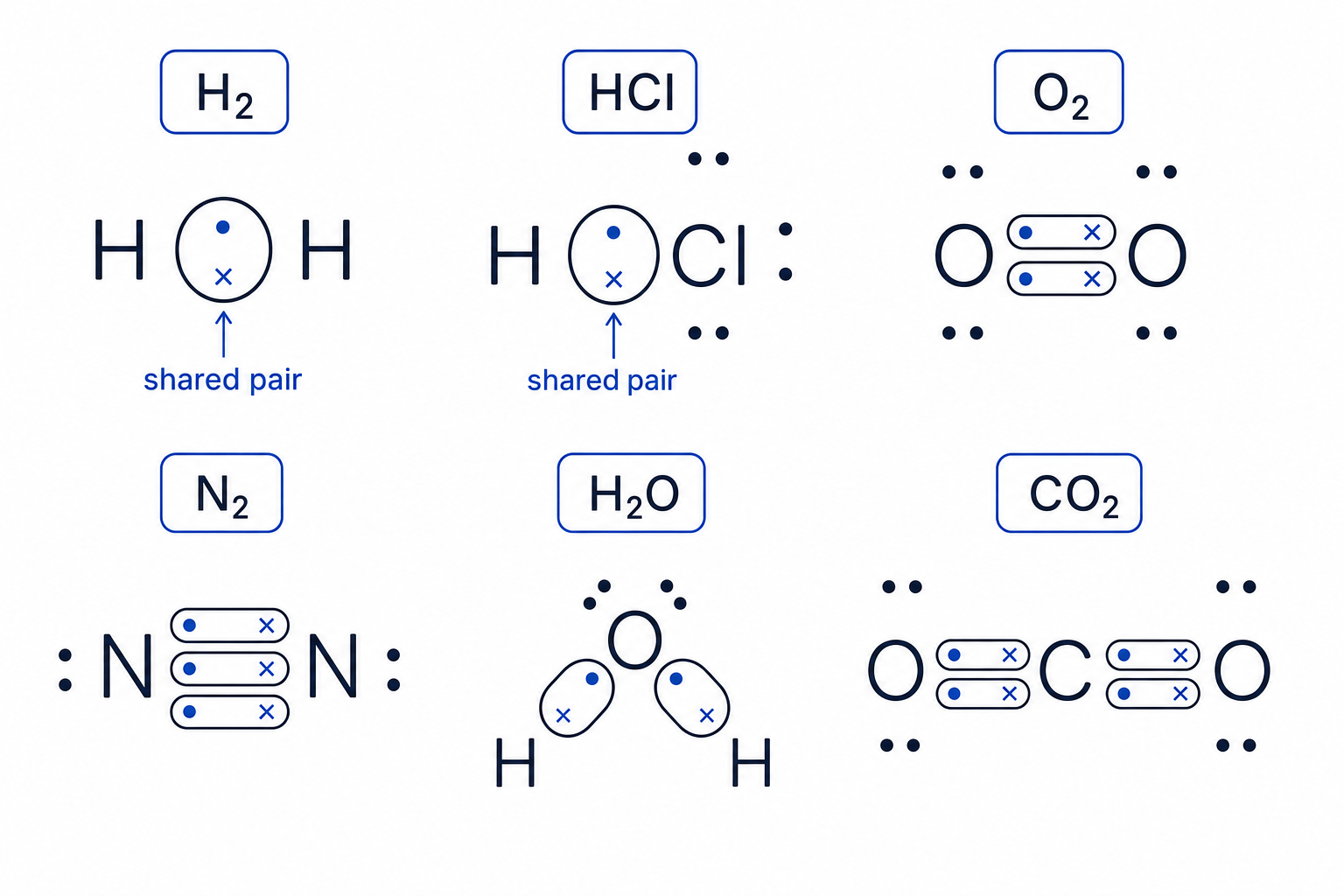
Diatomic molecules
A diatomic molecule contains two atoms.
You should be able to represent:
- Hydrogen, H2H_2H2: one shared pair.
- Oxygen, O2O_2O2: two shared pairs, so a double bond.
- Nitrogen, N2N_2N2: three shared pairs, so a triple bond.
- Halogens, such as F2F_2F2, Cl2Cl_2Cl2, Br2Br_2Br2 and I2I_2I2: one shared pair; each halogen also has three lone pairs.
- Hydrogen halides, such as HFHFHF, HClHClHCl, HBrHBrHBr and HIHIHI: one shared pair between hydrogen and the halogen.
Common inorganic molecules
You also need these patterns:
- Water, H2OH_2OH2O: oxygen forms two single bonds and has two lone pairs.
- Ammonia, NH3NH_3NH3: nitrogen forms three single bonds and has one lone pair.
- Carbon dioxide, CO2CO_2CO2: carbon forms two double bonds, giving the structure O=C=O.
Drawing carbon dioxide
-
Carbon is in Group 4, so it has 4 outer electrons. Oxygen is in Group 6, so each oxygen atom has 6 outer electrons. The total number of outer electrons is 4+6+6=164 + 6 + 6 = 164+6+6=16.
-
Put carbon in the centre because it needs to make 4 bonds. Each oxygen needs 2 more electrons to complete its outer shell, so carbon shares two pairs of electrons with each oxygen.
-
Draw the molecule as O=C=O. Each C=O double bond contains 2 shared pairs of electrons. Each oxygen also has 2 lone pairs, so every atom has a full outer shell.
Organic molecules with up to two carbon atoms
An organic molecule is a carbon-based molecule, usually containing carbon bonded to hydrogen and sometimes other atoms such as halogens.
Key examples:
- Methane, CH4CH_4CH4: carbon forms four single C–H bonds.
- Ethane, C2H6C_2H_6C2H6: the two carbon atoms have a single C–C bond; each carbon also forms three C–H bonds.
- Ethene, C2H4C_2H_4C2H4: the two carbon atoms have a C=C double bond; each carbon also forms two C–H bonds.
- Molecules containing halogen atoms, such as chloromethane, CH3ClCH_3ClCH3Cl: carbon still forms four single bonds, and chlorine forms one single bond plus three lone pairs.
Simple molecular structures
Many covalent substances are made of small, separate molecules. These are called simple molecular substances.
Inside each molecule, the atoms are joined by strong covalent bonds. Between separate molecules, there are much weaker attractions.
Intermolecular forces of attraction
Intermolecular forces of attraction are forces between molecules. At IGCSE, this term can be used to represent all forces between molecules.
Simple molecular substances are often gases or liquids at room temperature. If they are solids, they usually have low melting points compared with ionic or giant covalent substances.
This is because melting and boiling only require enough energy to overcome the weak intermolecular forces between molecules. The strong covalent bonds inside the molecules are not broken.
Breaking the wrong forces
When a simple molecular substance boils, the covalent bonds inside each molecule are not broken. The intermolecular forces between molecules are overcome.
Relative molecular mass and boiling point
The relative molecular mass, MrM_rMr, is the sum of the relative atomic masses, ArA_rAr, of all the atoms in a molecule.
In general, as MrM_rMr increases, the intermolecular forces between molecules become stronger. More energy is then needed to separate the molecules, so melting and boiling points increase.
Explaining a boiling point trend
-
Compare the relative molecular masses: Mr(Cl2)=2×35.5=71M_r(\text{Cl}_2)=2 \times 35.5=71Mr(Cl2)=2×35.5=71, Mr(Br2)=2×80=160M_r(\text{Br}_2)=2 \times 80=160Mr(Br2)=2×80=160, and Mr(I2)=2×127=254M_r(\text{I}_2)=2 \times 127=254Mr(I2)=2×127=254.
-
Iodine molecules have the largest relative molecular mass, so they generally have the strongest intermolecular forces. Chlorine molecules have the smallest relative molecular mass, so they generally have the weakest intermolecular forces.
-
Therefore, the boiling point increases from chlorine to bromine to iodine, because more energy is needed to overcome the intermolecular forces between the larger molecules.
Giant covalent structures
Not all covalent substances are simple molecular. Some have giant covalent structures.
Giant covalent structure
A giant covalent structure is a large network of atoms joined together by many covalent bonds.
Giant covalent structures have very high melting and boiling points because many strong covalent bonds must be broken to separate the atoms. This takes a lot of energy.
The comparison below shows how the structures of diamond, graphite and C60C_{60}C60 fullerene affect their properties.
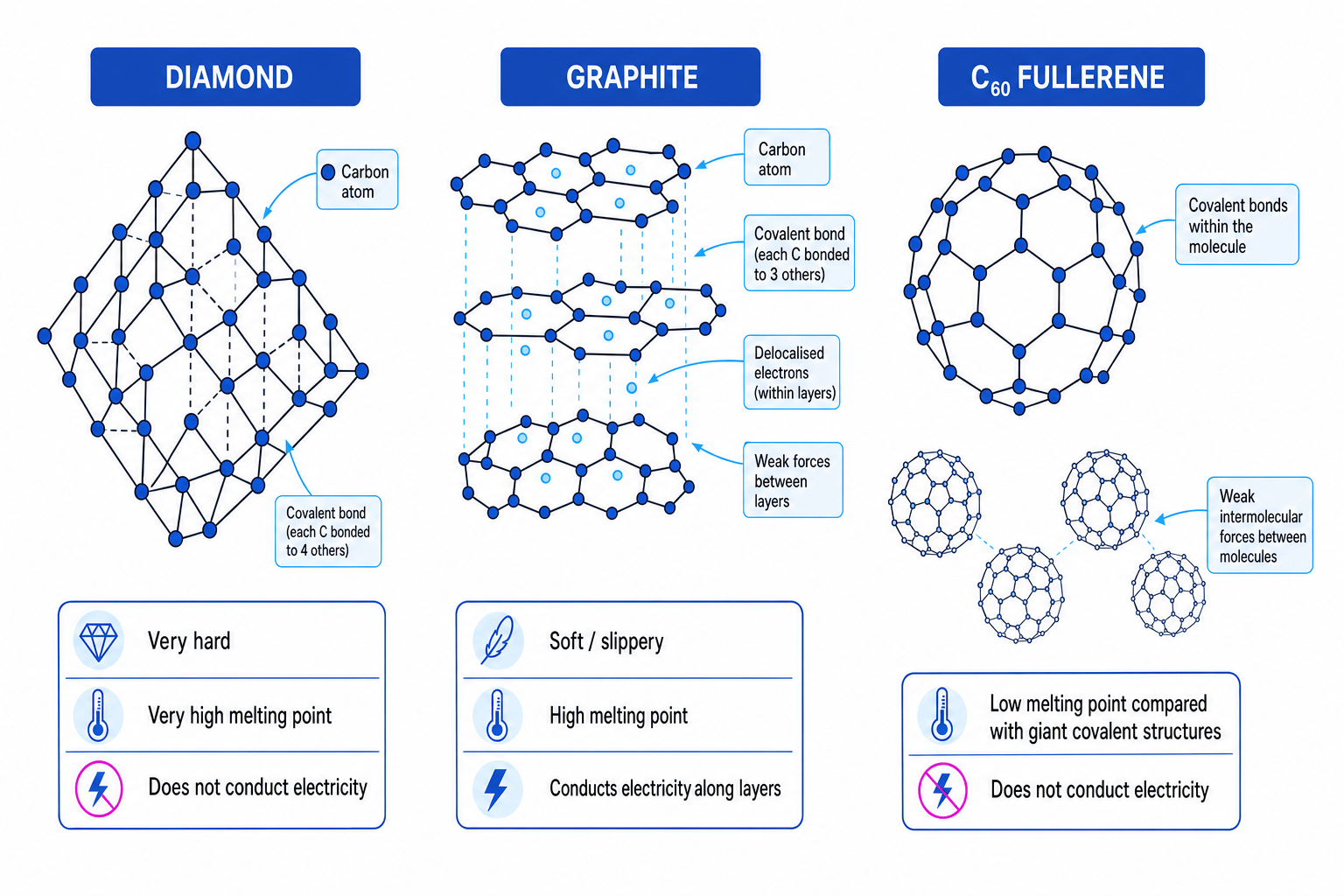
Diamond
Diamond is a giant covalent structure. Each carbon atom forms four covalent bonds to other carbon atoms in a three-dimensional network.
This makes diamond:
- very hard, because the atoms are held in a rigid network;
- very high melting, because many strong covalent bonds must be broken;
- unable to conduct electricity, because it has no mobile charged particles.
Graphite
Graphite is also a giant covalent structure, but its bonding is different. Each carbon atom forms three covalent bonds in flat layers of hexagons. The layers are held together by weak forces.
Graphite is:
- soft and slippery, because layers can slide over each other;
- high melting, because strong covalent bonds exist within the layers;
- able to conduct electricity along the layers, because it has delocalised electrons that can move and carry charge.
Explaining graphite’s conductivity and softness
-
In graphite, each carbon atom forms 3 covalent bonds, so one outer electron from each carbon atom is delocalised.
-
These delocalised electrons can move along the layers and carry electrical charge, so graphite conducts electricity.
-
The forces between the layers are weak, so the layers can slide over each other, making graphite soft and slippery.
C60C_{60}C60 fullerene
C60C_{60}C60 fullerene is made of molecules containing 60 carbon atoms arranged in a hollow sphere. Covalent bonds hold the atoms together within each molecule, but weak intermolecular forces act between separate C60C_{60}C60 molecules.
So C60C_{60}C60 fullerene has a much lower melting point than diamond or graphite. Pure C60C_{60}C60 does not usually conduct electricity because it does not have charged particles free to move throughout the solid.
Do covalent substances conduct electricity?
Covalent compounds do not usually conduct electricity. This is because they usually do not contain ions or delocalised electrons that are free to move.
For a substance to conduct electricity, it needs mobile charged particles:
- mobile ions, as in molten or dissolved ionic compounds;
- or mobile electrons, as in metals and graphite.
Usually does not mean never
Graphite conducts because of delocalised electrons, but graphite is an element rather than a covalent compound. Some covalent substances can form ions when dissolved in water, such as acids, so their solutions may conduct.
In the exam
-
For dot-and-cross diagrams, count outer electrons from the group number, draw shared pairs for bonds, then check full outer shells.
-
For melting and boiling questions, clearly separate strong covalent bonds inside molecules from weak intermolecular forces between molecules.
-
For conductivity questions, always identify whether there are mobile charged particles, such as delocalised electrons or ions.
Check yourself
- How would you draw a dot-and-cross diagram for ammonia, including its lone pair?
- Why does iodine have a higher boiling point than chlorine?
- Why does graphite conduct electricity but diamond does not?
