

What you'll learn
- What crude oil is made of, and why it can be separated into useful fractions.
- How fractional distillation works in an oil refinery.
- The names, uses and property trends of the main crude oil fractions.
- How hydrocarbon fuels burn, form pollutants, and why cracking is needed.
1. What is crude oil?
Crude oil is a naturally occurring, dark mixture found underground. It is not a single substance: it contains many different compounds mixed together.
A mixture contains substances that are not chemically bonded to each other. This matters because mixtures can often be separated by physical methods, without making new substances.
Hydrocarbon
A hydrocarbon is a compound that contains hydrogen and carbon atoms only. Crude oil is a mixture of many different hydrocarbons.
Most of the useful molecules in crude oil are alkanes. An alkane is a hydrocarbon with only carbon-carbon single bonds. Some alkane molecules are short, while others are long chains with many carbon atoms.
2. Fractions and boiling points
A boiling point is the temperature at which a liquid changes into a gas. Different hydrocarbons have different boiling points, mainly because their molecules have different sizes.
Small hydrocarbon molecules usually have low boiling points. Long-chain hydrocarbon molecules usually have high boiling points.
Fraction
A fraction is a mixture of hydrocarbons with similar boiling points. A fraction is not usually one pure compound.
This is the key idea behind separating crude oil: if the hydrocarbons boil at different temperatures, they can be separated by heating and cooling.
3. Fractional distillation of crude oil
Fractional distillation is the industrial process used to separate crude oil into fractions. It is a physical separation process: the hydrocarbon molecules are not changed into different molecules.
The crude oil is heated in a furnace until most of it vaporises. The hot vapour enters a tall fractionating column, which is hot at the bottom and cooler at the top. As the vapours rise, they cool down. Each fraction condenses when it reaches a part of the column below its boiling point. Condensation means a gas changing into a liquid.
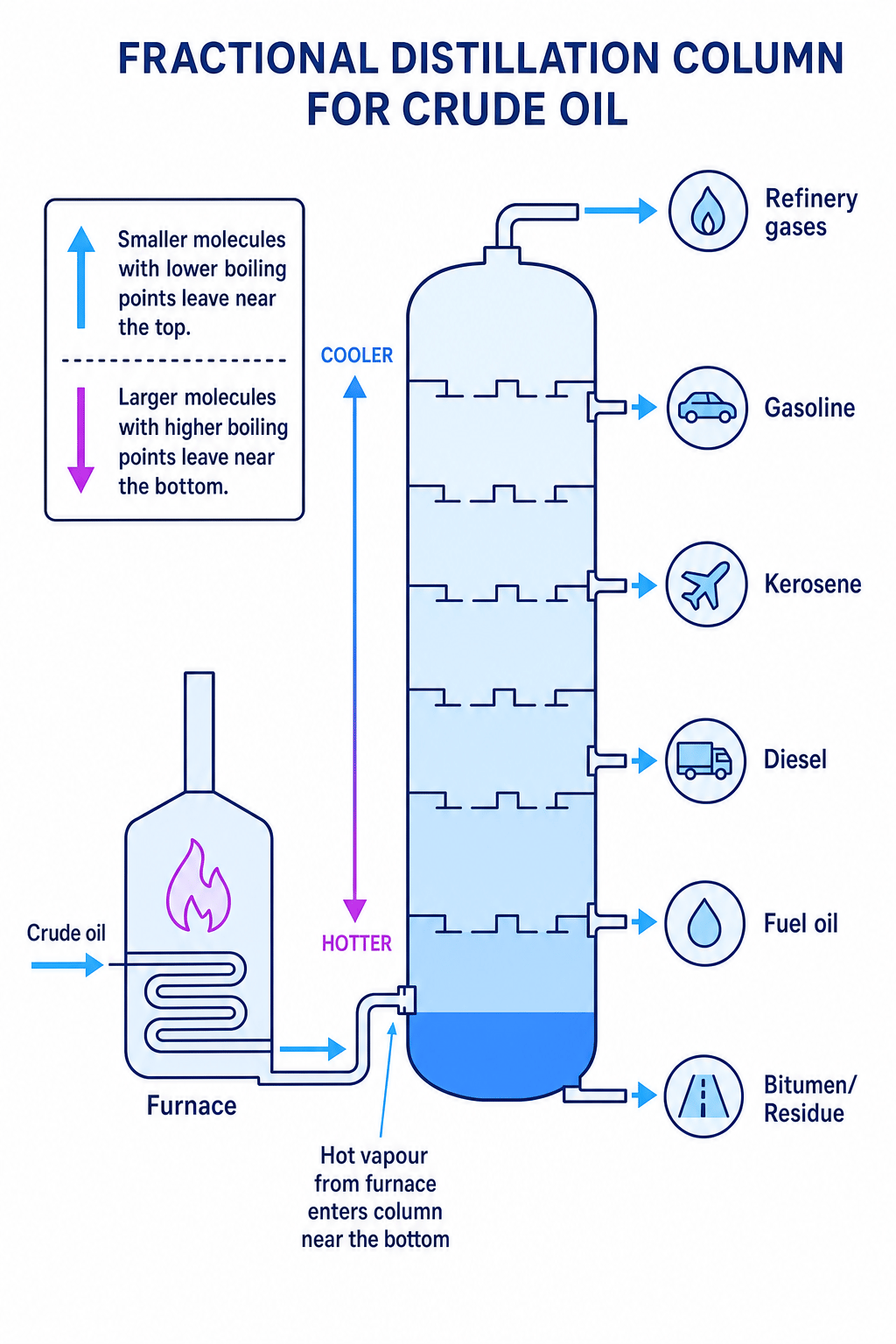
How the column separates fractions
Lower-boiling fractions rise higher before condensing, so they are collected near the top. Higher-boiling fractions condense lower down, and the heaviest residue remains near the bottom.
Locating a fraction in the column
A fraction with boiling point 40 °C and a fraction with boiling point 320 °C are collected from crude oil. Decide which one leaves higher in the column and which is likely to be more viscous.
- The 40 °C fraction has the lower boiling point, so it can remain as a vapour until it reaches a cooler part of the column.
- Cooler parts are near the top, so the 40 °C fraction leaves higher up than the 320 °C fraction.
- The 320 °C fraction has a higher boiling point, so it contains larger molecules and condenses lower down.
- Larger molecules are usually darker and more viscous, so the 320 °C fraction is likely to be thicker and less runny.
4. Main fractions, uses and trends
You need to know the main fractions in order from top to bottom.
| Fraction | Typical position | Main uses | Trend in properties |
|---|---|---|---|
| Refinery gases | Top | Bottled gas, cooking, heating | Very low boiling point, very runny, usually colourless |
| Gasoline | High | Petrol for cars | Low boiling point, pale, runny |
| Kerosene | Middle-high | Aircraft fuel | Higher boiling point than gasoline |
| Diesel | Middle-low | Diesel engines in cars, buses and lorries | More viscous and darker |
| Fuel oil | Low | Ships, power stations, industrial heating | High boiling point, thick, dark |
| Bitumen | Bottom | Road surfaces and roofing | Very high boiling point, very viscous, black |
The overall trend from top to bottom is:
- molecules get larger
- boiling point increases
- colour becomes darker
- viscosity increases
Viscosity means resistance to flow. A low-viscosity liquid is runny; a high-viscosity liquid is thick and flows slowly.
Top-to-bottom memory
Top fractions are small, pale and runny. Bottom fractions are large, dark and thick.
Separating is not cracking
Fractional distillation separates hydrocarbons by boiling point. It does not break covalent bonds or make new molecules.
5. Fuels and combustion
Fuel
A fuel is a substance that releases heat energy when it is burned.
Burning is also called combustion. In combustion, a substance reacts with oxygen. Hydrocarbon fuels burn in oxygen from the air.
Complete combustion
Complete combustion happens when there is plenty of oxygen. A hydrocarbon burns to form carbon dioxide and water only.
For example, methane burns completely:
CH4(g)+2O2(g)→CO2(g)+2H2O(l)CH_4(g) + 2O_2(g) \rightarrow CO_2(g) + 2H_2O(l)CH4(g)+2O2(g)→CO2(g)+2H2O(l)Incomplete combustion
Incomplete combustion happens when there is not enough oxygen. Possible products include carbon monoxide, solid carbon particles called soot, carbon dioxide and water.
For example:
2CH4(g)+3O2(g)→2CO(g)+4H2O(l)2CH_4(g) + 3O_2(g) \rightarrow 2CO(g) + 4H_2O(l)2CH4(g)+3O2(g)→2CO(g)+4H2O(l)or:
CH4(g)+O2(g)→C(s)+2H2O(l)CH_4(g) + O_2(g) \rightarrow C(s) + 2H_2O(l)CH4(g)+O2(g)→C(s)+2H2O(l)Balancing complete combustion of propane
Balance the complete combustion equation for propane, C3H8C_3H_8C3H8.
- Balance carbon first: propane has 3 carbon atoms, so make 3 molecules of carbon dioxide.
- Balance hydrogen next: propane has 8 hydrogen atoms, so make 4 molecules of water.
- Count oxygen atoms on the right: 3CO23CO_23CO2 contains 6 oxygen atoms and 4H2O4H_2O4H2O contains 4 oxygen atoms, giving 10 oxygen atoms in total.
- Since oxygen gas is O2O_2O2, 10 oxygen atoms need 5 oxygen molecules.
6. Pollutants from burning fuels
Carbon monoxide, COCOCO, is poisonous because it reduces the capacity of the blood to transport oxygen. If the blood cannot carry enough oxygen, body cells cannot release energy by respiration properly, which can be fatal.
Carbon monoxide is not carbon dioxide
Carbon dioxide, CO2CO_2CO2, is made in complete combustion. Carbon monoxide, COCOCO, is made in incomplete combustion and is poisonous.
Oxides of nitrogen
Air contains nitrogen and oxygen. In car engines, the temperature gets high enough for nitrogen and oxygen to react, forming oxides of nitrogen such as nitrogen monoxide, NONONO, and nitrogen dioxide, NO2NO_2NO2.
N2(g)+O2(g)→2NO(g)N_2(g) + O_2(g) \rightarrow 2NO(g)N2(g)+O2(g)→2NO(g) 2NO(g)+O2(g)→2NO2(g)2NO(g) + O_2(g) \rightarrow 2NO_2(g)2NO(g)+O2(g)→2NO2(g)Sulfur dioxide
Some hydrocarbon fuels contain sulfur impurities. When these impurities burn, sulfur dioxide forms.
S(s)+O2(g)→SO2(g)S(s) + O_2(g) \rightarrow SO_2(g)S(s)+O2(g)→SO2(g)Acid rain
Acid rain
Acid rain is rainwater made more acidic when pollutant gases, especially sulfur dioxide and oxides of nitrogen, dissolve and react in water in the atmosphere.
Sulfur dioxide can form sulfurous acid:
SO2(g)+H2O(l)→H2SO3(aq)SO_2(g) + H_2O(l) \rightarrow H_2SO_3(aq)SO2(g)+H2O(l)→H2SO3(aq)Nitrogen dioxide can help form nitric acid in rainwater:
4NO2(g)+O2(g)+2H2O(l)→4HNO3(aq)4NO_2(g) + O_2(g) + 2H_2O(l) \rightarrow 4HNO_3(aq)4NO2(g)+O2(g)+2H2O(l)→4HNO3(aq)Acid rain can damage plants, aquatic life, metal structures and limestone buildings.
Tracing pollutants from a fuel
A car engine burns a fuel containing sulfur impurities, and sometimes the oxygen supply is limited. Explain which pollutants may form.
- Sulfur impurities burn in oxygen, so sulfur dioxide, SO2SO_2SO2, can form.
- The engine temperature is high, so nitrogen and oxygen from the air can react to form oxides of nitrogen.
- Limited oxygen means incomplete combustion can occur, forming carbon monoxide, COCOCO, and possibly soot.
- Sulfur dioxide and oxides of nitrogen can dissolve and react in rainwater, contributing to acid rain.
7. Catalytic cracking
Fractional distillation gives refineries a problem: there is often more demand for shorter-chain fuels, such as gasoline, than the crude oil naturally supplies. There is also high demand for alkenes, which are used to make polymers.
Cracking
Cracking is a chemical process that breaks long-chain hydrocarbons into shorter-chain hydrocarbons.
In catalytic cracking, long-chain alkanes are heated to 600-700 °C and passed over a hot catalyst. A catalyst speeds up a reaction without being used up. The catalyst is usually silica, SiO2SiO_2SiO2, or alumina, Al2O3Al_2O_3Al2O3.
Cracking produces:
- shorter-chain alkanes, which are useful as fuels
- alkenes, which contain a carbon-carbon double bond and are useful for making polymers
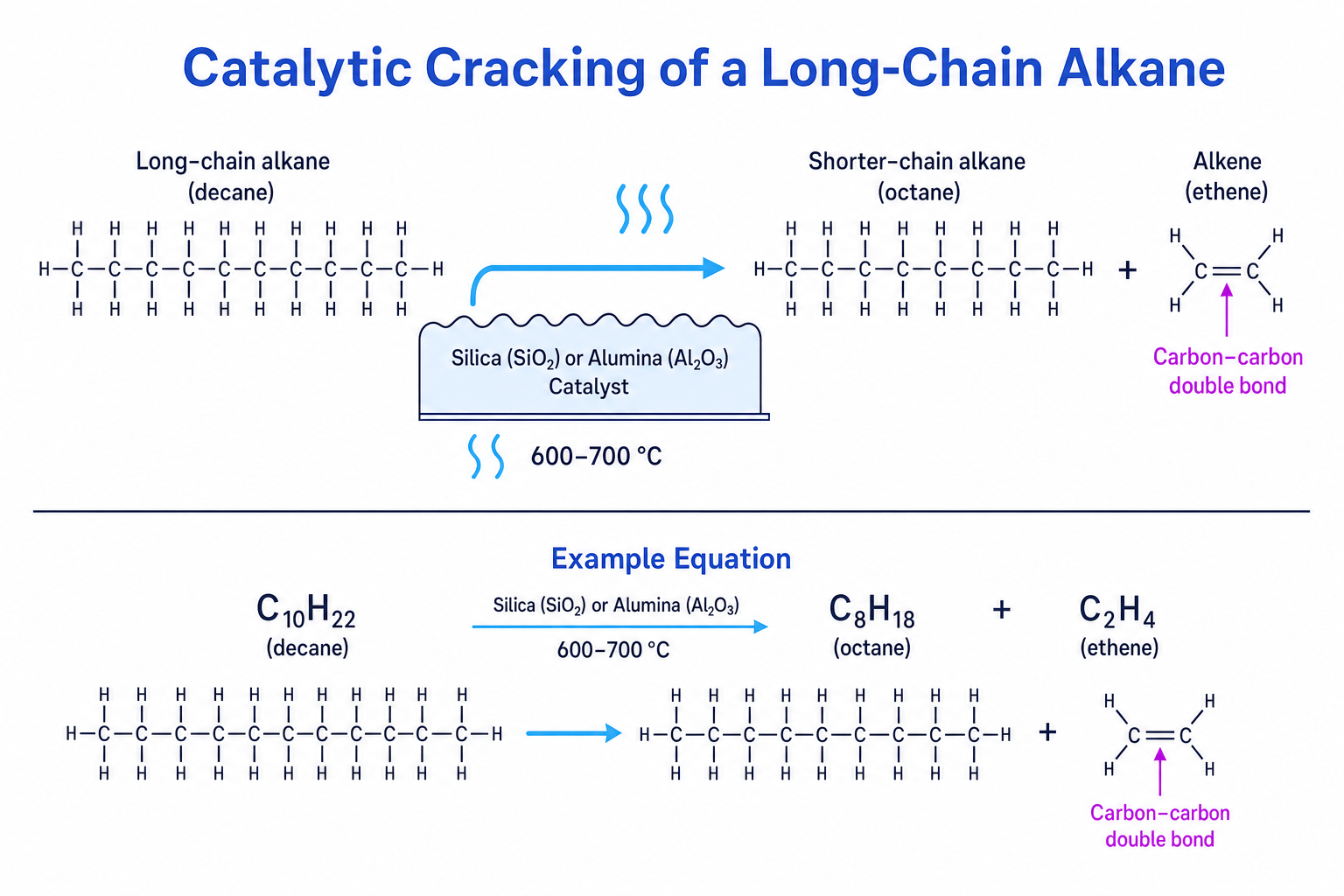
For example:
C10H22(g)→C8H18(g)+C2H4(g)C_{10}H_{22}(g) \rightarrow C_8H_{18}(g) + C_2H_4(g)C10H22(g)→C8H18(g)+C2H4(g)This shows decane cracking into octane and ethene.
Balancing a cracking equation
A long-chain alkane cracks to form octane and one alkene. Complete the equation.
C12H26(g)→C8H18(g)+?C_{12}H_{26}(g) \rightarrow C_8H_{18}(g) + \text{?}C12H26(g)→C8H18(g)+?- Count carbon atoms: the reactant has 12 carbon atoms and octane has 8, so the missing molecule must contain 4 carbon atoms.
- Count hydrogen atoms: the reactant has 26 hydrogen atoms and octane has 18, so the missing molecule must contain 8 hydrogen atoms.
- The missing product is therefore C4H8C_4H_8C4H8, which in this cracking context is an alkene.
- The balanced equation is:
Why cracking is necessary
Cracking changes less-demanded long-chain fractions into more-demanded short-chain fuels and alkenes, helping refineries match supply to demand.
In the exam
- For fractional distillation, always link position in the column to boiling point: low boiling point near the top, high boiling point near the bottom.
- For combustion questions, first decide whether oxygen is plentiful or limited, then choose the correct products.
- Keep pollutant sources separate: carbon monoxide from incomplete combustion, sulfur dioxide from sulfur impurities, and oxides of nitrogen from hot engines.
- For cracking, mention both conditions: 600-700 °C and a silica or alumina catalyst.
Check yourself
- Why does gasoline leave the fractionating column higher than diesel?
- What products can form when a hydrocarbon burns with a limited oxygen supply?
- Why does catalytic cracking help refineries meet demand?
