

What you'll learn
- How to test for hydrogen, oxygen, carbon dioxide, ammonia and chlorine.
- How flame tests identify some metal cations.
- How sodium hydroxide, silver nitrate, barium chloride and acids are used to identify ions.
- How to test for water, and how to check whether water is pure.
Big picture: what chemical tests do
A chemical test uses a reagent or a simple physical method to identify a substance from a clear observation, such as a flame colour, a gas relighting a splint, or a coloured precipitate.
Qualitative test
A qualitative test tells you what substance is present, not how much of it is present. The key exam answer is usually the reagent used plus the positive observation.
A positive result is the observation that confirms the substance is present. For example, “limewater turns milky” is a positive result for carbon dioxide.
A precipitate is an insoluble solid that forms when two solutions react. In ion tests, precipitate colour is often the main clue.
Tests for common gases
Most gas tests involve either a splint, limewater, or damp litmus paper. Indicator paper must be damp because many gases need to dissolve in water before they affect the indicator.
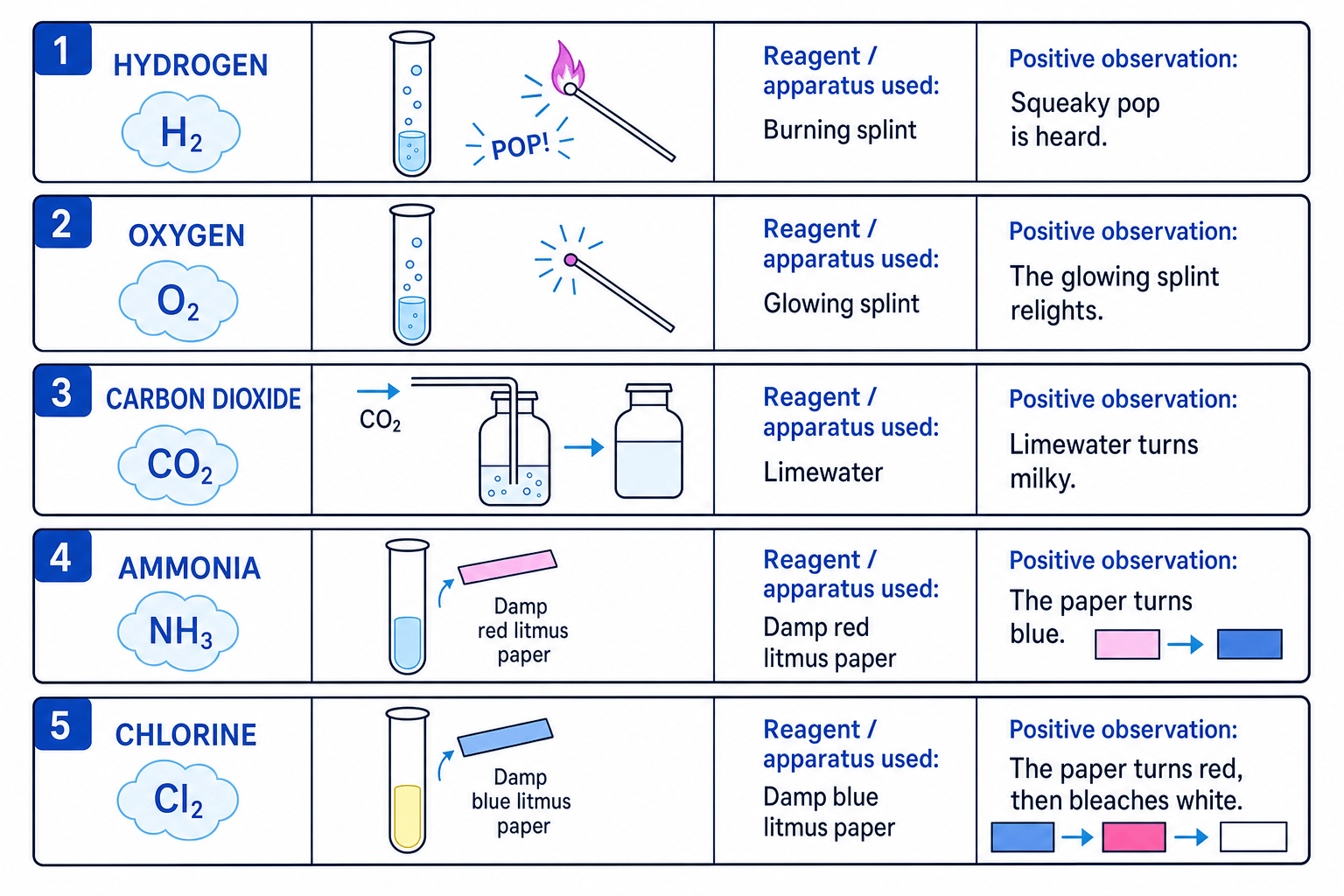
The diagram summarises the five gas tests you need for this section.
Hydrogen, H2H_2H2
Test hydrogen using a burning splint. If hydrogen is present, it burns with a squeaky pop.
The reaction is:
2H2(g)+O2(g)→2H2O(l)2H_2\text{(g)} + O_2\text{(g)} \to 2H_2O\text{(l)}2H2(g)+O2(g)→2H2O(l)Oxygen, O2O_2O2
Test oxygen using a glowing splint. If oxygen is present, the glowing splint relights because oxygen supports combustion.
Carbon dioxide, CO2CO_2CO2
Test carbon dioxide by bubbling it through limewater, which is aqueous calcium hydroxide, Ca(OH)2(aq)Ca(OH)_2\text{(aq)}Ca(OH)2(aq). Carbon dioxide turns limewater milky because insoluble calcium carbonate forms.
CO2(g)+Ca(OH)2(aq)→CaCO3(s)+H2O(l)CO_2\text{(g)} + Ca(OH)_2\text{(aq)} \to CaCO_3\text{(s)} + H_2O\text{(l)}CO2(g)+Ca(OH)2(aq)→CaCO3(s)+H2O(l)Ammonia, NH3NH_3NH3
Test ammonia using damp red litmus paper. Ammonia turns damp red litmus paper blue because ammonia is alkaline when dissolved in water.
Chlorine, Cl2Cl_2Cl2
Test chlorine using damp blue litmus paper. Chlorine turns the paper red, then bleaches it white.
Chlorine is toxic, so in real practical work it must be handled carefully, usually in very small amounts and with good ventilation.
Gas-test observations
Learn the exact positive observations: hydrogen gives a squeaky pop, oxygen relights a glowing splint, carbon dioxide turns limewater milky, ammonia turns damp red litmus blue, and chlorine turns damp blue litmus red then white.
Identifying gases from observations
Three unknown gases are tested. Gas A relights a glowing splint, gas B turns limewater milky, and gas C turns damp red litmus paper blue.
- Gas A must support combustion, so the relighting glowing splint identifies it as oxygen.
- Gas B reacts with limewater to form a milky calcium carbonate precipitate, so it is carbon dioxide.
- Gas C is alkaline enough to turn damp red litmus blue, so it is ammonia.
Flame tests for metal cations
A cation is a positively charged ion. Flame tests identify some metal cations because their compounds give characteristic flame colours.
To carry out a flame test:
- Clean a nichrome or platinum wire loop by dipping it in dilute hydrochloric acid and heating it in a Bunsen flame until no flame colour is seen.
- Dip the clean loop into the solid sample, or into a solution of the sample.
- Place the loop in the hottest part of a blue Bunsen flame.
- Observe and record the flame colour.
The flame-test colours you must know are:
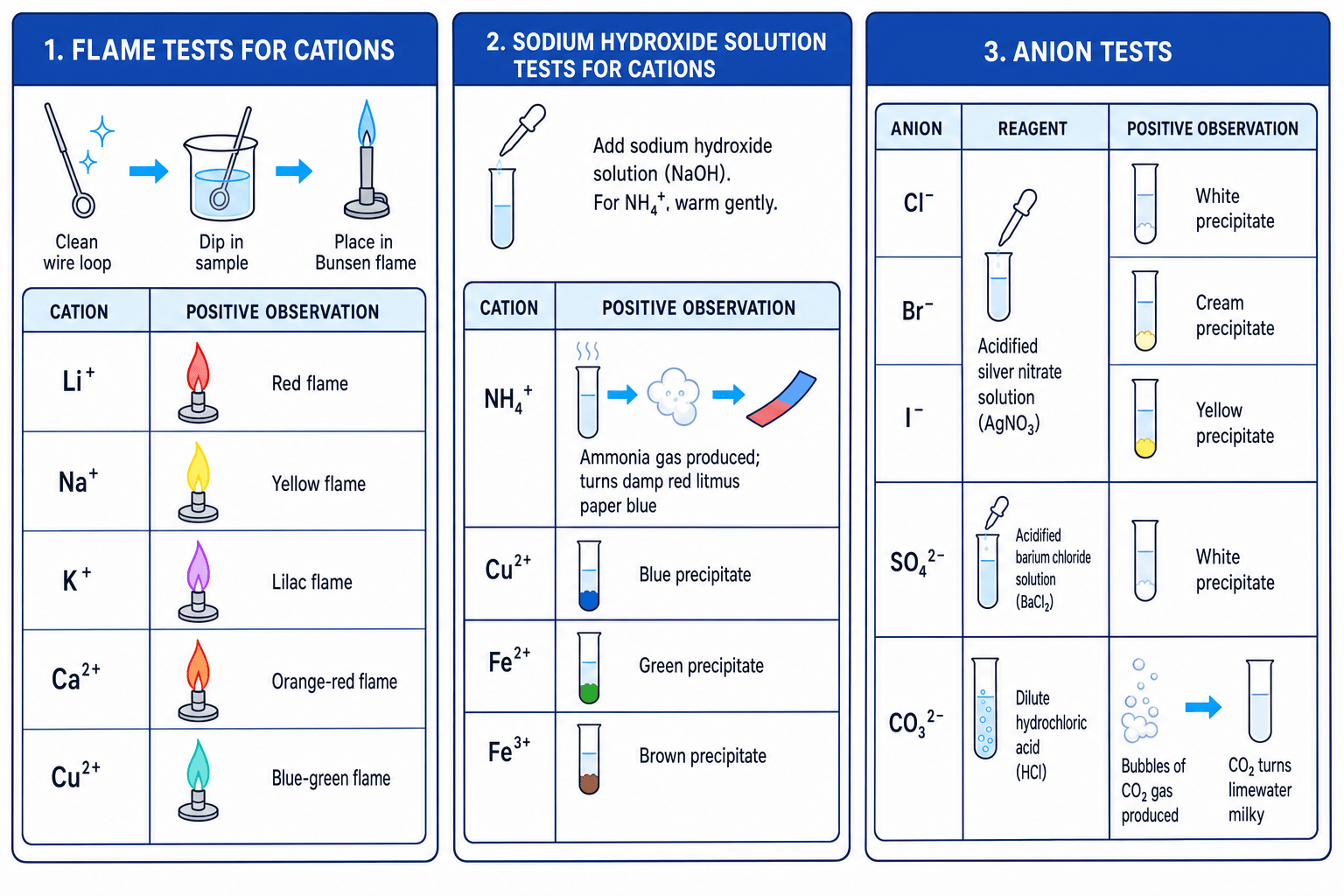
- Li+Li^+Li+ gives a red flame.
- Na+Na^+Na+ gives a yellow flame.
- K+K^+K+ gives a lilac flame.
- Ca2+Ca^{2+}Ca2+ gives an orange-red flame.
- Cu2+Cu^{2+}Cu2+ gives a blue-green flame.
Sodium contamination
Sodium compounds are common contaminants and give a very strong yellow flame. If the wire loop is not cleaned properly, a sodium flame can hide other colours.
The chart below brings together the required cation and anion tests.
Cation tests using sodium hydroxide solution
Sodium hydroxide solution, NaOH(aq)NaOH\text{(aq)}NaOH(aq), supplies hydroxide ions, OH−OH^-OH−. Some metal ions form insoluble metal hydroxide precipitates with hydroxide ions.
For the cations in this section:
- NH4+NH_4^+NH4+: warm with sodium hydroxide solution. Ammonia gas is produced, which turns damp red litmus paper blue.
- Cu2+Cu^{2+}Cu2+: add sodium hydroxide solution. A blue precipitate forms.
- Fe2+Fe^{2+}Fe2+: add sodium hydroxide solution. A green precipitate forms.
- Fe3+Fe^{3+}Fe3+: add sodium hydroxide solution. A brown precipitate forms.
Useful ionic equations are:
NH4+(aq)+OH−(aq)→NH3(g)+H2O(l)Cu2+(aq)+2OH−(aq)→Cu(OH)2(s)Fe2+(aq)+2OH−(aq)→Fe(OH)2(s)Fe3+(aq)+3OH−(aq)→Fe(OH)3(s)\begin{aligned} NH_4^+\text{(aq)} + OH^-\text{(aq)} &\to NH_3\text{(g)} + H_2O\text{(l)} \\ Cu^{2+}\text{(aq)} + 2OH^-\text{(aq)} &\to Cu(OH)_2\text{(s)} \\ Fe^{2+}\text{(aq)} + 2OH^-\text{(aq)} &\to Fe(OH)_2\text{(s)} \\ Fe^{3+}\text{(aq)} + 3OH^-\text{(aq)} &\to Fe(OH)_3\text{(s)} \end{aligned}NH4+(aq)+OH−(aq)Cu2+(aq)+2OH−(aq)Fe2+(aq)+2OH−(aq)Fe3+(aq)+3OH−(aq)→NH3(g)+H2O(l)→Cu(OH)2(s)→Fe(OH)2(s)→Fe(OH)3(s)Ammonium is not ammonia
The ion being tested in solution is ammonium, NH4+NH_4^+NH4+. The gas produced after warming with sodium hydroxide is ammonia, NH3NH_3NH3.
Anion tests
An anion is a negatively charged ion. For anion tests, use a fresh portion of the sample for each test, because one reagent can interfere with another test.
Halide ions: Cl−Cl^-Cl−, Br−Br^-Br− and I−I^-I−
Halide ions are tested using acidified silver nitrate solution.
Method:
- Acidify the sample with dilute nitric acid.
- Add silver nitrate solution.
- Observe the precipitate colour.
Positive results:
- Cl−Cl^-Cl− gives a white precipitate of silver chloride, AgClAgClAgCl.
- Br−Br^-Br− gives a cream precipitate of silver bromide, AgBrAgBrAgBr.
- I−I^-I− gives a yellow precipitate of silver iodide, AgIAgIAgI.
Wrong acid in the halide test
Do not acidify the halide test with hydrochloric acid. Hydrochloric acid contains chloride ions, so it could give a false white precipitate.
Sulfate ions, SO42−SO_4^{2-}SO42−
Test sulfate ions using acidified barium chloride solution. A positive result is a white precipitate of barium sulfate, BaSO4BaSO_4BaSO4.
Ba2+(aq)+SO42−(aq)→BaSO4(s)Ba^{2+}\text{(aq)} + SO_4^{2-}\text{(aq)} \to BaSO_4\text{(s)}Ba2+(aq)+SO42−(aq)→BaSO4(s)The acid helps remove carbonate ions, which could otherwise also produce a white precipitate with barium ions.
Carbonate ions, CO32−CO_3^{2-}CO32−
Test carbonate ions by adding dilute hydrochloric acid. A positive result is effervescence — fizzing caused by carbon dioxide gas. Confirm the gas by bubbling it through limewater; it turns limewater milky.
CO32−(aq)+2H+(aq)→CO2(g)+H2O(l)CO_3^{2-}\text{(aq)} + 2H^+\text{(aq)} \to CO_2\text{(g)} + H_2O\text{(l)}CO32−(aq)+2H+(aq)→CO2(g)+H2O(l)Identifying ions from test results
An unknown soluble solid is tested. When warmed with sodium hydroxide solution, it gives a gas that turns damp red litmus paper blue. A separate acidified sample gives a cream precipitate with silver nitrate solution.
- The gas from warming with sodium hydroxide is ammonia, so the original cation is NH4+NH_4^+NH4+.
- A cream precipitate with acidified silver nitrate is silver bromide, so the anion is Br−Br^-Br−.
- Combining NH4+NH_4^+NH4+ and Br−Br^-Br− gives the neutral salt NH4BrNH_4BrNH4Br, ammonium bromide.
Testing for water
Chemical test for the presence of water
To test for water, add the sample to anhydrous copper(II) sulfate.
Anhydrous
Anhydrous means “without water”. Anhydrous copper(II) sulfate is white because it has no water of crystallisation.
If water is present, anhydrous copper(II) sulfate changes from white to blue as hydrated copper(II) sulfate forms.
CuSO4(s)+5H2O(l)→CuSO4⋅5H2O(s)CuSO_4\text{(s)} + 5H_2O\text{(l)} \to CuSO_4 \cdot 5H_2O\text{(s)}CuSO4(s)+5H2O(l)→CuSO4⋅5H2O(s)This test shows that water is present. It does not prove that the water is pure.
Testing whether water is pure
A physical test does not make a new substance. To test whether water is pure, measure its boiling point or freezing point.
At normal atmospheric pressure:
- pure water boils at 100°C
- pure water freezes at 0°C
Impure water usually boils over a range of temperatures and often has a boiling point above 100°C.
Pressure affects boiling point
Boiling point depends on pressure. In IGCSE questions, assume normal atmospheric pressure unless the question tells you otherwise.
Judging water purity from boiling data
A water sample starts boiling at 101.5°C and the temperature rises to 103.0°C while it continues boiling. Decide whether it is pure.
- Pure water should boil at a fixed temperature of 100°C at normal atmospheric pressure.
- This sample boils above 100°C and over a range from 101.5°C to 103.0°C.
- The sample is not pure; it contains dissolved impurities, although this physical test does not identify what they are.
In the exam
- For every chemical test, give both the reagent or apparatus and the positive observation.
- Use precise wording for precipitates: include the colour, such as white precipitate, cream precipitate, or brown precipitate.
- For gas tests with litmus, write damp litmus paper, not dry litmus paper.
- Use separate samples for different ion tests to avoid one reagent affecting the next result.
Check yourself
- Which gas turns limewater milky, and what solid causes the milkiness?
- What observations distinguish Fe2+Fe^{2+}Fe2+ and Fe3+Fe^{3+}Fe3+ when sodium hydroxide solution is added?
- How would you test whether a sample contains water, and how would you test whether that water is pure?

