

What you'll learn
- How to use the general formula for alkanes.
- Why alkanes are called saturated hydrocarbons.
- How to draw and name unbranched alkanes with up to five carbon atoms.
- How alkanes react with halogens in ultraviolet radiation.
Starting point: what are organic compounds?
In IGCSE Chemistry, organic chemistry is the study of compounds containing carbon. Most organic compounds also contain hydrogen, and many contain other elements such as oxygen, chlorine or bromine.
Alkanes are one of the simplest families of organic compounds. They are important because they are major components of crude oil and natural gas.
Alkane
An alkane is a hydrocarbon containing only carbon–carbon single bonds.
Hydrocarbons
A hydrocarbon is a compound that contains hydrogen and carbon only.
For example:
- Methane, CH4CH_4CH4, is a hydrocarbon.
- Propane, C3H8C_3H_8C3H8, is a hydrocarbon.
- Ethanol, C2H5OHC_2H_5OHC2H5OH, is not a hydrocarbon because it also contains oxygen.
Hydrocarbon
A hydrocarbon is a compound made from carbon and hydrogen atoms only.
The general formula for alkanes
All alkanes follow the same pattern:
CnH2n+2C_nH_{2n+2}CnH2n+2Here, nnn is the number of carbon atoms in the molecule.
So if an alkane has:
- 1 carbon atom, it has 2n+2=42n+2 = 42n+2=4 hydrogen atoms, so the formula is CH4CH_4CH4.
- 2 carbon atoms, it has 2n+2=62n+2 = 62n+2=6 hydrogen atoms, so the formula is C2H6C_2H_6C2H6.
- 5 carbon atoms, it has 2n+2=122n+2 = 122n+2=12 hydrogen atoms, so the formula is C5H12C_5H_{12}C5H12.
General formula
The general formula for alkanes is CnH2n+2C_nH_{2n+2}CnH2n+2. This lets you work out the molecular formula of any alkane if you know how many carbon atoms it has.
Using the alkane general formula
An alkane contains 6 carbon atoms. Work out its molecular formula.
-
Use the alkane general formula CnH2n+2C_nH_{2n+2}CnH2n+2 and substitute n=6n = 6n=6 because there are 6 carbon atoms.
-
Calculate the number of hydrogen atoms: 2n+2=(2×6)+2=142n+2 = \left(2 \times 6\right) + 2 = 142n+2=(2×6)+2=14.
-
Put the carbon and hydrogen numbers into the formula, giving C6H14C_6H_{14}C6H14.
Why alkanes are saturated
Alkanes are described as saturated because their carbon atoms are joined by single covalent bonds only.
A covalent bond is a shared pair of electrons between atoms. In alkanes, the carbon atoms share electrons with other carbon atoms and hydrogen atoms.
Carbon forms 4 covalent bonds. Hydrogen forms 1 covalent bond. In an alkane, each carbon has as many hydrogen atoms attached as possible because there are no carbon–carbon double bonds.
Saturated hydrocarbon
A saturated hydrocarbon contains hydrogen and carbon only, and has only carbon–carbon single bonds.
This is why alkanes are saturated hydrocarbons:
- They are hydrocarbons because they contain carbon and hydrogen only.
- They are saturated because they contain only single bonds between carbon atoms.
Saturated does not mean dissolved
In organic chemistry, saturated means “single carbon–carbon bonds only”. It does not mean a solution is full of solute.
Checking whether a compound could be an alkane
Decide whether C4H10C_4H_{10}C4H10 and C4H8C_4H_8C4H8 could be alkanes.
-
For an alkane with 4 carbon atoms, substitute n=4n = 4n=4 into CnH2n+2C_nH_{2n+2}CnH2n+2.
-
Calculate the expected number of hydrogen atoms: 2n+2=(2×4)+2=102n+2 = \left(2 \times 4\right) + 2 = 102n+2=(2×4)+2=10.
-
Compare each formula with the alkane pattern. C4H10C_4H_{10}C4H10 matches, so it could be an alkane. C4H8C_4H_8C4H8 does not match, so it is not an alkane.
Formulae used for alkanes
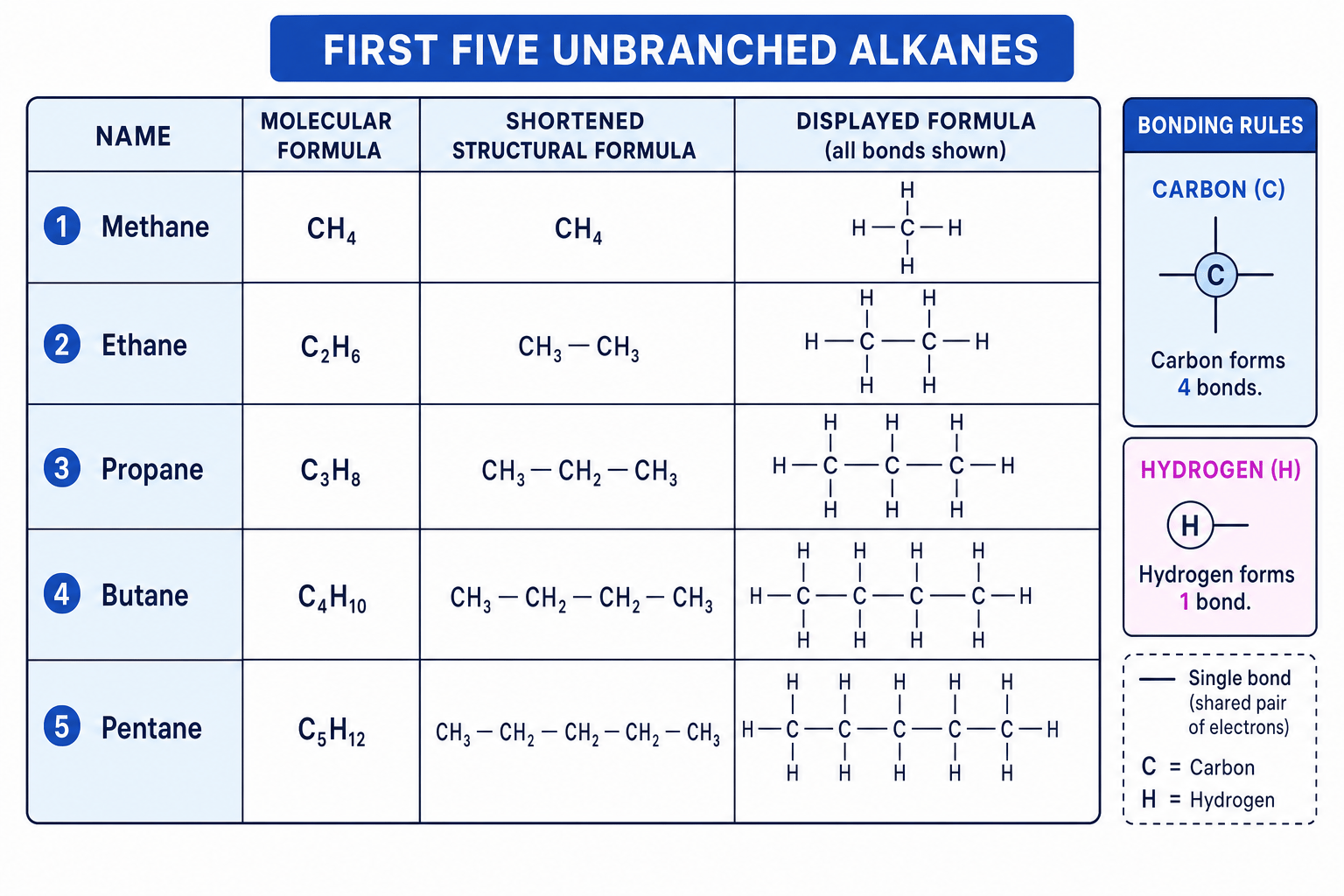
You need to recognise and draw different types of formula.
Molecular formula
The molecular formula shows the actual number of each type of atom in one molecule.
For example, propane has molecular formula C3H8C_3H_8C3H8.
This tells you there are 3 carbon atoms and 8 hydrogen atoms, but it does not show how the atoms are connected.
Structural formula
The structural formula shows how the atoms are arranged, usually in a shortened form.
For example, propane can be written as:
CH3CH2CH3CH_3CH_2CH_3CH3CH2CH3
This shows a chain of 3 carbon atoms.
Displayed formula
The displayed formula shows every atom and every bond in the molecule.
For alkanes, every bond shown should be a single line because alkanes only contain single covalent bonds.
Drawing displayed formulae
When drawing an alkane, make sure every carbon has 4 bonds and every hydrogen has 1 bond. This is the quickest way to spot missing or extra hydrogens.
Naming unbranched alkanes up to five carbons
An unbranched chain means the carbon atoms are joined in one continuous chain, with no side chains.
You need to know the names of the first five unbranched alkanes:
- 1 carbon atom: methane, CH4CH_4CH4
- 2 carbon atoms: ethane, C2H6C_2H_6C2H6
- 3 carbon atoms: propane, C3H8C_3H_8C3H8
- 4 carbon atoms: butane, C4H10C_4H_{10}C4H10
- 5 carbon atoms: pentane, C5H12C_5H_{12}C5H12
The names use a prefix to show the number of carbon atoms:
- meth- means 1 carbon
- eth- means 2 carbons
- prop- means 3 carbons
- but- means 4 carbons
- pent- means 5 carbons
The ending -ane shows that the compound is an alkane.
Isomer
Isomers are compounds with the same molecular formula but different structural formulae.
At this stage, focus on naming the unbranched-chain alkanes. For example, the unbranched-chain alkane with formula C4H10C_4H_{10}C4H10 is butane.
Molecular formula vs structural formula
C4H10C_4H_{10}C4H10 tells you the numbers of atoms only. CH3CH2CH2CH3CH_3CH_2CH_2CH_3CH3CH2CH2CH3 shows the carbon chain arrangement, so it is a structural formula.
Drawing the displayed formula of butane
Draw the displayed formula of butane.
-
Use the name to find the number of carbon atoms. The prefix but- means 4 carbon atoms, so start with a chain of 4 carbon atoms joined by single bonds.
-
Add hydrogen atoms so that each carbon has 4 bonds in total. The two end carbon atoms each need 3 hydrogens, and the two middle carbon atoms each need 2 hydrogens.
-
Count the atoms to check the formula: there are 4 carbon atoms and 10 hydrogen atoms, so the displayed formula matches C4H10C_4H_{10}C4H10.
Reactions of alkanes with halogens
Alkanes are fairly unreactive because their covalent bonds are strong and non-polar. However, they do react with halogens such as chlorine or bromine in the presence of ultraviolet radiation.
Halogen
A halogen is an element in Group 7 of the Periodic Table, such as fluorine, chlorine, bromine or iodine.
In this topic, you only need to know mono-substitution reactions. You do not need to know the detailed reaction mechanism.
Substitution reaction
A substitution reaction is a reaction in which one atom, or group of atoms, is replaced by another atom or group of atoms.
Methane and chlorine
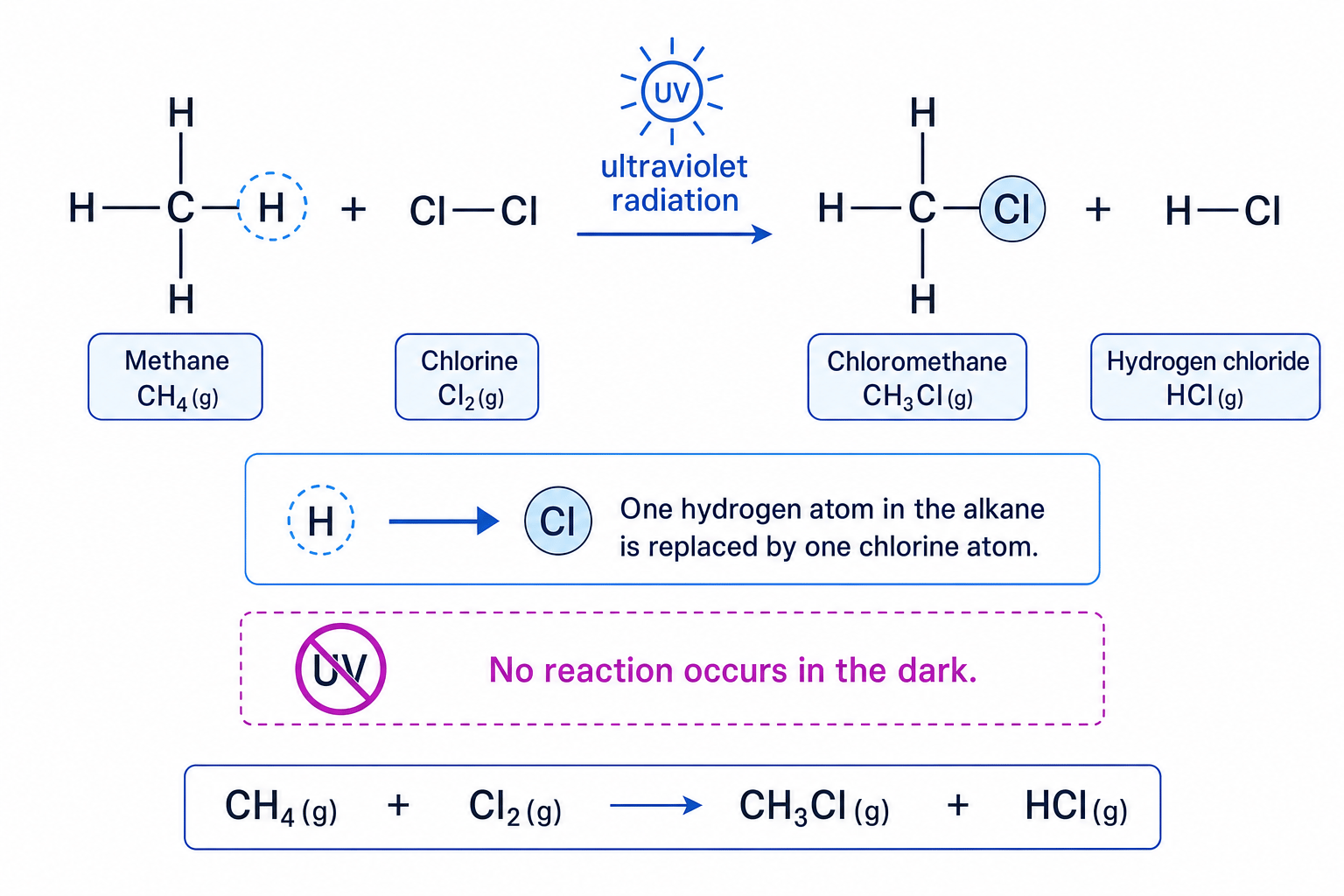
Methane reacts with chlorine in ultraviolet radiation to form chloromethane and hydrogen chloride:
CH4(g)+Cl2(g)→CH3Cl(g)+HCl(g)CH_4\text{(g)} + Cl_2\text{(g)} \to CH_3Cl\text{(g)} + HCl\text{(g)}CH4(g)+Cl2(g)→CH3Cl(g)+HCl(g)One hydrogen atom in methane is replaced by one chlorine atom.
What mono-substitution means
Mono- means one. In mono-substitution, only one hydrogen atom in the alkane is replaced by one halogen atom.
For example:
C2H6+Cl2→C2H5Cl+HClC_2H_6 + Cl_2 \to C_2H_5Cl + HClC2H6+Cl2→C2H5Cl+HClEthane reacts with chlorine to form chloroethane and hydrogen chloride.
Alkane halogenation
Alkanes react with halogens in ultraviolet radiation by substitution: one hydrogen atom is replaced by one halogen atom, producing a haloalkane and a hydrogen halide.
Writing a mono-substitution equation
Write the equation for the mono-substitution reaction between ethane and chlorine.
-
Start with ethane and chlorine as the reactants: ethane is C2H6C_2H_6C2H6 and chlorine molecules are Cl2Cl_2Cl2.
-
Replace one hydrogen atom in ethane with one chlorine atom. This changes C2H6C_2H_6C2H6 into C2H5ClC_2H_5ClC2H5Cl.
-
The removed hydrogen atom combines with the other chlorine atom to form hydrogen chloride, HClHClHCl.
-
Write the balanced equation: C2H6+Cl2→C2H5Cl+HClC_2H_6 + Cl_2 \to C_2H_5Cl + HClC2H6+Cl2→C2H5Cl+HCl.
Ultraviolet radiation is required
Alkanes do not usually react with chlorine or bromine in the dark. Ultraviolet radiation provides the energy needed to start the substitution reaction.
Naming the products
When chlorine substitutes into an alkane, the product is a chloroalkane.
For example:
- Methane forms chloromethane.
- Ethane forms chloroethane.
When bromine substitutes into an alkane, the product is a bromoalkane.
For example:
- Methane forms bromomethane.
- Ethane forms bromoethane.
The other product is a hydrogen halide:
- Chlorine gives hydrogen chloride, HClHClHCl.
- Bromine gives hydrogen bromide, HBrHBrHBr.
Product pattern
For mono-substitution, think: alkane + halogen → haloalkane + hydrogen halide.
Quick summary
Alkanes are saturated hydrocarbons with the general formula CnH2n+2C_nH_{2n+2}CnH2n+2. They contain carbon and hydrogen only, and all carbon–carbon bonds are single bonds. You should be able to draw molecular, structural and displayed formulae for methane to pentane, and name the unbranched-chain alkanes. Alkanes react with halogens in ultraviolet radiation by mono-substitution, where one hydrogen atom is replaced by one halogen atom.
In the exam
-
For formula questions, substitute the number of carbon atoms into CnH2n+2C_nH_{2n+2}CnH2n+2 and check that the hydrogen number matches.
-
For displayed formulae, count bonds carefully: carbon must have 4 bonds and hydrogen must have 1 bond.
-
For halogenation equations, remember the pattern: alkane + halogen → haloalkane + hydrogen halide, and include ultraviolet radiation if conditions are asked for.
Check yourself
- What is the molecular formula of the unbranched alkane with 5 carbon atoms?
- Why are alkanes described as saturated hydrocarbons?
- What are the products when methane reacts with chlorine in ultraviolet radiation?
