

What you'll learn
- How to recognise the alkene functional group, >C=C<>C=C<>C=C<.
- Why alkenes are called unsaturated hydrocarbons.
- How to draw and name unbranched alkenes with up to four carbon atoms.
- How alkenes react with bromine, including the bromine water test.
Starting point: hydrocarbons and carbon bonds
A hydrocarbon is a compound containing carbon and hydrogen atoms only. Alkanes and alkenes are both hydrocarbons.
Carbon forms four covalent bonds. In alkanes, every carbon-carbon bond is a single bond. In alkenes, at least one pair of carbon atoms is joined by a carbon-carbon double bond, written as C=C.
Functional group
A functional group is the atom or group of atoms that gives an organic compound its characteristic reactions. The alkene functional group is the carbon-carbon double bond, written as >C=C<>C=C<>C=C<.
The symbols around >C=C<>C=C<>C=C< show that each carbon in the double bond is also bonded to other atoms or groups.
The alkene homologous series
Alkenes are a homologous series, which means they are a family of organic compounds with:
- the same functional group, C=C
- similar chemical reactions
- a general formula
- neighbouring members differing by CH2CH_2CH2
The general formula for alkenes with one C=C double bond is:
CnH2nC_nH_{2n}CnH2nHere, nnn is the number of carbon atoms.
General formula
For an alkene with one carbon-carbon double bond, the number of hydrogen atoms is twice the number of carbon atoms: CnH2nC_nH_{2n}CnH2n.
There is no “methene”, because you need at least two carbon atoms to make a C=C double bond. The first alkene is ethene, C2H4C_2H_4C2H4.
Using the alkene general formula
What is the molecular formula of an alkene with five carbon atoms?
- Use the alkene general formula: CnH2nC_nH_{2n}CnH2n.
- Substitute n=5n = 5n=5, because the molecule has five carbon atoms.
- Calculate the number of hydrogen atoms: 2n=2×5=102n = 2 \times 5 = 102n=2×5=10.
- Write the molecular formula as C5H10C_5H_{10}C5H10.
Why alkenes are unsaturated hydrocarbons
Alkenes are called unsaturated because the C=C double bond can open up and allow more atoms to be added to the molecule.
A saturated hydrocarbon has only carbon-carbon single bonds, so it contains the maximum possible number of hydrogen atoms for that carbon chain. Alkanes are saturated.
An unsaturated hydrocarbon has at least one carbon-carbon double bond or triple bond. Alkenes are unsaturated because they contain C=C.
Unsaturated hydrocarbon
An unsaturated hydrocarbon contains carbon and hydrogen only, and has at least one multiple carbon-carbon bond, such as a C=C double bond.
Unsaturated does not mean watery
In chemistry, unsaturated is about bonding, not about dissolving. An alkene is unsaturated because it has a C=C double bond that can react by addition.
Displayed and structural formulae
A displayed formula shows every atom and every bond in a molecule.
A structural formula shows how the atoms are connected, but in a more compact way. For example, ethene can be written as CH2=CH2CH_2=CH_2CH2=CH2.
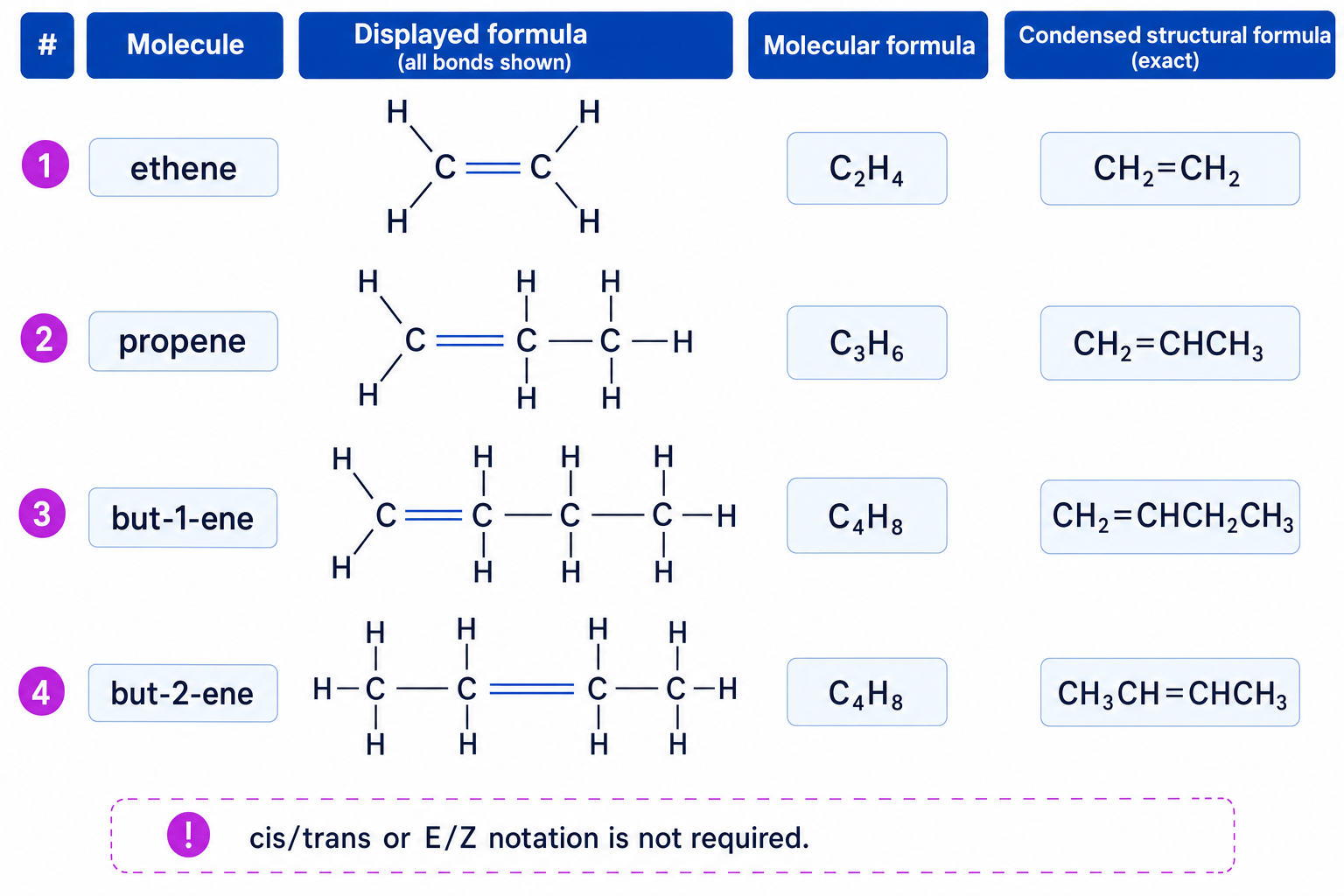
For Edexcel IGCSE, you need to draw and name the unbranched alkenes with up to four carbon atoms:
- ethene: C2H4C_2H_4C2H4, structural formula CH2=CH2CH_2=CH_2CH2=CH2
- propene: C3H6C_3H_6C3H6, structural formula CH2=CHCH3CH_2=CHCH_3CH2=CHCH3
- but-1-ene: C4H8C_4H_8C4H8, structural formula CH2=CHCH2CH3CH_2=CHCH_2CH_3CH2=CHCH2CH3
- but-2-ene: C4H8C_4H_8C4H8, structural formula CH3CH=CHCH3CH_3CH=CHCH_3CH3CH=CHCH3
But-1-ene and but-2-ene are isomers.
Isomer
Isomers are compounds with the same molecular formula but different structural formulae.
This diagram shows the unbranched alkenes you need to recognise and draw.
How alkene names work
The ending -ene tells you the molecule contains a C=C double bond.
For butene, there are four carbon atoms, so the chain name starts with but-. The number tells you where the double bond starts:
- but-1-ene: double bond between carbon 1 and carbon 2
- but-2-ene: double bond between carbon 2 and carbon 3
Knowledge of cis/trans or E/Z notation is not required for this specification point.
Naming an unbranched alkene
Name the alkene with structural formula CH3CH=CHCH3CH_3CH=CHCH_3CH3CH=CHCH3.
- Count the carbon atoms in the longest chain: there are four, so the name begins with but-.
- Find the C=C double bond: it is between the two middle carbon atoms.
- Number from the end that gives the double bond the lowest possible number: the double bond starts on carbon 2.
- Add the alkene ending -ene, giving but-2-ene.
Checking alkene drawings
Each carbon atom must have four bonds in total. A double bond counts as two bonds, so each carbon in C=C has already used two of its four bonds.
Addition reactions of alkenes
Alkenes are more reactive than alkanes because the C=C double bond can react.
The key reaction type is an addition reaction.
Addition reaction
An addition reaction is a reaction where atoms are added across a carbon-carbon double bond, turning it into a carbon-carbon single bond.
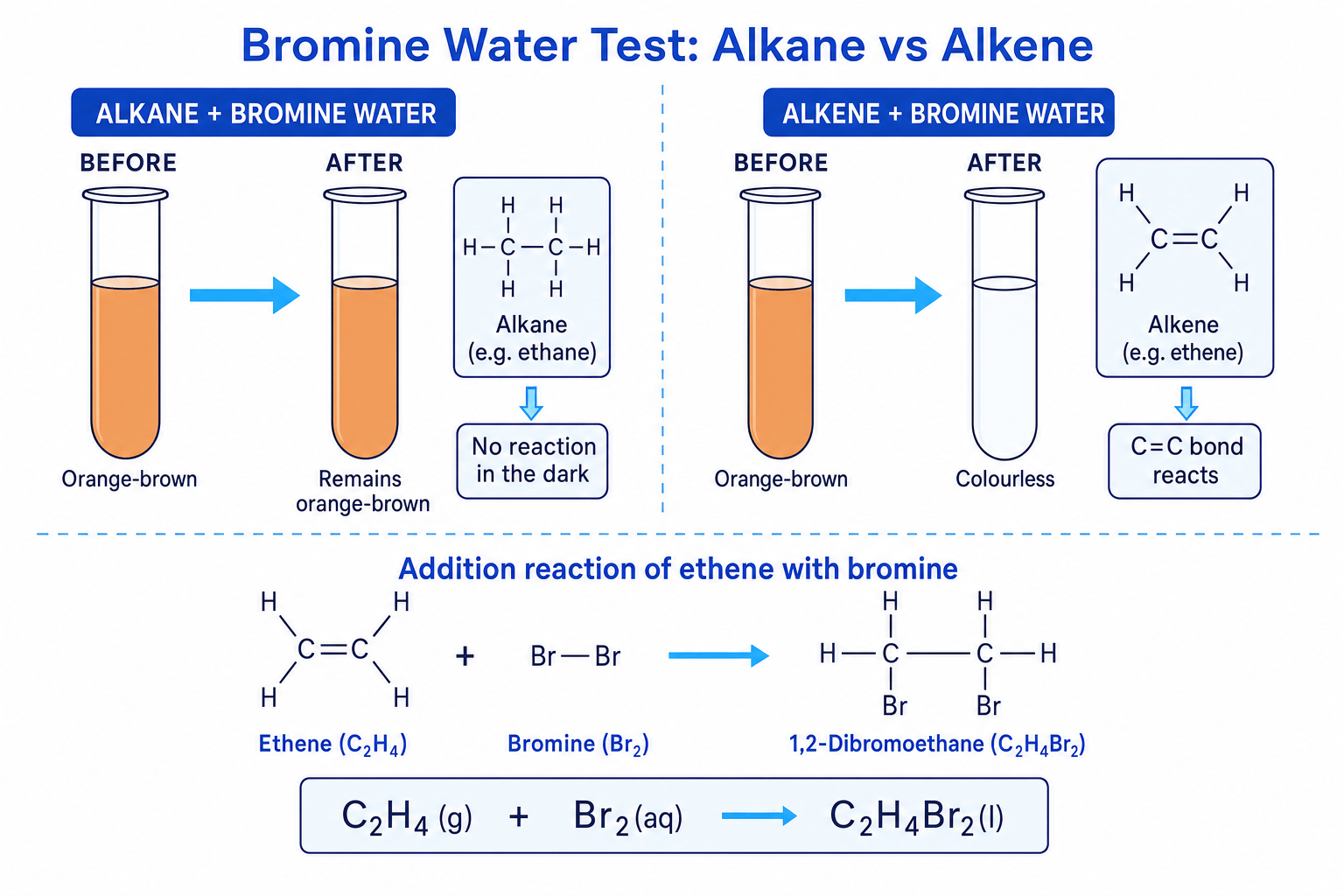
When an alkene reacts with bromine, Br2Br_2Br2, the bromine molecule adds across the C=C double bond. The product is a dibromoalkane.
“Di-” means two, so a dibromoalkane has two bromine atoms added.
For ethene:
C2H4(g)+Br2(aq)→C2H4Br2(l)C_2H_4(g) + Br_2(aq) \rightarrow C_2H_4Br_2(l)C2H4(g)+Br2(aq)→C2H4Br2(l)The product is 1,2-dibromoethane because one bromine atom joins to each carbon atom.
What happens to the double bond
In bromination of an alkene, the C=C double bond becomes a C-C single bond, and one bromine atom is added to each of the two carbon atoms.
Predicting the bromine addition product
Predict the product when propene, CH2=CHCH3CH_2=CHCH_3CH2=CHCH3, reacts with bromine.
- Identify the two carbon atoms in the C=C double bond: they are carbon 1 and carbon 2 in propene.
- Break the double bond to make a single C-C bond.
- Add one bromine atom to each of the two carbons that were in the double bond.
- The product is CH2BrCHBrCH3CH_2BrCHBrCH_3CH2BrCHBrCH3, called 1,2-dibromopropane.
Bromine water test for alkenes
Bromine water is an orange-brown solution of bromine in water. It is used to test whether a hydrocarbon is saturated or unsaturated.
With an alkene, bromine water is decolourised: it changes from orange-brown to colourless. This happens because bromine reacts with the C=C double bond.
With an alkane, there is no reaction in the dark, so the bromine water stays orange-brown.
Interpreting bromine water observations
A hydrocarbon is shaken with bromine water. The orange-brown colour disappears quickly. What type of hydrocarbon is present?
- The colour disappears, so bromine has reacted.
- Bromine reacts quickly with a C=C double bond by addition.
- Therefore the hydrocarbon is an alkene, so it is an unsaturated hydrocarbon.
Saying bromine water turns clear
Write colourless, not “clear”. A solution can be clear and still coloured. The expected observation for an alkene is orange-brown to colourless.
Summary
Alkenes are hydrocarbons containing the functional group >C=C<.Theirgeneralformulais>C=C<. Their general formula is >C=C<.TheirgeneralformulaisC_nH_{2n}$, and they are unsaturated because the C=C double bond can open up in addition reactions. You should be able to draw and name ethene, propene, but-1-ene and but-2-ene. Bromine water tests for alkenes: alkenes decolourise bromine water, while alkanes do not react in the dark.
In the exam
- When naming alkenes, count the longest carbon chain and number it so the C=C double bond has the lowest possible position number.
- In bromine water questions, give both the starting and final colours: orange-brown to colourless for an alkene.
- For bromine addition products, remember that the C=C becomes C-C and one bromine atom joins to each carbon from the original double bond.
Check yourself
- Why is propene described as an unsaturated hydrocarbon?
- What is the structural formula of but-1-ene?
- What observation would you expect when ethene is shaken with bromine water?
