1.1.1 States of matter and the particle model
Properties of solids, liquids and gases
Solid
A state of matter that has a fixed shape and a fixed volume because its particles are held in fixed positions.
Liquid
A state of matter that has a fixed volume but no fixed shape, so it flows and takes the shape of its container.
Gas
A state of matter that has no fixed shape and no fixed volume, so it spreads out to fill the whole of any container.
- Every substance exists in one of three states of matter: solid, liquid or gas.
- You can tell the three states apart by four properties: their shape, their volume, whether they can flow and whether they can be compressed.
- Solids
- A solid has a fixed shape, so it keeps the same shape when it is moved from one container to another.
- A solid has a fixed volume, so the same mass of solid always takes up the same amount of space at a given temperature.
- A solid does not flow, which is why an ice cube keeps its shape on a plate until it melts.
- A solid is very difficult to compress, so squeezing it does not make its volume noticeably smaller.
- Liquids
- A liquid has no fixed shape, so it takes the shape of the part of the container that it fills.
- A liquid has a fixed volume, so 100 cm3100\ \text{cm}^3100 cm3 of water still measures 100 cm3100\ \text{cm}^3100 cm3 after it is poured from a beaker into a measuring cylinder.
- A liquid flows, which is why it can be poured.
- A liquid is very difficult to compress, just like a solid.
- Gases
- A gas has no fixed shape and no fixed volume, because it spreads out to fill the whole of any container it is placed in.
- A gas flows easily, which is why gases can be carried through pipes.
- A gas is easily compressed, which is how a large volume of air can be squeezed into a bicycle tyre or a diving cylinder.
- The same substance can exist in all three states, so water is solid ice below 0 ∘C0\,^{\circ}\text{C}0∘C, liquid water between 0 ∘C0\,^{\circ}\text{C}0∘C and 100 ∘C100\,^{\circ}\text{C}100∘C, and gaseous steam above 100 ∘C100\,^{\circ}\text{C}100∘C at normal atmospheric pressure.
Particles in solids, liquids and gases
Particle model
A model in which all matter is made of tiny particles whose separation, arrangement and motion decide whether a substance is a solid, a liquid or a gas.
- The particle model explains the properties of each state by describing three features of its particles: their separation, their arrangement and their motion.
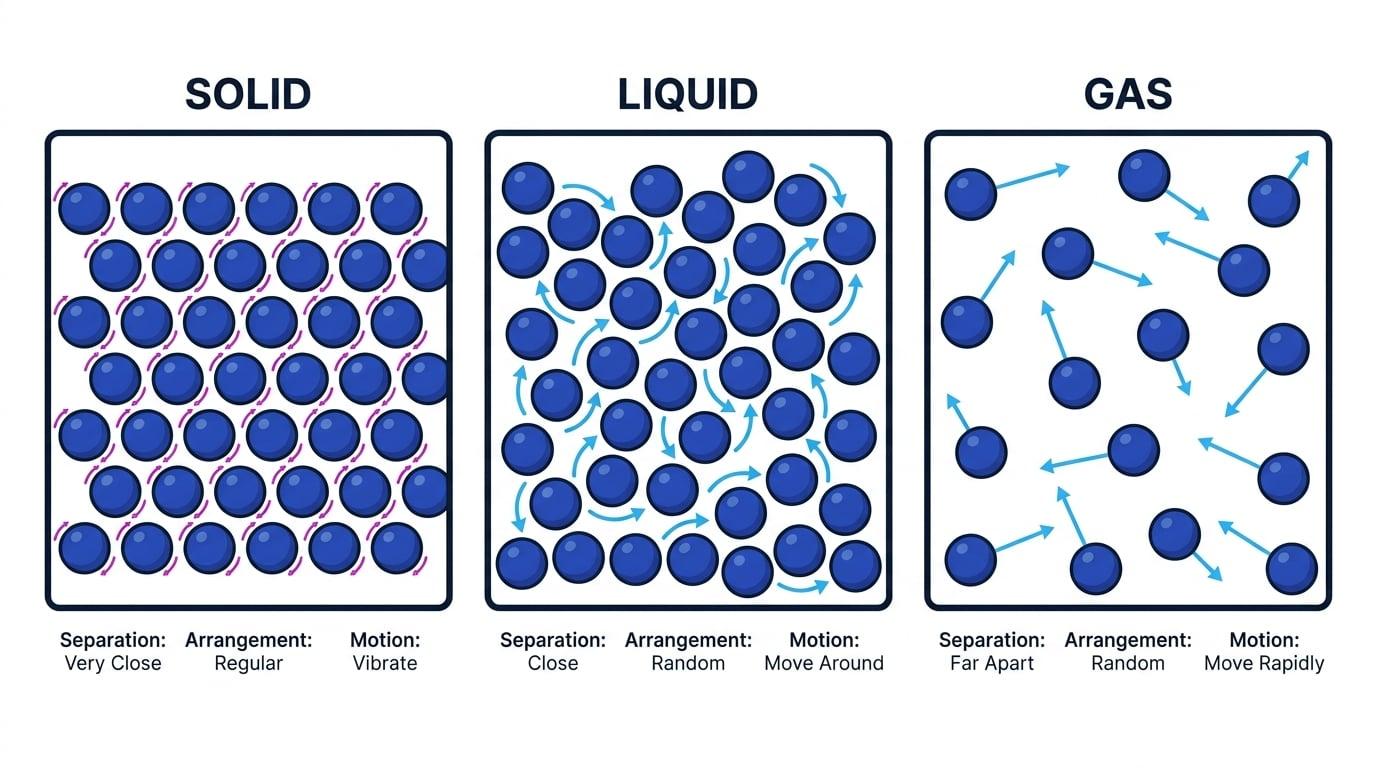
- Particles in a solid
- Separation: the particles are very close together and touch their neighbours.
- Arrangement: the particles are packed in a regular arrangement, in neat repeating rows.
- Motion: the particles vibrate about fixed positions and do not move from place to place.
- The particles cannot leave their fixed positions, so a solid keeps its shape and cannot flow.
- There is almost no space between the particles, so a solid cannot be compressed.
- Particles in a liquid
- Separation: the particles are close together, and most of them still touch their neighbours.
- Arrangement: the particles are in an irregular arrangement, with no fixed pattern.
- Motion: the particles move randomly and slide past one another.
- The particles can slide past each other, so a liquid flows and takes the shape of its container.
- The particles stay close together, so a liquid keeps a fixed volume and is very difficult to compress.
- Particles in a gas
- Separation: the particles are far apart, with large empty spaces between them.
- Arrangement: the particles are randomly arranged, with no pattern at all.
- Motion: the particles move quickly and randomly in all directions, travelling in straight lines until they hit another particle or the walls of the container.
- The particles move freely in every direction, so a gas spreads out to fill its whole container.
- There are large spaces between the particles, so a gas can be squeezed into a smaller volume.
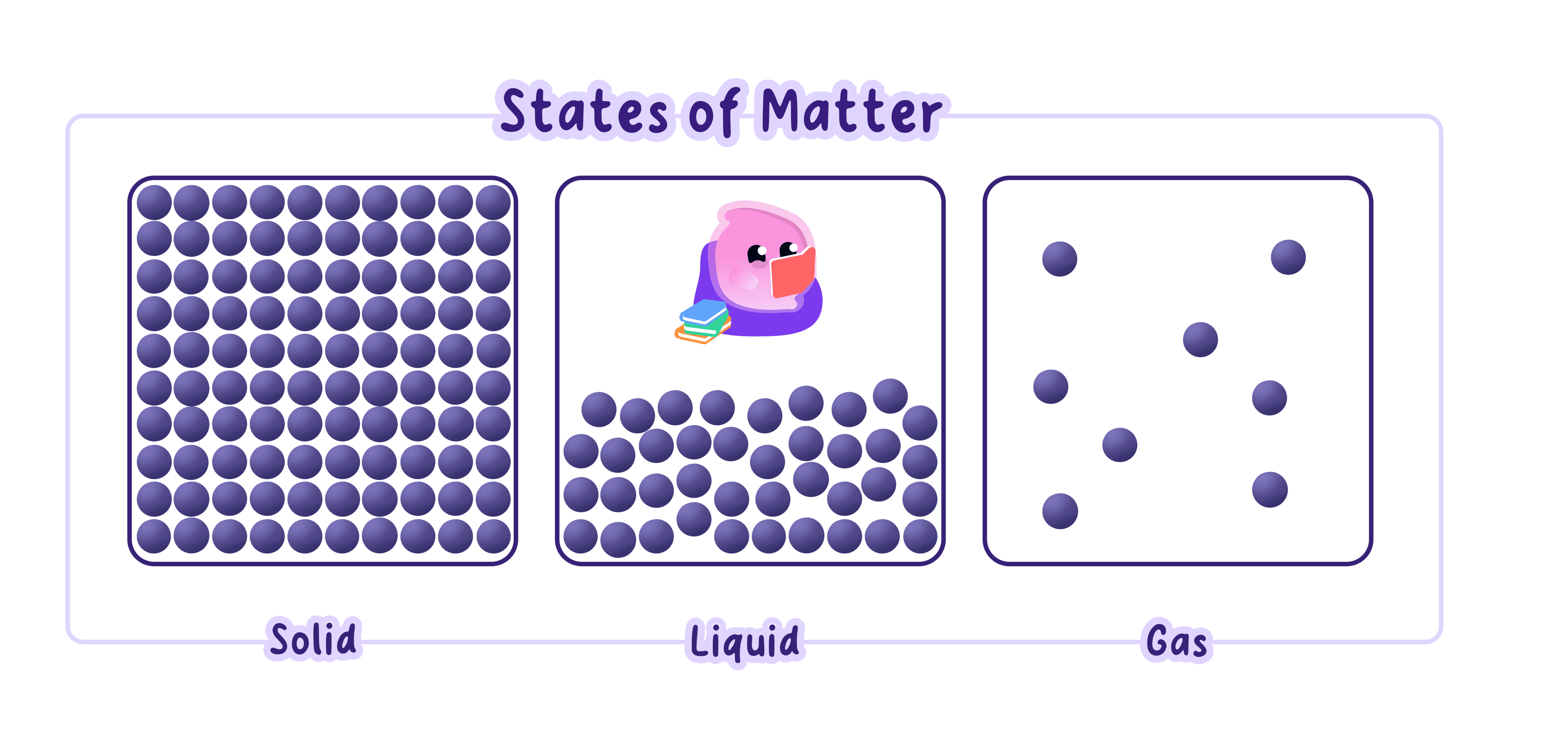
- In a particle diagram, solid particles are drawn touching in neat rows, liquid particles are drawn touching but jumbled, and gas particles are drawn widely spaced with only a few in the box.
Describing particles
- When a question asks you to describe the particles in a state, give all three features: separation, arrangement and motion.
- Write that the particles in a solid vibrate about fixed positions, because the statement that they "do not move" is wrong and gains no credit.
- Use the word random for the arrangement of gas particles and for the motion of both liquid and gas particles.
- Draw the particles the same size in all three states, and change only how close together they are and how they are arranged.
Do not say that the particles themselves get bigger when a solid melts or a liquid boils, because the particles stay the same size and only the spaces between them change.
Melting and freezing
Melting
The change of state from a solid to a liquid that takes place when a solid is heated to its melting point.
Freezing
The change of state from a liquid to a solid that takes place when a liquid is cooled to its freezing point.
Melting point
The temperature at which a solid changes into a liquid.
- A change of state is a change from one state to another in which the substance itself stays the same, so ice, liquid water and steam are all H2O\text{H}_2\text{O}H2O.
- A change of state can be reversed by heating or cooling the substance again.
- Melting takes place when a solid is heated until it reaches its melting point.
- During melting, the particles stop vibrating about fixed positions and begin to slide past one another, so the regular arrangement of the solid is lost.
- Freezing is the reverse of melting, and it takes place when a liquid is cooled until it reaches its freezing point.
- During freezing, the particles stop sliding past one another and settle into fixed positions in a regular arrangement.
- For a single substance, the freezing point is the same temperature as the melting point, so water freezes at 0 ∘C0\,^{\circ}\text{C}0∘C and ice melts at 0 ∘C0\,^{\circ}\text{C}0∘C.
- Different substances have different melting points, so iron melts at about 1538 ∘C1538\,^{\circ}\text{C}1538∘C while candle wax melts at about 60 ∘C60\,^{\circ}\text{C}60∘C.
Boiling, evaporation and condensation
Boiling
The rapid change of state from a liquid to a gas that takes place throughout the liquid at its boiling point.
Evaporation
The change of state from a liquid to a gas that takes place only at the surface of the liquid, at temperatures below its boiling point.
Condensation
The change of state from a gas to a liquid that takes place when a gas is cooled.
Boiling point
The temperature at which a liquid boils and changes into a gas throughout the liquid.
- Boiling and evaporation both change a liquid into a gas, but they happen in different ways.
- Boiling
- Boiling takes place only at the boiling point of the liquid, so pure water at normal atmospheric pressure boils at 100 ∘C100\,^{\circ}\text{C}100∘C.
- Boiling takes place throughout the liquid, so bubbles of gas form inside the liquid, rise to the surface and escape.
- Boiling is fast and continues only while the liquid is being heated.
- Evaporation
- Evaporation takes place at any temperature below the boiling point, which is how a puddle dries on a cool day.
- Evaporation takes place only at the surface of the liquid, so no bubbles form.
- Evaporation is much slower than boiling.
- During both boiling and evaporation, particles leave the close, irregular arrangement of the liquid and become widely spaced, randomly moving gas particles.
- Condensation
- Condensation is the reverse of boiling and evaporation, and it turns a gas back into a liquid when the gas is cooled.
- During condensation, the widely spaced gas particles come close together and take up the irregular arrangement of a liquid.
- Steam from a kettle condenses into tiny droplets of water when it meets a cold window, which is why the glass mists over.
- The five changes of state therefore form two reversible pairs: melting and freezing link solid and liquid, while boiling or evaporation and condensation link liquid and gas.
- Do not use boiling and evaporation as if they mean the same thing.
- Boiling happens throughout the liquid at one fixed temperature, while evaporation happens only at the surface and at any temperature below the boiling point.
Predicting the state of a substance
- Room temperature is taken as 25 ∘C25\,^{\circ}\text{C}25∘C, so compare 25 ∘C25\,^{\circ}\text{C}25∘C with the melting point and the boiling point of the substance.
- A substance is a solid at room temperature when its melting point is above 25 ∘C25\,^{\circ}\text{C}25∘C.
- A substance is a liquid at room temperature when its melting point is below 25 ∘C25\,^{\circ}\text{C}25∘C and its boiling point is above 25 ∘C25\,^{\circ}\text{C}25∘C.
- A substance is a gas at room temperature when its boiling point is below 25 ∘C25\,^{\circ}\text{C}25∘C.
- Bromine melts at −7 ∘C-7\,^{\circ}\text{C}−7∘C and boils at 59 ∘C59\,^{\circ}\text{C}59∘C, so at 25 ∘C25\,^{\circ}\text{C}25∘C it has melted but not yet boiled, and it is a liquid.
- Chlorine boils at −34 ∘C-34\,^{\circ}\text{C}−34∘C, so at 25 ∘C25\,^{\circ}\text{C}25∘C it is far above its boiling point, and it is a gas.
- Sodium chloride melts at 801 ∘C801\,^{\circ}\text{C}801∘C, so at 25 ∘C25\,^{\circ}\text{C}25∘C it is far below its melting point, and it is a solid.
Gas volume, temperature and pressure
Gas pressure
The force that a gas exerts on each unit area of the walls of its container.
- The volume of a gas changes far more than the volume of a solid or a liquid when its temperature or its pressure changes.
- To see each effect clearly, you must keep the mass of gas fixed and change only one condition at a time.
- Effect of temperature at constant pressure
- When a fixed mass of gas is heated, its volume increases and the gas expands.
- When a fixed mass of gas is cooled, its volume decreases and the gas contracts.
- A balloon carried from a warm room into a freezer shrinks, then swells back to its original size when it warms up again.
- Effect of pressure at constant temperature
- When the pressure on a fixed mass of gas is increased, its volume decreases.
- When the pressure on a fixed mass of gas is decreased, its volume increases.
- Pushing in the plunger of a sealed syringe full of air increases the pressure on the air and squeezes it into a smaller volume.
- Releasing the plunger lets the pressure fall back, so the air expands and pushes the plunger out again.
Effect of temperature on the volume of a gas
- Aim: to measure how the volume of a fixed mass of air changes as its temperature rises at constant pressure.
- Apparatus: a dry 100 cm3100\ \text{cm}^3100 cm3 conical flask fitted with a rubber bung and a short delivery tube, a 100 cm3100\ \text{cm}^3100 cm3 gas syringe with a freely moving plunger, a large beaker to act as a water bath, crushed ice, a thermometer reading from −10 ∘C-10\,^{\circ}\text{C}−10∘C to 110 ∘C110\,^{\circ}\text{C}110∘C, a stirring rod, a Bunsen burner, tripod, gauze, heatproof mat, two clamp stands and eye protection.
- Method:
- Push the plunger of the gas syringe fully in, then connect the syringe to the delivery tube so that the air in the flask is sealed inside the apparatus.
- Clamp the flask so that it sits as deep as possible in the beaker, then fill the beaker with a mixture of water and crushed ice until the flask is almost completely covered.
- Clamp the gas syringe horizontally so that the plunger can slide out freely without being pulled by gravity or held back by friction.
- Stir the water, wait until the syringe reading stops changing, then record the temperature of the water and the volume reading on the syringe.
- Heat the water gently with the Bunsen burner, and remove the flame each time the temperature has risen by about 10 ∘C10\,^{\circ}\text{C}10∘C.
- Stir the water and wait about two minutes, so that the air inside the flask reaches the same temperature as the water around it.
- Record the temperature and the syringe reading each time, and continue until the water reaches about 80 ∘C80\,^{\circ}\text{C}80∘C.
- At the end, fill the flask completely with water and pour the water into a measuring cylinder to find the volume of the flask.
- Add the volume of the flask to each syringe reading to give the total volume of air at each temperature.
- Plot a graph of volume of air / cm3\text{cm}^3cm3 on the vertical axis against temperature / ∘C^{\circ}\text{C}∘C on the horizontal axis and draw a line of best fit.
- Variables: the independent variable is the temperature of the air, the dependent variable is the volume of the air, and the controlled variables are the mass of air, which stays fixed because the apparatus is sealed, and the pressure, which stays equal to atmospheric pressure because the plunger moves freely.
- Results: the plunger moves steadily outwards as the water is heated, and the points on the graph lie close to a straight line that slopes upwards.
- Conclusion: at constant pressure, the volume of a fixed mass of gas increases as its temperature increases.
- Sources of error: a sticking plunger raises the pressure inside and makes the volume readings too small, a leak at the bung lets air escape, and taking a reading before the air has reached the temperature of the water makes the volume too small.
- Safety: wear eye protection, take care with hot water and the hot tripod, clamp the glassware firmly, and never heat the flask with the syringe plunger fixed in place, because the trapped air would build up pressure.
- State three properties that distinguish a gas from a solid.
- Describe the separation, arrangement and motion of the particles in a liquid.
- State two differences between boiling and evaporation.
- Name the change of state that turns a gas into a liquid.
- State what happens to the volume of a fixed mass of gas when its pressure is increased at constant temperature.
1.1.2 Kinetic particle theory of gases
Kinetic particle theory
Kinetic particle theory
The theory that all matter is made of tiny particles in constant motion, whose energy and forces of attraction explain the properties of solids, liquids and gases.
Kinetic energy
The energy that a particle has because it is moving.
Forces of attraction
The forces that pull neighbouring particles towards one another and hold them together in a solid or a liquid.
- Kinetic particle theory explains the behaviour of solids, liquids and gases using two ideas: the particles are always moving, and there are forces of attraction between neighbouring particles.
- A moving particle has kinetic energy, and the faster it moves the more kinetic energy it has.
- The temperature of a substance is a measure of the average kinetic energy of its particles, so a higher temperature means that the particles are moving faster on average.
- The forces of attraction are strongest in a solid, weaker in a liquid and very weak in a gas, because the particles are furthest apart in a gas.
- When a substance is heated, energy is transferred to its particles and is used in one of two ways.
- The energy can increase the kinetic energy of the particles, so they move faster and the temperature rises.
- The energy can overcome the forces of attraction between the particles, so they move further apart and the substance changes state while the temperature stays constant.
- When a substance is cooled, energy is transferred from its particles to the surroundings, so the particles slow down or are pulled closer together by the forces of attraction.
- The stronger the forces of attraction between the particles of a substance, the more energy is needed to separate them, so the higher its melting point and boiling point.
Explaining changes of state
- Melting
- As a solid is heated, its particles gain kinetic energy and vibrate more strongly about their fixed positions, so the temperature rises.
- At the melting point, the particles have enough energy to overcome some of the forces of attraction that hold them in fixed positions.
- The particles can then slide past one another, so the regular arrangement breaks down and a liquid forms.
- Energy must keep being taken in from the surroundings until all the solid has melted.
- Boiling
- As a liquid is heated, its particles gain kinetic energy and move faster, so the temperature rises.
- At the boiling point, particles throughout the liquid have enough energy to overcome the remaining forces of attraction between them.
- The particles separate and move far apart as a gas, forming bubbles of gas inside the liquid.
- Boiling needs far more energy than melting, because the particles must be separated completely rather than only freed from fixed positions.
- Evaporation
- The particles in a liquid do not all move at the same speed, so at any moment some of them have much more kinetic energy than the average.
- A particle at the surface that has enough kinetic energy can overcome the attractions of its neighbours and escape as a gas, even below the boiling point.
- The particles that escape are the most energetic ones, so the average kinetic energy of the particles left behind falls and the liquid cools down.
- This is why sweat evaporating from your skin cools you down on a hot day.
- Freezing
- As a liquid cools, its particles lose kinetic energy and move more slowly, so the temperature falls.
- At the freezing point, the forces of attraction pull the slow-moving particles into fixed positions in a regular arrangement.
- Energy is released to the surroundings as the particles settle into place, and this keeps the temperature constant until all the liquid has frozen.
- Condensation
- As a gas cools, its particles lose kinetic energy and move more slowly.
- When the particles are moving slowly enough, the forces of attraction pull them close together and the gas becomes a liquid.
- Energy is released to the surroundings while the gas condenses.
- Do not say that the particles themselves melt, expand or get bigger, because only their energy, movement and separation change.
- Do not say that a change of state breaks the particles apart, because the particles stay whole and only the forces of attraction between them are overcome.
Heating and cooling curves
Heating curve
A graph of temperature against time for a substance that is heated at a steady rate.
Cooling curve
A graph of temperature against time for a substance that is losing thermal energy to its surroundings.
Freezing point
The temperature at which a liquid changes into a solid, which is the same temperature as the melting point for a pure substance.
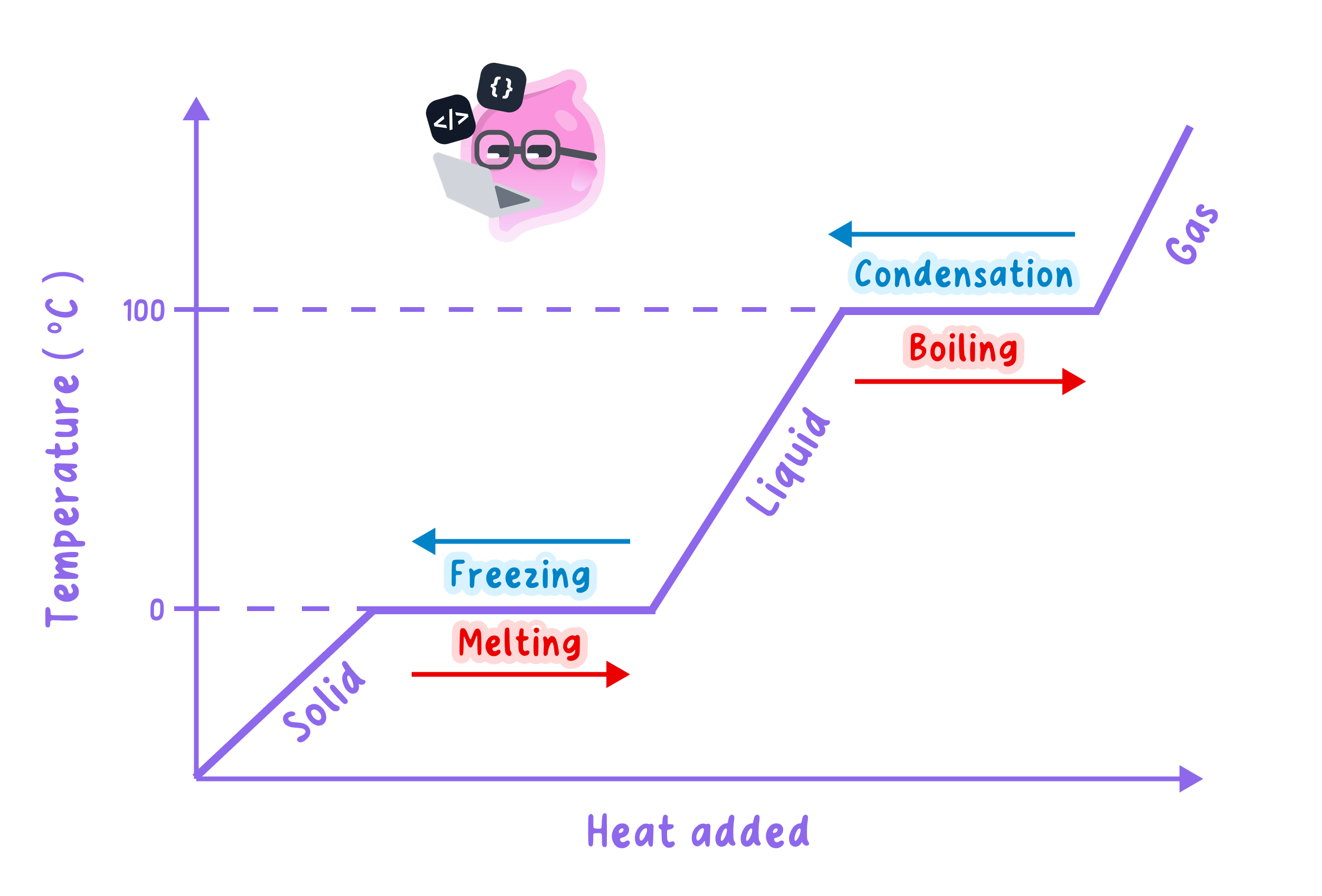
- A heating curve is drawn by heating a substance at a steady rate and plotting its temperature on the vertical axis against time on the horizontal axis.
- A cooling curve is drawn in the same way while the substance cools.
- Each curve is made of two kinds of section.
- A sloping section shows that only one state is present and that the temperature of that state is changing.
- A horizontal section, called a plateau, shows that two states are present together and that the substance is changing state at a constant temperature.
- Reading a heating curve that starts with a solid
- In the first sloping section, only solid is present, and its particles vibrate more strongly as the temperature rises.
- At the first plateau, the solid is melting, so solid and liquid are both present and the temperature stays at the melting point.
- The temperature stays constant because the energy supplied overcomes forces of attraction instead of increasing the kinetic energy of the particles.
- In the second sloping section, only liquid is present, and its particles move faster as the temperature rises.
- At the second plateau, the liquid is boiling, so liquid and gas are both present and the temperature stays at the boiling point.
- The boiling plateau is longer than the melting plateau, because more energy is needed to separate the particles completely than to free them from fixed positions.
- In the final sloping section, only gas is present, and its particles move faster as the temperature rises.
- Reading a cooling curve that starts with a gas
- In the first sloping section, only gas is present, and its particles slow down as the temperature falls.
- At the first plateau, the gas is condensing, so gas and liquid are both present.
- In the second sloping section, only liquid is present, and it cools.
- At the second plateau, the liquid is freezing, so liquid and solid are both present and the temperature stays at the freezing point.
- The temperature stays constant during each plateau because energy is released as the forces of attraction pull the particles together, and this replaces the energy lost to the surroundings.
- In the final sloping section, only solid is present, and it cools.
- The melting plateau on a heating curve and the freezing plateau on a cooling curve occur at the same temperature for the same substance.
- The boiling plateau on a heating curve and the condensing plateau on a cooling curve also occur at the same temperature.
Interpreting a cooling curve
- Liquid X is cooled from 120 ∘C120\,^{\circ}\text{C}120∘C and its temperature is recorded every minute.
- The temperature falls from 120 ∘C120\,^{\circ}\text{C}120∘C to 80 ∘C80\,^{\circ}\text{C}80∘C during the first 4 min4\ \text{min}4 min, so only liquid X is present and its particles are slowing down.
- The temperature stays at 80 ∘C80\,^{\circ}\text{C}80∘C from 4 min4\ \text{min}4 min to 11 min11\ \text{min}11 min, so this plateau shows X freezing, with liquid and solid present together.
- The freezing point of X is therefore 80 ∘C80\,^{\circ}\text{C}80∘C, which is also its melting point.
- After 11 min11\ \text{min}11 min the temperature falls again, so all of X has become solid and the solid is cooling.
- Room temperature, 25 ∘C25\,^{\circ}\text{C}25∘C, is below the melting point of X, so X is a solid at room temperature.
Obtaining a cooling curve
- Aim: to record the temperature of a molten substance as it cools and freezes, and to use the cooling curve to find its freezing point.
- Apparatus: a boiling tube about one third full of stearic acid, a 250 cm3250\ \text{cm}^3250 cm3 beaker of hot water at about 90 ∘C90\,^{\circ}\text{C}90∘C, a thermometer reading from −10 ∘C-10\,^{\circ}\text{C}−10∘C to 110 ∘C110\,^{\circ}\text{C}110∘C in 1 ∘C1\,^{\circ}\text{C}1∘C divisions, a clamp stand, a stopwatch and eye protection.
- Method:
- Stand the boiling tube in the beaker of hot water until all of the stearic acid has melted into a clear liquid.
- Put the thermometer into the molten stearic acid and leave it until the temperature reaches about 85 ∘C85\,^{\circ}\text{C}85∘C.
- Lift the boiling tube out of the water, dry the outside and clamp it upright in the air, away from draughts.
- Start the stopwatch and record the temperature every 30 s30\ \text{s}30 s, reading the thermometer at eye level to the nearest 0.5 ∘C0.5\,^{\circ}\text{C}0.5∘C.
- Stir gently with the thermometer while the stearic acid is still liquid, and stop stirring as soon as solid begins to form.
- Note the time when solid first appears and the time when the stearic acid has become completely solid.
- Continue recording until the temperature has fallen to about 50 ∘C50\,^{\circ}\text{C}50∘C.
- Plot a graph of temperature / ∘C^{\circ}\text{C}∘C against time / min and join the points with a smooth curve.
- Results: the temperature falls steadily at first, stays almost constant at about 69 ∘C69\,^{\circ}\text{C}69∘C for several minutes while the stearic acid freezes, and then falls again once all of it is solid.
- Conclusion: the temperature of the plateau is the freezing point of stearic acid, which is also its melting point.
- Sources of error: draughts change the rate of cooling, and a thermometer bulb that is not fully covered by the stearic acid gives readings that are too low.
- Safety: wear eye protection, take care with the hot water and the hot molten stearic acid, and do not try to pull the thermometer out of the solid stearic acid, because it can snap.
Temperature and the volume of a gas
Gas pressure
The force that a gas exerts on each unit area of the walls of its container.
- In a gas the particles are far apart and the forces of attraction between them are very weak, so the particles move freely in straight lines at high speed.
- The particles continually collide with the walls of the container, and each collision pushes on the walls.
- These collisions with the walls are what produce gas pressure.
- The pressure is greater when the particles hit the walls more often or with more force.
- Heating a gas at constant pressure
- Heating gives the gas particles more kinetic energy, so they move faster.
- The faster particles hit the walls more often and with more force.
- In a container that can change size, such as a balloon or a gas syringe, these collisions push the walls outwards and the gas expands.
- As the gas expands, the particles spread further apart and hit each part of the walls less often.
- The gas stops expanding when its pressure has fallen back to the pressure of the surroundings, so at a higher temperature the gas takes up a larger volume.
- Cooling a gas at constant pressure
- Cooling lowers the kinetic energy of the particles, so they move more slowly and hit the walls less often and with less force.
- The pressure of the surroundings is now greater than the gas pressure, so the walls are pushed inwards and the gas contracts to a smaller volume.
- If the container cannot change size, heating the gas raises its pressure instead of its volume, which is why an aerosol can must never be heated.
Pressure and the volume of a gas
- Increasing the pressure at constant temperature
- Pushing in the plunger of a sealed syringe squeezes the same number of particles into a smaller volume.
- The temperature does not change, so the particles keep the same average kinetic energy and the same average speed.
- The particles are now closer together, so they hit each part of the walls more often and the gas pressure rises.
- The plunger stops moving when the gas pressure has risen to match the pressure pushing on the plunger, so a higher pressure gives a smaller volume.
- Decreasing the pressure at constant temperature
- When the pressure on the gas is reduced, the collisions of the particles push the walls outwards and the gas expands.
- The particles spread further apart and hit each part of the walls less often, until the gas pressure falls to match the lower pressure outside.
- A lower pressure therefore gives a larger volume.
Do not explain gas pressure using collisions between the particles themselves, because the pressure comes from the particles colliding with the walls of the container.
Explaining gas and state changes
- Mention the particles in every explanation, because an answer about "the gas" alone does not use kinetic particle theory.
- For a temperature change, link the temperature to the kinetic energy and speed of the particles, then to how often and how hard they hit the walls.
- For a pressure change at constant temperature, state that the speed of the particles does not change and that they hit the walls more or less often because they are closer together or further apart.
- At each plateau on a heating or cooling curve, name both states that are present and state that the energy is used to overcome forces of attraction or is released as they pull particles together.
- State what happens to the average kinetic energy of the particles when the temperature of a substance rises.
- Explain why the temperature of a substance stays constant while it is melting.
- Name the two states present during the boiling plateau of a heating curve.
- Explain why evaporation cools the liquid that is left behind.
- Explain, in terms of particles, why heating a gas at constant pressure increases its volume.