Polymers and monomers
Polymer
A large molecule built up from many smaller molecules called monomers.
Monomer
A small molecule that joins with many other small molecules to build up a polymer.
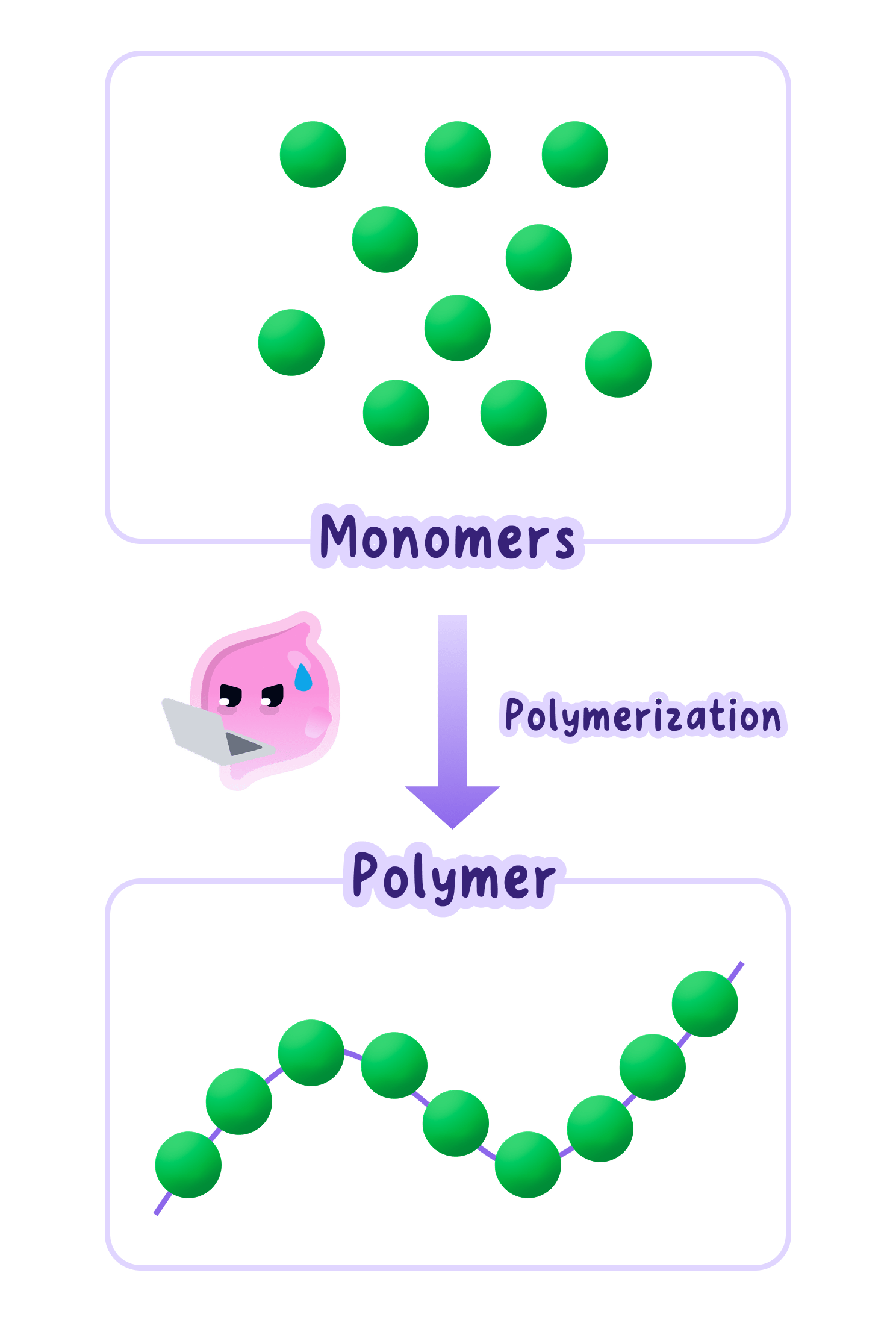
- A polymer is a very large molecule, built up from many smaller molecules called monomers.
- The monomers join end to end by forming covalent bonds with each other, giving a long chain.
- A single polymer chain can contain thousands of monomer units, so its relative molecular mass is very large.
- The process of joining monomers to make a polymer is called polymerisation.
- The name of a polymer usually comes from the name of its monomer.
- The prefix poly means "many", so poly(ethene) means "many ethene units joined together".
- The monomer name goes in brackets after "poly", so propene gives poly(propene) and chloroethene gives poly(chloroethene).
- A useful picture is a paper chain: each paper loop is a monomer, and the whole chain of linked loops is the polymer.
Making poly(ethene)
Addition polymerisation
A reaction in which many unsaturated monomers join together, by opening their carbon-carbon double bonds, to form a polymer as the only product.
- Ethene, C2H4\text{C}_2\text{H}_4C2H4, is the monomer used to make the polymer poly(ethene), which is often called polythene.
- Ethene is an unsaturated molecule because it contains a carbon-carbon double bond, C=C\text{C=C}C=C.
- When ethene polymerises, one of the two bonds in each C=C\text{C=C}C=C double bond breaks.
- Each carbon atom then forms a new single bond to a carbon atom in the next ethene molecule.
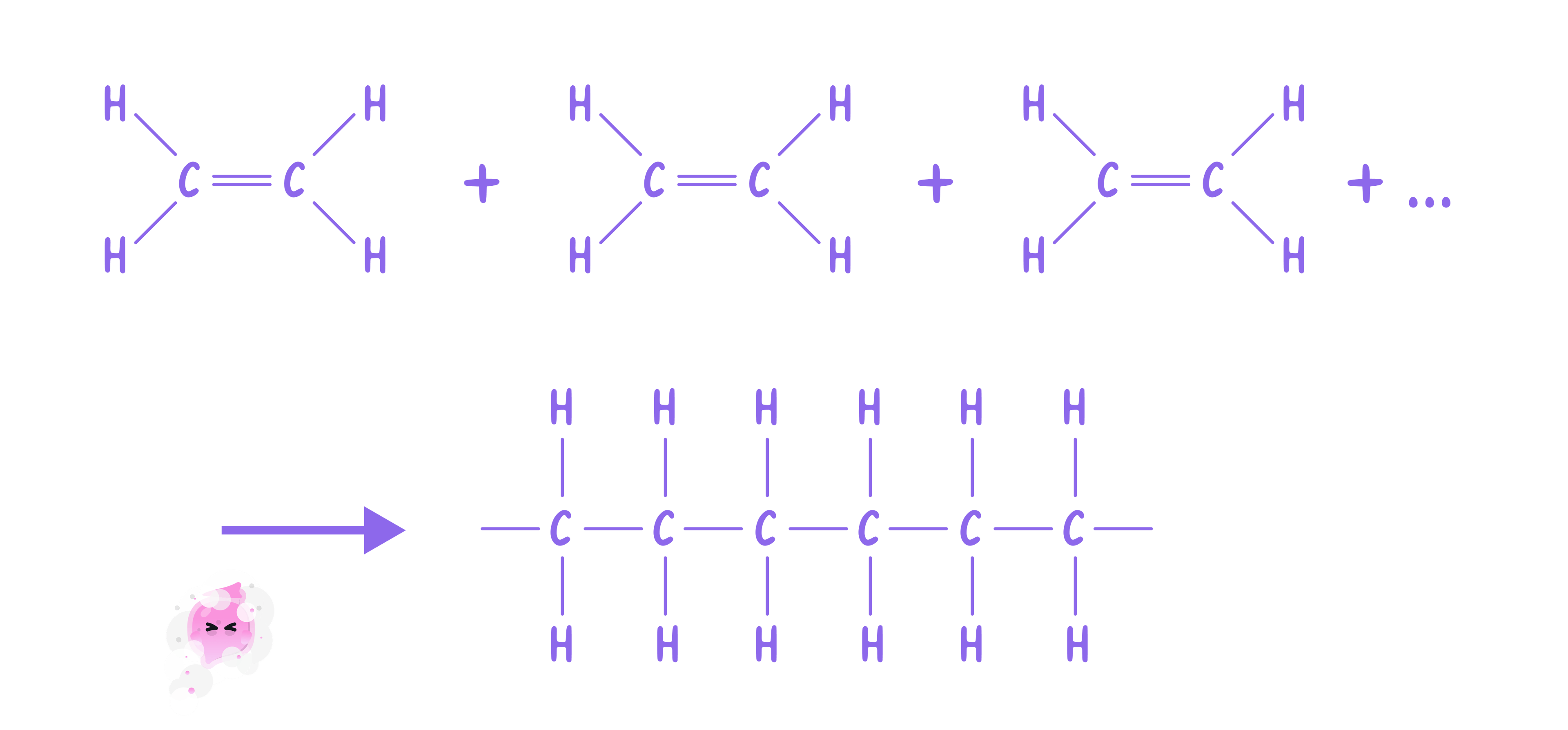
- Repeating this many times links the ethene molecules into one long chain of carbon atoms joined by C-C\text{C-C}C-C single bonds, with two hydrogen atoms on every carbon.
- This type of reaction is called addition polymerisation, because the monomers add on to each other.
- Poly(ethene) is the only product, so every atom from the ethene molecules ends up in the polymer.
- The polymer has no C=C\text{C=C}C=C double bonds left, so poly(ethene) is saturated even though ethene is unsaturated.
- A short section of a poly(ethene) chain, made from three ethene molecules, looks like this.
The poly(ethene) equation
-
Because a polymer chain contains a huge but variable number of monomers, the equation uses the letter nnn to stand for a large number.
-
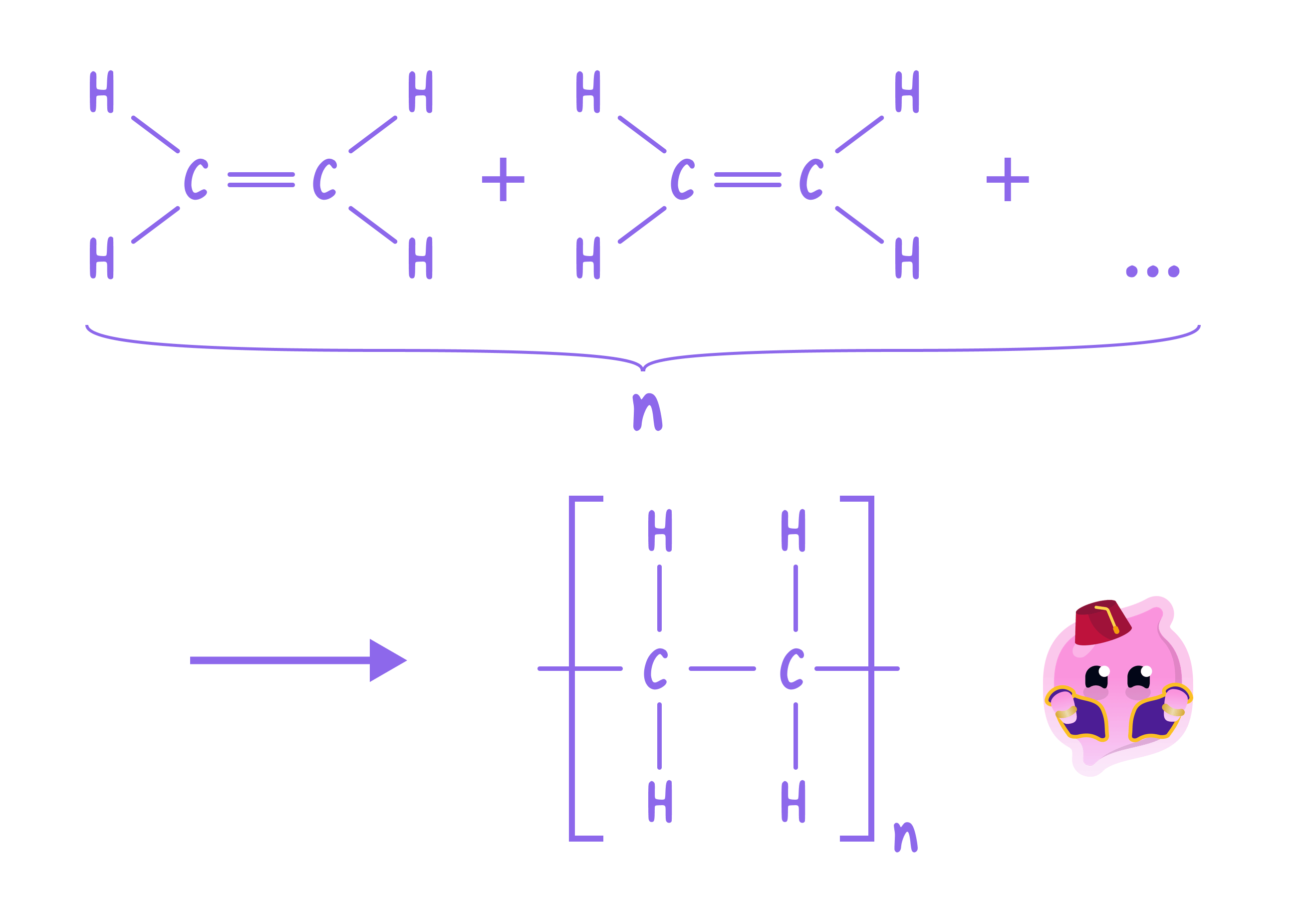
The equation for making poly(ethene) is shown below with displayed formulae.
n HH∣∣C=C∣∣HH→[HH∣∣−C−C−∣∣HH]n n\ \begin{array}{ccc} \text{H} & & \text{H} \\ | & & | \\ \text{C} & = & \text{C} \\ | & & | \\ \text{H} & & \text{H} \end{array} \rightarrow \left[ \begin{array}{ccccc} & \text{H} & & \text{H} & \\ & | & & | & \\ - & \text{C} & - & \text{C} & - \\ & | & & | & \\ & \text{H} & & \text{H} & \end{array} \right]_n n H∣C∣H=H∣C∣H→−H∣C∣H−H∣C∣H−n -
The same equation can be written more compactly with structural formulae.
n CH2=CH2→[−CH2−CH2−]n n\,\text{CH}_2\text{=CH}_2 \rightarrow \left[-\text{CH}_2-\text{CH}_2-\right]_n nCH2=CH2→[−CH2−CH2−]n -
Each part of the equation tells you something about the reaction.
- The nnn in front of ethene shows that a large number of ethene molecules react.
- The square brackets enclose the section made from one ethene molecule, and this section is repeated along the whole chain.
- The bonds on each side cross through the brackets to show that the chain carries on in both directions.
- The subscript nnn outside the brackets shows that the bracketed section appears nnn times in one polymer molecule.
Building the poly(ethene) equation
- Start with ethene drawn as a displayed formula, with the C=C\text{C=C}C=C double bond horizontal and the four hydrogen atoms above and below.
- Write nnn in front of the ethene to show that many molecules take part.
- On the right, keep the same two carbon atoms and four hydrogen atoms, but change the double bond into a single bond.
- Add a single bond sticking out from each carbon atom, because these are the bonds that join on to the next units.
- Draw square brackets so that the outer bonds pass through them, then write nnn at the bottom right.
- Both sides contain 2n2n2n carbon atoms and 4n4n4n hydrogen atoms, which confirms that no other product is formed.
Plastics
Plastic
A material made from polymers that can be moulded into many different shapes.
- Plastics are materials made from polymers.
- The long polymer chains make plastics strong and flexible, and most plastics can be moulded into shape when warm.
- Poly(ethene) is one of the most widely used plastics.
- It is used to make plastic bags, cling film, food packaging and plastic bottles.
- It is cheap to make, light, waterproof and does not react with most foods or drinks.
- Most plastics are made from chemicals obtained from crude oil (petroleum).
- Large alkane molecules from petroleum are cracked to produce alkenes such as ethene, and the alkenes are then polymerised.
- The chain of substances for a poly(ethene) bag runs: ethene (the monomer) forms poly(ethene) (the polymer), and the polymer is shaped into the plastic product.
- Do not call ethene a polymer, because ethene is the monomer and poly(ethene) is the polymer.
- Do not draw a C=C\text{C=C}C=C double bond inside the brackets of poly(ethene), because the double bond opens during polymerisation.
- Do not leave off the bonds that cross the brackets, because without them the drawing shows a separate molecule, not part of a chain.
- Check your spelling of ethene and ethane, because only ethene, the alkene, can form an addition polymer.
- Do not say that plastics are made directly from monomers, because plastics are made from polymers.
Writing about polymers
- Define a polymer as a large molecule built from many smaller molecules called monomers, because answers that leave out "many" or "monomers" lose the mark.
- When asked how poly(ethene) forms, name the monomer ethene and the process addition polymerisation, and say that the C=C\text{C=C}C=C double bond breaks or opens.
- In the equation, put nnn in front of the monomer and as a subscript after the brackets, and make the bonds extend through the brackets.
- If a question asks what plastics are made from, the answer is polymers, not crude oil or monomers.
- What is a polymer?
- Which monomer is used to make poly(ethene)?
- What happens to the carbon-carbon double bond when ethene molecules polymerise?
- Why is poly(ethene) the only product of the reaction?
- What are plastics made from?
