Oxidising ethanol
Oxidation (in terms of oxygen)
The gain of oxygen by a substance.
Oxidising agent
A substance that oxidises another substance and is itself reduced.
-
Ethanoic acid can be made by oxidising ethanol, which means the ethanol gains oxygen.
-
In the laboratory, ethanol is heated with acidified aqueous potassium manganate(VII).
- The potassium manganate(VII) solution is acidified by adding dilute sulfuric acid.
- Potassium manganate(VII) is the oxidising agent, because it supplies the oxygen that oxidises the ethanol.
-
As the reaction happens, the solution changes colour from purple to colourless, because the manganate(VII) ions are reduced.
-
The −CH2OH-\text{CH}_2\text{OH}−CH2OH group of ethanol becomes the −COOH-\text{COOH}−COOH group of ethanoic acid, while the CH3\text{CH}_3CH3 group is unchanged.
-
The oxygen supplied by the oxidising agent is shown as [O][\text{O}][O] in the equation.
CH3CH2OH+2[O]→CH3COOH+H2O \text{CH}_3\text{CH}_2\text{OH} + 2[\text{O}] \rightarrow \text{CH}_3\text{COOH} + \text{H}_2\text{O} CH3CH2OH+2[O]→CH3COOH+H2O -
In this change ethanol gains one oxygen atom and loses two hydrogen atoms, which leave as part of a water molecule.
-
The product smells of vinegar, which is a simple sign that ethanoic acid has formed.
Oxidising ethanol with potassium manganate(VII)
- Aim: to oxidise ethanol to ethanoic acid using acidified potassium manganate(VII) and to observe the colour change.
- Apparatus: boiling tube, test-tube rack, dropping pipettes, 10 cm310\ \text{cm}^310 cm3 measuring cylinder, ethanol, dilute potassium manganate(VII) solution, dilute sulfuric acid, 250 cm3250\ \text{cm}^3250 cm3 beaker of hot water at about 60 ∘C60\ ^\circ\text{C}60 ∘C from a kettle, thermometer, and eye protection.
- Method:
- Pour 2 cm32\ \text{cm}^32 cm3 of dilute sulfuric acid into the boiling tube.
- Add 5 drops of potassium manganate(VII) solution and swirl, so the mixture is clear purple.
- Add 1 cm31\ \text{cm}^31 cm3 of ethanol and swirl again.
- Stand the boiling tube in the beaker of hot water for about 5 minutes, watching the colour.
- Remove the tube and carefully waft the vapour towards your nose to check the smell.
- Results:
- The purple colour fades and the solution becomes colourless.
- The mixture smells sharp, like vinegar.
- Conclusion: acidified potassium manganate(VII) oxidises ethanol to ethanoic acid and is itself reduced, which removes the purple colour.
- Safety: wear eye protection, keep ethanol away from all naked flames because it is highly flammable, avoid skin contact with potassium manganate(VII) because it is an oxidiser that stains, and treat the sulfuric acid as an irritant.
Making vinegar
-
Ethanoic acid also forms when ethanol is oxidised by bacteria, which is how vinegar is made.
-
Wine, cider or another solution containing ethanol is left open to the air in warm conditions.
-
Bacteria in the liquid use oxygen from the air to oxidise the ethanol to ethanoic acid.
ethanol+oxygen→ethanoic acid+water \text{ethanol} + \text{oxygen} \rightarrow \text{ethanoic acid} + \text{water} ethanol+oxygen→ethanoic acid+water -
The balanced symbol equation is shown below.
C2H5OH(aq)+O2(g)→CH3COOH(aq)+H2O(l) \text{C}_2\text{H}_5\text{OH(aq)} + \text{O}_2\text{(g)} \rightarrow \text{CH}_3\text{COOH(aq)} + \text{H}_2\text{O(l)} C2H5OH(aq)+O2(g)→CH3COOH(aq)+H2O(l) -
This process is aerobic, because it needs oxygen, unlike fermentation, which must be kept away from oxygen.
-
The product, vinegar, is a dilute aqueous solution of ethanoic acid, which is why vinegar tastes sour.
-
The same reaction explains why an opened bottle of wine left exposed to air slowly turns sour.
Balancing the bacterial oxidation
- Ethanol, C2H5OH\text{C}_2\text{H}_5\text{OH}C2H5OH, reacts with oxygen to form ethanoic acid, CH3COOH\text{CH}_3\text{COOH}CH3COOH, and water.
- Carbon is balanced, with 2 atoms on each side.
- Hydrogen is balanced, with 6 atoms on the left and 4+2=64 + 2 = 64+2=6 on the right.
- Oxygen is balanced, with 1+2=31 + 2 = 31+2=3 atoms on the left and 2+1=32 + 1 = 32+1=3 on the right, so no extra numbers are needed.
Making esters
Esterification
The reaction of a carboxylic acid with an alcohol, in the presence of an acid catalyst, to form an ester and water.
-
A carboxylic acid reacts with an alcohol to form an ester and water.
carboxylic acid+alcohol⇌ester+water \text{carboxylic acid} + \text{alcohol} \rightleftharpoons \text{ester} + \text{water} carboxylic acid+alcohol⇌ester+water -
The conditions for the reaction are listed below.
- A few drops of concentrated sulfuric acid are added as an acid catalyst.
- The mixture is warmed, usually in a hot water bath.
-
The reaction is reversible, so the mixture never turns completely into ester and water.
-
The −OH-\text{OH}−OH from the acid and the H\text{H}H from the −OH-\text{OH}−OH group of the alcohol are removed to form the water molecule.
-
The two remaining parts join through the ester group, −COO−-\text{COO}-−COO−.
-
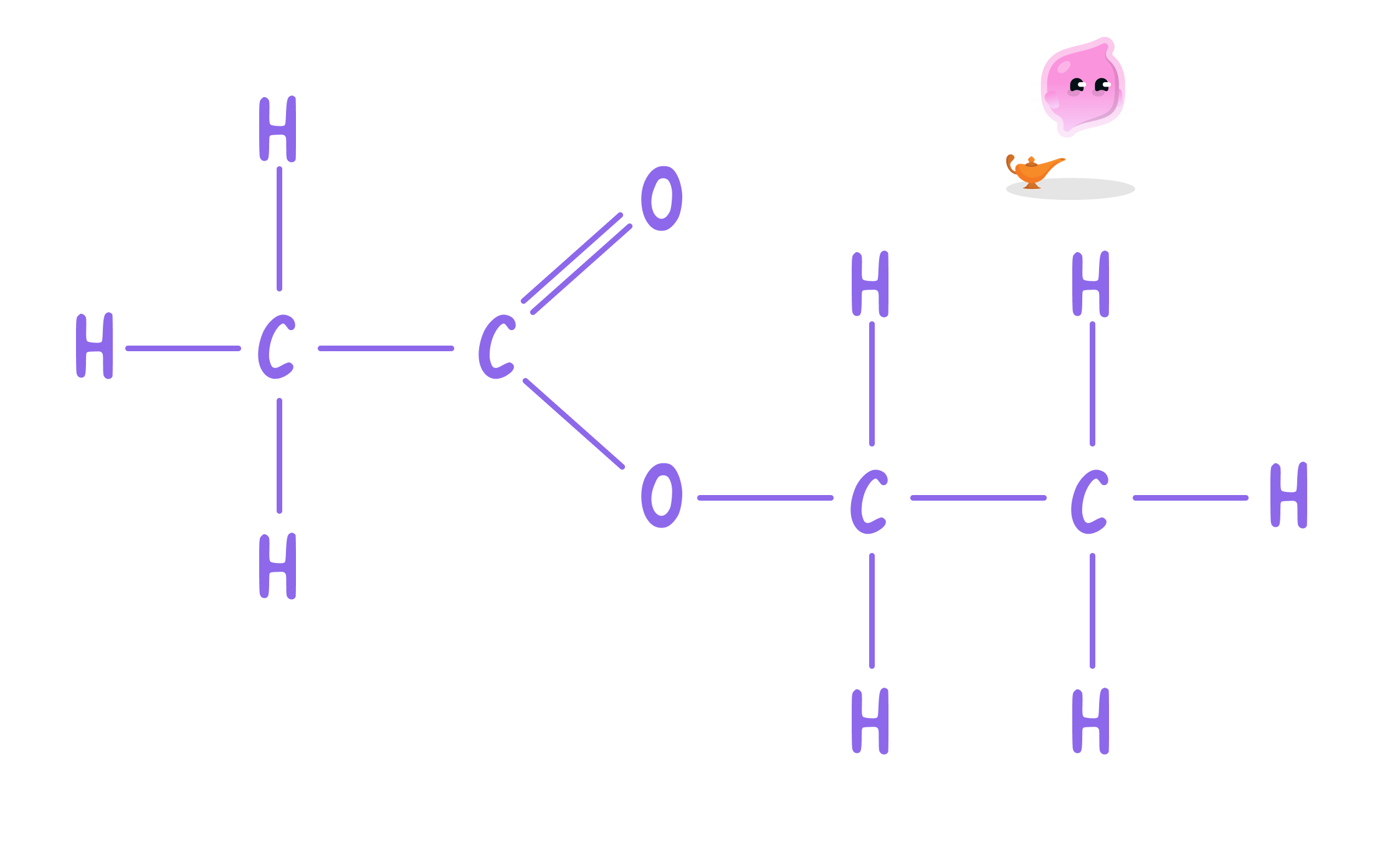
Ethanoic acid and ethanol react to form the ester ethyl ethanoate.
ethanoic acid+ethanol⇌ethyl ethanoate+water \text{ethanoic acid} + \text{ethanol} \rightleftharpoons \text{ethyl ethanoate} + \text{water} ethanoic acid+ethanol⇌ethyl ethanoate+water -
The balanced symbol equation is shown below.
CH3COOH+CH3CH2OH⇌CH3COOCH2CH3+H2O \text{CH}_3\text{COOH} + \text{CH}_3\text{CH}_2\text{OH} \rightleftharpoons \text{CH}_3\text{COOCH}_2\text{CH}_3 + \text{H}_2\text{O} CH3COOH+CH3CH2OH⇌CH3COOCH2CH3+H2O -
The name of an ester has two parts, and the part from the alcohol comes first.
- The alcohol gives the first word, ending in -yl, so ethanol gives ethyl and methanol gives methyl.
- The acid gives the second word, ending in -oate, so ethanoic acid gives ethanoate and propanoic acid gives propanoate.
-
Esters are volatile liquids with sweet, fruity smells, so they are used in flavourings and perfumes.
Methyl ethanoate and ethyl propanoate
- Methanol is the alcohol, so the first word is methyl, and ethanoic acid is the acid, so the second word is ethanoate.
- The ester formed is methyl ethanoate, CH3COOCH3\text{CH}_3\text{COOCH}_3CH3COOCH3.
- Ethanol is the alcohol, so the first word is ethyl, and propanoic acid is the acid, so the second word is propanoate.
- The ester formed is ethyl propanoate, CH3CH2COOCH2CH3\text{CH}_3\text{CH}_2\text{COOCH}_2\text{CH}_3CH3CH2COOCH2CH3.
Making ethyl ethanoate
- Aim: to make a small sample of the ester ethyl ethanoate from ethanoic acid and ethanol.
- Apparatus: boiling tube, dropping pipettes, 10 cm310\ \text{cm}^310 cm3 measuring cylinder, ethanol, pure ethanoic acid, concentrated sulfuric acid, 250 cm3250\ \text{cm}^3250 cm3 beaker of water at about 70 ∘C70\ ^\circ\text{C}70 ∘C from a kettle, 100 cm3100\ \text{cm}^3100 cm3 beaker containing 50 cm350\ \text{cm}^350 cm3 of sodium hydrogencarbonate solution, eye protection and gloves.
- Method:
- Pour 1 cm31\ \text{cm}^31 cm3 of ethanol and 1 cm31\ \text{cm}^31 cm3 of pure ethanoic acid into the boiling tube.
- Carefully add 3 drops of concentrated sulfuric acid as the catalyst.
- Stand the boiling tube in the hot water bath for about 5 minutes.
- Pour the warm mixture into the sodium hydrogencarbonate solution, which neutralises the leftover acids.
- Waft the vapour from the beaker gently towards your nose.
- Results:
- The sodium hydrogencarbonate solution fizzes as it neutralises the unreacted acids.
- A thin, oily, colourless layer of ester floats on the surface of the solution.
- The mixture has a sweet, fruity smell, quite different from the sharp smell of ethanoic acid.
- Conclusion: ethanoic acid and ethanol react, with concentrated sulfuric acid as the catalyst, to form the ester ethyl ethanoate.
- Safety: wear eye protection and gloves, because concentrated sulfuric acid and pure ethanoic acid are corrosive, use a water bath instead of a flame because ethanol and the ester are highly flammable, and work in a well-ventilated room.
- Do not describe the colour change of potassium manganate(VII) as "purple to pink" or "clear", because the correct change is purple to colourless.
- Do not call vinegar production fermentation, because bacteria oxidise ethanol using oxygen, while fermentation needs the absence of oxygen.
- Do not put the acid part first when naming an ester, because the alcohol part comes first, as in ethyl ethanoate.
- Do not leave water out of the esterification equation.
Writing about oxidation and esters
- Name the oxidising agent in full as acidified (aqueous) potassium manganate(VII), including the Roman numeral.
- Give the colour change with both colours, purple to colourless, when asked what you would see.
- State the catalyst for esterification as concentrated sulfuric acid or an acid catalyst, and mention warming or heating.
- To name an ester, take -yl from the alcohol and -oate from the acid, then check the total number of carbon atoms matches both parents.
- Which reagent is used to oxidise ethanol to ethanoic acid in the laboratory?
- What colour change is seen when ethanol is oxidised by acidified potassium manganate(VII)?
- What is needed, besides ethanol, for bacteria to make vinegar?
- Name the catalyst used to make an ester from a carboxylic acid and an alcohol.
- Name the ester formed from ethanoic acid and methanol.
