Growth can eventually make a business harder and more expensive to manage
Definition
Diseconomies of scale: increases in average cost per unit that occur when a business grows beyond its most efficient scale.
- Economies of scale do not continue forever. As an organisation becomes larger, additional layers, sites and employees can create coordination and management problems that outweigh earlier cost savings.
Note
Think of growth as useful only while the business can still coordinate its larger scale efficiently. Size itself is not the problem; the extra complexity is.
Communication problems can create delay, mistakes and extra cost
- In a very large organisation, information may pass through several management layers or across distant locations before reaching the people who need it. Messages can arrive late, become distorted or require more meetings and systems to coordinate.
- The result can be duplicated work, production mistakes, slower responses to customers and additional management costs, pushing average cost per unit upwards.
Coordination becomes harder as departments and locations multiply
- Different departments or sites can follow conflicting priorities, repeat the same work or wait for approval from other parts of the business. More managers and control systems may then be needed simply to keep the organisation aligned.
- A larger business may reduce this problem by delegating decisions or dividing operations into smaller teams or regions, but those systems also need clear accountability and communication.
Employees can feel less connected to a very large organisation
- Workers may have less contact with senior managers and less influence over decisions, which can reduce motivation for some employees. If productivity or quality falls, more labour time and resources are needed for each unit produced.
Example
- A restaurant business expands from five sites to several hundred.
- If local problems now require several management approvals, decisions slow down and extra regional managers are needed, so the larger scale can increase the cost of running each restaurant.
Common Mistake
A rise in total cost does not prove there is a diseconomy of scale. Average cost per unit must rise as the business expands.
Diseconomies place a practical limit on the benefits of growth
- If average cost rises, the business either accepts a smaller margin or raises price, weakening the cost advantage that growth was meant to create.
- Managers therefore have to judge whether further expansion still produces more benefits than complexity. Better delegation, communication systems and smaller operating units can help a large business control diseconomies rather than simply stop growing.
Exam technique
- Identify the growth problem: communication, coordination or employee motivation.
- Trace how that problem creates delay, waste, lower productivity or extra management cost.
- Finish by linking the effect to a rise in average cost per unit, not merely a rise in total cost.
Self review
- What are diseconomies of scale?
- How can communication problems raise average cost?
- Why can coordination become harder as a business grows?
- How can lower employee motivation contribute to diseconomies of scale?
- Give two ways a large business can try to control diseconomies of scale.
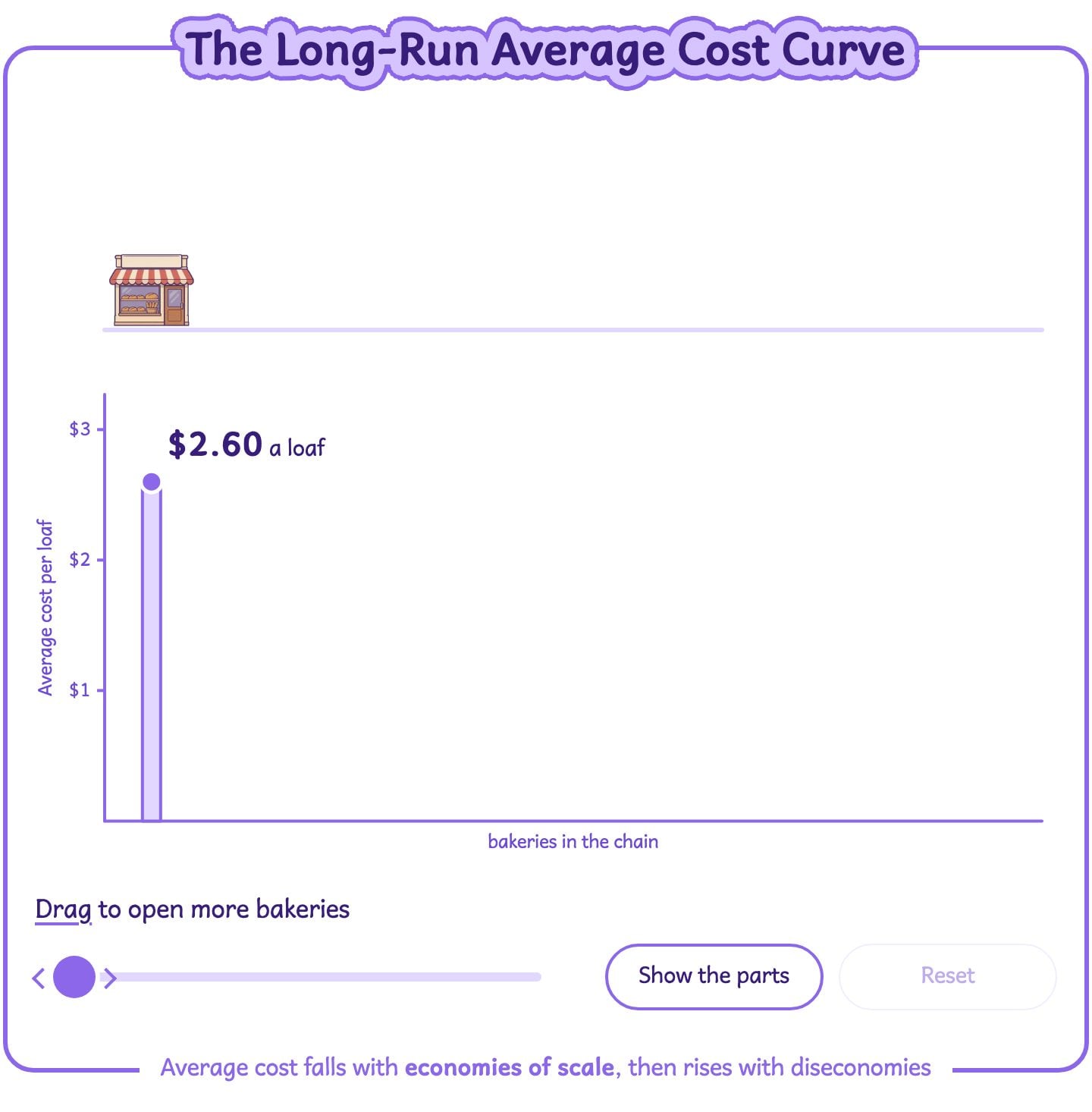
Increase output and watch average cost fall with economies of scale, then rise with diseconomies.