Production method depends mainly on volume, variety and the resources available
Production process: the method a business uses to organise resources and turn inputs into finished goods or services.
- Job, batch and flow production trade flexibility against volume and unit cost. As demand for identical units rises, businesses can often move towards more repetitive and automated methods, although the right choice still depends on the product and finance available.
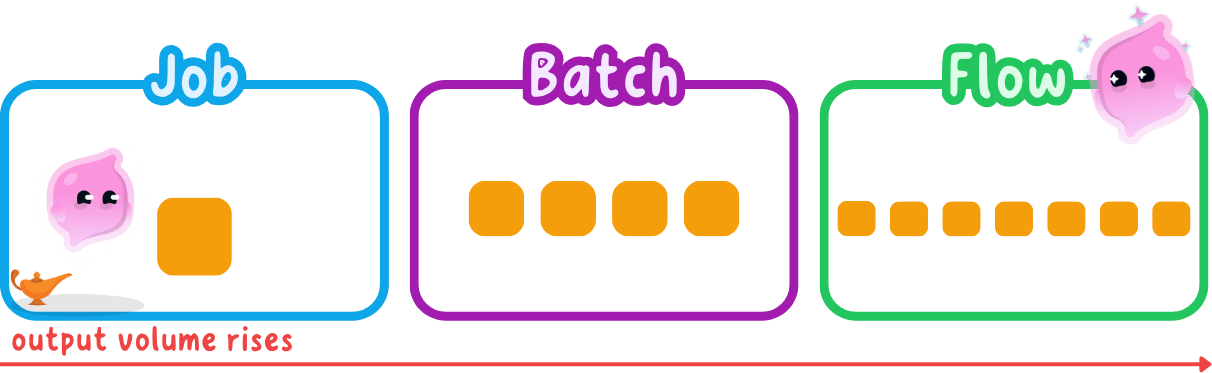
Job production maximises customisation but has high unit costs
Job production: producing one individual item or service at a time to a customer's specific requirements.
- Advantages: the business can customise closely, change the design for an individual customer and often charge a premium price for specialist quality or service.
- Disadvantages: production is relatively slow and usually relies on skilled labour, so output is low and cost per unit is high.
A business making a fitted kitchen for one customer's measurements can adapt the design throughout the job, but each order uses significant skilled labour and cannot be produced at mass-market speed.
Batch production balances variety with repeated production
Batch production: producing a group of identical items together, then changing the process before producing a different batch.
- Advantages: the business can make a reasonable volume while still offering different varieties, and repeated work can reduce unit cost compared with one-off job production.
- Disadvantages: changing from one batch to another can require cleaning, resetting or reprogramming equipment, creating downtime and cost; inventories can also build up between stages or while a batch waits to be sold.
A bakery can make a batch of white loaves followed by a batch of wholemeal loaves, giving customers variety without making every loaf as an individual job.
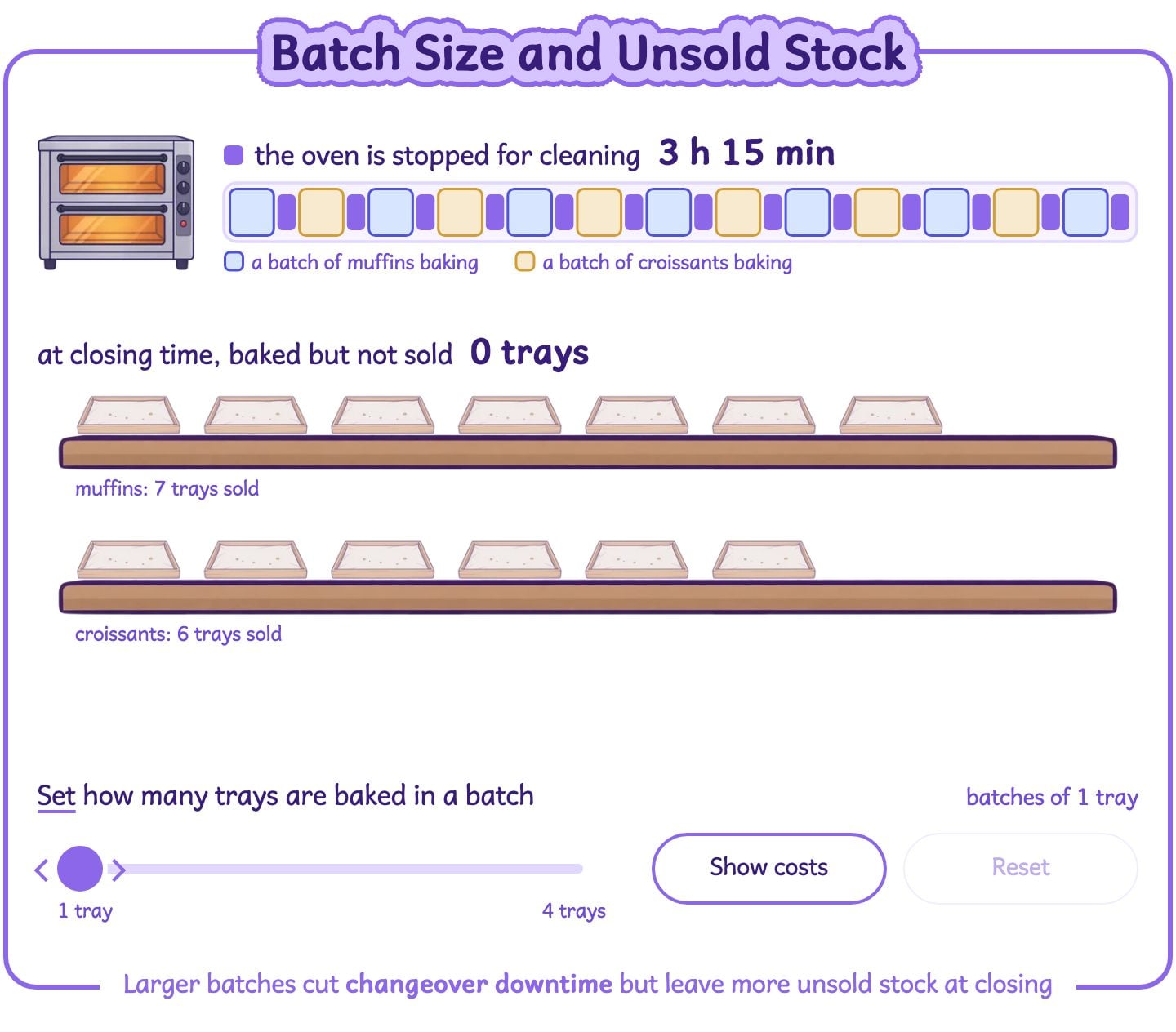
Change the batch size and watch changeover downtime fall while unsold stock at closing rises.
Flow production produces high volumes efficiently but sacrifices flexibility
Flow production: producing large numbers of standardised items continuously as each unit moves from one stage of production to the next.
- Advantages: continuous, repetitive production can create very high output, consistent quality and low unit costs when demand is large enough to use the line efficiently.
- Disadvantages: specialised equipment can be expensive to install, the process is less flexible when customer needs change, and a breakdown at one stage can disrupt the whole line.
Do not choose the production method from the type of product alone. The same product can be made by job, batch or flow methods depending on volume and customisation.
Labour-intensive and capital-intensive describe what the process relies on most
Labour-intensive production: production that relies relatively heavily on employees and their skills rather than machinery.
Capital-intensive production: production that relies relatively heavily on machinery, equipment and technology rather than direct labour.
- Labour-intensive production: can offer flexibility, personal service and lower initial spending on machinery, but wage costs continue over time and output or quality can depend heavily on worker skill and availability.
- Capital-intensive production: can produce high volumes consistently and reduce labour cost per unit, but requires major investment, maintenance and skilled technical support, while breakdowns can be costly.
Job production is often more labour-intensive and flow production is often more capital-intensive, but these are not fixed rules. Production method describes how output is organised; labour or capital intensity describes which resources the process relies on most.
The best process fits demand, customisation and finance
- Low-volume customised demand favours job production, repeated demand for several varieties can favour batch production, and high, predictable demand for standardised output can justify flow production.
- The business must also be able to finance the chosen process. A flow line may have the lowest potential unit cost but still be unsuitable when demand is uncertain or the business cannot afford the equipment.
- Use output volume and the amount of customisation to distinguish job, batch and flow production.
- Link the method to a trade-off such as unit cost, flexibility, quality consistency or setup investment.
- Keep the production method separate from labour or capital intensity and justify each from the resources used.
- What is the difference between job, batch and flow production?
- Give one advantage and one disadvantage of each production method.
- Why can a changeover between batches reduce efficiency?
- What is the difference between labour-intensive and capital-intensive production?
- Why can flow production be unsuitable even when it offers a low unit cost?