Stakeholders: everyone with an interest in the business
Definition
Stakeholder: Any individual or group with an interest in a business, because the decisions it takes affect them or their actions affect it.
- Internal stakeholders are part of the business itself: the owners or shareholders, the managers and the employees.
- External stakeholders sit outside it but are affected by what it does: customers, suppliers, lenders, the government and the local community.
- A business has to take these groups seriously because each one supplies something it cannot run without and can withdraw it.
- Employees supply labour and can leave or strike, customers supply revenue and can switch, suppliers supply materials and credit and can demand cash up front, and lenders can refuse to renew an overdraft.
- Stakeholders are not the same as shareholders, because every shareholder is a stakeholder but most stakeholders own no part of the business.
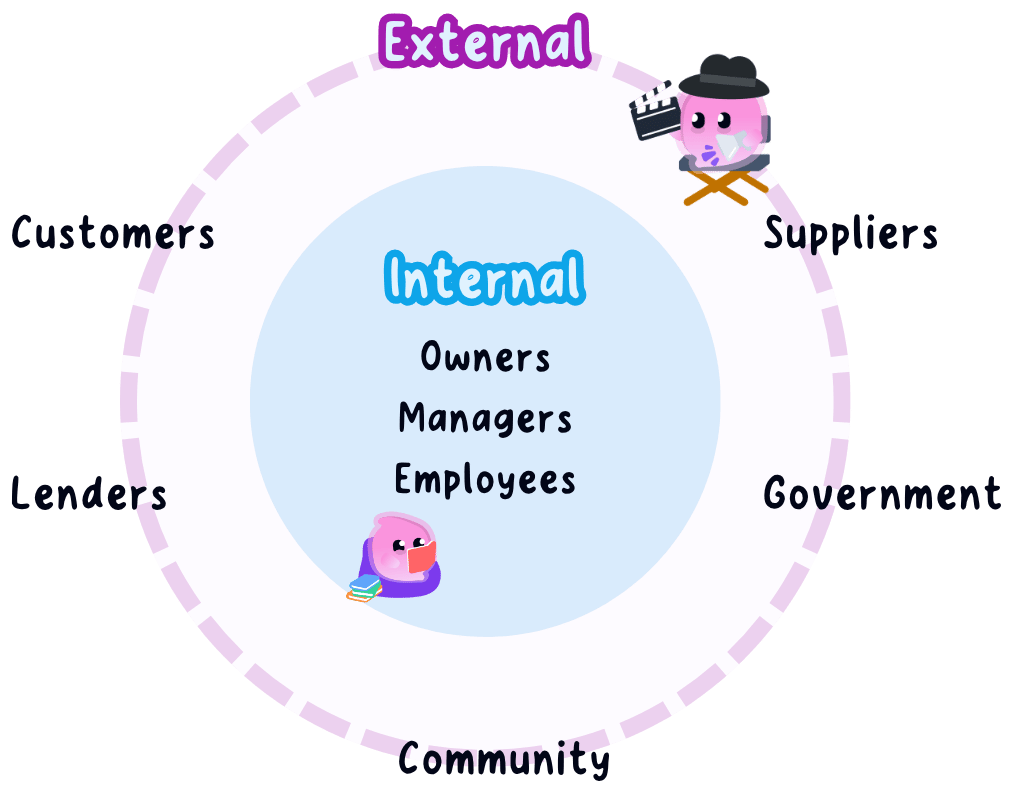
Internal stakeholders: owners, managers and employees
Definition
Shareholder: A part-owner of a limited company who has bought shares in it and receives a share of the profits as a dividend.
- Owners and shareholders want profit, because it is the return on money they risked and could have earned interest on elsewhere.
- They gain in two ways: a dividend paid out of profit, and a rise in the share price if the company is expected to keep earning.
- They can vote at the annual general meeting to remove directors, which is the sharpest power any stakeholder holds.
- Managers want a high salary, a bonus, job security and the status that comes with running a larger department.
- Because pay and status usually rise with the size of the business, managers often push for growth even when shareholders would prefer the cash paid out as dividends.
- Employees want good pay, a secure job, safe conditions, training and a route to promotion.
- When these wants are ignored, labour turnover rises, so the firm pays again to recruit and train replacements and loses the experience of the staff who left.
- Where workers are in a trade union they can take industrial action, and a week of stopped production costs far more than the pay rise that was refused.
Example
- The John Lewis Partnership, which also owns Waitrose, is owned in trust for its staff, who are called partners rather than employees.
- Profit is shared with those partners as an annual bonus instead of being paid to outside shareholders, which removes the usual wages-against-dividends conflict.
- It does not remove every conflict, since money spent on the bonus is money not spent on refitting stores or cutting prices for customers.
External stakeholders: customers, suppliers, lenders, government and community
- Customers want value for money, reliable quality, safety, choice and help when something goes wrong.
- Their power depends on how easily they can switch, so a shopper with four supermarkets on the same road has far more power than a household with one broadband cable.
- Suppliers want to be paid in full and on time, and to receive regular orders they can plan production around.
- A supplier paid late has to fund its own wages from an overdraft, so it adds a margin to its prices or demands cash on delivery, which then damages the buyer's cash flow.
- Lenders such as banks want interest paid on the agreed date, the loan repaid in full, and assets held as security in case it is not.
- They therefore prefer steady, low-risk plans, and will refuse to fund a bold expansion that the owners are excited about.
- The government wants tax revenue, more people in work and the law obeyed on health and safety, the minimum wage, consumer protection and pollution.
- Every extra worker a firm hires both adds income tax revenue and removes a benefit payment, which is why governments offer grants to firms locating in areas of high unemployment.
- The local community wants jobs, spending in nearby shops and support for local causes, without noise, traffic, litter or pollution.
- Objections are made through planning applications and local newspapers, so a firm that ignores them can lose permission to build and waste the money already spent on the design.
Example
- Closing a UK factory and moving production overseas pulls the same firm's stakeholders in opposite directions.
- Shareholders gain because unit costs fall and profit rises, while 300 workers lose their income, nearby shops lose the wages those workers spent, and the government collects less income tax while paying more in benefits.
Why stakeholder objectives conflict: one pot of money, many claims
Definition
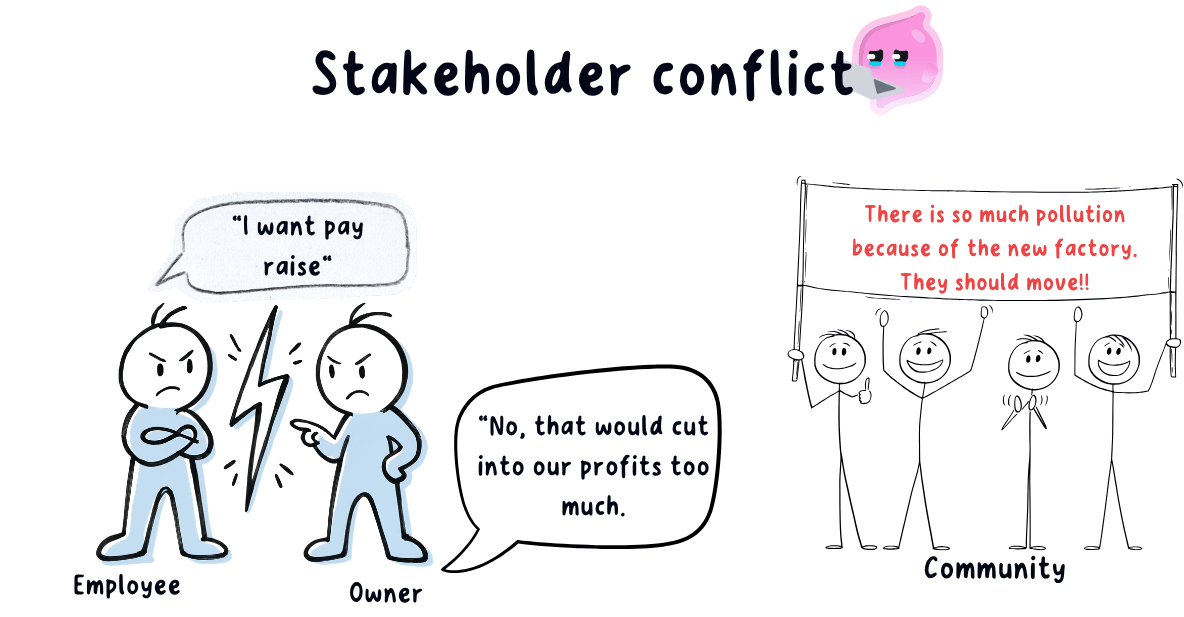
Stakeholder conflict: A situation in which meeting the objective of one stakeholder group means another group's objective cannot be met.
- Conflict happens because a business has one stream of revenue and every group wants a larger share of it, so a pound spent on wages is a pound not available for dividends, lower prices or cleaner equipment.
- Employees against owners: higher pay and more staff raise costs, and lower profit means a smaller dividend.
- A 6 per cent pay rise on a £5m wage bill adds £300,000 a year to costs, so employees gain and this year's dividend is smaller, although lower labour turnover can cut recruitment and training spending later.
- Customers against owners: lower prices and better quality please customers but cut the profit margin on every unit sold.
- Suppliers against customers: a retailer that squeezes supplier prices to fund a price cut leaves the supplier unable to invest, and quality falls later.
- Community against owners: filters, quieter machinery and shorter operating hours protect residents but raise costs and cut output.
- Government against owners: meeting safety and environmental law adds cost, while shifting profits abroad to avoid tax reduces the revenue the government needs.
- Conflict also runs inside a single group, so long-serving employees may want a pay rise while newer staff want the same money spent on hiring more people to cut their workload.
Exam technique
A conflict needs two named groups pulling opposite ways, so employees want higher pay is only half of it until you add whose objective that damages.
Self review
- Name the three internal and five external stakeholder groups.
- What does a lender want from a business, and why does that make it cautious about expansion?
- Explain one conflict between employees and shareholders.
- Who gains and who loses when a firm moves production overseas?
- Give one conflict between a supermarket's customers and its suppliers.