Survival: the objective that comes before all others
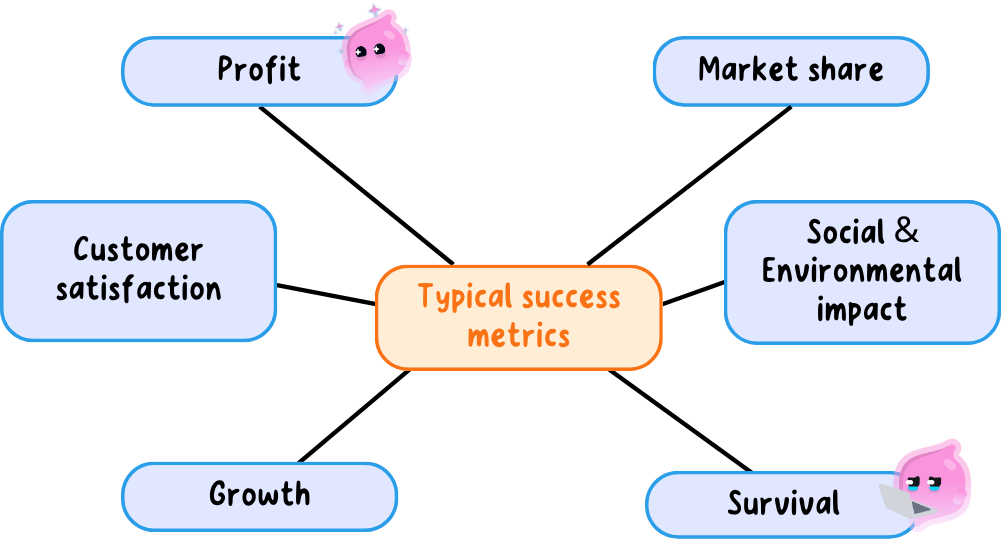
- Survival: staying in business by keeping enough cash coming in to pay wages, suppliers and rent on the day they fall due.
- Survival goes to the top of the list for a start-up with no reputation, in a recession when incomes fall faster than fixed costs can be cut, and when a new competitor undercuts the firm's prices.
- A firm chasing survival cuts prices to keep cash flowing, delays buying new equipment, asks suppliers for longer credit and may make workers redundant.
- Each of those decisions weakens the business later, because old machinery breaks down and redundancies remove the experienced staff needed when demand recovers.
Common Mistake
- Do not treat profit and cash as the same thing when you write about survival.
- A shop can record a profit for the year and still close in March, because the profit is owed by customers while the rent is due now.
Profit: the reward for risk and the fuel for growth
Definition
Profit: The amount left when the total costs of running a business are taken away from its total revenue.
- Profit is the usual objective of private sector businesses because the owners risked their own money and could have earned interest by leaving it in the bank instead.
- Profit pays the owners, as drawings for a sole trader or as dividends for shareholders in a company.
- Profit kept inside the business is retained profit, an internal source of finance that costs no interest and needs no lender's permission.
- A record of profit persuades banks to lend and investors to buy shares, because it shows the business can repay them.
- Chasing the largest profit this year can shrink profit next year, because customers who switch to a rival after a price rise from £3.00 to £3.60 do not come back, and a cut training budget leaves staff slower and more error-prone.
Growth: getting bigger and what it buys
- Growth: increasing the size of the business, measured by the number of employees, the level of output or the capital employed.
- Larger output spreads fixed costs such as rent and management salaries over more units, so the cost of making each unit falls and the firm can undercut smaller rivals.
- Selling several products in several markets spreads risk, so a bad year in one country or one product range does not sink the whole business.
- Expansion has to be paid for before the extra sales arrive, so a firm that fits out a second shop for £120,000 can run out of cash while trading well.
- Selling shares to fund growth hands votes to new owners, so the founder can lose control of the business they built.
Market share: the slice of the market a business holds
Definition
Market share: The proportion of total sales in a market that is held by one business or one product, usually written as a percentage.
- Share is worked out as the firm's sales divided by total sales in the market, multiplied by 100.
- A sportswear brand selling £4m in a market worth £50m has £4m£50m×100=8%\frac{£4\text{m}}{£50\text{m}} \times 100 = 8\%£50m£4m×100=8% of the market, so there is far more room to grow inside the existing market than by adding new customers to it.
- A rising share is the sign that a business is beating its rivals rather than simply riding a growing market, and sales can rise 5 per cent while share falls.
- The largest share in a market is market leadership, which brings advantages rivals cannot copy quickly, because retailers give the leading brand the best shelf space and the leader buys in the largest quantities at the lowest price per unit.
- Share is usually bought with lower prices or heavier advertising, both of which cut profit in the short run, so a firm chasing share is accepting thinner margins today for a stronger position later.
Example
- Aldi entered UK grocery as a small discounter and has taken share from the established supermarkets year after year.
- It stocks a few thousand product lines rather than tens of thousands, which cuts storage costs and lets it buy huge quantities of each line cheaply.
- The trade-off is a narrow choice for shoppers, so customers who want a specific brand still go elsewhere.
Social enterprise objectives: the triple bottom line
Definition
Social enterprise: A business that trades to achieve a social or environmental purpose and reinvests most of its surplus into that purpose rather than paying it to owners.
Triple bottom line: Judging a business on three results at once: its economic performance, its social impact on people, and its environmental impact on the planet.
- A social enterprise still sells goods or services in the market, so it is not a charity living on donations and it must cover its costs.
- Economic: make a surplus and stay financially independent, because an enterprise that cannot pay its bills helps nobody.
- Social: improve the lives of a named group, for example by training long-term unemployed workers or paying growers in developing countries above the market price.
- Environmental: cut the damage done by the business, for example by using recycled packaging or reducing the tonnes of waste sent to landfill.
- The three aims pull against each other, because paying growers a guaranteed price above the market rate raises the cost of each bar of chocolate, so the shelf price is higher, the volume sold is lower and the smaller surplus limits how fast the social aim can be extended.
Why objectives change as a business develops
- Objectives are reviewed as circumstances change, so the target a firm sets in its first year is rarely the one it holds ten years later.
- The usual path runs from survival to profit, then to growth and market share, and later to social or environmental aims.
- A start-up cannot afford ethical sourcing that adds 15 per cent to its costs, while an established firm with steady profit can and uses it to protect its reputation.
- The loss of a major customer or a downturn in trade sends an established firm straight back to survival, so expansion plans are shelved and cash is protected.
- A change of ownership changes the target, because shareholders who bought for dividends push for profit while a founder may have been content with independence.
- New laws or shifting customer attitudes on packaging and emissions force environmental objectives onto firms that had ignored them.
- Netflix shows the pattern, because it began by posting DVDs, switched its objective to winning subscriber numbers when broadband made streaming possible, and later shifted spending towards making its own programmes.
Exam technique
- Do not call a social enterprise a charity, because it earns its income by trading and the difference is what it does with the surplus.
- When a business is given a stated objective, answer against that objective rather than assuming every firm wants maximum profit.
Self review
- Why is survival the first objective of most new businesses?
- Give two uses a business has for the profit it makes.
- A firm sells £6m in a market worth £75m, so what is its market share?
- Name the three parts of the triple bottom line.
- State two events that would push an established business back to a survival objective.