Two sectors: who owns the organisation and who pays for it
Definition
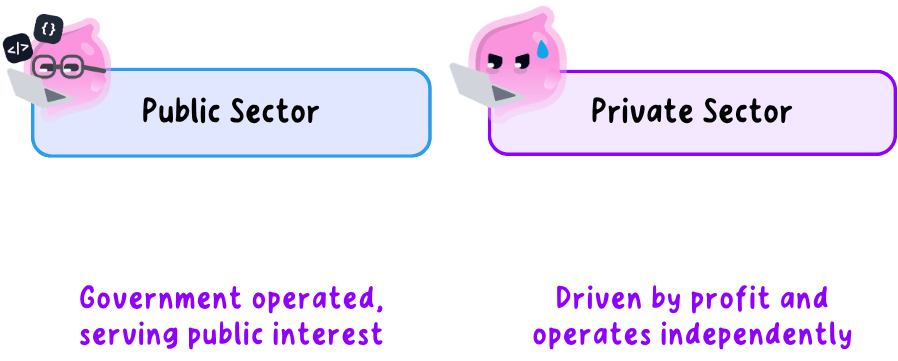
Private sector: The part of the economy made up of businesses owned and run by individuals or shareholders rather than by the government.
Public sector: The part of the economy owned and controlled by central or local government and funded mainly out of taxation.
- A private sector business is funded by the owners' own capital, by loans it must repay with interest and by profit it keeps back.
- If revenue stops covering costs, no outside body makes up the difference, so the business closes and the owners lose the money they put in.
- A public sector organisation is funded mainly by taxation, set as a budget by government rather than earned from customers.
- Because the money comes from taxpayers who have no choice about paying, the organisation must show it has spent the budget on what it was given for.
- That single difference in funding explains almost every difference in objectives that follows.
Private sector objectives: profit, growth, share and survival
- Profit is the central objective because the owners risked their capital and expect a return larger than leaving the money in a bank would have given.
- Survival takes over in the first years of trading and in a recession, because a firm that runs out of cash cannot pay wages next month.
- Growth and market share are pursued because a larger firm spreads its fixed costs over more units and buys materials more cheaply than smaller rivals.
- Private firms also set social and environmental objectives, but they have to fund them out of profit.
- Unilever can commit to cutting packaging and sourcing materials sustainably because its brands earn enough to absorb the extra cost, which a struggling firm could not do.
- A private business is free to refuse any customer or drop any product that does not make money.
- A bus company will close a rural route carrying six passengers a day, because the fares do not cover the driver and the fuel.
Common Mistake
- Not every private sector business chases the largest possible profit, since sole traders often prefer a steady income, independence and time off.
- Equally, a public sector body is not free to ignore money, because overspending its budget means cuts to the service later in the year.
Public sector objectives: service, access and value for money
- Providing a service: the main objective is to deliver healthcare, education, policing or refuse collection to everyone entitled to it.
- Fair access: the service must reach people regardless of income or where they live, which is why a village keeps a postal delivery that could never pay for itself.
- Value for money: costs are controlled so that more of the fixed budget reaches the service, and cutting the cost of treating a patient by £50 releases money to treat more patients rather than creating profit for anyone.
- Meeting quality standards: targets such as ambulance response times, class sizes and street cleaning frequency replace the profit figure as the measure of performance.
- Wider social objectives: public sector bodies are large employers and are often used to create jobs in areas of high unemployment.
- Some public sector organisations do charge, so a council leisure centre may aim to break even on membership fees, and any surplus goes back into the service because there are no shareholders to pay.
Example
- The NHS is funded from general taxation and treats patients free at the point of use, so it cannot raise revenue by charging more when demand rises.
- A private hospital facing the same rise in demand can put its prices up or lengthen its list of paying patients.
- The NHS instead has to ration by waiting time, which is why waiting lists, not profit, are the number reported on.
Why the objectives differ: risk, funding and who is served
- Who bears the risk: private owners lose their own savings if the business fails, so they need a reward for taking that risk, while a public sector body cannot be forced to close by one bad year.
- Who the organisation answers to: a plc answers to shareholders who can sell their shares or vote out directors, while a public service answers to ministers and to voters at an election.
- Who can be turned away: a private firm serves the customers who are profitable, while a hospital must treat the expensive patient as well as the cheap one.
- This is why the public sector supplies services the private sector would never offer, such as flood defences, street lighting and loss-making rural transport.
- What happens after failure: a private firm that misses its targets for long enough goes out of business, while a public body that misses them faces inspection, replaced managers and political pressure.
Exam technique
- Saying a public sector organisation does not want profit is only half the point, so name what it does want instead: service level, access or value for money.
- A charity is not the public sector, because it is privately run on donations even though neither aims at profit for owners.
Self review
- How is a private sector business funded compared with a public sector organisation?
- State three objectives of a public sector organisation.
- Why can a private bus company close a rural route when a public one might not?
- Give two measures a public service uses in place of profit.
- Why do private owners need a return that a public sector organisation does not?