The mixed economy: two sectors operating side by side
Definition
Mixed economy: An economy in which some businesses and resources are owned by private individuals and firms and some are owned by the government.
- Almost every country runs a mixed economy, so a student meets privately owned shops, factories and banks alongside government-run hospitals, schools and roads.
- The mix keeps the incentive and choice of private ownership while using the government to supply services the market would provide too little of.
- The balance of the mix differs between countries, so some governments own the railways, the post and the energy companies while others leave all of these to private firms.
- The balance also moves over time, because a government can sell a state-owned business to shareholders or take a failing private business into state ownership, so ownership has to be checked rather than assumed.
Example
- Food retailing is almost always private sector, so Tesco, Aldi and the corner shop all compete for the same shoppers.
- Healthcare in many countries is mainly public sector, with a smaller number of private hospitals charging fees alongside the state service.
- Some industries contain both, since state-funded schools and fee-charging independent schools teach in the same town.
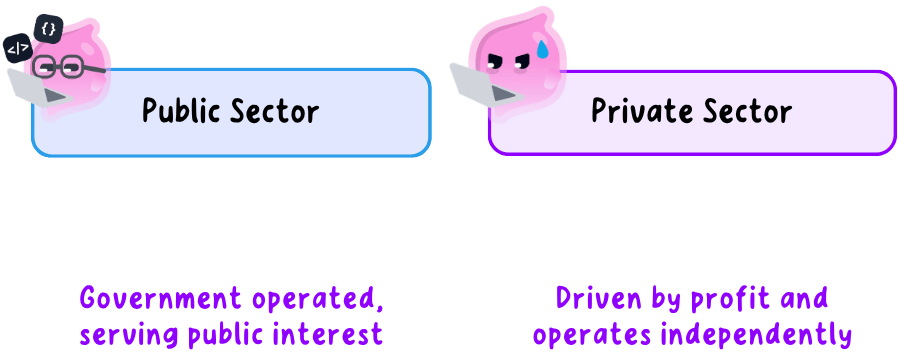
The private sector: owned and controlled by individuals
Definition
Private sector: The part of the economy made up of businesses owned and controlled by private individuals, partners, shareholders or members rather than by the government.
- Control belongs to the owners, or to managers the owners appoint, so decisions on prices, products, opening hours and staffing are made inside the business without government approval.
- It contains sole traders, partnerships, private and public limited companies, franchises, joint ventures and charities, and the differences between these forms are covered in 1.4.
- Finance comes from the owners' own capital, retained profit, bank loans and, for companies, the sale of shares, so no money arrives from taxation.
- This means the owners carry the risk, because if the business cannot cover its costs the owners lose the money they put in and the business closes.
- The usual main aim is profit, since a firm that makes losses year after year runs out of cash, cannot pay suppliers or wages, and closes.
- Profit shapes everyday decisions, so unprofitable branches are closed, weak product lines are dropped and costs are held down wherever quality allows.
- Aldi stocks a few thousand product lines rather than the tens of thousands a large supermarket carries, which cuts handling and storage costs per item and lets it charge lower prices while still making a profit.
- Other private sector aims exist alongside profit, including survival in the first difficult years, growth in sales or market share, and social goals for charities.
- A charity such as Oxfam is private sector because the government does not own it, yet any surplus is spent on the charity's work rather than paid to owners.
The public sector: owned and controlled by government
Definition
Public sector: The part of the economy made up of organisations owned and controlled by central or local government and funded mainly through taxation.
- Central government owns organisations such as the state health service and the armed forces, while local government owns services such as refuse collection, libraries and street lighting.
- Control rests with ministers and elected councillors, who set budgets and targets, so the organisation is accountable to voters rather than to shareholders.
- Funding comes mainly from taxation and government borrowing, with some charges such as prescription fees, so spending is controlled by a fixed annual budget.
- The main aim is to provide a service rather than to make a profit, so services are supplied to everyone who needs them regardless of ability to pay.
- A profit-seeking firm would close a rural bus route that loses money, but a council may keep it running and cover the loss because residents need access to hospitals, schools and shops.
- Governments also run services that private firms would supply too little of, such as street lighting, policing and flood defences, because these benefit everyone and cannot easily be sold to individuals.
- Other public sector aims include keeping prices affordable, maintaining employment in a region, and breaking even so that costs are covered without a surplus for owners.
- This is why failure looks different in the two sectors: a private business that cannot cover its costs closes, while a public sector service that overspends is usually funded from taxation or cut back instead.
Common Mistake
- The public sector is not the same as a public limited company, since a plc is privately owned by its shareholders and the word public only means anyone may buy its shares.
- A service that is free at the point of use is not free to provide, because taxpayers have already paid for it.
- Public sector organisations still have to control costs, because a fixed budget forces choices between services.
Classifying an organisation: apply the ownership test
- Ask one question first: who owns it?
- If central or local government owns it, it is public sector, and if individuals, partners, shareholders, members or trustees own it, it is private sector.
- Use the aim only to confirm the answer, because charities and social enterprises are private sector even though neither exists to enrich owners.
- Government funding does not transfer ownership, so a privately owned care home paid by a council to house residents stays in the private sector, with the council simply a customer buying places.
- Size and fame decide nothing, because a national supermarket chain with thousands of stores is private sector and a single local library is public sector.
Exam technique
- The classic error is putting a public limited company in the public sector, so check the owner rather than the word public in the name.
- Name the owner and the sector in the same sentence, because "a state hospital is public sector as central government owns and funds it" answers the question that "a state hospital is public sector" leaves open.
- Do not use "it provides a service" as proof of public ownership, since a hairdresser and a bank provide services and both are private sector.
Self review
- Which single question decides whether an organisation is in the private or the public sector?
- Why is a public limited company such as Tesco in the private sector?
- Give two ways a public sector organisation is financed.
- Explain one reason a council might keep running a bus route that makes a loss.
- Which sector does a charity belong to, and why?